
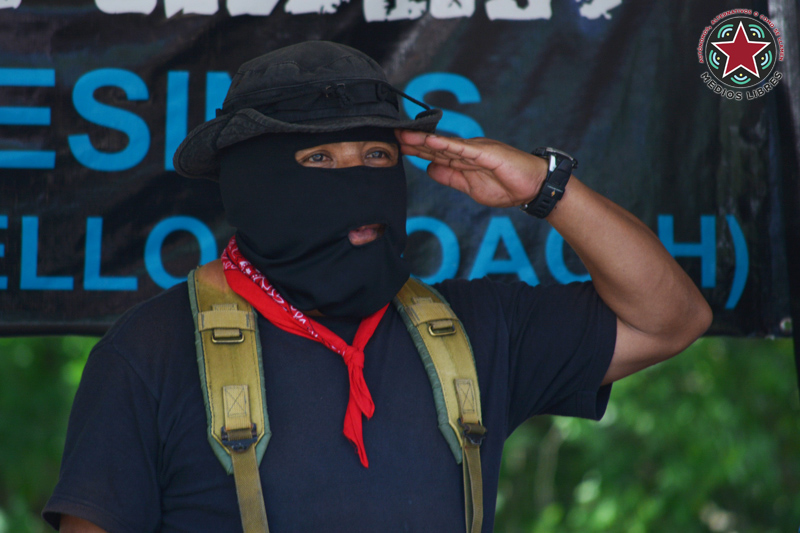
Palabras del Subcomandante Moisés a los Medios libres, autónomos, alternativos o como se llamen en La RealidadWords by Subcomandante Moisés to the Free, Autonomous, Alternative Media or whatever they’re called at La Realidad
[podcast]https://radiozapatista.org/Audios/comparticion092014_SubMoi_medios.MP3[/podcast]
Transcripción a cargo de “Los Tercios Compas” abajo:
[podcast]https://radiozapatista.org/Audios/comparticion092014_SubMoi_medios.MP3[/podcast]
Transcription by “Los Tercios Compas” below:
Segunda parte: palabras del Sub Moisés.
Bueno, compañeros, compañeras, escucharon lo que dijo el compañero Subcomandante Insurgente Galeano. Eso es lo que vemos, eso es lo que pensamos.
O sea necesitamos la fuerza de uno a otro porque si lo entendemos de cómo está la vida, entonces por qué no lo entendemos de cómo tenemos que enlazarnos unos a otros.
Algunos otros compañeros que quedan acá, que estuvieron como medios libres pero al mismo tiempo como CNI, esos y esas compañeras los escucharon y los vieron. Deben ahora sí que hacer compartición entre ustedes porque no es lo mismo de que yo platico pero yo no he escuchado.
Es allí donde se siente entonces que tenemos que enlazarnos, tenemos que agarrarnos de las manos unos a otros.
Como se les preguntaba a los compañeros del Congreso Nacional Indígena, de que tenemos que agarrarnos juntos, o sea indígenas y no indígenas, y los compañeros, ¿en una sola voz sale pues la palabra? Sí. O sea que los compañeros se entiende la vida de los que no son indígenas, entonces cómo vamos a hacer eso, ¿cómo vamos a luchar?
O sea hay un gran trabajo que es mucho más, nosotros pensamos que es mucho más difícil pues a ustedes los que viven en la ciudad, aunque también nosotros, los que vivimos en las comunidades como Congreso Nacional Indígena, pero por lo menos ahí todavía queda lo que es lo común, pero en las ciudades no.
Atrás de la barda de donde vive uno no sabe qué problema tiene su vecino, a veces ni lo conoce quién es su vecino; y en las tres paredes, yo vivo aquí y ahí vive la otra, el otro vecino y ahí vive el otro; no se preocupa mi vecino qué me está pasando a mí, ni yo me preocupo por parte de él o de ella. Y así está encadenado.
Entonces pues es un trabajo muy fuerte, con lo que viene, lo que dicen los compas “la bestia que viene”, pues entre todos nos van a destruir. Entonces cómo podemos hacer ese trabajo. Pero ahí lo que nosotros pensamos, no les estamos pidiendo de que entonces háganse indígenas, pero ni nos pidan tampoco que pensemos o que seamos como ciudadanos que están ahí.
No. Cada quien luchemos pero estemos unidos. Recuerden que como decía el finado SubMarcos, por tanto que hemos escuchado, por escuchar en varios de los caracoles que hemos hecho encuentro, tratamos de decir qué es lo importante y la hora de –por cierto, varias veces se hizo aquí–, no llegamos de acuerdo. Todos tienen las ideas buenas y no sale pues porque a fuerzas quieren que sea aceptado lo que dice uno, lo que dice otro, y esto, pero a los compañeros, lo que podemos hacer es ver cuál es lo que sí les funciona, pero solamente esto podemos detectarlo si es que escuchamos y si es que observamos.
Ya ven que algunos aquí, los que ya habían entrado ya en la última, el cierre de la asamblea del CNI, esperaban los compañeros que alguien va a dar la palabra para que se cierra, y no es que así lo teníamos acordado que así se iba a cerrar, bueno, para los que lo vieron, porque son los mismos compañeros lo cerraron, no estaba acordado.
Entonces se dieron cuenta de que pasó uno, ‘ah, entonces yo también quiero decir’. Cuando empezó querían dar todavía como compartición, pero se dieron cuenta de que no, ya es el cierre. Se encarrilaron ahí luego, luego y así se cerró, ¿por qué? Porque es nada más el sentido de que es de los compañeros la asamblea y por lo tanto son los asambleístas los que tienen que cerrar la asamblea. Esas cosas, por ejemplo.
Necesitamos ver qué cosa es que funciona y que entonces se sienten que todos somos iguales. No es eso de que “yo soy la más importante o el más importante”. Pensamos nosotros es que no. Pensamos que ése es ejemplo, cómo podemos hacer entre todos nosotros eso. O sea que vayamos encontrando cómo es eso que decimos que un mundo nuevo.
Hay que ir trabajando eso. Tan es así que los compañeros del Congreso Nacional Indígena dijeron: sí necesitamos compartir, no sólo nomás nosotros los indígenas, queremos compartir con los compañeros y compañeras de la Sexta nacional e internacional. Luego entonces, cómo vamos a compartir, porque hay que pensar los que no le entran a la Sexta, ¿cómo vamos a compartir con ellos y con ellas?
O sea, ¿cómo vamos a respetarnos? ¿Cómo vamos a construir ese respeto? Porque hay que construir ese respeto, así como estamos ahorita, esto. Y creo que entonces tenemos que mostrar ese ejemplo, compañeros y compañeras de la Sexta de la ciudad, y compañeros y compañeras de la Sexta en el campo, y que nos encontremos y nos sentimos uno solo, sin pedirnos dejar lo que somos, sino que nos unimos a lo que queremos, a este mundo.
Por ejemplo, cuando estábamos preparando esta compartición con los compañeros bases de apoyo, pensaban los compañeros y compañeras que (nosotros como mandos) íbamos a decirles “esto es lo que van a hacer”. No. Se tuvo que hacer la asamblea aquí donde están sentados ahorita, y empezó a salir las ideas y hasta que lo encontramos donde lo sentimos, como dicen los compas, estos son los puntos.
Pero salieron un montón de apuntes y hasta que comúnmente dijeron ‘esto es’. Para eso se enriqueció mucho, porque decían nuestros compañeros: la tierra –la madre tierra, como hablamos– se dice que en el marxismo, en el leninismo se dice que la base principal del capitalismo es los medios de producción, que es la tierra. Entonces los compañeros dicen no.
Y les preguntábamos por qué. Porque no, sí sabemos que así piensa el capitalismo y así nos hizo el favor de dejar escrito, ésos, los que transmitieron la idea, pero nosotros tenemos que entender, tenemos que luchar para decir ¡ni madres! No vamos a permitir que sea así.
Entonces la tierra, la madre tierra, es la base fundamental de la vida de los seres vivos, así sale de los que estábamos sentados acá.
–A ver, compañero, compañera, argumenta eso.
–Sí –dice–, porque entonces campo y ciudad, seres humanos en el campo y en la ciudad viven la tierra, y todo lo que hay encima de la tierra, los bichos, más lo que hay abajo, también es su base de la vida, los gusanitos, eso. ¿Por qué vamos a permitir a esos bestias que vienen a destruir?
Y luego entra en discusión otra vez así:
–¡Ah, chingá! ¿Cómo vamos a hacer? Cómo vamos a hacer porque estamos diciendo de que es medio de producción y hay que quitárselos.
Así dijimos, porque se acuerdan que en uno de los encuentros ahí en CIDECI, el finado SubMarcos cuando presentó el bote de la coca ahí es donde decíamos que sí es medio de producción para nosotros, entonces que hay que quitar. Entonces cómo vamos a hablar con los compas del CNI, que tenemos que entenderlo que tenemos que quitar como medio de producción.
Otra vez empezamos a discutirlo eso. El problema de aquí es quién tiene las mejores tierras y quién se adueña de la riqueza que tiene la tierra. Ahí es donde empezamos a apartar eso.
–No, pues es que son los transnacionales o los terratenientes, y por lo tanto sí se necesita de que hay que quitárselo.
Hay que quitárselo, nada más que ahora sí, entre todos los que vivimos en esa tierra, la madre tierra, todos tenemos que cuidarlo. Y hay compañeros que ahí dicen otra vez:
–Sí, porque los que viven en la ciudad cuántas toneladas le va ahí en el excremento y se va en un río, entonces contaminan el río. Y los empresarios lo tienen jodido a la madre tierra.
Pero bueno, es nada más una partecita, cómo es tan rico cuando vemos común. Entonces les estoy pasando eso porque como que se necesita que haya compartición. No sé cómo lo vayan a hacer eso, porque se necesita organización, se necesita trabajo, se necesita pensar pues.
Pero creo que en el espacio que ya acordaron los compañeros, en el espacio como compañeros y compañeras de la Sexta, que se vaya organizándose eso y cada quien va a tener que luchar de lo que va a tener que transmitir.
De verás que se siente que si alguien transmite lo que ha observado, o lo que ha trabajado, o lo que ha convivido con el pueblo. Porque luego se siente de que alguien así como presumiendo “es que yo”, “es que mí” o “él”, o “ella”. O sea, lo estás levantando a él, a ella, y lo real, no es cierto, es lo que estábamos explicando entre nosotros como CNI, que tenemos que consolidar lo que era antes, que verdaderamente representaban a los compañeros, las compañeras.
Porque todavía existen. Claro que lo quieren destruir por completo, pero no han podido el capitalismo. Pero sí hay una buena parte ya que sí, pero es por el control está haciendo su trabajo.
Entonces creemos de que con esto algo va a tener que venir, otro trabajo. Porque esto, no se crean que nosotros lo planeamos, ésa es una de las cosas, nosotros no lo planeamos esto, vino del mismo de los compañeros y las compañeras; eso es uno de lo que les compartía a los compañeros casi finalizando la asamblea.
Y eso queremos compartirles también aquí como medios libres, porque vemos que cuando hablamos a nuestras bases, a nuestros pueblos, nada más tenemos que apoyarlos a ellos y acordar con ellos y con ellas si les parece pues de lo que sale en su participación de ellos y de ellas.
Estaba eso de que nosotros estábamos como entregando la herencia, como decimos. Y la única herencia que íbamos pasándoles de cómo se tiene que trabajar, cómo se tiene que cuidar y todo eso, pues es la organización como EZLN y la autonomía.
Entonces los compañeros y las compañeras decían, “te falta otra, porque qué vamos a hacer, no sabemos qué vamos a hacer con eso –sobre de la Otra Campaña–. Y es también ahí donde a nosotros eso nos despertaron porque entonces qué íbamos a decir de la Otra. Ahí es donde les dijimos:
–Pues más bien ustedes. Lo que queremos de la Otra es que el pueblo se organiza y que un día tiene que mandar ese pueblo, o sea es lo que ustedes están haciendo. Entonces ustedes tienen que compartir con los compañeros de la Sexta, los que le entran al trabajo de la Sexta. Eso fue una campaña que hicimos, por eso se llama Otra Campaña, pero los que le entran al trabajo de lo que dice la Sexta, que es organizarse, que es luchar y ser anticapitalistas, entonces hay que compartir con esos compañeros y compañeras.
Como estábamos discutiendo eso, ya entre todos y todas, ahí es donde sale.
–Pues como que hay que hacer una escuelita entonces –dicen los compás.
Por eso de ahí nace, pues se va a llamar escuelita porque así sienten, sintieron los compañeros que es una cosa chiquitita, es una escuelita. Entonces vamos a probar y vamos a hacer. Y sí, ayudó mucho, y muchos de los compañeros y compañeras, de los alumnos y alumnas que vinieron, tienen otro forma de pensar ahora porque ya lo vieron en sus propios ojos, no es porque se lo cuentan, no es porque vieron en película, sino que las vivieron esas horas que estuvieron ahí.
Entonces de seguro que esos compañeros alumnos y alumnas que vinieron, algo quizás, nos van a querer compartir.
Entonces eso es lo que vemos.
Pero muchas veces cuando hacemos ese tipo de compartición, a veces se calma unos minutos y luego nos empezamos a hacernos pregunta de todo lo que ya dijimos. ¿Qué vimos? ¿Qué pensamos? ¿Qué creemos?
Entonces aquí los compañeros, los que estuvieron como Congreso Nacional Indígena, y lo que ahora escucharon otra vez ahorita, ¿cómo lo ven? ¿Qué se imaginan? Y como medios que llegaron pues escucharon lo que presentaron los compañeros en la clausura, a lo mejor de ahí tienen alguna pregunta pues, porque dentro de la pregunta vámonos ayudando y vámonos aclarando lo que no está claro, así que si tienen pregunta hagan la pregunta y si no hay quiere decir que todo está claro… o nada se entendió.
(Fin de la intervención del Sub Moisés, siguen las intervenciones y preguntas de los medios libres y l@s compas de la sexta mundial presentes)
(Transcripción del audio original a cargo de “Los Tercios Compas”)
Copyleft: “los tercios compas” 12 agosto del 2014. Se permite la reproducción in vitro, la circulación aún con carga vehicular y el consumo desmedido.
http://enlacezapatista.ezln.org.mx/2014/08/12/segunda-parte-palabras-del-sub-moises/
Second part of EZLN Press Conference: the Words of Subcomandante Insurgente Moises
Well, compañeros, compañeras, you heard what Subcomandante Insurgente Galeano said. This is what we see; this is what we think.
We need one another’s strength, because if we understand how life is, then we must also understand that we need to link ourselves together.
You saw and heard some of the other compañeros who were here as part of the free media but also part of the CNI. Now you [from the free media] should have an exchange amongst yourselves, because sharing in an exchange is not the same thing as speaking without having listened.
It is through sharing that we realize that we have to link ourselves together, that we have to grab onto each other’s hands.
The question is, as we asked the compañeros of the National Indigenous Congress, what is it that we have to grab onto together, indigenous and non-indigenous people, can we speak in one voice? Yes. The [indigenous] compañeros understand the life of those who are not indigenous. So how will we do this? How will we struggle?
In other words, our already large task is even greater, and we think that it is even more difficult for those who live in the city, although it is also hard for those of us who live in communities, like those of the National Indigenous Congress. At least in the communities there is still a life in common, but in the cities there isn’t.
There, in the city, behind the fences where one lives, people don’t know their neighbor’s problems, sometimes they don’t even know who their neighbor is. Even sharing three walls—I might live here, and some other neighbor lives over there, and someone else over there—my neighbor isn’t concerned about what is happening with me and I am not concerned with him or her. One after another people live like that.
And so it is a very large task, especially given what is coming, what the compas call “the coming beast.” But among all of us we will destroy it. The question we have to answer then is: how can we do this work? That’s what we think. We are not asking you to become indigenous, but you also shouldn’t ask us to think like or be like the people who live in the city.
No. Each of us struggles, but we are united. Remember what the late SubMarcos used to say: for all we have heard and all the listening we have done in the different caracoles where we have held encounters, and where we have tried to determine and say what is most important, even then—certainly it has happened multiple times here—we don’t manage to create an agreement. Everyone thinks they have the best idea and there is no agreement because everyone wants their particular idea to be accepted. But for us compañeros, all that we can do is see what works, and we can only figure this out if we listen and observe.
So some of you saw—those of you who had already arrived during the last session, the closing of the CNI—the compañeros were thinking that someone would officially close the conference. But we hadn’t decided that; those who witnessed this saw that it was the compañeros themselves who closed the congress, we hadn’t arranged this beforehand.
So you who were here saw that someone came up thinking to himself, “oh, I want to say something too.” He started off with something adequate for the exchange part of the conference, but people realized this wasn’t the time and place for that, that this was the closing. Soon they got things back on track and closed the exchange. Why? Because this was the will of the compañeros of the assembly, and it is the assembly members who have to close the assembly. These are just some examples of what I’m talking about.
We have to figure out what works best and what assures that we feel that we are all equal. None of this business of “I am the most important, or he is the most important.” We don’t think that works. We think this exchange has been an example of how we can do this among ourselves. This is how we go about figuring out how this thing we call a new world is going to be.
We have to continue to work on this. As the compañeros of the National Indigenous Congress said: yes, we need to share our experiences, and not only among indigenous people. We also need to share with the compañeros and compañeras of the national and international Sixth. Then we have to figure out how will we share. And we also have to think about those who aren’t part of the Sixth, how will we share with them?
That is, how will we respect one another? How will we construct this respect? Because respect is something that we have to build, just as we are doing right now. And I think that we have to provide this example – the compañeros and compañeras of the Sixth in the city, and the compañeros and compañeras of the Sixth in the rural areas – when we come together: to feel as one without losing what we are. Rather, we unite in order to build this world that we want.
For example, when we were preparing for this exchange with the compañero bases of support, they thought that (we as authorities) were going to tell them “this is what you are going to be doing.” But no, we had an assembly right where you are sitting now, and ideas started to emerge until we found what felt right, as the compas say, and from that we determined the points to be covered.
But tons of ideas emerged in the meantime until together everyone said, “this is it.” That process enriched our ideas so much. For example, our compañeros said: in Leninist Marxism they say that the primary base of capitalism is the means of production, and that is land – or what we call mother earth. But the compañeros disagreed.
And we asked them, why not? Because, [they said], we know that capitalism thinks of the land this way, and these guys did us the favor of writing down this idea, but we have to understand that our struggle is to say, hell no! We are not going to allow land to be the means of production for capital.
And so what came out of the conversation for those of us who were sitting here then was that the land, mother earth, is the fundamental basis of life for living beings.
“So, let’s see, compañero, compañera, how would you make this argument?”
“Yes,” they said, “because in the country and the city, human beings live on the land, and everything on the land and under it, down to the bugs and worms, is the basis of life. Why would we allow these beasts [capitalists] to come and destroy it?”
And the discussion continued:
“Oh shit! How are we going to do this? Because we are saying that this is their means of production and that we have to take it away from them.”
That’s what we said, because you might remember in one of the encuentros in CIDECI, the late SubMarcos presented a discussion about a can of coke, and in that discussion we said that whatever is a means of production for us we have to take back. And so how are we going to communicate to the compas from the CNI that we have to understand that we must take back the means of production. And so we started to discuss this again. The problem that we face here is has to do with who has the best lands and who takes all of the richness that the land possesses. That is the point from which we began the discussion.
“Well, it is the transnational corporations and the landowners that take the land’s richness, and that is why we need to get rid of them.”
We do have to get rid of them, but now all of us who live on this earth, on mother earth, have to care for it. And there are compañeros who said:
“Yes, because think how many tons of excrement those who live in the cities produce and release into the river, contaminating it. And the businessmen have completely screwed mother earth.”
But okay, that is just a little part of our conversation, so that you can see how rich it is when we share our ideas in common. I am telling you this because you need to have exchanges. I don’t know how you will do it; it requires organization, work, and thought.
But I think that in the space where the compañeros have already agreed to work together, in the space created as compañeros and compañeras of the Sixth, this can be organized, and everyone will have to struggle to communicate their struggle there.
You can sense when someone is communicating what they have observed or worked on or lived with the people. And you can tell the difference between that and someone who presumptuously starts from: “the thing is that I,” or that “he” or that “she” and so on. That is, you can tell when an individual is being glorified, but this isn’t really how things work. This is what we have been discussing among ourselves in the CNI, that what we have to do is strengthen the way we were before, to truly represent the compañeros and compañeras.
Because they still exist. It is true that capitalism wants to destroy them completely, but it hasn’t been able to. Yes, it has been able to destroy a lot, because it is doing its job.
And so we believe that something has to come, another task. You shouldn’t think that we [the authorities] planned this exchange. We didn’t plan it; the compañeros and compañeras did it themselves. The compañeros shared this fact near the closing of the assembly.
And this also is something that we want to share with you, the free media, because we realize that when our bases, our people, speak, all that we have to do is support and assist them so that others can see the fruits of their participation.
This is what we were doing here, passing on what we call the inheritance. And the only inheritance that we have to pass on is about how to work and to take care for things is our organization as the EZLN and our autonomy.
So then, the compañeros and compañeras said “you are forgetting something, because we don’t know what we are going to do with respect to this,” talking about the Other Campaign. And that reminded us that we needed to say something about the Other. And so we said to them:
“Well, its better if you do it. Our hope for the Other is that the people organize themselves so that one day it is the people who command, that is, that others do what you are already doing. So you have to share this with our compañeros from the Sixth, with those who do the work of the Sixth. The Other was a campaign that we carried out, that is why it was called the Other Campaign. But with regard to those who actually do the work of what is called the Sixth, which is to organize themselves, struggle, and be anticapitalist, you are the ones who have to share with these compañeros and compañeras.
This is what we were discussing, among everyone, and that is where this idea came from.
“Well, then, we have to have a little school,” the compas said.
And that is how the idea was born, and we decided that we would call it ‘the little school’ because that is how the compañeros thought about it, as a little thing, a little school. And so we were going to give it a try, we were going to do it. And yes, it helped a lot, and many of the compañeros and compañeras, the students who came, now have another way of thinking because they saw things here with their own eyes, not because someone told it to them, not because they saw it in a film, but because they lived it during those hours that they were here.
And so certainly these compañero and compañera students who came, maybe they want to share something with us.
That is how we see it.
But often when we have this type of exchange, sometimes it gets quiet for a few minutes and then we start to ask questions about all of the things that we have already discussed. What did we see? What do we think? What do we believe?
So now, compañeros who were here as part of the National Indigenous Congress and those who listened again now, how did you see things? What do you think? And to the media who came and listened to what the compañeros presented in the closing, maybe you have some questions, so that through your questions we can help and clarify whatever isn’t clear. So if you have questions, ask them, and if not that means that everything was clear…or that you didn’t understand anything.
(End of Sub Moisés’ intervention. The questions and interventions of the free media and the comp@s from the world Sixth who were present followed.)
(Transcription of the original audio by the “Odd Ones Out,” [Los Tercios Compas])
Copyleft: “los tercios compas” August 12, 2014. In vitro reproduction, vehicular circulation, and wasteful consumption permitted.

