Comunicados EZLN
ELLOS Y NOSOTROS. VI.- Las Miradas. Parte 4: Mirar y comunicar.
ELLOS Y NOSOTROS.
VI.- Las Miradas 4.
4.- Mirar y comunicar.
Les voy a contar algo muy secreto, pero no lo vayan a andar divulgando… o sí, ahí lo vean.
En los primeros días de nuestro alzamiento, después del cese al fuego, había mucha bulla sobre el ezetaelene. Estaba, por supuesto, toda la parafernalia mediática que la derecha suele levantar para imponer silencios y sangre. Algunos de los argumentos que se usaron entonces son los mismos que los de ahora, lo que demuestra lo poco moderna que es la derecha y lo anquilosado de su pensamiento. Pero ése no es el tema de ahora, como tampoco lo es el de la prensa.
Pero bueno, ahora les cuento que en ese entonces se empezó a decir que la del EZLN era la primera guerrilla del siglo XXI (sí, nosotros que usábamos todavía la coa para sembrar la tierra, que de la yunta de bueyes -sin agraviar- sabíamos de habladas, y que el tractor sólo lo conocíamos en fotografías); que el supmarcos era el guerrillero cibernético que, desde la selva lacandona, lanzaba al ciberespacio las proclamas zapatistas que darían la vuelta al mundo; y que contaba con comunicación satelital para coordinar las acciones subversivas que se realizaban en todo el mundo.
Sí, eso se decía, pero… compas, todavía en vísperas del alzamiento, el “poderío cibernético zapatista” que teníamos era una computadora de ésas que usaban los discos flexibles grandotes y tenía un sistema operativo DOS versión menos uno punto uno. Aprendimos a usarla con un tutorial de ésos de antes, no sé si todavía existen, que te iban diciendo qué tecla debías oprimir y se escuchaba una voz que decía, con acento madrileño, “¡Muy bien!“; y si te equivocabas te decía “¡Muy mal, idiota, vuelve a intentarlo!“. Además de para jugar pacman, la usamos para la “Primera Declaración de la Selva Lacandona”, que reprodujimos en una de esas viejas impresoras de matriz de puntos, que hacía más ruido que una ametralladora. El papel era de rollo y se atoraba a cada rato, pero tenía papel carbón y lográbamos imprimir 2 tantos cada varias horas. Hicimos un chingo de impresiones, creo que como 100. Se repartieron a los 5 grupos de mando que, horas después, tomarían 7 cabeceras municipales del suroriental estado mexicano de Chiapas. En San Cristóbal de Las Casas, que fue la que me tocó tomar a mí, rendida la plaza a nuestras fuerzas, fuimos pegando con masquinteip (o como se diga) las 15 que nos tocaban. Sí, ya sé que no sale la cuenta, que deberían haber sido 20, pero las 5 faltantes a saber dónde quedaron.
Bueno, cuando nos retiramos de San Cristóbal, la madrugada del día 2 de enero de 1994, la húmeda niebla que cubría nuestro repliegue, despegó las proclamas de los fríos muros de la soberbia ciudad colonial, y algunas quedaron botadas en las calles.
Años más tarde alguien me contó que manos anónimas habían arrancado algunas y se guardaban celosamente.
Vinieron luego los Diálogos de Catedral. Tenía yo entonces una de esas computadoras portátiles y ligeras (pesaba 6 kilos sin la batería), marca La Migaja, con 128 de ram, quiero decir 128 kilobytes de ram, disco duro de 10 megas, o sea que podía almacenar t-o-d-o, y un procesador velocísimo que, la encendías, te ibas a preparar un café, regresabas y todavía podías recalentar, 7 veces 7, el café antes de poder empezar a escribir. Una chulada de máquina. En la montaña, para hacerla funcionar usábamos un inversor de corriente conectado a un acumulador de auto. Después, nuestro departamento de alta tecnología zapatista, diseñó un artefacto que hacía funcionar la computadora con baterías “D”, pero pesaba más que la compu y, sospecho, algo tuvo que ver con que la pc expirara con una llamarada, eso sí muy llamativa, y una fumarola que ahuyentó a los mosquitos durante 3 días seguidos. ¿El teléfono satelital con el que el Sup se comunicaba con “el terrorismo internacional“? Un walkie–talkie con alcance máximo de 400 metros en terreno plano (por ahí deben andar todavía fotos del “guerrillero cibernético”, ¡já!). Así que ¿internet? En febrero de 1995, cuando el ejército federal nos perseguía (y no precisamente para una entrevista), la pc portátil quedó botada en el primer arroyo que vadeamos, y los comunicados de esa época se hicieron en una máquina de escribir mecánica que nos prestó el comisariado ejidal de uno de los pueblos que nos protegieron.
Eso era el poderoso equipo de alta tecnología que poseíamos entonces los “guerrilleros cibernéticos del siglo XXI”.
Lamento de veras si, además de mi ya maltrecho ego, destruyo algunas ilusiones que luego se crecieron por ahí, pero así fue, tal y como se los cuento ahora.
En fin, tiempo después supimos que…
Un joven estudiante en Texas, USA, tal vez un “nerd” (como le dirían ustedes), hizo una página web y le puso sólo “ezln“. Ésa fue la primera página web del ezln. Y este compa empezó a “subir” ahí todos los comunicados y cartas que se hacían públicos en la prensa escrita. Gente de otras partes del mundo, que se enteraba del alzamiento por fotos, imágenes video grabadas, o por notas periodísticas, buscaba ahí lo que era nuestra palabra.
A ese compa nunca lo conocimos. O tal vez sí.
Tal vez alguna vez llegó a tierras zapatistas, como uno más. Si llegó, nunca dijo: “soy el que hizo la página del ezln“. Tampoco: “gracias a mí saben de ustedes en muchas partes del mundo“. Mucho menos “vengo a que me agradezcan y me hagan homenajes“.
Pudo haberlo hecho, y los agradecimientos siempre hubieran sido pocos, pero no lo hizo.
Y es que ustedes tal vez no lo sepan, pero luego hay gente así. Gente buena que hace las cosas sin pedir nada a cambio, sin cobrarlas, “sin hacer bulla”, como decimos nosotros, nosotras las zapatistas.
Ya luego el mundo siguió dando vueltas. Llegaron compas que sí le sabían a eso de la computación y luego se hicieron otras páginas y estamos como estamos ahora. O sea con el maldito servidor que no jala como debiera, manque le cantemos y bailemos “la del moño colorado” a ritmo de cumbia-corrido-ranchera-norteña-tropical-ska-rap-punk-rock-balada-popular.
También sin hacer bulla, nosotros agradecimos a ese compa: que los dioses más primeros y/o lo supremo en el que él crea o dude o descrea, lo bendigan.
No sabemos qué haya sido de ese compa. Tal vez es un Anonymous. Tal vez sigue surfeando en la red, buscando una causa noble a la cual apoyar. Tal vez es despreciado por su apariencia, tal vez es diferente, tal vez lo ven mal sus vecinos, sus compañeros de trabajo o estudio.
O tal vez es una persona normal, una más de los millones que caminan el mundo sin que nadie les lleve la cuenta, sin que nadie las mire.
Y tal vez él alcance a leer esto que les cuento, y lea lo que ahora le escribimos:
“Compa, acá ahora hay escuelas donde antes sólo crecía la ignorancia; hay alimento, poco pero digno, donde en las mesas sólo el hambre era la invitada cotidiana; y hay alivio donde la única medicina para el dolor era la muerte. No sé si lo esperabas. Tal vez lo sabías. Tal vez viste algo de futuro en esas palabras que relanzaste al ciberespacio. O tal vez no, tal vez sólo lo hiciste porque sentías que era tu deber. Y el deber, nosotras, nosotros los zapatistas lo sabemos bien, es la única esclavitud que se abraza por voluntad propia.
Nosotros, nosotras aprendimos. Y no me refiero a aprender la importancia de la comunicación, o a saber los modos de las ciencias y las técnicas de la informática. Por ejemplo, fuera de Durito, ninguno de nosotros ha podido resolver el reto de hacer un comunicado twit. Frente a los 140 caracteres, no sólo soy un inútil, tan cayendo y recayendo en las comas, (los paréntesis), los puntos suspensivos… y se me va la vida y me faltan caracteres. Creo que es improbable que pueda hacerlo algún día. Durito, por ejemplo, ha propuesto un comunicado que se ajusta al límite del twit y que dice:
123456789 123456789 123456789 123456789 123456789 123456789 123456789 123456789 123456789 123456789 123456789 123456789 123456789 1234567890
Pero el problema es que el código para descifrar el mensaje ocupa el equivalente a los 7 tomos de la enciclopedia “Las Diferencias”, que la humanidad entera lleva escribiendo desde que inició su pesaroso andar sobre la tierra, y cuya edición ha sido vetada por el Poder.
No. Lo que aprendimos es que hay gente allá afuera, lejos o cerca, a quien no conocemos, quien tal vez no nos conozca, que es compa. Y lo es no porque haya participado en una marcha de apoyo, haya visitado una comunidad zapatista, lleve un paliacate rojo al cuello, o haya firmado un desplegado, una hoja de afiliación, un carnet de miembro, o como se diga.
Lo es porque las zapatistas, los zapatistas, sabemos que así como muchos son los mundos que en el mundo habitan, también muchas son las formas, los modos, los tiempos y los lugares para luchar contra la bestia, sin pedir ni esperar nada a cambio.
Te mandamos un abrazo, compa, donde quiera que estés. Estoy seguro que ya te puedes responder la pregunta que uno, una se hace cuando empieza a andar: “¿valdrá la pena?”
Tal vez luego te enteres de que en una comunidad o en un cuartel, un cuarto de cómputo zapatista se llama “él“, así, con minúsculas. Y tal vez te enteres luego que, si alguna de las personas invitadas lo topó el cuarto, reparó en el letrero, y preguntó quién era ese “él“, nosotros respondimos: “no sabemos, pero él sí sabe”.
Vale. Salud y, sí, valió la pena, creo.
Desde etcétera, etcétera.
Nosotras, nosotros, zapatistas del ezetaelene punto com punto org punto net o punto como se diga.”
-*-
Y todo esto viene al caso, o cosa, según, porque ustedes tal vez se hayan dado cuenta de que le confiamos mucho a los medios libres y/o libertarios, o como se diga, y a las personas, grupos, colectivos, organizaciones que tienen sus propios modos para comunicarse. Personas, grupos, colectivos, organizaciones que tienen sus páginas electrónicas, sus blogs, o como se diga, que le dan un espacio a nuestra palabra y, ahora, a las músicas e imágenes que la acompañan. Y personas o grupos que tal vez ni compu tienen, pero aunque sea platicando, o con un volante, o un periódico mural, o rayando un grafiti o un cuaderno o un transporte colectivo, o en una obra de teatro, un video, una tarea escolar, una rola, una danza, un poema, un lienzo, un libro, una carta, miran las letras que nuestro corazón colectivo dibuja.
Si no nos pertenecen, si no son parte orgánica nuestra, si no les damos órdenes, si no los mandamos, si son autónomos, independientes, libres (que quiere decir que se mandan ell@s mism@s) o como se diga, ¿por qué lo hacen entonces?
Tal vez porque piensan que la información es un derecho de tod@s, y que a cada quién le toca la responsabilidad de qué hacer o deshacer con esa información. Tal vez porque son solidarios y tienen el compromiso de apoyar así a quien también lucha, aunque con otros modos. Tal vez porque sienten el deber de hacerlo.
O tal vez por todo eso y por más.
Ellas, ellos sabrán. Y seguramente lo tienen ahí escrito, en su página, en su blog, en su declaración de principios, en su volante, en su canción, en su pared, en su cuaderno, en su corazón.
Es decir, hablo de quienes se comunican y con otros comunican lo que en nuestro corazón sienten, es decir, escuchan. De quien nos mira y se mira pensándonos y se hace puente y entonces descubre que esas palabras que escribe, canta, repite, transforma, no son de los zapatistas, las zapatistas, que nunca lo fueron, que son suyas de usted, y de todos y de nadie, y que son parte de una partitura que a saber dónde está, y entonces usted descubre o confirma que cuando nos mira mirándonos mirarl@, está tocando y hablando de algo más grande para lo que todavía no hay abecedario, y que no está así perteneciendo a un grupo, colectivo, organización, secta, religión, o como se diga, sino que está entendiendo que el paso a la humanidad se llama ahora “rebeldía“.
Tal vez, antes de dar el “click” a su decisión que ponga en sus espacios nuestra palabra, se pregunten “¿valdrá la pena?“. Tal vez se pregunten si no estarán contribuyendo a que el marcos esté en una playa europea, disfrutando del amable clima de estos calendarios en esas geografías. Tal vez se pregunten si no estarán sirviendo a un invento de “la bestia” para engañar y simular rebeldía. Tal vez se respondan a sí mism@s que la respuesta a esa pregunta de “¿valdrá la pena?” nos toca responderla a nosotros, nosotras las zapatistas, y que al darle “click” a la compu, al spray, al lapicero, a la guitarra, al cidi, a la cámara, nos están comprometiendo a que nosotras, nosotros respondamos “sí“. Y entonces le dan el “click” al “upload” o “subir” o “cargar” o al acorde inicial o al primer paso-color-verso, o a como se diga.
Y tal vez no lo sepan, aunque creo que es evidente, pero nos hacen un “paro” como luego dicen por ahí. Y no lo digo porque nuestra página se “cae” a veces, como si estuviera en el slam y al lanzarse al vacío no hubiera ninguna mano camarada que aliviara la caída que, si es en cemento, le seguirá doliendo sin importar su calendario y geografía. Lo señalo porque del otro lado de nuestra palabra hay muchos que no están de acuerdo y lo manifiestan; hay otro tanto mayor que no están de acuerdo y ni se toman la molestia de decirlo; hay unos pocos que sí están de acuerdo y lo manifiestan; hay otro tanto mayor a esos pocos que sí están de acuerdo y no lo dicen; y hay una gran, inmensa mayoría, que ni se entera. A estos últimos es a quienes queremos hablar, es decir, mirar, es decir, escuchar.
-*-
Compas, gracias. Lo sabemos. Pero estamos seguros de que, aunque no lo supiéramos, lo saben ustedes. Y de eso precisamente, creemos nosotros, nosotras las zapatistas, es de lo que se trata eso de cambiar el mundo.
(Continuará…)
Desde cualquier rincón en cualquier mundo.
SupMarcos.
Planeta Tierra.
Febrero del 2013.
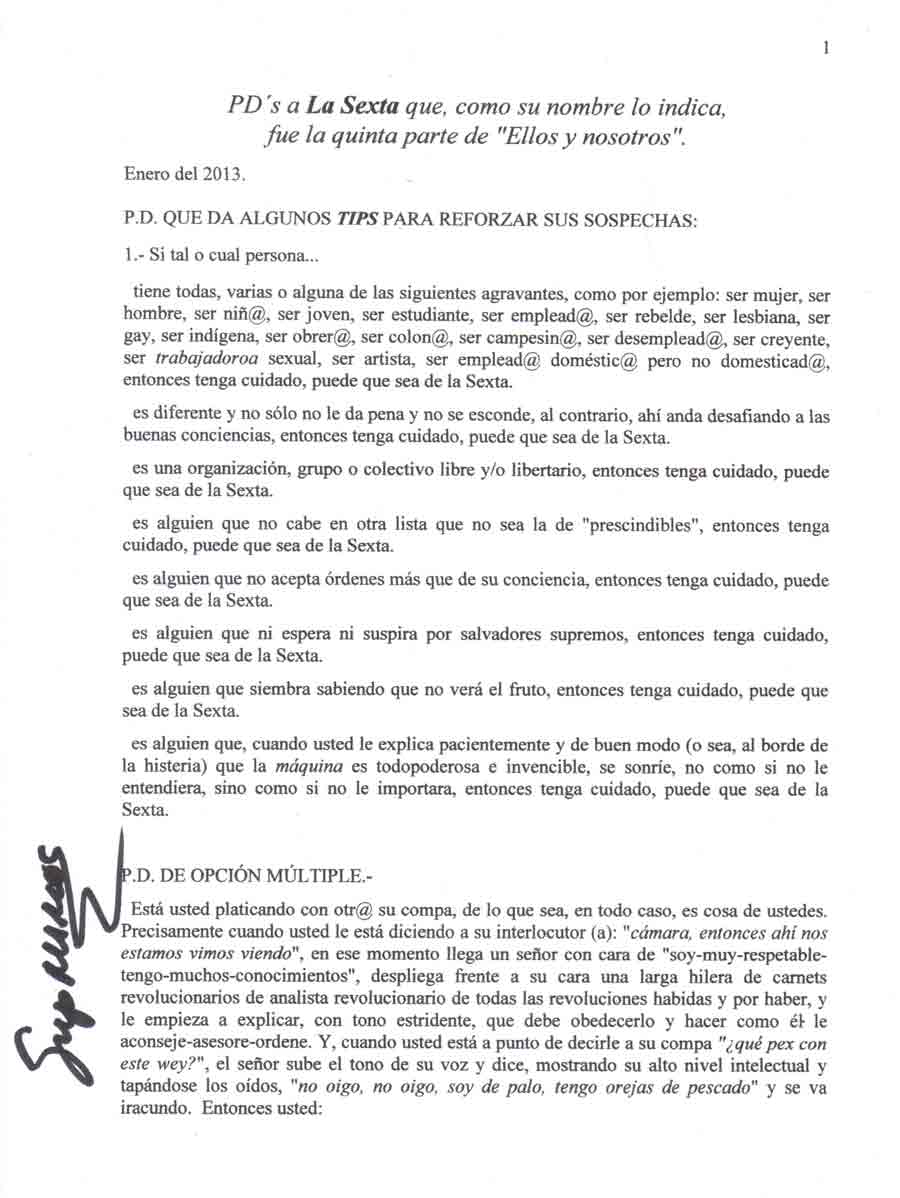
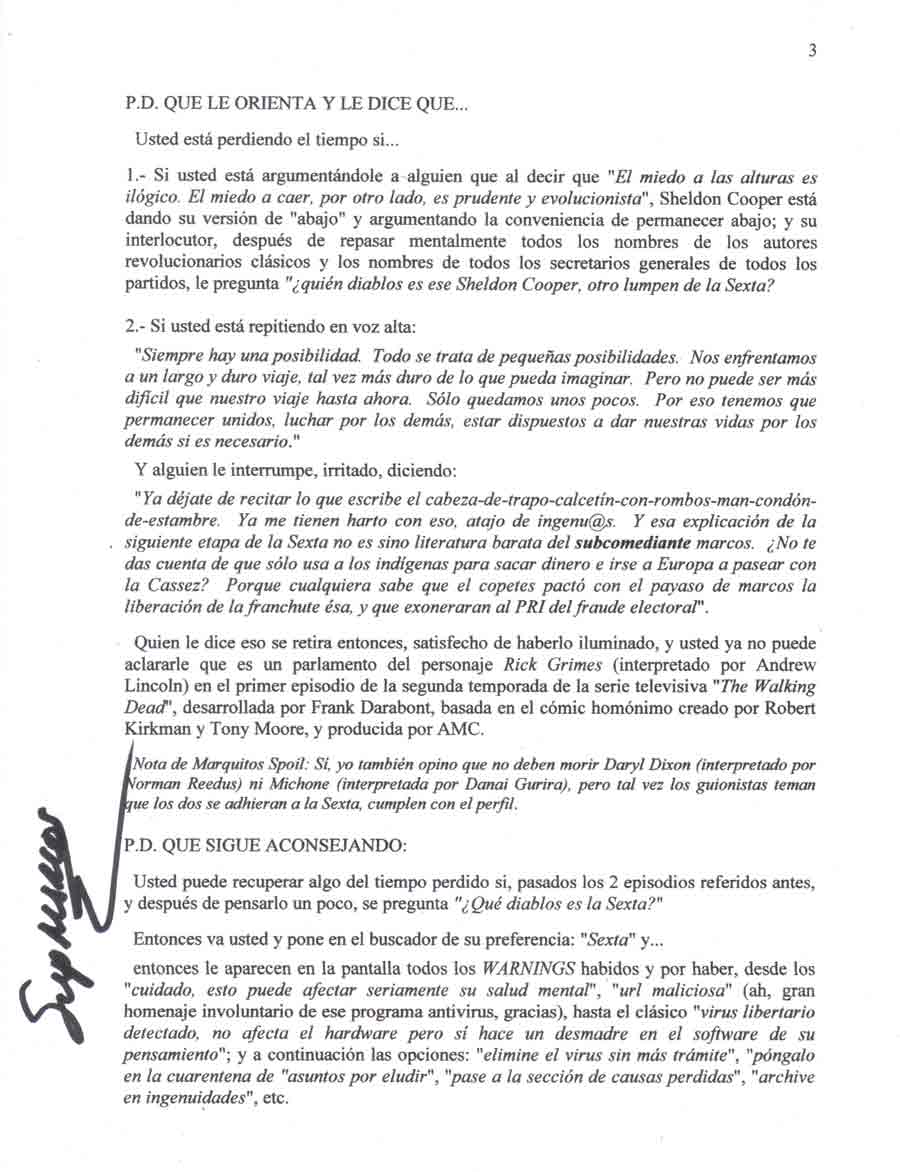
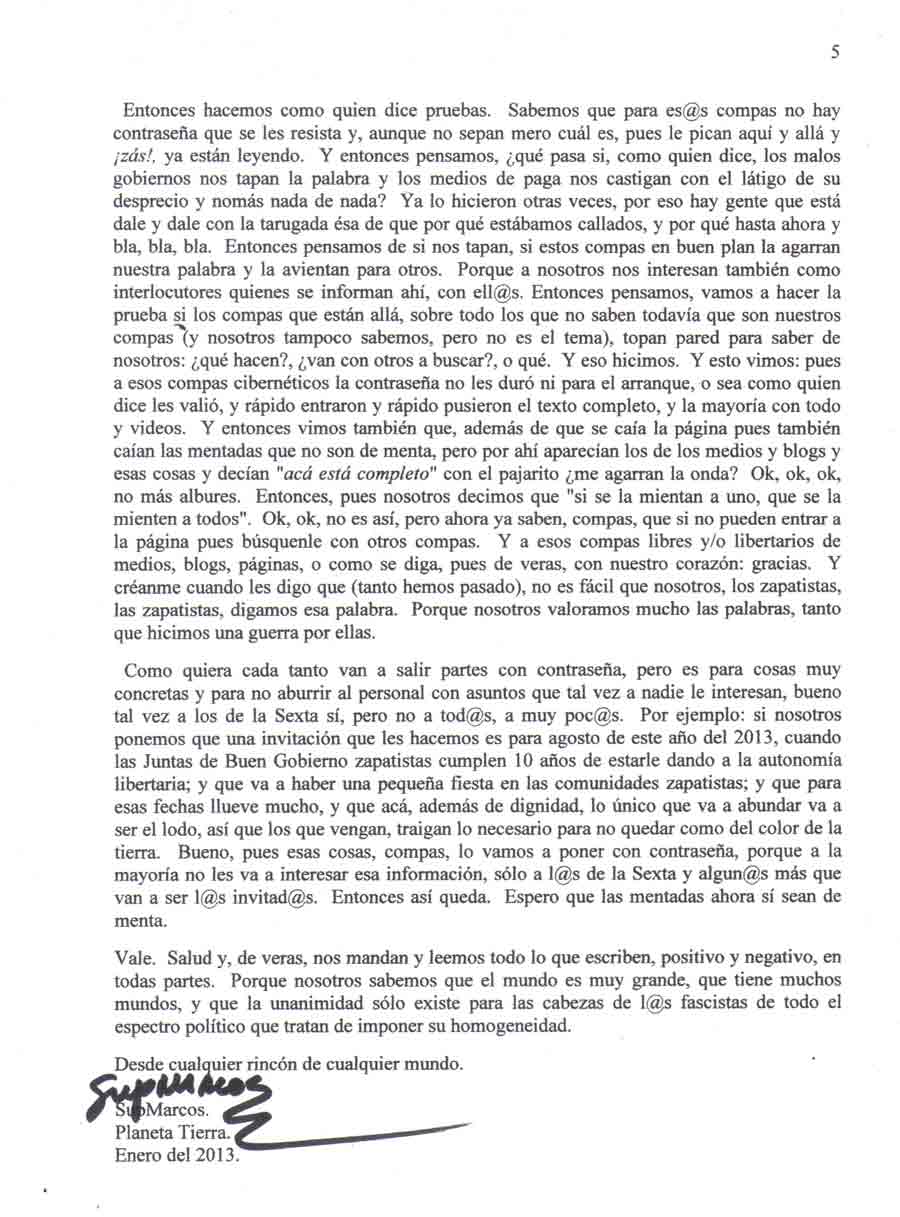
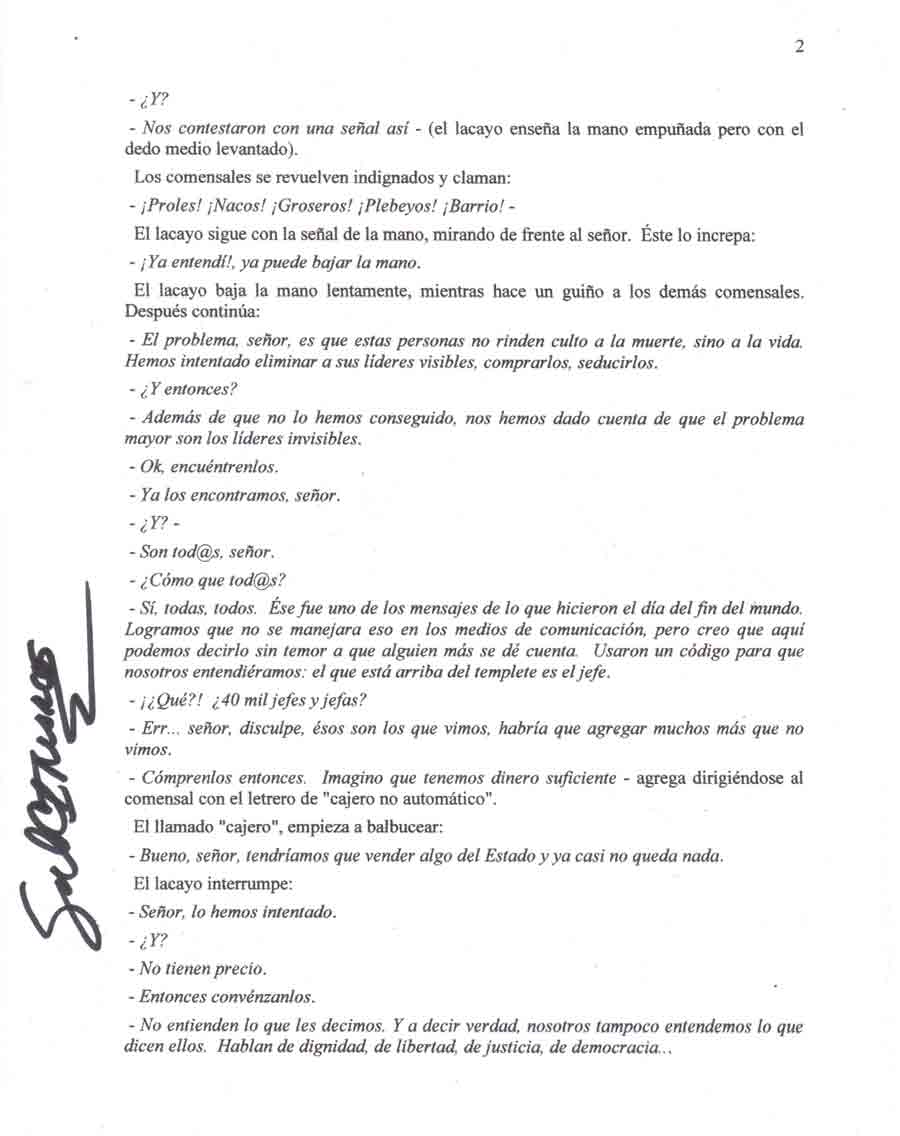
P.D.- Sí, tal vez hay, en la carta a él, alguna pista para la próxima contraseña.
P.D. QUE ACLARA INNECESARIAMENTE.- Tampoco tenemos cuenta de twiter ni facebook, ni correo electrónico, ni número telefónico, ni apartado postal. Los que aparecen en la página electrónica son de la página, y estos compas nos apoyan y nos mandan lo que reciben, así como ellos mandan lo que enviamos. Por lo demás, estamos en contra del copyright, así que cualquiera puede tener su twiter, su facebook, o como se diga, y usar nuestros nombres, aunque, claro, ni somos ni nos representan. Pero, según me han dicho, la mayoría de ell@s aclaran que no son quienes se supone que son. Y la verdad es que nos divierte imaginarnos la cantidad de insultos y mentadas (que no son de menta), que han recibido y recibirán, originalmente dirigidas al ezetaelene y/o a quien esto escribe.
:::::::::::::::::::::::::::::::::::::
Escucha y ve los videos que acompañan este texto.
Desde el Japón, la canción y coreografía “Ya Basta”, de Pepe Hasegawa. Se supone que se presentó en la prefectura de Nagano, Japón, en el 2010. La verdad no sé qué mero dice la letra, sólo espero que no sean mentadas sin menta.
———————————————————————————————
Desde Suecia, ska con el grupo Ska´n´ska, de Estocolmo. La rola se llama “Ya Basta” y forma parte de su disco “Gunshot Fanfare”.
———————————————————————————————–
Desde Sicilia, Italia, el grupo Skaramanzia con la rola “Para no olvidar”, parte del disco “La lucha sigue”.
——————————————————————————-
Desde Francia.- “Ya basta – EZLN” con el grupo Ska Oi. Del disco “Lucha y fiesta”
ELLOS Y NOSOTROS. VI.- Las Miradas. Parte 3: Algunas otras miradas.
ELLOS Y NOSOTROS.
VI.- Las Miradas 3.
3.- Algunas otras miradas.
una: Un sueño en esa mirada.
Es una calle, una milpa, una fábrica, un socavón, un bosque, una escuela, una tienda departamental, una oficina, una plaza, un mercado, una ciudad, un campo, un país, un continente, un mundo.
El Mandón está gravemente herido, la máquina rota, la bestia exhausta, la salvaje encerrada.
De nada sirvieron los cambios de nombre y de banderas, los golpes, las cárceles, los cementerios, el dinero fluyendo por las mil arterias de la corrupción, los “reality shows“, las celebraciones religiosas, las inserciones pagadas, los exorcismos cibernéticos.
El Mandón llama a su último capataz. Algo le murmura al oído. El capataz sale y se enfrenta a la muchedumbre.
Dice, pregunta, demanda, exige:
“Queremos hablar con el …“
Duda, la mayoría de quienes se le enfrentan son mujeres.
Corrige:
“Queremos hablar con la … “
Vuelve a dudar, no es pequeño el número de otr@s que se le enfrentan.
Vuelve a corregir:
“Queremos hablar con quien esté al mando“.
Por entre el silencio se adelantan un@ ancian@ y un@ niñ@, se paran frente al capataz y, con una voz inocente y sabia, dicen:
“Acá todas y todos mandamos“.
El capataz se estremece, y se estremece la voz del Mandón en su último grito.
La mirada despierta. “Extraño sueño“, se dice. Y, sin importar el calendario y la geografía, sigue la vida, la lucha, la resistencia.
Del raro sueño sólo unas palabras recuerda:
“Acá todas y todos mandamos“.
dos: Otra mirada desde otro calendario y otra geografía.
(fragmento de una carta recibida en el cuartel general del ezetelene, sin fecha)
“Saludos Compas.
(…)
Mi opinión es que fue una chingonería todo. Pero no niego que todo esto es en retrospectiva. Sería muy fácil decir que entendí perfectamente el silencio y que nada me sorprendió. Falso, yo también me impacienté con el silencio (desde luego no tiene que ver con lo que se dice de que antes no hablaban los zapatistas, yo sí leí todas las denuncias). La cuestión es que vista con la ventaja de los hechos que han pasado, y que están pasando, pues desde luego la conclusión es lógica: estamos en medio de la iniciativa más audaz, por lo menos desde la insurrección, de los zapatistas. Y esto tiene que ver con todo, no sólo con la situación nacional sino también internacional, creo yo.
Permítanme que cuente lo que yo entendí de lo que, a mi parecer, fue el hecho más significativo de la acción del 21 [de diciembre del 2012]. Desde luego hay muchas cosas: la organización, el esfuerzo militante, la demostración de fuerza, la presencia de los jóvenes y mujeres, etc. Pero a mí lo que más me impresionó fue el que anduvieran cargando unas tablas y que llegando a las plazas se hicieran unos templetes. Conforme se iba narrando lo que sucedía, muchos medios privados, y algunos de los libres, especulaban sobre la llegada de los líderes zapatistas. Y no se daban cuenta que los líderes zapatistas estaban ya ahí. Que eran los pueblos que se subían al templete y decían, sin hablar, aquí estamos, estos somos, estos seremos.
El templete les tocó a los que les debe tocar. Nadie ha reparado, creo yo, en ese hecho y, sin embargo, creo yo, ahí está, en una nuez, el significado profundo de una nueva forma de hacer política. Lo que rompe con todo lo viejo, lo único verdaderamente nuevo, lo único que merece la pena tener [ilegible en el original] “siglo XXI”.
El alma plebeya y libertaria de lo que ha sido en la historia momentos coyunturales, aquí se ha construido sin grandes alardes teóricos. Más bien con una práctica soterrada. Ya lleva demasiados años como para ser una ocurrencia. Ya es un proceso histórico social largo y sólido en el terreno de la auto organización.
Finalmente recogieron su templete, volvieron a convertirse en tablas y todos deberíamos de tener un poco de vergüenza y ser más modestos y sencillos y reconocer que algo inesperado y nuevo está frente a nuestros ojos y que debemos mirar, callar, escuchar y aprender.
Un abrazo para tod@s. Espero que, dentro de lo que cabe, estén bien.
El Chueco.”
tres: “Instrucciones sobre qué hacer en caso de … que l@ miren”
Si alguien lo mira, la mira, y usted se da cuenta de que…
No lo mira como si fuera usted transparente.
No quiere convencerlo de que sí o de que no.
No quiere cooptarlo.
No quiere reclutarlo.
No quiere dirigirlo.
No quiere juzgarlo-condenarlo-absolverlo.
No quiere usarlo.
No quiere decirle qué puede o no hacer.
No quiere darle consejos, recomendaciones, órdenes.
No quiere recriminarle porque no sabe, tampoco porque sí sabe.
No lo desprecia.
No quiere decirle lo que debe hacer o no debe hacer.
No quiere comprarle su auto viejo, su cara, su cuerpo, su futuro, su dignidad, su voluntad.
No quiere venderle algo…
(un tiempo compartido, una televisión lcd en 4D, una máquina súper-ultra-híper-moderna con botón de crisis instantánea (ojo: no confunda con el botón de eyección, porque la garantía no incluye amnesia por ridículos mediáticos), un partido político que cambia de ideología según sople el viento, un seguro de vida, una enciclopedia, una entrada vip al espectáculo o revolución o cielo de moda, un mueble en abonos chiquitos, un plan de telefonía celular, una membrecía exclusiva, un futuro regalado por el líder generoso, una coartada para rendirse, venderse, claudicar, un nuevo paradigma ideológico, etc.).
Entonces…
Primero.- Descarte usted que se trate de un depravado o depravada. Usted puede ser lo suci@, fe@, mal@ y groser@ que se quiera, pero, lo que sea de cada quien, tiene ese toque sexy y cachondo que da el estar dale y dale al trabajo; y ese “eso” puede despertar las bajas pasiones de cualquiera. Mmh… bueno, sí, una peinada no estaría de más. Si no se trata de un (a) depravad@, no se desanime, el mundo es redondo y da vueltas, y siga más abajo (de esta lista, se entiende).
Segundo.- ¿Está usted segur@ de que es a usted a quien mira? ¿No será a ese anuncio de desodorantes que está a sus espaldas (de usted, se entiende)? ¿O no será que está pensando (quien l@ mira a usted, se entiende): “Creo que así me veo yo cuando no me peino“? Si ha descartado eso, continúe.
Tercero.- ¿No tiene cara de policía buscando completar el pago que le tiene que reportar a su superior? Si sí, corra, aún está a tiempo de no perder lo del pasaje. Si no, pase al siguiente punto.
Cuarto.- Devuélvale la mirada, con seño severo. Una mirada mezcla de enojo, dolor de panza, fastidio y look de asesin@ serial servirá. No, así parece osit@ estreñid@. Vuelva a intentarlo. Ok, pasable, pero siga practicando. Ahora, ¿no huye despavorid@?, ¿no desvía la mirada?, ¿no se le acerca exclamando “¡tí@ juanch@! ¡No te reconocía! Pero con ese gesto…“? ¿No? Ok, continúe.
Quinto.- Repita los pasos primero, segundo, tercero y cuarto. Puede haber fallas en nuestro sistema (que, claro, es hecho en China). Si vuelve a llegar a este punto, pase al siguiente:
Sexto.- Tiene usted altas probabilidades de haber topado con alguien de la Sexta. No sabemos si felicitarle o darle el pésame. En todo caso, es su decisión y su responsabilidad lo que siga a esa mirada.
cuatro: Una mirada a un puesto zapatista.
(calendario y geografía sin precisar)
El SupMarcos: Tienen que apurarse porque se acaba el tiempo.
La insurgenta de sanidad: Oí Sup, el tiempo no se acaba, se acaban las personas. El tiempo viene de muy lejos y sigue su camino hasta alláaaaaa, donde no lo podemos mirar. Y nosotros somos como pedacitos de tiempo, o sea que el tiempo no se puede caminar sin nosotros. Nosotros lo que hacemos es que el tiempo camine, y cuando nos acabamos viene otro y lo empuja otro tanto al tiempo, hasta que se llega a donde se tiene que llegar, pero no lo vamos a mirar dónde es que se llega sino que otros lo van a ver si es que llega cabal o de repente no le alcanzó la fuerza para llegar y otra vuelta que hay que empujarlo otra vez, hasta que llegue de por sí.
(…)
La capitana de infantería: ¿Y por qué tardaste tanto?
La insurgenta de sanidad: Es que le estaba dando plática de la política al Sup, que sea que le estaba ayudando para que explique bien que hay que mirar lejos, hasta donde no nos alcanza ni el tiempo ni la mirada.
La capitana de infantería: Ajá, ¿y luego?
La insurgenta de sanidad: Me castigó porque no me apuré de los trabajos y me mandó a la posta.
(…)
cinco: Extracto de los “Apuntes para mirar el Invierno”.
(…)
Y sí, tod@s subieron al templete con el puño en alto. Pero no miraron bien. No miraron la mirada de esos hombres y mujeres. No miraron que, cuando cruzaban por arriba, volteaban la mirada hacia abajo y veían a sus decenas de miles de compañeros. Es decir, se miraron a sí mismos. Allá arriba no nos miraron mirándonos. Allá arriba no entendieron, ni entenderán nada.
(…)
seis: Ponga usted su mirada (o su mentada, manque no sea de menta).
—————————————————————————————————————————–
—————————————————————————————————————————–
—————————————————————————————————————————–
—————————————————————————————————————————–
—————————————————————————————————————————–
—————————————————————————————————————————–
(Continuará…)
Desde cualquier rincón de cualquier mundo.
SupMarcos.
Planeta Tierra.
México, Febrero del 2013.
:::::::::::::::::::::::::::::::::::::
Escucha y ve los videos que acompañan este texto.
Daniel Viglietti y Mario Benedetti interpretan “a la limón” la canción “La Llamarada” y el poema de Benedetti “Pregón”. Concierto en Montevideo, Uruguay, Latinoamérica, Planeta Tierra. Al iniciar, Daniel hace un reconocimiento a tod@s l@s que no están en el templete pero hacen posible que Daniel y Mario estén. Casi al finalizar, pueden escuchar a Mario Benedetti cantando, cantándose, cantándonos y, sin importar el calendario y la geografía, viceversa.
———————————————————————————–
Amparanoia interpreta “Somos Viento”. En una parte, Amparo Sánchez dice “Ik´otik”, que en tzeltal quiere decir “somos viento”.
—————————————————————————
Amparo Ochoa, voz que aún reverbera en nuestras montañas, interpretando “Quién tiene la voz”, de Gabino Palomares.