
Economía política desde las comunidades I. Subcomandante Insurgente Moisés. 4 de mayo de 2015Political Economy from the Perspective of the Communities I. Subcomandante Insurgente Moisés. 4 May 2015
Palabras del Subcomandante Insurgente Moisés (4 de mayo de 2015)
Escucha aquí:
[podcast]https://radiozapatista.org/Audios/pensamiento/4may_sup-moi.mp3[/podcast]
Buenas tardes compañeros, compañeras.
Lo que les voy a platicar, platicado, no leído, es sobre cómo era y cómo es la economía desde las comunidades, del capitalismo pues. Les voy a hablar de hace 30 años y de hace 20 años y unos pocos años de ahora. Les voy a platicar en tres partes: cómo viven las comunidades desde antes, de hace 30 años; cómo viven ahora los que no están organizados como zapatistas y luego cómo vivimos nosotros, nosotras como zapatistas de ahora.
No quiere decir que entonces no sabemos los demás siglos pasados, lo sabemos. Lo que queremos marcar de acá, porque nosotros tenemos 30 años, desde el 83, el año de 1983 cuando llega el grupo de compañeros, a partir de ahí hasta ahora tenemos 30 años.
Words by Subcomandante Insurgente Moisés (4 May 2015)
Seminar “Critical Thought vs. the Capitalist Hydra”
Listen here:
[podcast]https://radiozapatista.org/Audios/pensamiento/4may_sup-moi.mp3[/podcast]
Good afternoon compañeros, compañeras.
What I’m going to talk to you about—not read to you—has to do with what the economy was like and is like in the communities, that is, I’m going to talk to you about capitalism. I’m going to talk to you about how it was 30 years ago, 20 years ago, and in these past few years. I’m going to speak to you about this in three parts: how the communities lived before, 30 years ago; how those who are not organized as Zapatistas live today; and then about how we live, we the Zapatistas of today.
This isn’t to say that we don’t know how it was centuries ago; we do know. But we want to demarcate things from here because we are 30 years old—starting from ’83, the year 1983 when the group of compañeros arrived, and so from that date to now, we are 30 years old.
Cuando no había llegado el Ejército Zapatista de Liberación Nacional, entonces nosotros los indígenas de Chiapas para el sistema capitalista no existimos, no somos como gente, no somos como humano. Ni siquiera basura servimos para ellos pues. Y así nos imaginamos los demás hermanos indígenas en el resto de nuestro país. Y así nos imaginamos también en todos los países donde existen indígenas.
En donde vivimos, o sea en las serranías, en los cerros, ellos lo tienen así en reserva. No saben si existen indígenas ahí, como dicen, Biosfera de Montes Azules. Y entonces nadie llevaba la cuenta de cuántos niños, niñas, están naciendo. O sea el capitalismo no sabe nada, nadie lleva la cuenta porque no existimos para ellos.
¿Entonces cómo sobrevivimos ahí? Pues con la madre tierra. La madre tierra es la que nos dio la vida, aunque no haya gobierno, gobernadores o presidentes municipales que se acuerdan de nosotros, nosotras. Estamos olvidados. Sólo lo que había allá en nuestros pueblos, las mejores tierras, hay unos cuantos hombres, claro, con sus mujeres también, los terratenientes, los finqueros, o los latifundistas.
Ellos sí son los que tienen miles de hectáreas de tierras buenas, buen agua, buen río. Por eso a nosotros nos sacaron de ahí, nos empujaron hacia las serranías, porque para ellos esos cerros no sirven, no les dan nada para ellos, y ahí nos echaron a nosotros.
¿Para qué sirven esas miles y miles de hectáreas de las buenas tierras para ellos? Es para tener miles y miles de cabezas de ganado, vacas. ¿Cómo es que pudieron mantenerse allí a lo largo de muchos años? Porque tienen buenos pistoleros, que nosotros les decimos guardias blancas, que no nos dejaban pasar en sus terrenos, en la tierra que decían que es de ellos.
Pues así entonces, qué podemos hablar de economía en las comunidades si estamos olvidados ahí. Lo único lo que hacen es explotar ahí en sus fincas, a que lo trabajen nuestros abuelos, bisabuelos. Entonces lo que pasó con nosotros es tuvimos que inventar, tuvimos que imaginar cómo tenemos que vivir, sobrevivir en nuestra madre tierra, resistiendo todas las maldades de lo que hace el terrateniente o el latifundista.
Nunca se conoció si hay carreteras, nunca se supo ni de nombre que se dice clínicas u hospitales, mucho menos escuela, que se dice escuela, o los salones de la escuela, de la educación. Nunca hubo nada de campañas de salud, no hay programas, no hay becas, no hay nada, estábamos olvidados.
Entonces, así como estamos diciendo, porque hablo de todos los hermanos y los compañeros que estamos organizados ahora, no hablo por mí solo, vemos de que hace 20 años la economía capitalista en las comunidades, cómo empezaron a interesarse allá en las comunidades, no tanto por las comunidades sino de donde viven, donde vivimos, donde vivieron, porque también ya hay hermanos, compañeros muertos y muertas.
Primero es que entonces no les basta que tienen las mejores tierras, que para ellos ya les sirvió muchos años. Ahora se dieron cuenta de que en los cerros, las montañas, ahí está otra mercancía para ellos, que ya lo han dicho varias veces acá, es la riqueza de la naturaleza. Entonces empiezan a organizarse para volver a desalojarnos, donde nos empujaron, donde nos mandaron, ahora nos vuelven a querer sacar de ahí. O sea hacer el despojo, el desalojo, porque quieren esa riqueza.
Y esa riqueza que está ahí pues nosotros con nuestros tatarabuelos, como lo decimos, ellos lo tienen cuidado, y eso es lo que lo quieren llevar, sacar, ese capitalista que en pocos años lo van a destruir lo que hace miles de millones de años que está ahí en la madre tierra.
¿Cómo es eso? Pues lo saben, nada más les recuerdo cuál fue la maña, la trampa que hizo el sistema capitalista, es cuando cambiaron el artículo 27 para que entonces se pueda privatizar los ejidos, porque lo que quieren es que ahora sí se pueda vender o rentar a la madre tierra.
Les voy a tener que invitar a que hagan un poquito de imaginación porque estamos hablando de 20 años, o sea es cuando ya salimos nosotros a la luz pública.
Entonces cuando el gobierno se dio cuenta que así está eso, ahora sí, disfrazado de varias maneras, uno es de que entonces dice el mal gobierno que ya está cumpliendo nuestras demandas, empieza a meter carreteras, pero no es por eso, sino es por el cambio del artículo 27 para privatizar a los ejidos. Entonces aprovecha de dos maneras porque ya se dieron cuenta que nos levantamos, ahora hace como que está cumpliendo, empieza a meter carreteras, empieza a dar proyectos; y el proyecto que es cosa de un millón o dos millones de pesos, entre cien, doscientos, trecientos proyectos, sacan ahí en ese miserable de dinero pues, y ni siquiera llega en las comunidades, les queda a toda esa bola de gobiernos; pero eso es lo que anuncian, lo que nos dicen.
Si les dijera todo lo que dicen los compas y los hermanos también, de que hasta hay proyectos que le dicen que se llama “pececito”, vete a saber qué es lo que quiere decir pececito. Por eso estoy diciendo que lo parten muchos proyectos en poco dinero.
Y ya empezó a haber algunas escuelas, algunas clínicas. Ni siquiera saben leer los alumnos y dicen que ya les dan beca. Y de las clínicas dicen que les dan su seguro popular porque con esa credencial estás bien atendido o atendida, y a la hora de que se van le dicen que no hay doctor o doctora; y si está el doctor o la doctora ellos dicen no hay medicina; y si está ahí el doctor, doctora, y hay medicina, está caducada. Pero como no sabemos leer, ahí está el doctor, doctora, te da la medicina caducada, le dan de tomar y no es lo que cura el dolor que tienes. El chiste es nada más que te dan como que ya te están dando tu medicamento, ni sabes si es la medicina que necesitas para tu enfermedad.
Entonces así como les estoy diciendo, que empezó a meter muchos proyectos y con esas cositas que ya les digo, así vino pasando los años. Ahora como está, porque una de las cosas que hicieron de esos muchos proyectos que dice el mal gobierno y poco dinero para repartir, entonces es para el control que hace el mal gobierno, para que entren de ser zapatistas. Creo que le dicen la campaña de contrainsurgencia o la guerra de baja intensidad, no sé cómo le dicen pero es eso, el control de que ya no luches, ahora vamos a cumplirte, aquí está. Además si te vas a meter de zapatista míralo mi ejército, ellos están más preparados, nada más te vas a la muerte. Entonces eso es campaña para controlarlos.
Les estoy diciendo esto porque ahora esas comunidades, los que se dejaron privatizar su ejido, porque hay quienes se dejaron, ya están ahí, podemos decir como en las ciudades, hay vagabundos ahí, ahí están caminando, no tienen casa, está drogadicto en thinner, en esas cosas. Igual ya en las comunidades porque vendieron su tierra, porque recibieron los papeles, la escritura de ser propietarios, de ser como ranchero, pequeño ranchero, pequeño propietario, entonces ya lograron sea suyo entonces lo venden y ya quedaron en la calle, ya no tienen donde sembrar su maíz, su frijol.
Otros, los que han recibido proyectos de varios tipos de proyectos, ahora les están cobrando según el interés del capitalismo. Nada más como para decirles algunas, allá por el caracol de La Realidad hay una comunidad que se llama Agua Perla, donde corre el río Jataté. Entonces ese poblado recibieron los proyectos, ahora ya llega un grupo de, como dicen, como decimos, caxlanes, mestizos y les dicen: saben qué, señores, aquí está lo que deben; esa tierra ya no es de ustedes y para que vean que entonces no haya problema váyanse en Escárcega –o sea en Campeche, creo que en Campeche queda Escárcega–, o se van en Oaxaca –donde se están peleando con el gobierno de Chiapas y con el de Oaxaca, Las Chimalapas–.
Ahí les están ofreciendo ir a esos habitantes partidistas, les tengo que decir partidistas otra vez porque antes los priistas son los que chingaban, ahora todos los partidos están chingando, por eso partidistas les decimos ahorita.
Otra comunidad en Roberto Barrios, se llama Chulum Juárez, y han recibido proyectos. Lo mismo, les ofrecieron carretera y la comunidad lo aceptaron porque es pavimentado y tan rápido empezaron a meter, es cosa de meses nada más, pero bien hecho la carretera. Ya que llegó la carretera, que recibieron su domo, algo así le llaman las láminas, y otras cosas, que le metieron grava en sus calles de la comunidad, entonces ya que ya está puesto, ya que llegó la carretera, entonces llegan y les dicen: saben qué, señores, se tienen que salir porque ese cerro que está ahí hay uranio ahí, y lo va a sacar el gobierno, si es que quieren vivir entonces tienen que salir, váyanse en Oaxaca si es que quieren salir, o a la mala tienen que salir.
Entonces eso es lo que prepararon hace 20 años, ahora lo están cumpliendo. Más con esto ahora que ya hicieron el cambio de las leyes, para el sistema capitalista ya lo lograron, eso es lo que dicen, es lo que dice el papel. Es lo que nosotros decimos: el papel lo dice que sí ya está autorizado, pero falta que le topa a la gente, si realmente se va a dejar la gente, y falta también que nos topan a nosotros, las, los zapatistas.
Entonces esas cosas que les platico, nos hacemos la pregunta, porque es que estudiamos las historias pasadas de nosotros, decimos ¿por qué el capitalismo ellos sí se cambian de cómo ir dominando más y tener más de lo que ya tienen de por sí?, ¿por qué nosotros, los explotados y explotadas, seguimos lo mismo?
Así nos preguntamos eso porque los hermanos y hermanas que les decimos, los partidistas, también diferenciamos de decir eso. Nosotros les decimos hermanos, hermanas, a los partidistas, los que no nos hacen daño. No vamos a decirles hermanos, hermanas, a los pinches paramilitares, ésos son unos hijos de la chingada pues.
Eso es lo que les pasa a los hermanos partidistas. Ya cuando nosotros salimos a la luz pública pues como dice la compañera Vilma, nosotros decimos, los zapatistas, que recuperamos a la madre tierra. Es como si fuera que nos la quitaron a nuestra mamá y hay que ir a buscar dónde está y si la encuentras tienes que recuperarla, podemos decir muchas formas de la palabra, el chiste es de que véngase, mamá, ¿no? No pelearse pues.
Entonces algo pasó así, que nos habían quitado nuestra mamá y empezamos a organizarnos porque es lo primero. Hay que organizarse primero y fue lo que hicimos. Nos tuvimos que organizarnos mujeres y hombres para ir a recuperar, no hay más de otra forma de cómo decir.
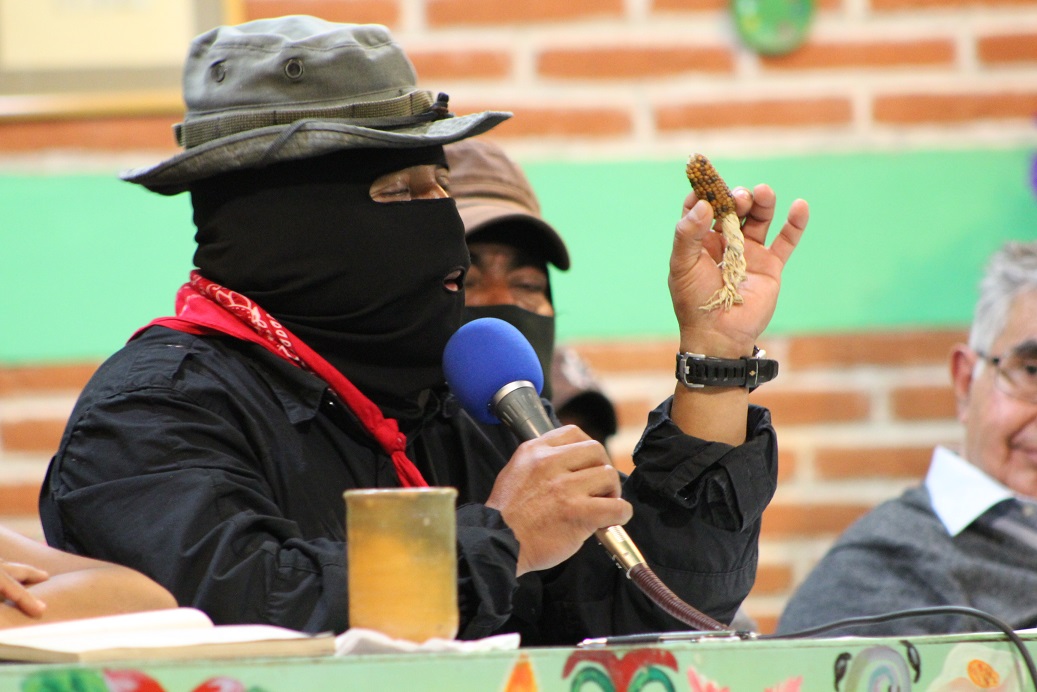
Porque de ahí sale todo en la madre tierra, entonces tuvimos que recuperar a la madre tierra y empezamos a organizarnos cómo vamos a trabajarla. Entonces pasando los años, el mal gobierno y los dueños, los terratenientes, empiezan a decir que por culpa de nosotros, las y los zapatistas, esas tierras, esas miles de hectáreas de tierra es improductivo. Y nosotros los zapatistas, las zapatistas, lo aceptamos, no es productivo para los terratenientes o el capitalismo, es productivo para nosotros, porque ahí ya no salen los miles de cabezas de ganado que sacaban antes los terratenientes; ahí lo que sale es miles y miles de mazorcas de maíz, así como éste.
Así de chiquitito nos empezó a dar en la madre tierra que nos habían quitado los terratenientes, nos la quitaron, no es cierto que nosotros la estamos quitando, de por sí era de nosotros, tan maltratada que la dejaron a la madre tierra que así de chiquititos daba los primeros productos que empezamos a hacer. Como de por sí nuestros abuelos saben trabajarla, poco a poco fuimos hallándonos nuevamente, otra vez, con nuestra madre tierra.
Esas tierras recuperadas las trabajamos en colectivo. Cuando decimos de colectivo se necesita mucha práctica para que descubres cosas ahí. Por ejemplo al principio empezamos a trabajar la tierra, así colectivos, todos, o sea nadie hacía su pedazo de milpa, sino juntos completamente todos. Entonces a veces viene el problema de mucha lluvia, de mucha sequía, o pasa tormenta, entonces empezamos a perder. Entonces los compañeros empiezan a decir que no, así no, mejor nos vamos a organizar, nos pongamos de acuerdo cuántos días vamos a dar el trabajo colectivo y cuántos días vamos a trabajar lo nuestro.
Y sobre todo son las compañeras las que aportan la idea porque son ellas las que siembran los condimentos de la comida, nosotros les decimos el cebollín, la cebolla y otros condimentos que usan las compañeras en la cocina, entonces como hacen colectivo entonces las compañeras mandaban un su hija, sus hijos, sus hijas en la milpa y se lo traen, y si alguien comienza uno ir a traer se va todo, porque es de todos y no hay acuerdo todavía.
Entonces se empieza a ver como un problema ahí, entonces lo que hacen los compas es que descubren muchas cosas. Entonces otros quieren elote, y como es colectivo la milpa si alguien agarra uno se va todo, y es donde se viola porque no hay acuerdo todavía. Entonces lo que hacen los compas es que nos vamos a poner de acuerdo, tantos días vamos a hacer el trabajo colectivo todos, y tantos días tenemos para nosotros.
Y el trabajo colectivo que se hace se hace a nivel pueblo, o sea local, comunidad; se hace nivel regional, así le decimos, región es donde ya están agrupados 40, 50 o 60 pueblos, a eso le decimos región; y luego se hace el trabajo colectivo a nivel municipal, cuando decimos nivel municipal a veces junta 3, 4 o 5 regiones, ya ése es el municipio autónomo rebelde zapatista. Y cuando decimos trabajo colectivo de zona es todos los municipios que hay como lo que se dice la zona de Realidad, o de Morelia o de Garrucha, las cinco zonas.
Entonces ya son cientos y cientos de pueblos cuando se habla de zonas, cuando se habla de municipios son decenas de pueblos. Entonces así se trabaja el trabajo colectivo, y el trabajo colectivo no es nada más en la madre tierra.
Sólo les recuerdo, como había dicho el difunto Sup Marcos, en aquellos tiempos cuando nos dijeron que no que decimos que somos anticapitalistas y tomamos coca cola, no sé si se acuerda alguien de acá, cómo les diré eso. Es que lo que pasa es que nos idealizan, piensan que todo lo que decimos ya. No, compañeros y compañeras, hermanos y hermanas. Lo que pasa es que nosotros sí estamos organizados.
Les voy a dar un ejemplo más claro. Recuerdo que una compañera de la ciudad estaba tan enojada que porque vio que un compa zapatista estaba gritándole a su compañera, y porque estaba bolo, está tomado, está borracho. Entonces le decíamos a la compañera: tranquila, compañera, porque esa compañera va a ir a quejarse con la autoridad, mañana, pasado, ese compa va a tener que ser castigado. Lo que pasa es que piensas que si decimos limpio, todo limpio; y si decimos negro, todo negro. No, eso es idealizarlo. Pero sí, la compañera se queja y ahí viene la sanción.
El chiste es estar organizado. Porque como antes, cuántos había así, mujeres maltratadas, no había síndico, no había regidor, no había presidente municipal que lo resuelva su problema a las compañeras, si era más peor el síndico, el regidor o el presidente municipal, entonces cómo lo van a resolver.
Bueno, entonces estamos hablando del trabajo colectivo. Es que se hace otros trabajos colectivos, por ejemplo en venta de eso que les acabo de decir, no es porque nos gusta, porque para nosotros, las y los zapatistas, para acabar el capitalismo es que tenemos que destruirla. Y una manera de destruir es quitar los medios de producción, adueñarnos y administrar nosotros, nosotras mismas. Entonces si vendemos las cosas, por ejemplo aquí está esto, eso es tierra, ¿pero eso que está ahí?, ¿eso que están las flores?, ¿ya es producido del capitalismo o no?, ¿esos lentes que traen?, ¿y eso?, ¿todo lo que traen?
Pero sí lo entendemos, pues así de que es una manera de rasguñar al capitalismo. Sí de por sí vamos a bajarle una su ganancia, es cierto, es la verdad. No es mentira, lo entendemos, pues. Es que nos acordamos porque es que nosotros nos comunicamos todos, es que es una cosa decir y otra hacer. Por ejemplo, recuerdo muchas ONGs acá decían no vamos a permitir, cuando entró el Chedrahui aquí, y que no vamos a comprarles. No pasó ni dos semanas. Entonces es que es una cosa decir y es otra cosa hacer.
Bueno, aquí les voy a empezar a mencionar cosas que empezamos a descubrir en lo que es el trabajo colectivo, y que son varias cosas, trabajos, no nada más en la madre tierra. Empezamos a ver sobre de la resistencia, empezamos a descubrir.
Empezamos la resistencia, es que nuestros compañeros y compañeras de nuestros pueblos, les quiero decir cómo nació la idea de la resistencia. Pues es que en esos tiempos del alzamiento el gobierno, el mal gobierno, empezó a usar, a utilizar, no sé cómo se dice, para que sean ellos el espía, la oreja, o sea para escuchar qué hacen, cómo se mueven los zapatistas. Entonces los compañeros y las compañeras se dieron cuenta que son espías, orejas, los maestros y maestras, los corren.
Entonces ahí empieza el problema, ahora ya no hay maestro y maestra. Bueno, tuvimos que inventar, tuvimos que imaginar, tuvimos que crear. Entonces, como les digo que el gobierno empezó a mostrar que va a dar muchos proyectos, entonces nosotros como que da envidia pues, porque empezamos a entender luego luego de que sí les están dando lo que les están dando porque no quiere el gobierno que sea zapatista, entonces por nosotros mismos les están dando. Ah, bueno, decíamos.
Entonces es ahí donde las compañeras empiezan a decir no, porque murieron compañeros insurgentes, milicianos, en el 94. Esas compañeras son las que empezaron a decir: si nosotros armados fuimos y murieron nuestros compañeros ahí, por qué nosotros vamos a recibir aquí lo que es sobrante, lo que es limosna, lo que es migaja que da el mal gobierno, porque lo que quiere es que nos quiere comprar como lo está comprando los que no son zapatistas para que no entren de zapatistas.
Entonces esa idea empezó a producirse y a reproducirse, de que entonces es lo mismo como si fuera combate al no recibir –así empezamos–, al no recibir nada del mal gobierno. Ya después empezamos a descubrir que no es nada más no recibir. Les explico nada más eso porque ahí es donde vimos que les estaban dando muchos proyectos a los partidistas, y ahí donde nosotros y nosotras empezamos a decir que tenemos que trabajar a la madre tierra. Y cuando empezamos a decir así, los compañeros y las compañeras dice: sí, de por sí, porque cuando estaban vivos nuestros bisabuelos y tatarabuelos, ¿a poco les daba frijol, arroz, aceite, leche, a nuestros bisabuelos? No, es al contrario, todo su fuerza de trabajo de nuestros bisabuelos se va para el patrón, nada. ¿Y entonces por qué ahora el gobierno te va a dar tu kilo de minsa, maseca, frijol? Además que es transgénico, como se dice, químico que ni siquiera es leche de verdad.
Entonces es ahí donde se dijo que sí tenemos que trabajar a la madre tierra, entonces conforme fuimos dándole fuerza a esa resistencia, entonces los que lo entendimos pronto, rápido, tienen frijol, tienen maíz, tienen café, tienen puercos, guajolotes, animales, los compas. Y entonces los que son partidistas, cuando reciben la lámina, el cemento, la varilla, esas cosas, como no trabajan la tierra y sí tienen los compas y necesitan su carretilla, su lámina, caen. Son los compas los que los compran porque sí tienen ellos porque trabajan la tierra.
Entonces cuando se dieron cuenta, los compas, es el asunto que empezamos a detectar nosotros, es que son puro práctico los indígenas, nosotros. Si lo vemos que sí funciona es que decimos acá, ya se chingó la cosa, es que vamos a hacerlo todos así porque es que lo vimos todos que sí funciona, entonces con más ganas empiezan los compas a trabajar la tierra.
Y es así como el gobierno entonces empieza a decir que sí está dando mucho proyecto, miran la lámina, los rojos, porque son puros rojos la lámina, y sí, los compas también lo ponen arriba, el cielo como dicen, lo rojo. Y el gobierno dice que ahí está, ésos son de proyecto, y no es cierto, son casas de los compas que compraron la lámina. Y el gobierno se dio cuenta, ahora los tuvo que controlar, obligatoriamente que sí tienen que ver que sí lo construyan su casa, y así hicieron también los partidistas, porque los partidistas también dan proyectos de casa, y los obligan que sí tienen que ver que lo están construyendo porque si no van a ser de los zapatistas, dicen pues.
A nosotros, en las comunidades zapatistas, de otras formas de cómo lo vemos cómo están los hermanos partidistas, la verdad, compañeros y compañeras, hermanos y hermanas, da tristeza cómo viven, da amargura de cómo están, porque muchos de sus jóvenes y jóvenas que los conocimos ya no están, se fueron pues con el sueño americano a buscar el dinero verde, el dólar. Y muchos ya no regresaron, y algunos que han regresado ya están en puño de ceniza, y los que sí regresaron ya vinieron mal porque son drogadictos, fuman marihuana. Y los que no fuman marihuana ya vienen cambiado su cultura, dicen que ya no quieren tomar el pozol, que ya no lo conocen, es peor todavía.
Así viene de regreso ya el hijo o la hija, y llega en su casa con su papá, su mamá, y está igual su papá, su mamá, porque ya el gobierno lo tiene acostumbrado con los brazos así, abrazados, ya los tiene programado en su cabeza cada cuándo va a recibir el oportunidades, creo que prospera le dicen ahorita. O sea los hermanos partidistas los hicieron digamos inútil, porque ya no lo trabajan la tierra. Entonces creo que lo dicen la palabra sumiso, creo que le dicen así.
Por lo menos en la época de la esclavitud ahí sí te das cuenta quién es tu patrón que te está esclavizando, pero en este caso no, porque es que te amaña, te acostumbra, te programa en tu chip, o sea en tu cabeza, tu cerebro pues. Entonces ya no entiendes y además no lo ves cómo es su cara el Peña Nieto, ni el Velasco, ni el otro; otros pues que te van a ir a engañar.
¿Por qué hacen eso? Porque es la otra cara de la forma de cómo lograr lo que quieren lograr, o sea la madre tierra para sacar la riqueza. No es nada más una sola forma de cómo nos quieren ganar a la fuerza a la madre tierra, lo que no quieren es que llegue a matar el ejército y la policía, pero va a llegar su día cuando topa al pueblo que no va a permitir. Por ahora lo que hace eso de que te da los proyectos, te acostumbra y te programa para que te acostumbras de no trabajar la tierra, de ahí te acostumbras, y peor si ya tienes ahí el papel de la tierra, o sea la escritura, lo vendes.
Con tal de que gane la tierra eso es lo que les está pasando a los hermanos partidistas. Eso es lo que está queriendo lograr el capitalismo, de lo que hay con la madre tierra.
Cuando les decimos que en las comunidades partidistas que está muy triste cómo se ve, les voy a dar el ejemplo, y ojalá de que están aquí esos hermanos y hermanas para que vean ahí eso, lo confirman lo que decimos. Hay una comunidad allá por la zona de La Realidad, creo que se llama Miguel Hidalgo, cerca con el pueblo Nuevo Momón. Ahí esos hermanos, eran, porque hace pocos meses eran de la CIOAC-Histórica, ellos estaban de acuerdo lo que pasó de nuestro compañero maestro Galeano. Semanas después de lo que hicieron del compa maestro Galeano, les pasa a esos hermanos, ex cioaquistas ahorita, porque ya no quieren ser CIOAC y eran CIOAC, eran ellos mismos, por diferencias políticas partidistas, por diferencias políticas ideológicas en los proyectos, y entonces a esos hermanos lo que pensaron es que mejor nos vamos a hacernos a un lado porque no vamos a matarnos. Entonces se van a una tierra que es recuperada en 94, ahí se fueron a refugiarse esos hermanos cuando los sacaron violentamente de su comunidad.
Entonces ya no hay respeto de eso, los líderes de las organizaciones sociales tienen que ver mucho en eso, porque se dejan, se venden, y también así hombres y mujeres de esa organización pues hace falta que se organiza.
Por eso decimos que es un desastre así como está. Ahora esos comunidades partidistas de como los tiene hallado el gobierno, eso lo que les voy a platicar tiene más o menos como un mes o mes y medio, ya ven que el gobierno dijo que lo va a tener que recortar el proyecto social, y ya en las comunidades dan becas aunque no saben leer y escribir los alumnos, cada alumno les daban mil o mil doscientos pesos a cada alumno, alumna. Entonces los padres, los que tienen cuatro hijos en la escuela entonces ya tienen sus cinco mil pesos, entonces ya estaban acostumbrados los papás y mamás.
Hace más o menos como un mes o mes y medio, los que tienen cuatro hijos en la escuela y que reciben su beca ahora les están dando 800 pesos por los cuatro, entonces dicen ya nos chingaron. Pues sí, ya los chingaron, hermanos. ¿Qué les vamos a decir? Y luego, porque ese es el modo de los indígenas, es como si fuera celular pues, ahí rápido se comunican; si alguien está perdido rápido la comunidad está enterado que está perdido alguien; si alguien está enfermo rápido la comunidad se entera luego luego. Es como un teléfono que se avisa así luego luego pues.
Bueno, nosotros, con los compas de los pueblos, con las bases, hacemos reunión donde explicamos de que viene cabrón la situación y no nomás así para nosotros los indígenas, sino en todo México, campo y ciudad, y no sólo México. Entonces lo que pasa es que nosotros los zapatistas hay familiares que no son zapatistas, hay unos que son buenos, buenas, la familia; hay unos que son que no quieren nada con nosotros pues. Entonces son ellos los que se platican, las bases pues, cuando se conocen quiénes son los que sí entienden, no están en contra, entonces les platican de la situación. Entonces se empieza a correr la voz de que viene cabrón la situación, entonces ya ellos empiezan a contar también que sí, que ya llegó la licenciada fulana, ya llegó el licenciado fulano, ya nos entregaron la factura. Es ahí donde se empieza a salir la información.
Esa es la parte que estábamos leyendo ayer, que nos están preguntando a nosotros que qué pueden hacer ellos, ellas. Y lo que les decimos es: organícense, hermanos.
¿Pero qué vamos a hacer ahí en la organización? Piénsenlo.
¿Pero cómo le vamos a hacer para pensar? Cómo vives, y así.
Y otra de las cosas que vemos ahí en la vida de los partidistas es que los niños, las niñas, no tienen nada de culpa de cómo están. Aparte de que el gobierno mal orienta, los niños, igual están abandonados, abandonadas. ¿Quién sabe qué es lo que va a pasar ahí con ellos? O ya se despertarán cuando se dan cuenta lo que va a pasar, pero para eso pensamos que van a tener que pasar muchas cosas. Van a ser rateros, bandidos, robalones de maíz, de frijol, de todo, porque así están, peor que son drogadictos. Hay comunidades que sí realmente son así fumalones de marihuana, de veras, no les miento. Por eso les digo que ahí los niños, ahí las niñas ya están como si fueran un pollo abandonado.
Esto lo que les platicamos es así como vivimos nosotros, nosotras. Ustedes saben cómo viven en donde viven, lo único que nosotros decimos es que se necesita pasar ya a la práctica de lo que ideamos, porque si no vamos a estar dice, y dice, y dice. Puede ser eso un mal ejemplo como les voy a decir, de los creyentes, ya se hizo (inaudible) de la mano, de la biblia, como le dicen, por estar tanto lee y lee y lee, y se murió, y dice justicia, dice libertad, ya no a la injusticia, pero sólo es decir; y los políticos también así ha pasado.
Entonces no les estamos diciendo, compañeros, compañeras, hermanos, hermanas, no les estamos diciendo de que levántense en armas, ni les estamos diciendo de que tómenlo ese ejemplo o cópialo. No. Veamos cada quién nuestro terreno, qué cosa es lo que podemos hacer ahí, pero ya se necesita que tenemos que poner en la práctica.
Es como por ejemplo cuando decimos esa frase que decimos, que lo que queremos construir es siglos y por los siglos y para siempre, entonces decimos, ¿cómo vamos a hacer esto? Si las y los luchadores, viejos zapatistas no lo preparan a sus hijos, a sus hijas, o sea la nueva generación, los que tienen 19 o 20 años ahorita, de aquí a 50, 60 años, regresa su nieto el general Absalón Castellanos Domínguez, el ex general, el ex gobernador de Chiapas, regresa y ése es el que va mandar otra vez en las comunidades si es que no se prepara esa generación. Y así tiene que preparar ésa a otra generación, y así para que entonces dure ese que decimos siglos y por los siglos y para siempre, si no, no.
Una de las bases de lo que es nuestra resistencia económica, nosotros, nosotras las zapatistas, es la madre tierra. No tenemos esas casas que da el mal gobierno, bloques y todo eso, pero sí tenemos salud, tenemos educación, estamos en eso que son los pueblos los que mandan y los gobiernos obedecen.
Cuando quedo así pensando lo que les quiero decir es que es una cosa de cómo estamos de la economía y es otra cosa de cómo estamos gobernando. Me cuesta mucho cómo explicarles eso porque la forma de cómo hacen los compas no es una sola forma de cómo lo hacen.
Ejemplo: algunos colectivos de los compas cuando es tiempo de las ventas, ya sea maíz, ya sea frijol, ya sea ganado, lo que hacen los compas es que se organizan como colectivo y entonces digamos así que se pasan como tipo coyote, para competir con el coyote. Por ejemplo si yo soy zapatista y el compa es el comprador del café, del ganado, del maíz, entonces él va a dar, creo que ahorita estuvo a 23 pesos el kilo de café, entonces yo como zapatista investigo cuánto es lo que se compra donde compra el coyote, si allá se vende a 40 pesos y aquí el coyote es el que paga 23 entonces cuánto está ganando. Lo que hago yo ahí es la cuenta de cuánto voy a gastar en el transporte y cuánto puedo subir yo, si él está pagando a 23 pesos el kilo entonces yo tengo que pagar a 24. Y entonces así vienen los compas zapatistas y hasta los partidistas, entonces el coyote ya no tiene su cliente. Entonces cuando el coyote escucha que yo estoy pagando 24 pesos y él 23, vuelve a competir conmigo, paga a 24 pesos. Entonces lo que el zapatista hace es que hace su cuenta otra vez, todavía puede, ahora pago a 25 pesos el kilo. Es competencia como de tipo coyote a coyote, ¿me entienden? Ésa es la lucha.
Al mismo tiempo es donde dicen los partidistas: ya ven cómo los zapatistas pagan más caro –dicen– por un peso. Es que así es, ésa es la vida en las comunidades. Por eso les digo que no es una sola forma de cómo se hace, se busca. Y eso tiene que ver también de la economía en el ser autoridad autónoma.
Por ejemplo, en la autonomía todo iba bien de la salud, todo iba bien de la educación, todo iba bien de la agroecología, o de las tres áreas, como dicen los compas, que es hueseras, parteras y plantas medicinales; pero cuando había proyectos o cuando había donativos de nuestros compañeros y compañeras solidarios y solidarias, cuando bajó ese donativo o ese proyecto de las ONGs entonces empezó a bajar la organización de lo que es la construcción de la autonomía, o sea de la educación y la salud.
Entonces nos dimos cuenta ahí otra vez que fallamos, porque entonces por decir así, que sólo nos gustó gastar nada más, porque no es nuestro sudor, como dicen los compas. Porque cuando uno es su sudor sí lo va a cuidar bien, no como quiera los gasta. Entonces es como nos dimos cuenta ahí que no está bien como estamos, tenemos que corregirlo.
A la hora de que empezamos a tratar de corregir es ahí donde vino otro problema. Muchas de las cosas de lo que vamos haciendo, de cómo vamos a ir organizándonos, no se crean que porque tenemos buena imaginación, porque somos súper no sé qué cosa. No, compañeros, compañeras, hermanos, hermanas. Vamos inventando, vamos creando. Conforme a los problemas ahí vamos a ir resolviendo, lo que pasa es que no nos dejamos. Es eso, no dejamos abandonado, tenemos que resolver ese problema y la ventaja es que somos ya nosotros que vamos a resolverlo, ya no dependemos de ninguna instancia del gobierno. Si vamos mal es que estamos mal todos. Si vamos bien es que estamos bien todos.
Entonces les estaba diciendo que en el proyecto, en los donativos, y que entonces tenemos que corregirnos, y cuando encontramos la forma de cómo vamos a corregirnos entonces ya allí no les gustó los que buscan el proyecto. Porque dijimos: vamos a tener que reproducir, no es nada más gastar, entonces tenemos que pensar qué cosa es lo que vamos a reproducir para que entonces un día que ya no hay proyecto, un día que ya no hay donativo de nuestros hermanos y hermanas, compañeras y compañeros solidarios, entonces sí sabemos resistir como antes.
Ahí ese error, esa falla que tuvimos en lo económico nos hizo recordar los tiempos pasados en la clandestinidad, porque ahí pudimos construir clínicas en la clandestinidad, y no sabíamos de que íbamos a ver compañeros y compañeras del continente asiático, los cinco continentes pues, nunca soñábamos y sin embargo sí lo pudimos hacer. No era de solidaridad, es del sudor. Entonces empezamos a decir a los compañeros eso, entonces se recupera y empezamos a trabajar, así estamos ahora.
Por eso decimos que estamos reeducándonos, reorganizándonos con esto de la tormenta que viene. Realmente, compañeros y compañeras, muchas cosas podemos decirlo. No es así tan fácil las cosas, nada más para que se den cuenta, el chiste es no nos dejemos.
El trabajo colectivo, esto que les voy a platicar es cosa de hace dos o tres meses, porque es que estamos reorganizándonos como estamos diciendo, reeducándonos, entonces tenemos que darle duro al trabajo colectivo para que tengamos cómo nos vamos a tener que mover, o cómo vamos a luchar.
Entonces resulta que a la hora que están haciendo asambleas los compas, pueblos, regiones, municipios y zonas, un compa zapatista dice, compañeros, compañeras, yo no voy a entrar en el trabajo colectivo porque no encuentro nada ahí, porque no sale ahí para mi sal, para mi jabón, pero no es porque no voy a seguir en la lucha, yo voy a seguir siendo zapatista, y si es que entonces hay que cooperar por la lucha yo estoy de acuerdo.
Entonces los compas dicen, compa estás mal como estás diciendo, tienes que recordar lo que eres, eres zapatista, porque aquí no estamos discutiendo nada más el trabajo colectivo, aquí estamos discutiendo ser zapatista. El zapatista tiene que enfrentar todo. Entonces si tú dices que no quieres ir a trabajar en el colectivo porque nos lleva cuatro, tres, cinco días, entonces te va a tocar ser municipio autónomo rebelde zapatista, y son tres años que tienes que dar ese servicio, y sólo tres, cuatro días de que tenemos que ir a hacer el trabajo colectivo. Piénsalo lo que estás diciendo.
Y están en asamblea así como estamos en esto, entonces se para el hijo del compa, y el hijo del compa dice: de por sí es su maña ése mi papá –y dice–, mi papá me dice –porque el compa es promotor de salud, mi papá me dice que sólo es de nombre que tengo promotor de salud que no sé ni siquiera dar una aspirina. Eso es lo que me dice porque lo que quiere es que yo deje mi cargo de ser promotor de salud y que yo salga a estudiar –o sea afuera de la escuela autónoma, que se vaya no sé a dónde el compa–. Entonces dice el compa promotor: y cada vez que se enferma mi papá viene a pedirme pastilla.
Les cuento eso, compas, para que vean eso que el chiste es no te dejas, el chiste es que no sólo nomás digas. Enfréntalo, hazlo, búscalo, invéntalo, créalo. Es eso.
Porque también a lo mejor también por ahí se imaginan a la hora que decimos que sí trabajamos a la madre tierra, y por ahí lo han visto, por ahí lo hayan llevado sus guardianes, sus guardianas, ¿entonces no que trabajan la tierra los zapatistas?, ¿no que no se migran los zapatistas? Nada más tómenlo en cuenta eso que les digo del compa base de apoyo, eso que dice que no quiere hacer trabajo colectivo, de ahí generan los problemas. Uno mismo se auto sale, o se auto expulsa, porque acá el ser zapatista es que tienes que enfrentarlo todo y hay algunos donde ya no, y es así donde se van. Pues esos, los que se van, es que de plano ya no quieren estar haciendo la lucha, o sea ya nos abandonó la organización.
Por eso nosotros, de lo poco que trabajamos económicamente, nosotros no pagamos luz, agua, tenencia de la tierra, nada. Pero nada recibimos también del sistema. Y nosotros, como ya se dijo, es nada más para confirmar aquí con nuestro trabajo colectivo, zona, región, municipios o pueblos, es que nos vamos en nuestra mirada si es que tenemos que hacer movilización para apoyar a otros hermanos, hermanas, compañeros, compañeras, mas no para exigir al gobierno que cumpla su promesa, no hacemos gastos para eso.
Entonces entre lo que vamos a ir platicando más, el chiste de cómo estamos, de lo que queremos hacer y lo que pensamos hacer, es que ya son los compas, los pueblos, son los que se autorizan, son los que mandan, son los que deciden. No dependemos del gobierno. Y esa nuestra forma de ser así vamos a seguir así trabajando, luchando, y moriremos así si es necesario, por defender en lo que estamos ahora.
Before the Zapatista Army for National Liberation was created, we indigenous from Chiapas didn’t exist for the capitalist system; we weren’t people to it; we weren’t human. We didn’t even exist as trash for it. And we imagine that’s how it was for the other indigenous brothers and sisters in the rest of our country. And that’s how we imagine it is in any country where indigenous people exist.
Where we live, that is, in the mountainous regions, in the hills, they had it designated as a reserve. They didn’t know that indigenous people lived there, in what they call the Montes Azules Biosphere. So nobody counted how many little boys and girls were born there. That is, capitalism didn’t know anything about us; nobody was counting us because we didn’t exist for them.
So then how did we survive there? Well, with Mother Earth. Mother Earth is what gave us life even though there wasn’t any government, any governors or mayors taking us into account. We were forgotten. They only thing thought to be of importance there were the very good lands surrounding our communities, and so there were a few men (with their wives of course) living there, the land owners, the finqueros, or the owners of large estates.
They are the ones who had thousands of hectares of good land, good water, good rivers. That’s why they expelled us from that area; they pushed us into the mountains because for them, those hills were useless—they didn’t provide anything for them, so that’s where they left us.
Why do they need thousands and thousands of hectares of good land for themselves? It’s so that they can have thousands and thousands of heads of livestock, cows. How was it that they were able to stay there for such a long time? Because they had great gunmen, who we call the guardias blancas [white guards], who kept us from coming onto their lands, onto the lands that they said were theirs.
So then, what economy in the communities could we talk then if we were forgotten? The only thing these plantations did was exploit our grandparents and great-grandparents. What happened with us was that we had to become inventive; we had to imagine how we had to live, survive on our Mother Earth, resisting all of the evil that the landowners and estate owners sent our way.
No one knew about highways, no one knew that there were things called clinics and hospitals, much less schools, or classrooms for education. There were never any health campaigns, programs, grants, nothing. We were forgotten.
So then, like we’re saying—because I speak for all of the brothers and sisters, compañeros who are organized today, I don’t speak just for myself—in these last 20 years, we now see the capitalist economy inside the communities because now those above have started to take an interest in the communities. Not so much an interest in the communities themselves, but an interest in where they live, where we live—well and where we once lived because there are brothers and sisters, compañeros and compañeras who have died.
First it wasn’t enough that they had the best lands, which had already served them for many years. Now they started taking an interest in the hills, in the mountains; this is another commodity for them, as it’s been said many times over here—it is nature’s wealth. So then they started to organize themselves so they could evict us from the very place they had pushed us into, the very place they had ordered us into. Now they want to push us out of there. That is, they want to dispossess and evict us because now they want that wealth.
The wealth that exists there, well, we together with our great-great-grandparents, as we say, have taken good care of it. And that’s what they want to take, to extract—that capitalist who, in only a few years, will destroy what it took Mother Earth billions of years to make.
How is that? Well, just remember the trick of the capitalist system, the trap that it set when they changed Article 27 so that the ejidos could be privatized. Because what they’re trying to do now is make Mother Earth sellable and rentable.
I will have to invite you to use a little imagination, because we’re talking about 20 years ago—when we came out publicly.
When the government saw all of this, then it did start coming to these areas, disguising itself in many different ways. One way is for the bad government to go around saying that it is fulfilling our demands by building highways. But that’s not why they’re building them—it’s because of the change of Article 27 that allowed the privatization of the ejidos. So the government takes advantage of the situation in two ways: it saw that we rose up and now it acts like it’s fulfilling our demands by putting in highways and funding projects. But then, while they say that with these projects they are contributing one or two million pesos, when this sum is divided into a hundred, two hundred, three hundred projects, what’s left for each is a pittance, and even then it doesn’t go to the communities—it just goes back into the pockets of the various levels of government. But they declare it success anyway; this is what they tell us.
If you only knew how the compas and the brothers and sisters talk about these projects. They say there are projects called “pececito,”[i] whatever that means. That’s why I’m saying they take a little money and make a bunch of projects.
Also, a few schools and clinics have now started popping up. There are students who don’t even know how to read but they’ve been awarded scholarships. And they say that if you provide your new popular health insurance identification card in the clinics, they will take good care of you. But when you actually visit the clinic they say that there are no doctors available; and if there is a doctor available, then they say that they don’t have any medicine; and if there is a doctor available and if they do have medicine, then its expired medicine. But because we can’t read, the doctor gives it to you anyway but it doesn’t cure whatever you have. The point is just to make it look as if they’re giving you your medication; you don’t even know if it’s the medicine you need for your illness.
So just like I’m describing to you, new projects like this started popping up over the years. Since the bad government has implemented these projects that distribute a little money, what has happened is that they are used to help the government control those who would become Zapatistas. I think they call it a counter-insurgency campaign, or a low-intensity war, I don’t know what they call it but it’s to control you so that you no longer struggle, like “Here you go, now we’re fulfilling your demands. And if you’re even thinking about joining the Zapatistas, just take a look at my military, they are much better prepared, and all you’re doing is sending yourself to your death.” So this is all a campaign to control them.
I tell you this because those communities that allowed their ejidos to be privatized—because there were some that did allow it—now are like the cities with vagabonds walking around, homeless, drug addicted to [paint] thinner and those kinds of things. Now it’s the same in those communities because they sold off their land, received the property deeds as if they were ranch owners—in their case, small ranch owners, petty proprietors—and once they own it they then go and sell it off and now they are left out on the streets. Now they don’t have anywhere to cultivate their maize, their beans.
Others, those who have received a project of some kind, are now having to pay back interest according to what capitalism dictates. Just to give a few examples, over by the Caracol of La Realidad, there is a community named Agua Perla, where the Jataté River runs. That community received these government projects and now there’s a group of caxlanes [non-indigenous people] or mestizos that arrives telling them: you know what gentlemen, this is what you owe. This land is no longer yours and just so that we don’t have any problems, why don’t you move on over to Escarcega—that is, to Campeche, I think that Escarcega is in Campeche—or why don’t you move to Oaxaca—where there’s fighting with the Chiapas government and the Oaxaca government, Las Chimalapas.
That’s where they’re asking those inhabitants who are partidistas [party members or followers] to go. I have to call them partidistas because before, it was just the PRI followers, the PRIistas who were fucking with us, and now all of the political parties are, so that’s why we now call them partidistas.
Another community in Roberto Barrios, named Chulum Juarez, has also received projects. It’s the same thing: they offered to build them a highway, and the community accepted it because it would be paved and they started building it really quickly. It only took a few months to build but it was really well made. Now that there’s a highway, now that they’ve received their domo (that’s what they call corrugated tin roofing and other things), now that they’ve put down gravel on the community’s roads, now that all that is in place, with the highway in place, now they come and they tell them, “You know what gentlemen, you’re going to have to leave because there is uranium in this hill and the government is going to extract it. So if you want to live then you will need to leave. Go to Oaxaca if you want, and if you don’t leave on your own, you will be forced to do so.”
So that’s what they began preparing to do 20 years ago, and now they’re carrying it out. And even more so now that they have changed laws for the capitalist system, it’s a done deal, it’s on paper. So what we say to that is, “It’s down on paper that this is all authorized, but what remains to be seen is when it runs up against the people, if they will stand for it, and it also remains to be seen if when it runs up against us, the Zapatistas, if we will stand for it.”
So in light of all these things I am telling you about, the question for us—because we study our own history—is: why do they, under capitalism, change the way that they dominate us in order to keep getting more than what they already have? Why do we, the exploited, continue on the same?”
That’s what we ask ourselves, because with the partidista brothers and sisters—this is how we refer to them, because we also make a distinction between partidistas who do not harm us, who we call ‘brothers’ and ‘sisters.’ But we’re not going to call the fucking paramilitaries ‘brothers and sisters’—those guys, well, those guys are real sons of bitches.
Anyway, this is what happens with the partidista brothers and sisters. Once we came into the public eye, like the compañera Vilma says, we Zapatistas recovered our Mother Earth. It’s as if they had taken our mother away from us and we had to go find where she was, and once you find her you have to get her back. We can say this in a lot of different ways, but the point is to get her back, not fight amongst ourselves.
Something like that happened; they had taken our mother away from us so we began to organize ourselves, because that is the first thing. You have to organize first and that’s what we did. We had to organize ourselves as women and men to go get her back. There isn’t another way to say it.
Everything arises from Mother Earth so we had to go recuperate her, and so we began to organize ourselves to see how we would work Mother Earth. As the years passed, the bad government and the bosses, the landowners, started to say that because of us, the Zapatistas, those lands, those thousands of hectares were now unproductive. And we Zapatistas accept this—they are not productive for the landowners or for capitalism; they are productive for us, because what they make now are not the thousands of heads of livestock that the landowners used to produce. What they produce now are thousands and thousands of cobs of corn, just like this one.
Mother Earth first gave us tiny corncobs like this one on the lands that the landowners had taken away from us. And they did take them away from us—it’s not true that we are taking them away from anyone. They were ours, and they had so mistreated Mother Earth that our first harvests were tiny just like this. Our grandfathers already knew how to work the land, and little by little we were able to find our way all over again, once again, with our Mother Earth.
We work these recuperated lands collectively. We say “collectively,” but one needs a lot of practice in order to figure out how to do that. For example, we first began working the land collectively, all of us. That is, nobody had their own milpa [cornfield]. Rather, we were completely together, all of us. Then, we would have the problem of too much rain, or of drought, or a storm, and so we started to suffer losses. The compañeros started to say that no, we shouldn’t do things this way. Why don’t we organize ourselves and come to an agreement on how many days we will contribute to collective work, and how many days to our own plot.
More than anything it was the compañeras who came up with this idea because they are the ones who cultivate the food’s flavorings—we call them cebollín, the onions, and other flavorings that the compañeras use for cooking. So because they worked collectively, when one compañera would send her son or daughter to the milpa to bring back something, everyone would go and everything would get picked, because it belonged to everyone but there wasn’t an agreement about it yet.
They start seeing this as a problem and the compas begin to discover various ways to do things. Like what to do if others want to take some corn, because since the milpa is collective, if one person takes some corn, then it all goes quickly, like a violation of the collective form because there was no agreement on how to use it. So the compas made an agreement—x number of days we will all work collectively, and x number of days we will work for ourselves.
The collective work is done at the level of the village, that is, the local level, the community; it is also done at the regional level, as we call it, where the region is a group of 40, 50, or 60 villages; and collective work is also done at the municipal level, by which we mean a group of 3, 4, or 5 regions—this here is the Autonomous Zapatista Municipalities in Rebellion. And when we say “collective work of the zone,” this means the work of all of the municipalities that exist in a zone like Realidad, or Morelia, or Garrucha—the five zones.
So when we talk about zones, we’re talking about hundreds and hundreds of villages, and when we talk about municipalities, we’re talking about dozens of villages. So that’s how collective work is done, and collective work is done not only on Mother Earth.
I’ll just remind you, as the now defunct Sup Marcos had said, in those days when they said to us, weren’t we supposed to be anti-capitalists and we’re over here drinking Coca Cola? I don’t know if anybody here might remember that. How can I explain this; what happens is that they idealize us, they think that everything that we say we magically accomplish. No compañeros and compañeras, brothers and sisters. The truth is that what we are is organized.
I’ll give you a clearer example. I remember that a compañera from the city was really angry because she witnessed a Zapatista compa yelling at his compañera, and he was wasted, intoxicated, drunk. So we told the compañera, be calm compañera, because that compañera is going to report it to the authorities, and tomorrow or the day after that compa will have to face punishment. You shouldn’t think that because we say the word “clean” that magically everything will be clean; that if we say the word “black” then magically everything will be black. No, that’s idealizing the situation. But yes, the compañera is going to report it and then punishment will come.
The point is to be organized. Because before, when there were women being mistreated, there was no trustee, there was no councilman, there was no mayor to resolve the compañeras’ problems. And what’s more, the trustee, the councilman, and the mayor were often worse; how could they possibly resolve anything?
Well then, we are talking about collective work. So we have other types of collective work, such as the sale of that thing that I just mentioned. And it’s not because we like it, because for us Zapatistas, in order to do away with capitalism we have to destroy it. And one way to destroy it is to take the means of production into our hands and administrate them ourselves. So then, if we sell things—like for example, here we have dirt, but what about that over there? The thing those flower are in? Is it produced by capitalism or not? And those eyeglasses you’re wearing? What about that? Everything that you have on?
But yes, we understand it as a way to scratch at capitalism. Yes, it is true that we will lower its profits a little. That’s not a lie, we understand it. But when we do something it is because we have come to an agreement through communication amongst all of us, and it is one thing to say something and another to do it. For example, I remember that a lot of NGOs around here were saying, “We won’t allow it” when [the supermarket chain] Chedrahui came here [San Cristóbal de las Casas]. They said, “We won’t buy from there.” That promise didn’t last two weeks. So it’s one thing to say something and another thing to do it.
Well then, now I will discuss with you some things that we started to discover as we were doing collective work, and this work was varied, not only work that had to do with Mother Earth. We started to see things about our resistance, we started to discover things.
We began the resistance with our compañeros and compañeras from our communities, and I want to tell you how the idea to resist was born. In those days when we rose up against the bad government, it began to use or utilize people to spy on us, “ears” we call them, people who listen to what the Zapatistas do and how they move. So then the compañeras and the compañeros realized that the teachers were serving as these spies, these ears, so they fired them.
Then we had a problem—we no longer had any teachers. So then we had to invent, we had to imagine, we had to create. And then, as I was mentioning earlier, the government started to tell everyone that it was going to give out a lot of projects. It was like others started to envy us, because it became clear to us that they’re giving out what they’re giving out because the government doesn’t want them to be Zapatistas. And so they’re giving away these things because of us. “Ah, well then,” we said.
And that’s when the compañeras start to say “No,” because compañeros who were insurgents and milicianos[ii] had died in ’94. Those compañeras are the ones who started to say, “If we armed ourselves and went out there and our compañeros died out there, why would we now accept the leftovers, the handouts, the crumbs that the bad government gives out? What it wants is to buy us off like it’s buying off those who are not already Zapatistas, just so that they don’t become Zapatistas.”
So then the idea started to grow and multiply, that refusing to accept things from the bad government was the same as being a combatant. And then we began to discover that it had to be more than just not accepting things. I tell you this because it was when we started to see that they were giving out a lot of projects to the partidistas that we started to say that we have to work the Mother Earth. And when we started to talk like this, the compañeros and compañeras said, “Yes, of course, because when our great-grandparents and great-great-grandparents were alive, did they get beans, rice, oil, and milk as handouts? No, on the contrary, all of the efforts of their work went straight to the boss. And why is the government now going to give you a kilo of Minsa [corn flour], Maseca [corn flour], beans, etc.? And not only is it genetically modified, and chemical, it’s not even real milk.
So that’s when we said that we have to work the Mother Earth. And so we started to really strengthen the resistance. Those of us compas who understood this quickly now have beans, maize, coffee, pigs, turkeys, and other animals. Those who are partidistas receive corrugated tin roofing, cement, and other cheaply made construction material. Since they don’t work the land and because the compas do have resources, when the compas need something and offer to buy the wheelbarrows and corrugated roofing from the partidistas, they immediately sell. The compas buy this stuff from them because they have the resources to do so since they work the land.
So the compas realized what was happening, we figured it out. It’s because we indigenous are very practical. If we see that something works then we say, “ha, now we’ve screwed them,” so then we all start doing it and keep at it because it works. So then the compas put in even more effort to work the land.
And that’s when the government started to say that it was giving out a lot of projects. “Look at all the red corrugated roofing,” they tell everyone, because the roofing they give out is always red. But the compas install this roofing on their houses too. So the government says, “Look—those come from our projects,” but it’s not true because those are the compas’ houses with the corrugated roofing that they bought. Then the government realized what was going on and now they try to control the people, they force them to show that they have built their houses with the material the government gave them. That’s what the partidistas started to do as well, because they also have these housing projects, and they force the people to show that they’re using the building material for themselves, because otherwise the material will end up with the Zapatistas, they say.
For us, in the Zapatista communities, we see the conditions of the partidista brothers, and honestly, compañeros and compañeras, it makes you really sad to see how they live. It makes you feel a bitter sorrow to see it because many of the youth that we used to know are no longer there. They left seeking the American Dream, to find that green money, dollars. And many never returned, and some who have returned have very little left of their former selves, and they’ve returned and are in a bad way, now addicted to drugs, they smoke marijuana. And those who don’t smoke marijuana come back with a different culture. They say that they no longer want to drink pozol,[iii] and worse, that they don’t even recognize it.
So the son or daughter returns home and they arrive at their father’s house, their mother’s house, and their father and their mother are also not doing so well because the government has them accustomed to sitting around with their arms crossed. It has their brains programmed to when they will receive their Oportunidades [government program], which I think they now call Prospera. That is, the partidista brothers have been made useless because they no longer work the land. I think that the word to describe them is “submissive.”
At least in the era of slavery, you knew very well that the boss was enslaving you. But in this case no, because now he’s gotten you used to things, he’s programmed your chip, that is, your head, he’s programmed your brain. So now you don’t understand what’s going on and you don’t see their faces behind it, whether Peña Nieto or Velasco or the other one, or any of the rest who will deceive you.
Why do they do that? Because it’s the other face they use to get what they want; and what they want is the Mother Earth so that they can extract all her riches. Force isn’t the only way to take Mother Earth. What they don’t want is to have a situation where the army and police have to kill, but the day will come when they clash with the people who aren’t going to allow what they’re doing. For now, what all those projects to do is get people used to them, programming them so that they become accustomed to no longer working the land. And from there, people get used to it and its even worse if the people have applied for the land title because then they can sell it.
The result is that their land can be taken away, this is what is happening to the partidistas brothers. That’s what capitalism is trying to get—what Mother Earth has.
When we say that in the partidista communities the situation is really sad, I can give you an example. And hopefully those brothers and sisters are here right now so that they can confirm all that we say. There is a community over near La Realidad, I think it’s called Miguel Hidalgo, near the village of Nuevo Momón. Up until a few months ago, the brothers there used to be CIOAC-Histórica—they supported what was done to our compañero teacher Galeano. Weeks after what happened to compa teacher Galeano, something happened with those brothers who are now ex-CIOAC. They no longer want to be CIOAC, but they used to be, and because of different party politics, different political ideologies with the projects, they decided, “It’s better to step aside so we don’t end up killing each other.” So when their community violently kicked them out, they went to land that was recuperated [by the Zapatistas] in ’94 to take refuge.
There’s no respect there. The leaders of the social organizations have a lot to do with this because they don’t stick up for themselves, they sell out and the men and women of that organization haven’t organized themselves.
That’s why we say that the way that things are is a disaster. The government has those partidista communities used to things the way they are, but now I’ll tell you something that happened maybe a month or month and a half ago. You’ve seen how the government has said that it’s going to have to cut back social programs, and that in the communities they receive scholarships even though the students don’t know how to read or write. Each student receives 1,000 or 1,200 pesos, and so parents who have four children in school get their 5,000 pesos. The mothers and fathers got used to this.
Maybe a month or a month and a half ago, those families with four children in school who are receiving scholarships are now only receiving 800 pesos for all four. And what they’re saying is, “Now they have fucked us over.” Well yes, now they have fucked you over, brothers. What can we tell you? And because this is our way as indigenous people—as if we were cellular phones—the word spreads very quickly. If someone is lost, the community quickly finds out that someone is lost. If someone is sick, the community quickly finds that out. It’s like a telephone that lets you know.
So we, together with the compas from the communities, the bases of support, held a meeting where we explained how much worse the situation is going to become, and not only for us the indigenous, but for all of Mexico, the country and city—and not even just Mexico. So as Zapatistas, we have family members who are not Zapatistas–there are some families who are good, and others that want nothing to do with us. We can recognize the ones who will understand, which ones aren’t against us, we talk with them about the situation. And that’s how word gets around that the situation is about to get bad, and then accounts begin to emerge that it’s true, that such-and-such official came by and left us with an invoice. That’s how information starts coming out.
That’s the part we were reading out loud yesterday, that they were asking us what they could do about it. And what we tell them is, “Organize yourselves, brothers and sisters.”
“But what are we going to do when we organize?”
“Think it through.”
“But how are we going to think it through?”
“How you live, start from there.”
And another thing that we see in the lives of the partidistas is that it is not the fault of the children that they live how they live. On top of the bad government’s bad guidance, the children are also abandoned. Who knows what will end up happening to them? Or maybe they will wake up when they realize what’s going to happen, but for that we think that a lot of things will need to take place first. They will go become pickpockets, bandits, thieves of maize, beans, everything, and worse if they are addicted to drugs. There are communities who smoke a lot of marijuana, and that’s the truth. That’s what I mean when I say that the children there are like abandoned baby chicks.
All this that we’re telling you about is how we live. You all know what the living is like where you live. The only thing that we’re saying is that it is time to put ideas into practice, because if not it’s just going to be talk, talk, talk. What I am about to tell you might be a bad example. It’s about the believers, the ones who have (inaudible) by the hand, from the Bible, however they call it, for always just reading, reading, reading, and he died. And they said justice, freedom, and no to injustice. But those are just words. It’s the same thing with the politicians.
So then, compañeros, compañeras, brothers, and sisters, we are not telling you to rise up in arms. And we’re also not telling you to take our example and copy it. No. All of us have to study our own terrain and see what is possible for us to do there. But what we all do need to do is to put things into practice.
For example, it’s like when we say that what we want to build is for centuries and centuries, and forever. And so we ask, “How are we going to do this? If the older Zapatistas fighters don’t prepare their children, that is, if they don’t prepare the new generation, those who are 19 and 20 years old now, then we will see that 50 or 60 years from now the grandson of Ex-General Absalón Castellanos Dominguez, the former governor of Chiapas will be back and he will be the one giving orders in the communities all over again if that new generation isn’t prepared. And that new generation has to prepare another, and so on so that what we create can last for centuries and centuries, forever. But if this doesn’t happen, it won’t last.
One of the bases of our Zapatista economic resistance is Mother Earth. We don’t have those houses that the bad government builds, with cinder block and all that. But we do have our health and education, and we live by the people ruling and the government obeying.
When I pause awhile to think about what I want to say to you, what I’m thinking is how it’s one thing to talk about our economic situation and another about how we are governing. It’s difficult for me to explain this because the compas don’t do it the same everywhere.
An example: With some of the compas’ collectives, when it’s time to sell, whether it’s maize, beans, or livestock, what the compas do is organize themselves collectively and act as a kind of coyote [middleman] in order to compete with the coyote. For example, I’m a Zapatista and the compa is selling coffee, or livestock, or maize wholesale, and he’s asking 23 pesos for a kilo of coffee (I think what it’s at now). I, as a Zapatista, investigate how much the coyotes are selling the coffee for at retail, and I see that it’s selling for 40 pesos over there. But the coyote is only paying 23 pesos for it over here, so how much is he making off of it? What I do then is calculate how much transportation costs are going to be for me if I go sell retail like the coyote, and how much more I can afford to pay the compa than what the coyote is paying him. If the coyote is paying 23 pesos for the kilo, then I buy it for 24 pesos. And then the compa Zapatistas come, as do the partidistas, and now the coyote doesn’t have his clients anymore. So then the coyote hears that I’ve been paying 24 pesos and he’s only been paying 23 pesos, then he tries to compete with me and begins to pay 24 pesos. Then what the Zapatista will do is to calculate again, sees that he can still raise his buying price, and offers 25 pesos for the kilo. So it’s like pitting two coyotes against each other in competition, you understand? That’s how the struggle goes.
At the same time, the partidistas go around saying, “You see how the Zapatistas pay us more? By one peso.” That’s how life is in the communities That’s why I say that there’s not just one way to do things, you have to figure out a way. This has to do also with the economy for autonomous authorities.
For example, under autonomy, everything was going well in health, education, and in agro-ecology, as well as in the three areas: bone-setters, midwifery, and herbal medicine as the compas call them. But when the projects started coming, when the donations from our compañeros and compañeras in solidarity starting coming, then when those donations and NGO projects dwindled, the organization of our construction of autonomy weakened—that is, education and health.
So we realized then and there that we failed because, how else to say it, that all we wanted to do was spend and that was it, that it wasn’t coming from our sweat, as the compas say. Because when it comes from your own sweat then you will take good care of it, you won’t go around spending it however you want. So we realized that what we were doing wasn’t right and that we had to remedy it.
When we tried to fix the situation, we came across another problem. A lot of the things that we do, the way that we go about organizing ourselves, don’t think that it’s because we are really imaginative, that we have superpowers or whatever else. No, compañeros, compañeras, brothers, sisters. We go about inventing, creating things. We go about resolving problems as they come, and what really happens is that we just don’t stop trying. We don’t ignore the problem, we have to resolve it and the advantage is that we ourselves are the ones to do it. We don’t depend on any government body to do it. If we’re not doing well, then none of us are doing well. If we are doing well, then we are all doing well.
So as I was saying about the projects and the donations, we have to correct this situation ourselves, and when we figured out how to correct it, then that’s when those people seeking projects started getting unhappy. Because we said, “We need to be able to reproduce this. We can’t just be spending. We need to think about how to reproduce this when the day comes that there’s no more project, when there’s no more donations from our brothers and sisters, compañeros and compañeras in solidarity. So in this way, we do know how to resist like before.
So that mistake we made, that failure with the economic situation made us remember the old days of clandestinity, because back then we were able to construct clinics while we were still clandestine, and we didn’t know back then that we would one day see compañeros and compañeras from the Asian continent, from the five continents. We didn’t even dream it but nevertheless, we were able to do it, not through solidarity, but through sweat. So then we started to talk to the compañeros about that, and we recovered that practice and began to work and that’s how we’re doing it now.
That’s why we say that we are re-educating and re-organizing ourselves in the face of the looming storm. In reality, compañeros and compañeras, we could say a lot more. Things really aren’t that easy, but so that you get an idea. The point is that we don’t just sit there and take it and we don’t give up.
I’ll tell you something else about collective work that took place about two or three months ago. So we are reorganizing ourselves, as we say, reeducating ourselves, so we have to give collective work everything we’ve got so that we understand how we are going to move, or how we are going to struggle.
So it turns out that as the compas in the communities, regions, municipalities and zones were meeting in their assemblies, a Zapatista compa says, compañeros, compañeras, I’m not going to join you in collective work because I don’t see anything there for me. Nothing from there buys my salt, or my soap. But it’s not to say that I’m not going to continue on in the struggle. I am going to continue being a Zapatista, and if we need to contribute [money] to the struggle then I am in agreement.
So then the compa say, “Compa, you’re wrong in what you’re saying. You have to remember what you are, you’re a Zapatista, and right now we’re not just discussing collective work, we’re also discussing what it means to be a Zapatista. The Zapatista has to confront everything. So if you say that you don’t want to be part of collective work because it takes us four, three, five days, then what you’ll have to do instead is work on in the Zapatista Autonomous Municipalities in Rebellion, and that service is three years long, while with collective work all we’re talking about is three, four days. Think about what you’re saying.”
And they’re in an assembly, just like how all of us are gathered right now. Then the son of the compa stands up and says, “It’s true, this is my dad’s bad habit.” The son is a health promotor [promoter/advocate], and he says, “My dad says that I am just a health promotor by name only because I don’t even know how to give someone an aspirin. That’s what he tells me because what he wants me to do is leave my cargo as health promoter so I can go away to study”—that is, not at the autonomous school, that the compa go who knows where to study—“But every time my dad gets sick, he comes and asks me to give him a pill.”
I tell you this story, compas¸ so that you can see that the point is for you to not just sit and take it, or just talk about it. Confront it, do it, find it, invent it, create it. That’s what this is about.
So think about that. You’ve seen that we work the land, your guardianes and guardianas[iv] have taken you there. Is it not true that the Zapatistas work the land? Is it not true that the Zapatistas do not emigrate?” Just remember that story that I told you about that compa base of support, that he said that he didn’t want to do collective work because that is what causes problems. In that case you oust yourself, you expel yourself. Because around here, being Zapatista means confronting it all, and there are some who no longer want to, and that’s how they in effect leave. Those who do this have really already left, they straight up don’t want to struggle anymore. That is, they have abandoned the organization.
That’s why, given the little that we do economically, we don’t pay for electricity, water, land ownership, nothing. But we don’t receive anything from the system either. And as it’s already been said, but to affirm it here, part of the reason we do our collective work at the zone, region, municipality, and community level is because we always have within our sight the possibility that we may need to mobilize to support the brothers, sisters, compañeros, compañeras. We don’t mobilize to demand that the government fulfill its promises, we don’t generate resources for that.
So then, what we will be talking more about is that in this process of evaluating how we are doing, what we want to do, and what we are thinking about doing, it is the compas, the communities, who authorize action, who rule, who decide. We don’t depend on the government. And since this is our way of being, we’re going to keep on working, struggling, and dying if necessary in order to defend the way we are doing things now.
[i] It seems Subcomandante Moises is pointing to the irony that the name of this government program (“pececito” or little fish) serves as a homonym to “pesesito” which might be also be a joking way of referring to a single lonely peso.
[ii] Member of the EZLN’s civilian militia or reserves.
[iii] A drink made from ground maize mixed with water and often consumed in the Mexican countryside as a midmorning or midday meal.
[iv] The Zapatista “guardians” or “votanes” that accompanied each student of the Zapatista Little School during their stay in Zapatista territory.

