Luis el zapatistaLuis the Zapatista
Escucha aquí:
[podcast]https://radiozapatista.org/Audios/pensamiento/homenaje_sup-galeano1.mp3[/podcast]
EJÉRCITO ZAPATISTA DE LIBERACIÓN NACIONAL.
MÉXICO
2 de mayo del 2015.
Introducción.
Buenas tardes, días, noches tengan quienes escuchan y quienes leen, sin importar sus calendarios y geografías.
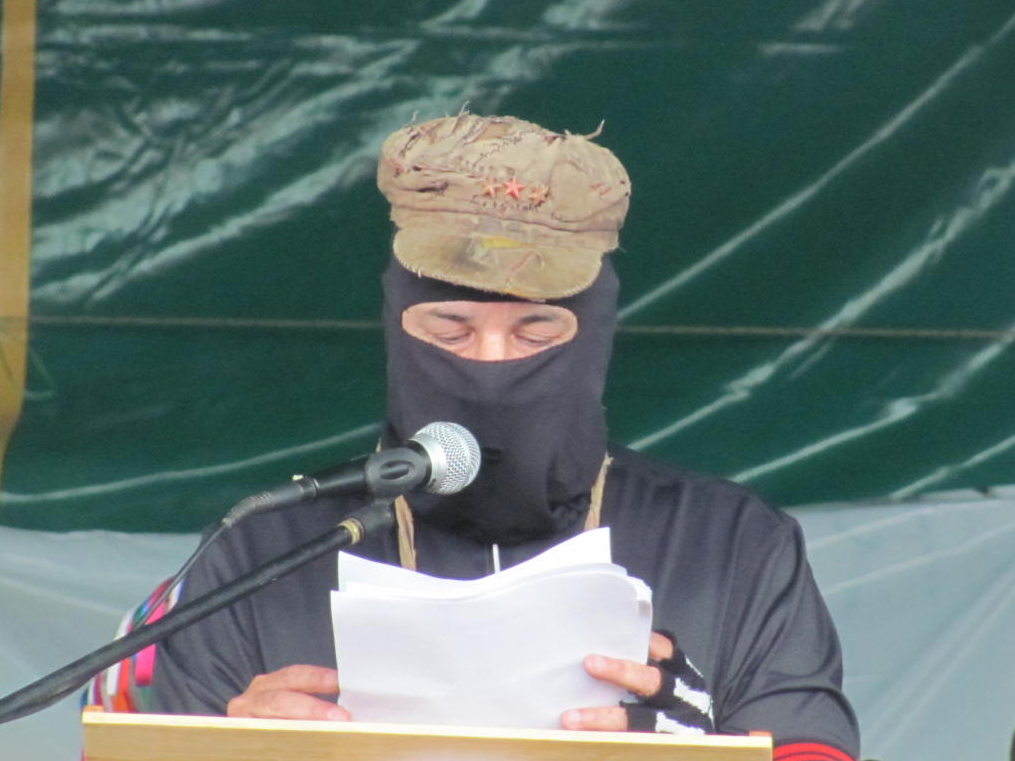
Las que ahora se harán públicas, son las palabras que el finado Subcomandante Insurgente Marcos había preparado para el homenaje a Don Luis Villoro Toranzo, mismo que se realizaría en Junio del 2014.
Suponía él que estarían presentes familiares de Don Luis, particularmente su hijo, Juan Villoro Ruiz, y su compañera, Fernanda Sylvia Navarro y Solares.
Días antes de que se celebrara el homenaje, fue asesinado nuestro compañero Galeano, maestro y autoridad autónoma, quien formó y forma parte de una generación de mujeres y hombres indígenas zapatistas que se forjó en la clandestinidad de la preparación, en el alzamiento, en la resistencia y en la rebeldía.
El dolor y la rabia que sentimos entonces y ahora se sumaron, en ese mayo de hace un año, al lamento por la muerte de Don Luis.
Listen here:
[podcast]https://radiozapatista.org/Audios/pensamiento/homenaje_sup-galeano1.mp3[/podcast]
ZAPATISTA ARMY FOR NATIONAL LIBERATION
MEXICO
May 2, 2015.
Introduction.
Good evening, good day, and good night to those who are listening and those who are reading, whatever your calendars or geographies may be.
What we will now read publicly are the words that the late Subcomandante Insurgente Marcos had prepared for the homage to Don Luis Villoro Toranzo in June of 2014.
He had imagined that the relatives of Don Luis would be present, specifically his son, Juan Villoro Ruiz, and his compañera, Fernanda Sylvia Navarro y Solares.
Days before this homage was to take place, our compañero Galeano was murdered. He was a teacher and autonomous authority who was and is part of the generation of indigenous Zapatista women and men forged in the clandestinity of our preparation, in the uprising, in resistance and in rebellion.
The pain and rage that we felt then and now over what happened that May one year ago, added to our sorrow over the death of Don Luis.
Se dieron así una serie de eventos, uno de los cuales fue la decisión de dar muerte a quien fuera hasta entonces el vocero y jefe militar del EZLN. La defunción del SupMarcos se concretó la madrugada del 25 de mayo del 2014.
Entre los pendientes, como decimos nosotros, nosotras, zapatistas, que dejó el finado supmarcos está un libro sobre política, comprometido con Don Pablo González Casanova a cambio de una caja de galletas pancrema, una serie de textos y dibujos inclasificables (varios de ellos se remontan a sus primeros días como insurgente del EZLN), y el texto de homenaje a Don Luis Villoro al que daré lectura en unos momentos.
-*-
Cuando, en la comandancia general del EZLN, con el subcomandante insurgente Moisés platicábamos sobre lo que sería este día antes y hoy, nos dábamos cuenta de que, al hacer el balance de una vida, juntábamos pedazos que no alcanzaban nunca a completarse.
Que siempre quedábamos con una imagen inconclusa, rota. Que lo que tenemos y teníamos, nos urgía a buscar y encontrar lo que faltaba.
“Falta lo que falta”, decimos obstinadamente las zapatistas, los zapatistas.
No con resignación, nunca con conformismo.
Sí para recordarnos que no está cabal la historia, que le faltan piezas, nombres, fechas, lugares, calendarios y geografías, vidas.
Que muertes y ausencias tenemos muchas, demasiadas.
Y que debíamos agrandar la memoria y el corazón para que no faltara ni una, sí, pero también para que no fueran inmovilizadas, para que fueran completadas una y otra vez en nuestro paso colectivo.
Así que imaginamos que este día, tarde, noche, madrugada siempre, bien podría ser un intercambio de piezas para seguir tratando de completar la vida de quien ustedes conocieron y conocen como el doctor Luis Villoro Toranzo, profesor de la Facultad de Filosofía y Letras de la UNAM, fundador del grupo Hiperion, discípulo de José Gaos, investigador del Instituto de Investigaciones Filosóficas, miembro del Colegio Nacional, presidente de la Asociación Filosófica de México, y miembro honorario de la Academia Mexicana de la Lengua. “Maestro, padre y compañero”, tal vez así diga su epitafio.
Hay compas, mujeres, hombres y otroas quienes tienen un lugar especial entre nosotros, nosotras, zapatistas del EZLN. No ha sido un regalo o un donativo. Ese lugar especial lo ganaron con un empeño y dedicación que está lejos de reflectores y templetes.
Por eso, cuando se marchan irremediablemente, no hacemos eco del ruido y el polvo que suelen levantarse con su muerte. Esperamos. Nuestra espera es así un homenaje silencioso, sordo. Como silenciosa y sorda fue su lucha a nuestro lado.
Dejamos entonces que el ruido se apague, que otra moda suceda a la que simula consternación y pena, que se asiente el polvo, que el silencio vuelva a ser sereno reposo para quien nos falta.
Tal vez porque respetamos esa vida ahora ausente, porque respetamos su tiempo y su modo. Y porque esperamos que, andando ya el calendario, su silencio tendrá lugar para escucharnos.
Para allá afuera, lo digo como señalando un hecho, no como reproche, el doctor Luis Villoro Toranzo fue un intelectual brillante, una persona sabia a la que tal vez sólo se le pueda reprochar la cercanía que en vida tuvo con los pueblos originarios de México, particularmente con aquellos que se alzaron en armas contra el olvido y que resisten más allá de modas y medios.
Para quienes no conocieron en vida al doctor Luis Villoro Toranzo, hay y, espero, habrá mesas redondas, reediciones, análisis en revistas especializadas y no.
Nuestra palabra de ahora no irá por esos caminos. No porque no conozcamos su obra histórica y filosófica, sino porque estamos aquí para cumplir un debe, saldar un pendiente, cumplir un encargo.
Porque ustedes, allá afuera, conocen a Luis Villoro Toranzo como un pensador brillante, pero nosotras, nosotros, zapatistas conocemos como…
¿Cómo?
Sabemos que tenemos sólo una de tantas piezas.
Y hemos venido aquí, a este homenaje, para entregarle a quienes compartieron y comparten sangre e historia con él, una pieza que, creemos, no sólo no tenían, sino que tal vez ni siquiera imaginaban.
La historia acá abajo, del lado zapatista, tiene muchos cuartos cegados. Compartimentos estancos en los que vidas diferentes se cumplen con aparente indiferencia, y en los que sólo la muerte derrumba los muros para que miremos y aprendamos de la vida que ahí transcurrió.
Y hagamos, ¿cómo decirlo?, ¿una permuta?, ¿un intercambio de lugares?
Al abrir el compartimento, al derribar el cuarto muro, al asomarnos dentro, hacemos un cambalache: esta muerte al museo, esta vida a la vida.
“Compartimentos estancos”, he dicho. Nuestro modo de lucha implica esta cuota de anonimato que, sólo para algunos de nosotros, es deseable. Pero tal vez después haya oportunidad de volver sobre esto.
Ya escucharán al Subcomandante Insurgente Moisés hablarles a nuestras compañeras y compañeros de las comunidades zapatistas una parte de lo que fue Don Luis Villoro Toranzo en nuestra lucha.
La inmensa mayoría de ellas y ellos no lo conocían, no lo conocieron. Y así como él, tenemos compañeras, compañeros y compañeroas de los que se ignora su existencia.
Este súbito saber que tuvimos compañeros y compañeras que ni siquiera sabíamos que existían, hasta que ya no existen, es algo que no es nuevo para nosotras, nosotros, zapatistas.
Tal vez es nuestro modo que, al nombrar la vida de quien falta, lo hacemos existir de otro modo.
Como si fuera nuestro modo de traer al colectivo al indígena zapatista Galeano antes, a Don Luis Villoro ahora.
Nuestro modo de apurarlos, de apremiarlos, de gritarles “¡Eh! ¡Nada de descanso!”, de traerlos de vuelta y que sigan en la lucha, la chamba, el jale, el trabajo, el camino, la vida.
Pero no es una vida la que les voy a relatar. Tampoco, es cierto, se trata de una muerte.
Es más, no les vengo a contar nada. Vengo a dibujarles un contorno, más o menos definido, más o menos nítido, de una pieza de un rompecabezas gigantesco, terrible, maravilloso.
Y lo que les voy a contar les sonará fantástico.
Tal vez mi hermano bajo protesta (bajo protesta de él), Juan Villoro, adivine después en mis palabras apenas una hebra de una madeja absurda y compleja, más cercana a la literatura que a la historia. Tal vez le sirva luego para completar ese libro que no sabe aún que escribirá.
Tal vez Fernanda intuya la irrupción de un concepto que parecía ausente, señalando un hueco cuya satisfacción daría un vuelco teórico a todo un pensamiento. Tal vez le sirva luego para iniciar la reflexión que ahora no sabe que emprenderá.
No lo sé. Tal vez él, ella, quienes no están, simplemente lo archiven en la carpeta de la “H”, de “homenaje”, de “herida”, de “humano”, de “Hidra”, de…
“Había una vez…”
Debo ser, por razones de seguridad, propositivamente impreciso en la geografía y el calendario, pero era madrugada y era el cuartel general del EZLN.
Tal vez una breve descripción de la comandancia general zapatista desilusione a más de uno, una, unoa.
No, no hay un mapa gigantesco con luces policromadas o alfileres de colores, cubriendo una de las paredes.
No, no hay modernos equipos de radiocomunicación con voces en muchas lenguas.
No hay un teléfono rojo.
No hay una moderna computadora con múltiples pantallas empeñadas en cifrar y descifrar la vertiginosa estática de la matrix cibernética.
Lo que hay es un par de mesas, dos o tres sillas, algunas tazas con restos de café frío, papeles mal arrugados, cenizas de tabaco, humo, mucho humo.
A veces hay también un tazón de palomitas rancias, pero sólo en caso de que se requiera un trueque con algún ser insólito.
Porque no lo van a creer, pero lo que en otros lados se llama “Juicio por Combate”, acá se llama “Atáscate que hay lodo”.
No me extenderé en este peculiar modo de resolver las disputas judiciales entre seres que están más que alejados de la jurisprudencia real o de ficción. Baste decir que el tazón con palomitas rancias tiene su razón de ser.
Puede haber, no siempre, es cierto, una computadora portátil y una impresora. No diré ni marcas ni modelos, baste decir que la computadora trabaja a base de insultos y amenazas, y que la impresora tiene un peculiar sentido del albedrío pues se niega a imprimir lo que no le parece digno de ir más allá de la pantalla.
Cierto, suele haber en la pantalla de esa computadora, invariablemente un procesador de textos y un escrito que no termina nunca por alcanzar el punto final…
¿Virus? Los únicos que pueden llegar a través del bejuco que le sirve para conectarse a uno de los túneles de la red. O sea arañas, o bichos que huyen de las susodichas mientras una lucecita parpadea alarmada.
Pero dejemos que la imaginación de cada quien complete el mobiliario.
Podría adornarme y decirles que esa madrugada estaba yo leyendo algún tratado de filosofía helénica, o las Fábulas de Higinio, o el tratado Sobre los Dioses de Apolodoro de Atenas, o Los Doze Trabajos de Hércules, sí, con “z”, de Enrique de Villena, el Astrólogo, pero no.
O podría decirles, y presumirme de moderno, diciéndoles que estaba yo, en la red alterna, tomando un curso en línea con un, una, unoa hacker anónimo. Iba a poner famoso, pero si es anónimo no puede ser famoso. ¿O sí? O tal vez es un colectivo organizado: “tú dale click al reload, tú oprime la tecla control, no, no toques la letra “z” porque se hace un desmadre y acabas chateando con un ser incomprensible en las montañas del sureste mexicano”. En fin, un nickname y un avatar, casi los equivalentes a un nombre de lucha y un pasamontañas, que, pacientes, explican los fundamentos de un terreno de lucha. Como en cada lengua nueva que se aprende, lo primero que hay que conocer son los insultos. Y así saber que “noob” es el equivalente a una mentada de madre.
O podría contarles, y reiterar el cliché, que estaba yo en una reñida multipartida de ajedrez interoceánico con el colectivo llamado “los Irregulares de Baker Street” asentado en la rubia Albión.
Pero no.
Lo que en realidad estaba yo haciendo es tratando de poner un punto final a un texto que lleva ya 20 años pendiente, pero…
Entonces apareció en el dintel de la puerta la posta, el guardia, el centinela, el vigía o como le quieran decir:
-“Sup, hay quien te quiere hablar”-, dijo lacónico después del saludo militar.
-¿Quién?- pregunté casi por trámite porque suponía que sería la insurgenta Erika con alguno de sus complicados acertijos de amores y esas cosas.
-“Un Don Luis, dice. Ya de edad él, de juicio”-, respondió el insurgente.
-¿Don Luis?, no conozco ningún Don Luis-, dije con enfado.
-Subcomandante – escuché su voz, y su figura se recortó en el umbral.
El guardia alcanzó a balbucear: “se metió sin avisar, le dije que esperara, no obedeció”,
“Ajá, no obedeció, como de por sí. Déjalo”, le dije al vigía y nos dimos un abrazo con Don Luis Villoro Toranzo, nacido en Barcelona, Cataluña, Estado Español, el 3 de noviembre del año 1922.
Le ofrecí una silla.
Don Luis se sentó, se quitó la boina y se frotó las manos sonriendo. Imagino que por el frío.
¿Dije ya que hacía frío esa madrugada?
Hacía de por sí, como de por sí cuando no hay una luz que entibie la sombra, como hoy. Es más, el frío mordía las mejillas como amante obseso.
Don Luis no parecía tomar nota de ello.
¿Hace frío en Barcelona?, le pregunté, un poco como saludo de bienvenida, otro poco para distraerlo mientras discretamente apagaba yo la computadora.
En fin, guardé la portátil, pedí café para 3 y volví a encender la pipa, rellena como estaba de tabaco usado y húmedo.
No recuerdo ahora si Don Luis respondió a la pregunta sobre el clima en Barcelona.
Sí que esperó pacientemente a que terminara yo de darme por vencido, y dejara de tratar de avivar las brazas de la cazueleja.
“¿No tendrá tabaco de casualidad?”, le pregunté anticipando con desilusión su negativa.
“No recuerdo”, dijo, y siguió sonriendo.
¿Se refería al frío en Barcelona o a si llevaba tabaco?
Pero no eran ésas las principales preguntas que se me acumulaban en la cazuela apagada de la pipa.
Antes de preguntarle al doctor en filosofía Luis Villoro Toranzo qué diablos hacía ahí, pues dejen les explico…
En esas fechas, el cuartel general del EZLN era el “Cama de Nubes”, nombrado así porque se encuentra en lo alto de una sierra y, fuera de los pocos días de la seca, se mantiene de continuo cubierto por nubes. Aunque de por sí la comandancia general es trashumante, a veces se aposenta ahí, aunque con más brevedad que las nubes.
“El Cama de Nubes”.
Llegar ahí no es fácil. Primero se deben cruzar potreros y acahuales. Malo si lluvia, malo si sol. Después de unas 2 horas de espinas e insultos, se llega al pie de la montaña. De ahí se eleva un estrecho sendero que faldea el contorno del cerro de modo que siempre hay un abismo a la derecha. No, no fueron consideraciones políticas las que decidieron ese trazo en espiral ascendente, sino el corte caprichoso de ese pico montañoso en mitad de la sierra. Aunque uno no paraba de subir hasta que estaba casi a las puertas de la champa de la comandancia general del ezetelene, se habían realizado algunas obras de ingeniería militar de modo que el puesto del vigía tuviera tiempo y distancia para un avistamiento oportuno.
De ahí, el caminamiento de acceso al cuartel era propositivamente difícil. A la rudeza de la montaña, habíamos agregado palotadas puntiagudas, zanjas y espinas, de modo que sólo era posible transitar por él de uno en uno.
Cuando yo era joven y bello, con carga promedio -digamos unos 15-20 kilogramos-, hacía yo unas 6 horas desde la base del cerro. Ahora que sólo soy bello, y sin carga, me toma de 8 a 9 horas.
Nuestro empecinado premodernismo y nuestro desprecio a las campañas electorales impiden que tengamos helipuertos en nuestras posiciones. Así que sólo se puede llegar caminando.
Con estas referencias, era lógico que la primera pregunta que aflorara fuera:
“¿Y cómo llegó hasta aquí Don Luis?”
Él respondió: “Caminando”, con la misma tranquilidad que si hubiera dicho “en taxi”.
Don Luis se veía completo, sin agitación visible, su boina intacta, su saco oscuro con apenas unas hebras de bejucos y ramas, su pantalón de pana apenas manchado y sólo en el bies, sus zapatos mocasines de una pieza. Todo completo. Si acaso había algo que notar era su barba de días y el evidente absurdo de su camisa clara, con el cuello almidonado abierto.
A mí esa subida me toma al menos 3 remiendos de la camisola, 4 del pantalón, un refuerzo en ambas botas, y un par de horas tratando de recuperar el aliento.
Pero Don Luis estaba ahí, sentado frente mío. Sonriendo. Aparte de un ligero arrebol en sus mejillas, se podría decir que, en efecto, se acababa de bajar de un taxi.
Pero no. Don Luis había respondido “caminando”, así que nada de taxi.
Estaba a punto de soltarme con una larga retahíla de reconvenciones sobre la salud, los calendarios hechos achaques, la imposibilidad de que, a su avanzada edad, tratara de hacer cosas absurdas, como subir una montaña y apersonarse, de madrugada, en la comandancia general del ezetaelene, pero algo me detuvo.
No, no fue el hecho incuestionable de que ahí se encontraba ya.
Fue que la sonrisa de Don Luis se había tornado nerviosa, inquieta, como cuando no se teme preguntar, sino tener respuestas.
Entonces hice la pregunta que habría de marcar esa madrugada:
“¿Y qué es lo que quiere Don Luis?”
“Quiero entrarme de zapatista”, respondió.
No había en su voz rastro alguno de burla, sarcasmo o ironía. Tampoco duda, temor, inseguridad.
Ya antes me he enfrentado a que un ciudadano o ciudadana declara así su intención, (aunque no con esas palabras, porque más bien lo suelen hacer con consignas incendiarias y frases rimbombantes donde hay mucha muerte y poco o nada de vida), aunque, claro, no pasan del potrero.
Me atraganté, y ni siquiera estaba encendida la pipa para fingir que era por el humo. Resignado ante la falta de tabaco seco, me limité a mordisquear la boquilla.
“Quiero entrarme de zapatista”, dijo. Don Luis había usado una expresión verbal más propia de la cotidianeidad en las comunidades zapatistas, que de la Academia Mexicana de la Lengua.
Seguí el protocolo en estos casos:
Le detallé las dificultades geográficas, temporales, físicas, ideológicas, políticas, económicas, sociales, históricas, climáticas, matemáticas, barométricas, biológicas, geométricas e interestelares.
A cada dificultad, la sonrisa de Don Luis perdía algo de nerviosismo y ganaba en seguridad y aplomo.
Al terminar la larga lista de inconvenientes, el rostro de Don Luis parecía haber recibido un asiento en el Colegio Nacional, en lugar del “NO” diplomático que le había endilgado.
“Estoy dispuesto”, dijo después del crujido del último pedazo sano de la boquilla de mi pipa.
Intenté disuadirlo mencionado los inconvenientes de la clandestinidad, el ocultarse, el anonimato.
“Además”, añadí con displicencia, “ya no hay pasamontañas”.
Era evidente que no estaba yo haciendo el mejor papel. Por más que me reacomodaba en la silla y movía nervioso los cosas sobre la mesa, no encontraba cuál era la explicación lógica al absurdo de la situación.
Don Luis se acomodó la boina sobre el plata de su rala cabellera.
Pensé que se iba a despedir pero, cuando me incorporaba para llamar a la guardia para que lo acompañara, dijo:
“Éste es mi pasamontaña”, dijo señalando su boina.
Cuando le argumenté que el pasamontañas debía ocultar el rostro de modo que sólo la mirada permaneciera, me refutó:
“¿No se puede ocultar el rostro sin cubrirlo?”
En ese momento agradecí dos cosas:
Una, que en el continuo mover las cosas sobre la mesa, había encontrado una bolsita de tabaco seco.
La otra, que la pregunta del doctor en filosofía Luis Villoro Toranzo, me daba tiempo para tratar de acomodar las piezas y entender de qué iba todo eso.
Así que, me resguardé detrás de las palabras para pensar mejor:
“Se puede, Don Luis, pero para lograrlo tiene que modificar como quien dice el entorno. Hacerse invisible es, entonces, no llamar la atención, ser uno más entre muchos. Por ejemplo, se puede ocultar a alguien que perdió el ojo derecho y usa un parche, haciendo que muchos usen un parche en el ojo derecho, o que alguien que llame la atención se ponga un parche en el ojo derecho. Todas las miradas irán sobre quien llama la atención, y los demás parches pasan a segundo plano. De ese modo, el tuerto real se vuelve invisible y puede moverse a sus anchas”.
“Dudo que usted pueda lograr que en el medio académico y universitario todos usen boina negra o que alguien que llame la atención poderosamente la use. Por ejemplo, si usted logra que Angelina Jolie y Brad Pitt usen boina negra, bueno, entonces sí, no se ofenda Don Luis, ni quien se fije en usted”.
“Además la boina remite más al Ché Guevara que a la filosofía idealista de la ciencia. Ya sabe usted, aunque es una selva, el instituto de investigaciones filosóficas no es precisamente un centro de subversión, que digamos”
“Pero”, interrumpió él, encajando sin dificultad el calambre, “otra forma de no llamar la atención, es decir, de pasar desapercibido, es no modificar la rutina, seguir vistiendo lo de costumbre. Al mirarme con la boina negra, no verán nada extraño. En cambio, si me pongo un pasamontañas, pues eso sería una modificación radical. Me verían. Llamaría la atención. Dirían “es el profesor Luis Villoro con pasamontañas, ha enloquecido, pobre, tal vez oculta alguna deformación reciente, o las huellas de la vejez, o la enfermedad, o un crimen inconfesable”. Y, mutatis mutando, si se deja de hacer algo rutinario o de costumbre, llama la atención. Por ejemplo, Subcomandante, si usted deja la pipa, llama la atención. Si se pone un parche en el ojo, otro ejemplo, se fijarán más y empezarán a especular si lo ha perdido o si lo tiene amoratado por un golpe”.
“Buen punto”, dije y discretamente tomé nota.
Don Luis continuó: “Si me pongo la boina, cualquiera que me vea no dirá nada, pensará que sigo siendo el mismo”.
Entonces, agregó como conclusión lógica:
“Y mi nombre de lucha va a ser “luis villoro toranzo”.
“Pero Don Luis”, rechacé, “si de por sí ése es su nombre”.
“Correcto”, dijo levantando el índice derecho. “Si me pongo ese nombre de lucha, nadie va a saber que soy zapatista. Todos pensarán que soy el filósofo Luis Villoro Toranzo”.
“¿No dijo usted que al cubrirse el rostro los zapatistas se mostraban?”
Asentí sabiendo a dónde iba.
“Ahí está, con la boina y el nombre me muestro, es decir, me oculto”.
“¿No era esa la paradoja?”
Hubiera dicho “Touché”, pero estaba tan desconcertado que mi francés quedó en el baúl de los olvidos.
El resto de la noche-madrugada la pasé argumentando en contra y él contra argumentando a favor.
Déjenme decirles que, hay que reconocerlo, su razonamiento lógico era impecable, y con gracia y buen humor sorteaba una y otra vez las trampas falaces con las que suelo hacer tropezar a los más renombrados intelectuales.
Sí, estoy siendo sarcástico, así que nadie se llame a ofensa.
El caso, o cosa, era que Don Luis Villoro Toranzo, aspirante a zapatista cuyo nombre de lucha sería “Luis Villoro Toranzo” y que, para ocultarse mejor, mejor se mostraría con una boina negra como pasamontañas, fue deshaciendo uno a uno los obstáculos y reparos que, con cierta necedad, le fui poniendo.
“La edad”, le dije como postrer argumento y casi desfalleciendo.
Él remató con: “Si mal no recuerdo, usted, subcomandante, alguna vez señaló que el límite era un segundo antes del postrer suspiro”.
La luz del amanecer ya delineaba los garabatos del horizonte cuando decidí asumir la mejor posición en estos casos: alegué demencia.
“Mire Don Luis, si por mí fuera, claro, sería un honor, claro, pero no a mí me corresponde, claro, aceptar o rechazar una solicitud de alta en el EZLN, claro. Yo soy, claro, digamos que el sinodal, claro, pero quien califica es otro, claro. Además de ahí sigue el responsable local, claro, el regional, claro, el comité, claro, la comandancia general del ejército zapatista de liberación nacional, claro. ¿Por qué mejor no se va usted a su casa y ya le avisaré cuando sepa algo”?
Pero… cuando estaba yo diciendo eso, entró a la comandancia general el otro indígena que nos completa a Moy y a mí.
“Ah”, dijo, “veo ya hablaste con él”
“Sí”, dije, “pero está necio en que quiere ser zapatista”.
“Bueno”, dijo el otro, “en realidad le estaba hablando al compa Luis Villoro Toranzo, no a ti”.
“Él ya había hablado conmigo, le dije que como quiera pasara contigo para que revisara sus argumentos”.
“Pero ya está: lo tengo ya dado de alta en la unidad especial. Ahora es para nosotros el colego Luis Villoro Toranzo”.
“Ya le expliqué que, por nuestro modo, le diremos sólo “Don Luis”, así que creo que sólo falta darle la bienvenida y asignarle su trabajo”.
El ya compañero zapatista Luis Villoro Toranzo se puso de pie y, con admirable prestancia, en posición de firmes saludó al oficial.
“¿Y cuál será el trabajo que se le asignará?” alcancé a preguntar en medio de la bruma de mi confusión.
“Pues el que le toca de por sí: la posta”, dijo el otro y se marchó.
Casi podría aventurar que Juan, Fernanda y quienes ahora me escuchan y me leerán después, han recibido estas palabras como una más de las fantásticas historias que pueblan las montañas del sureste mexicano, remontadas una y otra vez por escarabajos, niños y niñas irreverentes, fantasmas, gato-perros, lucecitas titilantes y otros absurdos.
Pero no. Es hora ya de que sepan que Don Luis Villoro Toranzo se dio de alta en el EZLN una madrugada de mayo, hará ya muchas lunas.
Su nombre de lucha fue “Luis Villoro Toranzo” y en la comandancia general del EZLN lo conocíamos como “Don Luis” por razones de brevedad y eficacia.
El lugar fue en el cuartel general “Cama de Nubes”, donde dejó guardada su camisola marrón para los regresos en los que incurrió varias veces antes de fallecer.
¿Qué más puedo decirles?
Cumplió a cabalidad su misión. Como centinela en uno de los puestos de guardia de la periferia zapatista estuvo atento a lo que ocurría, con el rabillo del ojo del pensamiento crítico se percató de cambios y movimientos que, para la inmensa mayoría de la intelectualidad autodenominada progresista, pasaron desapercibidos.
Producto de la alerta del caracol a su cargo, ustedes escucharán, y algunos más leerán, en estos días, las reflexiones que sobre esos cambios y movimientos hemos hecho.
UN REGALO AL ESTILO ZAPATISTA
Fue otra madrugada. Don Luis, el entonces Teniente Coronel y hoy Subcomandante Insurgente Moisés, y yo habíamos iniciado la plática como a las 1700 hora del frente de combate suroriental. Como a las 2100 el ahora SupMoy se disculpó porque tenía que retirarse a checar las posiciones circundantes.
El modo de debatir de Don Luis tenía su particularidad: donde otros manotean y alzan la voz, él sonríe con vaga ausencia. Donde otros argumentan consignas él dice un disparate -“Sólo por darse tiempo”, me decía a mí mismo.
Por lo regular esas pláticas semejaban a encuentros de esgrima. Aunque sobre decirlo, las más de las veces me vi derribado. Así sucedió cierta vez. Don Luis entonces río y soltó: “¡Derribado, pero no destruido!” Yo me reincorporé con palabras, haciéndole ver que sería mal visto que un filósofo neopositivista, cite, queriéndolo o no, la segunda carta del apóstol Pablo a los Corintos. Y él, sonriendo taimado, “y se vería peor que un jefe zapatista identificara la cita”. Entonces se puso de pie y recitó dramático: “Que estamos atribulados en todo, más no angustiados; en apuros, más no desesperados; perseguidos, más no desamparados; derribados, pero no destruidos” y luego dirigiéndose a mí: “y me extraña que no haya señalado que se trata del capítulo IV, versículos 8 y 9″.
Aún adolorido por la paliza argumentativa, repuse: “siempre he pensado que ese texto más parece comunicado zapatista describiendo la resistencia, que parte del Nuevo Testamento”.
“¡Ah! ¡la resistencia zapatista!”, exclamó con entusiasmo.
Y luego: “¿Sabe Subcomandante? Ustedes deberían abrir una escuela”.
“No una, muchas”, le dije.
Deben haber sido los años 2005-2006, años antes Don Luis se había dado de alta en nuestras filas y las Juntas de Buen Gobierno se empeñaban en las necesidades de salud y educación en las zonas, regiones y comunidades.
Don Luis precisó entonces: “No, no me refiero a esas escuelas. Claro, hay que abrir muchas de ellas, ni dudarlo. Yo hablo de una escuela zapatista. No una donde se enseñe zapatismo, sino una donde se muestre el zapatismo. Una donde no se impongan dogmas, sino que se cuestione, se pregunte, se obligue a pensar. Una cuyo lema sea “¿Y tú qué?”.
En realidad la idea de Don Luis no era original. Ya antes la habían esbozado, con enunciados distintos, Pablo González Casanova y Adolfo Gilly.
Pero nuestra idea no era ni es enseñar, tampoco “mostrar”. Sino provocar. El “¿y tú qué?” no buscaba recibir una respuesta, sino incitar una reflexión.
En fin, prosigo:
La discusión pasó a ser plática, de la misma forma en que un torrente alcanza una planada en su serpenteo y se convierte en un plácido fluir. Plácido, sí, pero imparable.
Ya era madrugada. La guardia nocturna nos avisó que Moy seguía ocupado y nos ofreció café. A mi mirada Don Luis respondió con un gesto afirmativo. No sé realmente si Don Luis tomaba café siquiera, siempre dejó su taza sin tocar. Entonces lo achaqué al calor de la plática. Ahora se me ocurre que nunca le pregunté siquiera si acostumbraba beberlo. Uno podría suponer, claro, filósofo, claro, “café” es para un filósofo como un apellido indeseable. O tal vez lo tomaba. Estamos en Chiapas, pues. Venir a Chiapas y no tomar café es… como ir a Sinaloa y no comer chilorio, como ir a Hamburgo y no zamparse una hamburguesa, como ir a La Realidad y no toparse con ídem.
El asunto es que, sin darnos apenas cuenta, estábamos hablando de regalos.
“Imagine cuál sería el regalo perfecto”, propuso.
“El más sorpresivo”, respondí sin pensar.
“No, el que no pudiera ser agradecido.”, reviró.
“O el que no fuera regalo”, contra ataqué.
“¿Cómo?”, preguntó intrigado.
“Como por ejemplo un enigma, o una pieza de rompecabezas. O sea, un regalo sin razón de ser. Si no hay una razón, aumenta la sorpresa”, dije.
“Cierto, pero para quien lo da, podría ser un regalo el no poder ser agradecido por el regalo”, dijo como para sí mismo.
Conforme se hacía más revuelta la argumentación lógica, más pensaba yo que Don Luis se estaba cansando. Pero no, estaba animado y tenía la mirada brillante, como si…
Me levanté y le toqué la frente. No dije nada, sólo me dirigí a la puerta y le avisé a la posta: “Que venga la compa de sanidad”.
Don Luis tenía fiebre. La insurgenta de sanidad recomendó antipirético, un baño de agua fría y mucho líquido. Don Luis no se opuso a nada. Pero en cuanto se retiró la compañera, me dijo “basta con un poco de descanso” y se durmió. 2 días estuvo así, apenas despertándose para comer e ir al baño.
Ya repuesto del todo, me dijo que debía retirarse, me recomendó que releyera sus informes de vigilancia y se despidió.
Antes de cruzar el dintel de la puerta, sin voltear a verme y más bien para sí, murmuró: “Eso, un regalo que no se pueda agradecer. Sería muy zapatista”. Se colocó la boina, me dijo algo más y se fue.
Ahora, a más de 12 lunas de su ausencia, puedo contar lo que me dijo al despedirse esa ya mañana, con el sol levantando luces y sombras.
“Compañero subcomandante insurgente marcos”, me dijo cuadrándose con notable vitalidad.
“Compañero Luis Villoro Toranzo”, le dije siguiendo mi vieja costumbre de indicar así que estaba listo para escuchar.
“Quiero pedirle algo”
No se me escapó el abandono de la informalidad, pero lo achaqué a su nueva profesión.
“No vaya usted a decir nada de esto a nadie más, por el momento”, demandó.
“Claro”, le dije, “entiendo. El secreto, la clandestinidad, eso, que la familia no sepa”
“No es eso”, me dijo.
“Quiero que lo diga después”
“¿Cuándo?”, le pregunté.
“Usted va a saber cuándo es el mejor momento. Para usar nuestro modo: “de por sí llegarán el calendario y la geografía”.
“¿Y por qué?”, le pregunté curioso.
“Es un regalo que quiero darle a mis hijos y a mi compañera”.
“Hombre Don Luis, no chingue, mejor regálele una corbata verde con motas rojas a Juan, a Miguel una roja con motas verdes, o viceversa; a su hija Renata un jarrón y a Carmen, un cenicero, o viceversa. Como quiera, como en toda buena familia, se van a pelear. A Fernanda un cuaderno de apuntes, de ésos de rayas. Son inútiles y horribles todos esos obsequios, pero lo que cuenta es la intención”.
Don Luis rio de buena gana. Ya más serio continuó:
“Cuénteles mi historia. O bueno, esta parte de mi historia. Entonces ellos y ellas entenderán que no me escondí de ellos. Sólo lo guardé como regalo. Porque el encanto de los regalos es que son una sorpresa. ¿No cree usted?”
“Dígales que les regalo este pedazo de mi vida. Dígales que se los oculté no como se esconde un crimen, sino como se guarda un regalo”.
“Mire Sup, muchas cosas se dirán de mi vida, algunas buenas, algunas malas. Pero esta parte, creo, les desarreglará todo, pero no con pena y dolor, sino con la alegre travesura de ese viento fresco que tanta falta nos hace cuando la pena de la ausencia y los grises de la seriedad, la formalidad y los nombramientos, se convierten en piedra y epitafio.”
“Está bien, Don Luis”, le dije, “pero no descarte lo de las corbatas, el jarrón, el cenicero y el cuaderno de apuntes”.
Se marchó sonriendo.
Así que Juan, Fernanda, familiares de Don Luis Villoro Toranzo, durante años guardé como secreto este pedazo del amplio rompecabezas que fue la vida de Don Luis.
No esa vez, sino después, cuando la rabia y el dolor nacían del cuerpo masacrado del compa maestro zapatista Galeano, fue que entendí el por qué de retener esa pieza de su vida.
No era que él se los ocultara porque le diera vergüenza, ni porque temiera que lo delataran con el enemigo de mil cabezas, o porque así evitara que trataran de disuadirlo.
Era porque quería darles este regalo.
Una pieza que provoca, que alienta, que agita, justo como su pensamiento hecho viento travieso en nosotros.
Una pieza más de la vida de Don Luis.
La pieza que se llamó Luis Villoro Toranzo, el zapatista del EZLN.
Cayó y calló en el cumplimiento de su deber, cubriendo la posición de centinela en este mundo absurdo, terrible y maravilloso que es el que nos empeñamos en construir.
Sé bien que dejó un legado de libros y brillante trayectoria intelectual.
Pero también me dejó estas palabras para que, hoy, yo se las dijera:
“Porque hay secretos que no avergüenzan, sino enorgullecen. Porque hay secretos que son regalos y no afrentas”
Ahora y sólo ahora, cuando les entrego estas hojas, podrán leer cómo se titula este texto en el que viene envuelto, con mis torpes palabras, la pieza del rompecabezas que se llamó:
“Luis Villoro Toranzo, el zapatista”.
Vale. Salud y reciban de todos y todas nosotros el abrazo que les dejó guardado con nosotros el compa zapatista Don Luis.
Desde las montañas del Sureste Mexicano, y ahora bajo tierra.
Subcomandante Insurgente Marcos.
México, 2 de mayo del 2014.
Hecho público el 2 de mayo del 2015.
A series of events then played out, one of which was the decision to put to death the person who had been the spokesperson and military leader of the EZLN. The death of SupMarcos was finalized in the early morning hours of May 25, 2014.
Among the things left pending, as we the Zapatistas tend to say, which the late Supmarcos left behind, is a book about politics, promised to Don Pablo González Casanova in exchange for a box of pancrema crackers [like Ritz]; a series of unclassifiable texts and drawings (several of them date back to his early days as an insurgent with the EZLN); and the text of the homage to Don Luis Villoro, which I will read in a few moments.
-*-
In the general command of the EZLN, with Subcomandante Insurgente Moisés, we talked about what this day would consist of, then and now, and we realized that upon taking stock of a life, we were bringing together pieces that would never form a complete whole.
We realized that were always left with an inconclusive, broken image. And that what we had and have urges us to seek and find what was missing.
“What is missing is merely missing” we the Zapatistas say stubbornly.
Not with resignation, never with conformity.
But to remind ourselves that history is not complete; we are missing pieces, names, dates, places, calendars, geographies, and lives.
That we have many deaths and absences, too many.
And that we must grow our memory and our heart so that none remain missing, yes, but also so that they not be immobilized but rather completed time and again in our collective step.
This is how we came to imagine this day, afternoon, night, and early morning, as an exchange of pieces seeking to complete the life of Dr. Luis Villoro Toranzo, whom you knew and know. He was a professor in the Philosophy and Letters Department of the UNAM, founder of the group Hiperion, disciple of José Gaos, researcher for the Institute of Philosophical Research, member of the Colegio Nacional, President of the Philosophical Association of Mexico, and honorary member of the Mexican Academy of Languages. “Teacher, father, and compañero”, perhaps his epitaph should read.
There are compas, women, men, and otroas that have a special place among us, the Zapatistas of the EZLN. This does not come by gift or donation. This special place was earned with a commitment and dedication that is far from spotlights and stages.
So when they inevitably go, we do not echo the noise and dust that tends to rise with their death. We wait. Our waiting is a silent and voiceless homage. Just as his struggle at our side was silent and mute.
We let the noise fade away, let another way emerge to replace that which simulates consternation and sorrow. We let the dust settle so that silence once again becomes the serene repose for the one who is gone.
Perhaps this is because we respect that life which is now absent, because we respect his time and way of being. And because we imagine that, going forward along the calendar, his silence will be a place from which to hear us.
Apart from this, and I mention this as a fact and not as a reproach, Dr. Luis Villoro Toranzo was a brilliant intellectual, a wise person whom perhaps can only be reproached for the closeness he had in life to the originary peoples of Mexico, specifically those who rose up in arms against oblivion and who maintain their resistance far beyond what’s in vogue or in the news.
For those who did not know Dr. Luis Villoro Toranzo in life, there are and I hope there will be, roundtable discussions, reprinted editions, and analyses in specialized and other journals.
Our word today will not go down those paths. Not because we don’t know his philosophical or historical work, but because we are here to honor a duty, settle a pending task, fulfill a responsibility.
Because you out there know Luis Villoro Toranzo as a brilliant thinker, but we Zapatistas, know him as…
How?
We know that we only have one of many pieces.
And we have come here to this homage, to give to those who shared and share with him blood and history, a piece that we believe they may not have known and perhaps may not have even imagined.
History from below, from the angle of the Zapatistas, has many blind quarters, watertight compartments in which different lives are lived with apparent indifference, and in which we only see and learn about the life that took place there when death crumbles the walls.
And so that we can make, how do you say it? An exchange? A trading of places?
Upon opening the compartment and toppling the fourth wall, upon finding ourselves inside, we make a swap: this death to the museum, this life to living.
“Watertight compartments,” I’ve said. Our way of struggle implies a quota of anonymity which is only desirable to some of us. But maybe later on there will be a chance to come back to this.
You will hear Subcomandante Insurgente Moisés speak to our compañeras and compañeros from the Zapatista communities about one aspect of what Don Luis Villoro Toranzo was to our struggle.
The great majority of them did not know him, had never meet him. And just like him, we have compañeras, compañeros and compañeroas whose existence is not known.
The sudden knowledge that we had compañeros and compañeras that we didn’t know existed until they no longer existed is not something new for us Zapatistas. Perhaps in our manner of doing things, naming the life that is missing is a way to bring it into existence in another form.
Just like it was our manner of doing things to bring the indigenous Zapatista Galeano to the collective then, and Don Luis Villoro now.
Our way of hurrying them, pressuring them, yelling to them, “Hey! No time to rest!” to bring them back so that they can stay in the fight, the task, the grind, the work, the path, life.
But it’s not a life I am going to tell you about. Neither is it about a death.
What’s more, I’m not here to tell you anything. I am here to draw you an outline, more or less defined, more or less clear, of a piece of a gigantic puzzle, both terrible and marvelous. And what I’m about to tell you will sound fantastical.
Perhaps my brother under protest (his), Juan Villoro, will later discover in my words a thread from an absurd and complex plot, one closer to literature than to history. Perhaps it will later help him complete that book that he doesn’t yet know that he will be writing.
Perhaps Fernanda will intuit a breakthrough concept that appeared elusive, filling a void which leads to the theoretical overturning of an entire line of thought. Perhaps it will later help her initiate the reflection that she does not yet know that she will undertake.
I don’t know. Perhaps he, she, and those who are not here, will simply archive this in the “H” folder, for “homage,” “hurt,” “human,” for “Hydra,” for…
“Once upon a time…”
I should, for security reasons, be intentionally imprecise about the geography and the calendar, but I can tell you that it was in the wee hours of the morning, and it was at the EZLN headquarters.
It may be that a brief description of the Zapatistas’ general command center may disappoint more than a few of you.
No, there is no giant map with multicolored lights or colored pins covering one of its walls.
No, there is no modern radio communication equipment with voices speaking in many languages.
There is no red telephone.
There is no modern computer with multiple monitors dedicated to encrypting and decrypting the dizzying static of the cybernetic matrix.
There is just a pair of tables, two or three chairs, a few cups with cold, leftover coffee, crumpled papers, tins of tobacco, and smoke, lots of smoke.
Sometimes there is also a stale bowl of popcorn, but that’s just in case we need to make a trade with some out of the ordinary being who pops in.
Because you may not believe it, but what in other places is called “Trial by Combat,” here we call “Go ahead and get stuck, that’s what all the mud is for.”
I’m not going to elaborate on this particular way of resolving legal disputes among beings who are so far removed from either real or fictional jurisprudence. Let’s just say that the bowl of stale popcorn is there for a reason.
We may, although certainly not always, have a laptop computer and a printer. I won’t mention the brand or the model, but suffice it to say that the computer functions through insults and threats, and the printer has a peculiar sense of agency, because it refuses to print that which it doesn’t see as worthy of moving beyond the screen.
True, on the computer screen there is invariably a word processor open and a piece of writing that never manages to reach his final point…
Viruses? Only the ones that manage to get through the reed that we use to connect to the network. That is to say, spiders, or the bugs fleeing said spiders, while a little light blinks frantically.
But we’ll leave it up to you to imagine what the rest of the furniture looks like.
I could make myself look good and tell you that on that morning I was reading some treatise of Greek Philosophy, or the Fabulae of Hyginus, or the treatise Apollodorus of Athens on the Gods, or The Twelve [Doze] Labors of Hercules (yes, with a ‘z’), by Enrique de Villena, the Astrologer,[i] but I wasn’t reading any of that.
Or I could tell you, and make myself seem all modern, that I was there in the deep web taking an online course with an anonymous hacker. I almost said a famous hacker, but if they are anonymous then they can’t be famous. Or can they? Or maybe it is an organized collective: “click the reload butten, press the control key, no, don’t touch the letter “z” because it will create a chaotic mess and you will end up chatting with an incomprehensible being in the mountains of southeastern Mexico.” In short, it’s a nickname and an avatar, something like a nom de guerre and a ski mask, that patiently explain the fundamentals of a terrain of struggle. And just like every time you learn a new language, the first thing you need to know are the insults. And that’s how you know that a calling someone “newbie” is insulting.
Or, I could tell you, and repeat the cliché, that I was in a multi-party, inter-oceanic, hard-core game of chess with a collective called “The Baker Street Irregulars,” located in that “speckled blonde” Albion.[ii]
But no.
What I was really doing was trying to finish the final point on a text that has been on hold for 20 years, but…
In the doorway appeared the posta, the guard, the sentinel, the lookout, or whatever you want to call him.
– “Sup, there is someone here who wants to talk to you”-, he said tersely after giving the military salute.
-“Who?” – I asked almost as a formality because I was already assuming that it was insurgenta Erika with one of her intricate riddles about love and that type of thing.
-“One Don Luis,” he said. “He is old and wise,”- responded the insurgent.
-“Don Luis? I don’t know any Don Luis,”- I said with annoyance.
-“Subcomandante,”- I heard his voice and saw his figure fill the doorway.
The guard managed to stammer: “He slipped in unannounced, I told him to wait, he didn’t follow instructions.”
“Ah, he didn’t follow instructions, typical. It’s ok,” I said to the guard and I exchanged a hug with Don Luis Villoro Toranzo, born in Barcelona, Catalonia, in the Spanish State, on November 3, 1922.
I offered him a chair.
Don Luis sat down, took of his beret and rubbed his hands together smiling. I assumed because of the cold.
Did I already say that it was cold that morning?
And it was cold, as it usually is when there is no sun to warm up the shade, like today. What’s more, the cold bit our cheeks like an obsessed lover.
Don Luis didn’t seem to notice.
“Does it get cold in Barcelona?” I asked, in part as a welcome greeting, and in part to distract him as I discreetly turned off the computer.
In the end, I put away the computer, requested coffee for three, and re-lit the pipe, already filled with moist and used tobacco.
I can’t remember now whether Don Luis responded to the question about the climate in Barcelona.
He did wait patiently for me to finish failing at what I was attempting to do, waiting for me to stop trying to relight the embers in the pipe.
“You don’t have tobacco by any chance?” I asked him, anticipating his answer with disappointment.
“I don’t remember,” he said, and continued smiling.
Was he answering about the cold in Barcelona or on whether he had any tobacco?
But these weren’t the main questions that accumulated in the snuffed out bowl of my pipe.
Before asking the doctor of philosophy Luis Villoro Toranzo what the hell he was doing there, well, let me explain…
At that time, the EZLN headquarters was in the “Bed of Clouds,” so named because it was located high up in a mountain and except for the few days of the dry season, it was always under cloud cover. Even though the general command itself is nomadic, sometimes it stays there awhile, although never for as long as the clouds do.
“The Bed of Clouds.”
Getting there isn’t easy. First you have to cross pastures and abandoned fields. It’s bad in the rain and bad in the sun. After two hours of thorns and insults, you arrive at the foot of the mountain. From there, a stretch of the trail rises up, skirting the steep hill such that there is always an abyss on your right. No, it wasn’t political considerations that decided this spiral ascent; it was the capricious shape of this mountainous peak in the middle of the mountain range. Even though you don’t stop climbing until you are almost at the doors of the hut of the general command of the eezeeelen, a few works of military engineering had been built such that the guard at their post would have the time and distance necessary to see people coming from far away.
From there, the kind of walking necessary to access the hut was intentionally difficult. To the harshness of the mountains, we added pointy stakes, ditches, and thorns, such that it was only possible to pass one at a time. When I was young and beautiful, and carrying an average weight–let’s say some 15-20 kg–, it took me about six hours to get there from the base of the mountain. Now that I am only beautiful, and without carrying anything, it takes me between eight and nine hours.
Our premodern roots and our contempt for electoral campaigns inhibit us from getting helicopters at our camps. So you can only get there by walking.
Given all of this, it is logical that the first question that came up was:
“And how did you get here Don Luis?”
He responded “By walking,” as calmly as if he had said “by taxi.”
Don Luis appeared to be well put-together, not visibly agitated, his beret intact, his dark bag had just a few strands of roots and twigs hanging off of it, his corduroy pants barely dirty and only in the creases, his moccasins were in one piece. Well put-together. If there was anything worth noting it was his several-days-old beard and the obvious absurdity of his clean shirt, with its starched open collar. For me, this climb takes at least three shirt mendings, four for my pants, a reinforcement of both boots, and a couple of hours trying to catch my breath.
But Don Luis was here, sitting in front of me. Smiling. Apart from a slight flush in his cheeks, you could have said that he had, in fact, just gotten out of a taxi.
But no. Don Luis’ response had been, “by walking,” so there had been no taxi.
I was about to let loose with a long list of reprimands about his health, the calendars having taken a toll on him, the impossibility that, at his advanced age, he should try to do such crazy things, like climb a mountain and present himself in the wee hours of the morning in the general command of the eezeeelen, but something stopped me. No, it wasn’t the incontrovertible fact that he was actually there.
It was that Don Luis’s smile had become nervous, restless, as if fearful not of asking questions but of having the answers.
And so I asked a question that would mark that dawn.
“And what is it that you want Don Luis?”
“I want to become a Zapatista,” he responded.
His voice did not hold a trace of mockery, sarcasm, or irony. Nor did it hold doubt, fear, or insecurity.
I had already seen city people declare their intention in this way (although not with those words, because they usually do so with incendiary slogans and bombastic language, a lot about death and little to nothing about life), although of course, they don’t get past the pasture.
I choked, and the pipe wasn’t even lit so that I could pretend it was because of the smoke. Resigned to the lack of dry tobacco, I had been merely nibbling on the mouthpiece.
“I want to become a Zapatista,” he had said. Don Luis had used an expression that was more a part of the daily life in Zapatista communities then it was part of Mexican Academy of Languages.
I followed the protocol for these cases:
I explained in detail the geographical, temporal, physical, ideological, political, economic, social, historical, climatic, mathematic, barometric, biological, geometric and interstellar challenges.
To each difficulty that I detailed, Don Luis’ smile lost some of its nervousness and gained security and composure.
By the time I got to the end of this long list of inconveniences, Don Luis was smiling as if he had gotten a seat in the Colegio Nacional, rather than the diplomatic “NO” that I was dishing out.
“I’m prepared,” he said, as I crunched down on the last solid bit of the mouthpiece of my pipe.
Trying to dissuade him, I explained the inconveniences of clandestinity, of hiding oneself, of anonymity.
“And,” I added dismissively, “we’re out of ski masks.”
It was clear that I wasn’t doing the best job. As much as I shifted in my chair and nervously moved things around the desk, I couldn’t figure out a logical explanation for the absurdity of the situation.
Don Luis adjusted the beret on his thinning silver hair.
I thought that he was about to say goodbye, but when I got ready to call the guard to accompany him he said:
“This is my ski mask,” pointing to his beret.
When I argued that a ski mask should cover the face so that only the eyes were showing, he disagreed:
“You can’t hide your face without covering it?” In that moment, I was grateful for two things:
One was that, in continually moving things around on the desk, I had found a little bag of dry tobacco.
The other was that the question from the doctor of philosophy Luis Villoro Toranzo had bought me time to try to arrange the pieces and understand what this was all about.
So, I hid myself behind some words in order to be able to think things through.
“You can, Don Luis, but to be able to do so you have to change, as they say, your surroundings. To make yourself invisible is, then, to not call attention to yourself, to simply be one more among many. For example, you can hide someone who has lost their right eye and wears a patch, by having everyone wear a patch over their right eye, or by having someone who gets a lot of attention put a patch over their right eye. Everyone will look at the person who gets a lot of attention and the rest of the patches will just become secondary. In this way, the one who really only has one eye becomes invisible and can move around easily.”
“I doubt that you could get everyone in the academic and university world to wear a black beret, or get someone very much in the limelight to use one. For example, if you got Angelina Jolie and Brad Pitt to wear a black beret, well, then sure, but don’t be offended Don Luis because nobody will notice you.”
“Anyway, the beret is more a referent for Ché Guevara than for the idealist philosophy of science. You already know, though it may be a jungle, the institute of philosophical research is not exactly a center of subversion, as we say.”
“But,” he interrupted, absorbing the shock without much difficulty, “another way to not call attention to oneself, that is to say, to go unnoticed, is to not change the routine, to continue dressing as usual. Seeing me in a black beret won’t seem strange to anyone. But, if I put on a ski mask, well that would be a radical change. People would look at me. It would attract attention. They would say, ‘It is professor Luis Villoro with a ski mask, he’s gone crazy, poor guy, maybe it’s covering up some recent deformity, or the signs of old age, or illness, or an unspeakable crime.” And mutatis mutando, if one stops doing something routine or customary, it attracts attention. For example, Subcomandante, if you stopped smoking a pipe, it would attract attention. If you put a patch on your eye, as another example, they would notice and start to speculate whether you had lost it or had a black eye from a punch.”
“Good point,” I said and discreetly took note. Don Luis continued: “If I wear the beret, anyone who looks at me won’t say a thing, they will think that I continue being the same.”
And so, he brought his argument to its logical conclusion: “And my nom de guerre will be ‘Luis Villoro Toranzo.’”
“But Don Luis,” I reproached him, “that is actually your name.”
“Correct,” he said, raising his right index finger. “If I take this nom de guerre, no one will know that I am a Zapatista. They will all think that I am the philosopher Luis Villoro Toranzo.
“Didn’t you say that the Zapatistas cover their faces in order to be seen?”
I sat down, now seeing where this was going.
“There you have it, with the beret and the name I show myself, that is to say, I hide myself.
“Is this not the paradox?”
I would have said “Touché,” but I was so disconcerted that my French got stuck in the trunk of forgetfulness.
I spent the rest of the night and early morning hours arguing against the idea while he argued in favor of it.
Let me say that, I had to admit that his logical reasoning was impeccable, and with grace and good humor he dodged one false trap after another of the kind with which I can usually trip up the most renowned intellections.
And yes, I am being sarcastic, just so nobody takes offence.
The case, or the thing was that Don Luis Villoro Toranzo, aspiring Zapatista whose nom de guerre would be “Luis Villoro Toranzo” and who better hid himself with a black beret than with a ski mask, was dismantling one after another of the obstacles and objections that, out of a certain necessity, I was putting up.
“Your age,” I lobbed at him the last argument that I had, nearly at the point of collapsing.
He knocked that one down with, “If I remember correctly, you, Subcomandante, once said that the last possible moment was one second before one takes their final breath.”
The light of dawn was already beginning to outline the edges of the horizon when I decided to assume the best position in cases like these: I pled insanity.
“Look Don Luis, if it were up to me, of course, it would be an honor, but it isn’t my decision, of course, to accept or reject a request to join the EZLN, of course. I am, of course, let’s say, the Synod, sure, but someone else has to approve the decision. After that, there is the local authority, and of course the regional one and of course the comité,[iii] and the general command of the Zapatista Army for National Liberation, of course. Why don’t you go home and I’ll just let you know as soon as I know something?
But… just as I was saying this, the other indigenous person who completes the trio of me and Moy came into the general command.
“Ah,” he said, “I see you already spoke to him.”
“Yes,” I said, “but this stubborn man over here wants to be a Zapatista.”
“Well,” he said, “I was actually talking to Luis Villoro Toranzo, not to you.
“He had already talked to me, and I told him that in any case he should go and talk to you to check out your arguments.
“But the deed is done: I have already registered him in the special unit. Now for us he is our colleague Luis Villoro Toranzo.
“I already told him that, as is our manner, we will call him only ‘Don Luis,’ so I think that all that is left to do is welcome him and assign him his work.”
And the already Zapatista compañero Luis Villoro Toranzo stood up and, with admirable poise, stood at attention and greeted the officer.
“And what work will we assign him?” I managed to ask in the midst of my confusion.
“Well, the one that he’s always had: the watchman,” said the other and left.
You could probably venture a guess that Juan, Fernanda, and those others who are listening to me now and who will read this later, have heard these words as just one more of the fantastic stories that populate the mountains of southeast Mexico, told over and over by beetles, irreverent little boys and girls, ghosts, cat-dogs, twinkling lights, and other absurdities.
But no. It is time that you knew that Don Luis Villoro Toranzo became part of the EZLN one early morning in May, many moons ago.
His nom de guerre was “Luis Villoro Toranzo” and in the general command of the EZLN we referred to him as “Don Luis” for brevity and efficiency.
It happened in the general headquarters “Bed of Clouds,” where he left his brown shirt for the many return visits that he made there before he died.
What more can I say?
He fully carried out his mission. As a sentinel in one of the guard posts on the Zapatista periphery, he was attentive to what happened; out of the corner of the eye of critical thought he was attentive to the changes and movements that, for the vast majority of the self-proclaimed progressive intellectuals, go unnoticed.
As a result of his responsibility for sounding the caracol, in the coming days you will hear, and a few more of you will read, the reflections we have made on these changes and movements.
A GIFT, ZAPATISTA STYLE
It was another morning. Don Luis, then-Lieutenant Colonel Moisés (now-Subcomandante Insurgente Moisés), and I had started talking around 1700 hours on the southeast battlefront. Around 2100 hours, SupMoy, as he is called now, excused himself to go check on the surrounding positions.
Don Luis had a particular way of debating: where others gesticulate and raise their voice, he would smile with a wandering absence. Where others argued with slogans, he would say something absurd “Just to give himself time,” I thought to myself.
These talks regularly resembled sword fighting encounters. It need not be mentioned that many of these times I was soundly defeated. And this is how it went down this time. Don Luis then laughed and belted: “Struck down but not destroyed!” I recuperated through words, telling him that it would look bad for a neopositivist philosopher to quote, whether intentionally or not, the second letter from the Apostle Paul to the Corinthians. And he responded, with a sly smile “And it would look even worse that a chief Zapatista could identify the quote.” Then he got to his feet and dramatically recited: “We are hard pressed on every side, but not crushed; perplexed, but not in despair; persecuted, but not abandoned; defeated, but not destroyed” and then he pointed at me: “And I find it strange that you haven’t pointed out that this is from Chapter 4, verses 8 and 9.”
Still sore from the argumentative beating, I responded: “I always thought that text seemed more like a Zapatista communique describing the resistance, than part of the New Testament.”
“Ah! Zapatista resistance!” he exclaimed with enthusiasm.
And later: “You know what Subcomandante? You all should open a school.”
“Not one, many,” I told him.
It must have been around 2005-2006. Years earlier Don Luis had joined our ranks, and the Good Government Councils were immersed in the health and educational needs of the zones, regions, and communities.
Don Luis then said: “No, I’m not referring to those schools. Of course there must be many of them, without a doubt. I’m talking about a Zapatista school. Not one where Zapatismo is taught but rather one where Zapatismo is shown. Not one where dogmas are imposed, but one where one questions, asks, where one is obligated to think. One whose slogan would be ‘And what about you?’”
Really, Don Luis’ idea was not original. Prior to this both Pablo González Casanova y Adolfo Gilly had sketched this out in different words.
But our idea is neither to teach nor to “show.” But rather to provoke. The “And what about you?” did not seek an answer, but rather sought to incite reflection.
Anyway, allow me to continue:
The discussion turned into a conversation in the same way that a flood reaches a flat plane in its meandering, and becomes a calm flow. Calm but unstoppable.
It was already early morning. The night guard informed us that Moy was still busy and he offered us coffee. When I looked to him, Don Luis responded with an affirmative gesture. I don’t really know if Don Luis even drank coffee, as his cup was always left untouched. I chalked it up to the heat of the conversation. Now I realize that I never once asked him if he even drank coffee. One could assume, of course, well, he’s a philosopher, of course, and “coffee” is to a philosopher like an undesirable surname. Or maybe he did drink it. Well, we are in Chiapas. Coming to Chiapas and not drinking the coffee is…. like going to Sinaloa and not eating the chilorio,[iv] like going to Hamburg and not trying a hamburger, like going to La Realidad and not coming across reality.
The point is that without even noticing, we started talking about gifts.
“Imagine what would be the perfect gift,” he said.
“The most surprising,” I responded without thinking.
“No, the one that you couldn’t thank someone for,” he responded.
“Or the one that is not a gift,” I counter attacked.
“How?” He asked intrigued.
“Like for example an enigma or a piece of a puzzle. That is, a gift that has no reason to be so. If there is no reason, the surprise grows,” I said.
“True, but for the giver of the gift, it could be a gift to not be able to be thanked for the gift,” he said to himself.
The more turns the logic of this argument took, the more I thought that Don Luis was getting tired. But no, he was animated and his face was bright, as if…
I got up and touched his forehead. I didn’t say anything, I just turned toward the door and instructed the guard: “Get the compa in charge of health.”
Don Luis had a fever. The insurgenta responsible for health matters recommended a fever-reducing medicine, a cold bath, and lots of liquids. Don Luis didn’t argue with any of this. But when the compañera left he said “All I need is a little bit of rest” and he fell asleep. He was like this for two days, only waking up to eat and to go to the bathroom. Once rested, he told me that he should get going and he recommended that I re-read his vigilance reports and he said goodbye.
Before crossing the threshold at the door, and without turning around to look at me, and more to himself, he murmured: “Yes, a gift you can’t be thanked for. This would be very Zapatista.” He put on his beret, said one more thing to me, and left.
Today, after more than 12 moons of his absence now, I can talk about what he said as he was leaving that morning, as the sun was raising light and shadow.
“Compañero Subcomandante Insurgente Marcos,” he said squaring himself toward me, with a notable vitality.
“Compañero Luis Villoro Toranzo,” I said following my habit of indicating that I was ready to listen.
“I want to ask you something.”
I noticed that he abandoned his usual informality, but I chalked this up to his new profession.
“Don’t go telling anyone about any of this, for the moment,” he demanded.
“Of course,” I said. “I understand. The secret; the clandestinity; the family shouldn’t know.”
“That’s not it,” he said.
“I want you to tell them, but later.”
“When?” I asked him.
“You’ll know when the time comes. To use our manner of talking: the calendar and the geography will come.”
“And why?” I asked him curiously.
“It is a gift that I want to give my children and my compañera.”
“Don Luis, man, don’t mess around, better to give a new green tie with red polka dots to Juan, one red with green polka dots to Miguel, or vice-versa; give your daughter Renata a vase, and Carmen, an ashtray, or vice-versa. Either way, like in all good families, they’ll fight it out amongst themselves. To Fernanda, a notebook, one of those with lines. All of these gifts are useless and horrible, but it’s the thought that counts.”
Don Luis laughed readily. Growing serious again, he went on:
“Tell them my story. I mean, this part of my story. That way, they will understand that I didn’t hide from them. I just saved it as a gift. Because the reason we like gifts is because they are a surprise… Don’t you think?
“Tell them that I am giving them this piece of my life. Tell them that I kept it from them, not as one hides a crime, but as one hides a gift.
“Look Sup, many things will be said about my life, some good, some bad. This part I think will change everything, not with sorrow and pain, but with that happy mischief of a fresh wind that we need so desperately when the sorrow of absence and the greys of seriousness, formality and namings turn into rock and epitaph.”
“Okay, Don Luis,” I told him, “But don’t give up on the ties, the vase, the ashtray, and the notebook.”
He walked away smiling.
So, Juan, Fernanda and other members of Don Luis Villoro Toranzo’s family, for years I have kept this piece of the extended puzzle that was the life of Don Luis.
Not then, but only later, after the rage and pain arose from the massacred body of the compa and Zapatista teacher Galeano, did I understand why he held back this piece of his life.
It is not that he hid it because he was embarrassed, or because he was scared of being denounced to the enemy of a thousand heads, or in order to avoid having others try to dissuade him.
It was because he wanted to give you this gift.
A piece that provokes, that nourishes, that agitates, like his thought turned into a mischievous wind within us.
One more piece of Don Luis’ life.
The piece that was named Luis Villoro Toranzo, a Zapatista in the EZLN.
He fell, and fell silent, in the line of duty, carrying out his task of sentinel in this absurd, terrible, and marvelous world that we endeavor to create.
I know that he left a legacy of books and a brilliant intellectual trajectory.
But he also left me with these words so that today, I could say them:
“Because there are secrets that don’t embarrass, but rather fill us with pride. Because there are secrets that are gifts and not insults.”
Now and only now, as I give you these pages, can you read the title of this text in which my clumsy words wrap around the piece of the puzzle named:
“Luis Villoro Toranzo, Zapatista”.
Vale. Cheers and accept this embrace from all of us that compa Zapatista Don Luis left saved with us.
From the mountains of the Mexican Southeast, and now from underground.
Subcomandante Insurgente Marcos.
Mexico, May 2, 2014.
Made public May 2, 2015.
[i] Villena’s work “Los Doze Trabajos de Hércules” was written in Medieval Spanish, thus the “Doze” and not the contemporary Spanish form of “Doce.”
[ii] Both the “The Baker Street Irregulars” and the “Speckled Blonde” are fictional characters that appear in Arthur Conan Doyle’s Sherlock Holmes stories. “Albion” was frequently use by Doyle as the location of these stories and it is also the oldest known name for England.
[iii] The Indigenous Revolutionary Clandestine Committee.
[iv] Slow-cooked carnitas made with ancho chile sauce.

