
Palabras del Subcomandante Insurgente Moisés. Seminario “El Pensamiento Crítico frente a la Hidra Capitalista”, 6 de mayo de 2015Resistance and Rebellion I. Subcomandante Insurgente Moisés. May 6, 2015
Palabras del Subcomandante Insurgente Moisés
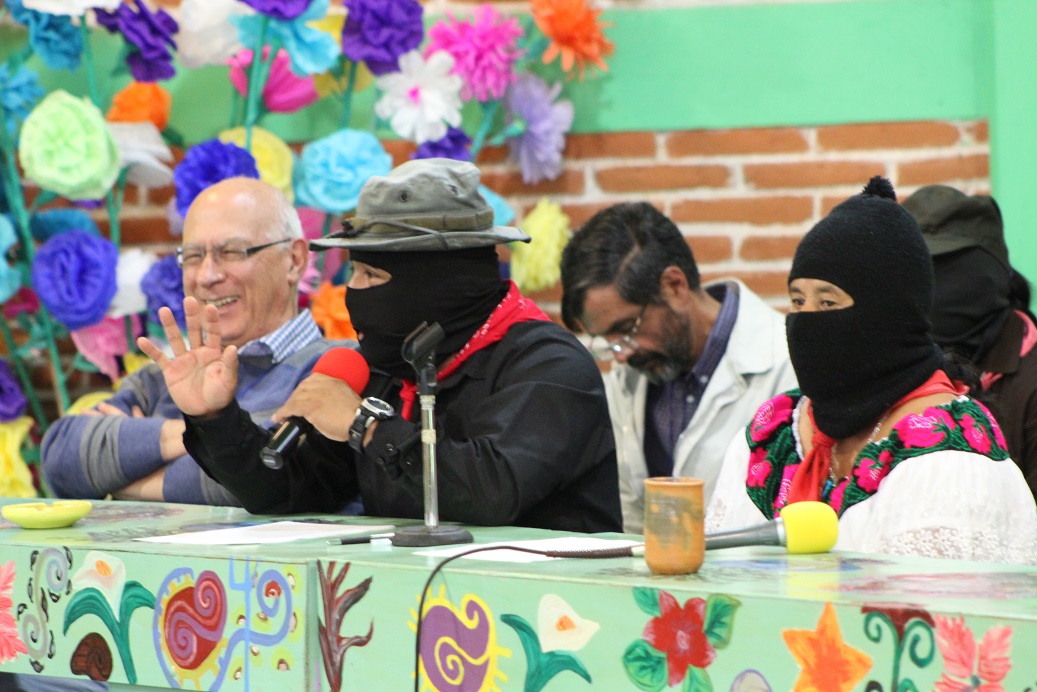
Escucha aquí: [podcast]https://radiozapatista.org/Audios/pensamiento/6mayo_sup-moises.mp3[/podcast]
6 de mayo de 2015
Buenas tardes, compañeros, compañeras, hermanos y hermanas.
Les voy a compartir sobre el cómo es que nosotros, nosotras, la tenemos como nuestras armas la resistencia y la rebeldía.
Antes de empezar eso, el cómo es que hacemos la resistencia y la rebeldía, les quiero recordarles que nosotros somos armados. Ahí tenemos nuestras armas, como una herramienta más en la lucha, así lo decimos ahora. Nuestras armas es una herramienta de lucha, es como machete, hacha, martillo, pico, pala, azadones, esas cosas; porque cada herramienta tiene su función, pero el arma, su función es, si las usas, es que matas.
Listen here: [podcast]https://radiozapatista.org/Audios/pensamiento/6mayo_sup-moises.mp3[/podcast]
Words of Subcomandante Insurgente Moisés
May 6, 2015
Good afternoon, compañeros, compañeras, brothers and sisters.
I am going to talk to you about how our resistance and rebellion are our weapons.
Before we begin talking about resistance and rebellion, I want to remind you that we are an armed group. We have our weapons, as one more tool in the struggle, that’s how we explain it now. Our weapons are a tool of struggle, just like the machete, axe, hammer, pick, shovel, hoe, and other such things. Each of these tools has its function, but the function of a weapon, well, if you use it, you kill.
So in the beginning, when we rose up at the dawn of the year 1994, a movement of thousands of Mexicans from all over the country emerged, grew to millions, and pressured the government, the baldy—that’s what we call him, Salinas the baldy—to sit down and dialogue with us, and at the same time urged us to sit down to dialogue and negotiate.
We understood the call of the people of Mexico. So we gave the order to retreat from violent struggle. It was then that we discovered, through the compañeras—because in combat our people died—but the compañeras were developing what we might call another way to struggle. Because the government, a month later, a year, two years later, wanted to buy us off, as we put it, they wanted us to accept aid and forget about struggle.
Entonces al principio cuando salimos en el amanecer del año 1994 salió el movimiento de miles de mexicanos y mexicanas, en todas partes, donde salen hasta que se convirtió a millones, donde presionan al gobierno, al pelón, le decimos nosotros, el pelón de Salinas, que tiene que sentarse a dialogar a nosotros; y a la vez también a nosotros nos están diciendo que tenemos que dialogar y negociar.
Bueno, entonces lo entendimos pues, la voz del pueblo de México. Entonces se dio la orden de que tenemos que replegarnos en la lucha violenta; entonces descubrimos, por parte de las compañeras, porque tuvimos nuestros muertos en el combate, que esas compañeras empezaron a dar otra forma de pelear, digamos así. Porque entonces el gobierno, meses, un año, dos años después, nos quieren comprar, como decimos, quieren que nosotros recibamos para que nos olvidamos de la lucha.
Entonces muchas compañeras hablaron y dijeron de que por qué y para qué murieron los compañeros en el amanecer del 94. Así como ellos, ellas, o sea los combatientes salimos a pelear contra el enemigo, entonces tenemos que ver como enemigo también el que nos quiere comprar, o sea que no recibir eso, lo que quieren dar.
Entonces así empezó. Nos costó mucho porque no podíamos hacer los contactos de zonas a otras zonas porque se llenó de militares, entonces poco a poco fuimos haciendo los contactos con los compañeros de una zona a otra zona para empezar a pasar esa voz que empezaron a decir las compañeras, que no hay que recibir lo que da el mal gobierno, que así como los combatientes salieron a pelear en contra de los enemigos que nos explota, así tenemos que hacer también como bases en que no hay que recibir eso. Entonces así, poco a poco, fue extendiéndose en todas las zonas.
Ya ahorita ya podemos dar varios sentidos lo que es rebeldía y resistencia para nosotros, porque es que ya fuimos descubriendo, practicando en los hechos, o sea ya podemos dar teoría, como se dice. Para nosotros resistencia es ponerse fuerte, duro, para dar respuesta a todo, cualquiera de los ataques del enemigo, del sistema; y rebelde es ser bravos, bravas para igual responder o para hacer las acciones, según la que convenga, ser bravas, bravos para hacer las acciones o lo que necesitamos hacer.
Entonces la resistencia descubrimos que no es nada más resistir a tu enemigo, de no recibir lo que da, las limosnas o sobrantes. Descubrimos que la resistencia, hay que resistir las amenazas o provocaciones que hace el enemigo, hasta por ejemplo, los ruidos de los helicópteros; sólo nada más con el ruido de los helicópteros empiezas a tener miedo, porque la cabeza te avisa que te va a matar, entonces sales corriendo y es ahí donde te ven, y es ahí donde ya te ametrallan. Entonces es no tenerle miedo, hay que tener resistencia, o sea tienes que ponerte fuerte de que no corras cuando escuchas el ruido. De por sí el pinche ruidero del helicóptero da miedo, te espanta, y es nada más no tenerle miedo, quedarte quieto, quieta.
Descubrimos eso, que no sólo es la de no recibir. Nuestra rabia, nuestro coraje contra el sistema también tenemos que resistirla, y lo difícil o lo bueno, difícil y bueno al mismo tiempo, es que esa resistencia y rebeldía hay que organizarla. ¿Y cuál es lo difícil? Es que somos miles los que usamos esa arma de resistencia y somos miles también que se puede convertir la rabia, entonces, cómo controlar eso, cómo usar al mismo tiempo para hacer la lucha, son dos cosas difíciles, por eso empecé diciendo que ahí tenemos nuestras armas.
Pero lo que hemos visto es que la resistencia sabiéndola organizarla y teniendo organización primero, por supuesto, no puede haber así nada más resistencia y rebeldía si no hay organización, entonces organizar esas dos armas de lucha nos ayudó mucho para tener, digamos que se abre más la mente, la forma de ver.
Recuerdo de una asamblea de compañeros y compañeras, de qué forma, porque es que se hace con trabajo político, ideológico, mucha plática, mucha orientación a los pueblos sobre la resistencia y la rebeldía. Entonces recuerdo que los compañeros y compañeras ponen en la balanza, esa que se dice la lucha política pacífica y la lucha violenta. Entonces algunos de nuestros compañeros, compañeras, dicen: ¿qué les pasó a nuestros hermanos de Guatemala? –nos hacemos la pregunta– 30 años de lucha violenta y qué cosa hay lo que tienen ahora nuestros hermanos.
¿Por qué tenemos que organizar bien la resistencia en la lucha política pacífica? ¿Por qué tenemos que preparar nuestra resistencia militar? ¿Cuál es la que nos conviene?
Entonces nos damos cuenta ahí que lo que queremos es la vida, como lo que decíamos antes de la sociedad civil mexicana, que esa movilización que hicieron el 12 de enero de 94 es que quieren nuestra vida, que no nos muriéramos. ¿Entonces cómo tenemos que hacer eso? ¿Qué cosa tenemos que hacer más para hacer la resistencia y la rebeldía?
Es ahí donde descubrimos que hay que resistir sobre las burlas que nos vaya a hacer la gente sobre nuestro gobernar, nuestra autonomía. Hay que resistir las provocaciones del ejército y la policía. Hay que resistir los problemas que vayan a causar las organizaciones sociales. Hay que resistir todas las informaciones que salgan en los medios, de eso que dicen que los zapatistas ya se acabaron, ya no tienen fuerza, en este caso, que el finado Marcos que ya está negociando bajo la mesa con Calderón, o que está dándole paga para su salud el Calderón porque ya se va a morir, bueno, ya está muerto ya, murió de por sí (inaudible), pero no porque él se fue a (inaudible) al Calderón, sino por darle vida a otro compañero.
Bueno todos esos bombardeos psicológicos, podemos decir, para que entonces se desmoralicen nuestras bases, un montón de cosas que hay que resistir.
Luego descubrimos la resistencia a todos nosotros, porque empezamos a tener varios trabajos, responsabilidades, pues en este caso a nosotros hay problemas en la casa, no sé ustedes a lo mejor no, entonces surgen los problemas y la resistencia se empieza a aplicar individualmente, y al mismo tiempo la resistencia se aplica colectivamente.
Cuando hacemos individualmente es cuando pues mi papá, mi mamá o mi mujer ‘¿dónde estás?, ¿qué estás haciendo?, ¿con quién andas?’, etcétera, ¿no? Entonces uno tiene que resistir de que no vaya a hacer nada mal que pega a la mujer o abandona su trabajo, porque luego hay reclamos, que no hay maíz, que no hay frijol, que no está la leña, y hay problemas con los hijos. Es ahí donde se individualiza la resistencia.
Cuando se hace en colectivo la resistencia es que es con disciplina, es decir, con acuerdo. Es que nos ponemos de acuerdo cómo le vamos a hacer para enfrentar algunos problemas. Por ejemplo, les voy a dar un ejemplo reciente. Hace cosa de… pues creo el mes de febrero, un grupo de personas con otro grupo de un terreno recuperado que ahí está viviendo esa gente que no son zapatistas, que no les estamos diciendo nada, pero ellos tienen la idea de que quieren ser dueños de la tierra, entonces están gestionando la tierra para que se legalice.
Entonces se ve de que el señor Velasco les está diciendo que se necesita cierta cantidad de personas, entonces esas personas empiezan a buscar en otros lados más miembros del pueblo, entonces esos miembros ahora sí empezaron a llegar armados. Llegaron a ser 58 personas, entonces empezaron a invadir el terreno de los compas, la tierra recuperada. Entonces los compas no lo vamos a dejar.
– ¿Cuántos son?
– Pues son cerca de 60.
– Basta que llevamos 600 armas y lo acabamos, porque es que tantas burlas que ya hicieron.
El potrero de los compañeros se metieron ese líquido para quemar, con el líquido mataron a un semental, destruyeron casas de los compañeros antes. Entonces los compas ya estaban así rebeldes, bravos, ya no quieren más la maldad que hacen. Entonces es cuando intervienen los compas así:
– Recuerden, compas, nosotros somos un colectivo.
Y le dicen a los compañeros, los 600 que se reunieron:
– Acuérdense de la naranja, ¿qué hemos dicho cuando una fruta se pica?, ¿qué pasa?
– Ah sí. ¿Sí, pero entonces esos cabrones acaso lo entienden así?
– Esos cabrones no nos van a imponer su tiempo de esos cabrones, sino era de nosotros.
¿Qué es lo que pasa a una naranja o una lima si lo picamos? Es que se pudre todo, ¿y en este caso qué quiere decir? Que lo vamos a afectar al resto de nuestra organización. Tenemos que preguntarle a la base si es que entonces vamos a dar respuestas violentas, entonces ya que sepan nuestras bases que vamos a entrar en otro modo. Entonces como ya veníamos pensando de por sí esto, lo que estamos llevando a cabo ahora, lo que estamos haciendo ahorita, entonces nuestras bases no permiten que se haga así.
Entonces, lo que se les dijo a los compas es que los que están muy rebeldes, bravos, encabronados, no van a ir, sólo dejen dicho nada más con sus representantes que no se van a ir porque si van, van a matar, entonces mejor no se van, digan a su responsable y que ya se sepa, y el que no se reporta es su problema de él. También los que tienen mucho miedo, tampoco se vayan. Sólo los que entienden hay que ir, no va a ir a provocar, sino va a ir a trabajar la tierra, o sea a trabajar la milpa, la casa y lo que se tiene que construir. Amaneciendo, los 600 se fueron, lo dejaron sus armas. Se coordinaron quién va a controlar.
Entonces es como se hace el control de las dos cosas, la rabia pero también el miedo. Se busca, se da explicación, se da plática, se da de entender, porque es verdad, que no van a permitir eso la gran mayoría de los compañeros.
Esa resistencia a lo largo ya de 20 años que venimos trabajando, al principio nos costó mucho porque son situaciones que nos enfrentamos y que tenemos que saber solucionar. Les voy a dar un ejemplo, ¿cómo es que nos cuesta cambiarlo? Cuando estaba en su gobierno de Salinas entonces daban los proyectos, daban proyectos en efectivo, o sea daban crédito, entonces recibían los compas, entonces imagínense pues que ya son milicianos, cabos, sargentos, o sea zapatistas. Entonces esto lo que está dando este cabrón la mitad se va para las balas, el arma y el equipo, y la otra mitad es que vamos a comprar la vaca, o sea de lo mismo que dio el gobierno se consiguió una vaca, por eso ya el gobierno después ya no dio, nomás les dio a los hermanos partidistas.
Entonces los compas tenían esa idea, por eso estoy diciendo, entonces cuando salió eso empezamos a planificar eso de ya no recibir. Nos costó mucho, pero sí lo entendieron los compas. Dijeron los compas, bueno, sí lo vamos a hacer, vamos a hacer esa resistencia. Entonces el negativo donde nos da el resultado es que cuando nos vamos a reunir, entonces dicen ‘yo no pude llegar porque yo estoy en resistencia, no tengo dinero, no tengo para mi pasaje’, eso es el pretexto, no es porque no, sino es para taparse, es un pretexto.
Pero como fuimos agarrando en serio eso de no agarrar nada del sistema, entonces descubrimos de que tenemos que darle duro al trabajo de la madre tierra, eso ya les conté estos días que hemos estado acá. Es ahí donde empezaron a tener sus productos los compañeros y se dieron cuenta los compas de que más vale trabajar la tierra y así nos olvidamos de lo que da el gobierno.
Entonces en la resistencia y la rebeldía nos empezamos a darnos cuenta de la seguridad a la organización en que estamos. Entonces se empezó a descubrir un montón de cosas, por ejemplo eso que les digo, que no hablamos con el gobierno, ni nuestras bases, ni aún haya asesinatos. Descubrimos que con resistencia y con rebeldía podemos gobernarse y que con resistencia y con rebeldía podemos desarrollar nuestras propias iniciativas.
Nuestra resistencia de hacer las cosas, ya sea en el terreno económico, ya sea en el terreno ideológico, político, cada quién la zona organiza. Unos tienen más posibilidades, otros tienen menos posibilidades, entonces vamos haciendo experimento. Por ejemplo, los compañeros de Los Altos durante sus vidas ellos están comprando el maíz, siembran pero muy poco, la gran parte tienen que comprar; y en otras zonas lo que hacen es llevar el maíz, en vez de que compran en almacén, en la bodega del gobierno, y que su dinerito de los compas de Los Altos se va en el gobierno, entonces mejor que se vaya en otro caracol. Entonces algunas veces nos ha salido bien, otras veces nos ha salido mal, pero es el mal que nosotros mismos lo producimos, porque sí, es que se lleva por tonelada, entonces los compañeros encargados de juntar el maíz no lo revisan y los compas bases de apoyo, así de cabrones, meten en medio el (inaudible) del maíz, y ya los otros compas tampoco lo revisan, entonces pasa, se va. Ya cuando llega a su destino donde se va a consumir entonces ahí sí lo revisan bien, y es ahí donde les caen que están vendiendo maíz (inaudible) entre compas, a los compas pues.
Entonces vamos corrigiendo eso, de que no se trata de eso. Si estamos en resistencia es organizar bien la resistencia. El intercambio, como se dice, o el trueque no funcionó para nosotros, porque en Los Altos no podemos llevarlo toneladas de pera o manzana, no se vende en la selva, que es lo que producen mucho los compas, verdura. Entonces no, estamos viendo cómo lo vamos a hacer, ya estamos discutiéndola, que casi vamos a la mitad sobre eso de cómo organizarlo.
Les voy a empezar a dar una serie de ejemplos. En el año 98, que es cuando desmantelaron nuestros municipios autónomos, cuando estaba todavía el Croquetas, el Albores de gobernador, en Tierra y Libertad, allá por el Caracol I, en la Realidad, entraron los judiciales, destruyeron la casa del municipio autónomo y los compañeros milicianos sobre todo, estaban pidiendo de que entonces le van a darle a los judiciales, realmente son soldados, estaban disfrazados de judiciales, y se les dijo no. Acudimos a las bases de apoyo, porque son los compas milicianos que estaban con la rabia, de que para qué nos están destruyendo nuestra casa en la autonomía.
Entonces acudimos a los pueblos, y los pueblos dicen: que lo destruyan, la autonomía la tenemos aquí y la tenemos aquí, la casa no es casa. Entonces recibimos apoyo y con más razón se da la orden de que no pueden hacer nada los milicianos, y nosotros pagamos el costo de la rabia, entonces nuestros milicianos decían ‘pinches mandos’. Entonces esas cosas empezamos a descubrir que a veces el coraje de la base, y que se ve que no nos va a ayudar a lo que se quiere hacer, entonces a veces paga el comité clandestino, o el regional, a los que tienen responsabilidad.
Otro ejemplo está cuando nos destruyeron nuestro primer Aguascalientes, el ejército. Es lo mismo, nosotros estábamos puestos, insurgentes y milicianos, porque sabíamos que como que si te quitan una parte sientes que ya estás derrotado, es que lo pensamos muy militarmente. Porque militarmente si es que pierdes una batalla ya te chingaste y te da gana de volver a recuperar, pero tienes que hacer el doble para que recuperes. Entonces otra vez eso nos orienta.
– ¿Qué es lo que queremos, la muerte o la vida?
– Pues la vida.
– Entonces que entren estos cabrones, no lo vamos a matar pero tampoco nos matan.
– ¿Entonces cómo vamos a hacerlo si ya están tendidas las emboscadas?
– Pues hay que mandar la comunicación.
Entonces tuvimos que levantar y así lo evitamos mucha muerte, por parte de nosotros y también por parte del enemigo. En una de las emboscadas sí se dio la (inaudible), y es ahí donde cayó, luego lo (inaudible), al general que cayó en Momón, el general Monterola, era Coronel creo, en ese tiempo.
Y así pasó también en el Caracol de la Garrucha cuando hubo la desmantelación de los municipios autónomos, sobre el municipio autónomo Ricardo Flores Magón. Lo mismo, se manda decir de que no se tiene que dar respuesta a la violencia que querían el enemigo y el gobierno.Y así la hemos pasado tantas provocaciones que buscan los que se dejan manipularse, en este caso de los partidistas.
Eso le ha pasado a los compañeros los que han recibido mucho esos golpes, búsqueda de provocaciones, son los compañeros del caracol de Morelia, el de Oventik, de Garrucha y Roberto Barrios, donde han actuado muy cruel los paramilitares es en Roberto Barrios y en Garrucha, en Morelia, en Oventik.
Por ejemplo, en San Marcos Avilés, donde están nuestras bases, tantas veces que han molestado. Lo que hacen los paramilitares es lo obligan a que caiga, se ve que está bien entrenado por parte del ejército y del gobierno, porque es que te fastidia; está llevando tu café, tu frijol, tu maíz, te arrancan las plantas que siembras, tumban el platanal, llevan la piña que siembras, o sea te fastidian. Hasta que un día ya nuestras bases dijeron ya, y lo bueno es porque esa rebeldía y esa resistencia es que se organiza en colectivo, entonces los compañeros y compañeras bases de San Marcos Avilés acuden a la Junta de Buen Gobierno a decir: venimos a decir que ya no aguantamos, no nos importa que nos vamos a morir pero también los vamos a llevar.
Entonces ahí es donde la Junta de Buen Gobierno y el Comité Clandestino los llaman a los compas y les explican: nosotros no vamos a decir que no, primero somos organización; segundo es que si ustedes van a quedar alguien sobreviviente ya no tienes que estar en tu población, te ves obligado a que tienes que esconderte porque no te van a dejar vivo, viva, esos cabrones, porque lo que quieren es terminar ahí las bases. Entonces lo que hay que hacer es hagan su escrito, hagan la grabación y entonces donde vamos a hacer que le llegue a ese pinche gobierno, que lo sepa que se van a morir los que están ahí y que también nos vamos a morir, y que entonces, pase lo que pase.
Luego ya buscamos otra forma más. Hicieron la grabación los compañeros, compañeras, y buscamos la forma que le llegue al gobierno, hasta ahora eso está vigente. Entonces el gobierno, lo sabemos, yo creo que les dio el dinero a esos partidistas que están ahí, se calmaron porque es su forma el gobierno cómo los ha calmado. En todo lo que han hecho es su forma del gobierno que les da un proyecto o le dan un poco de dinero para que se reparta, siempre ha hecho así el gobierno. Quién sabe que va a pasar ahora porque no va a tener el dinero el gobierno.
Sólo para dar mención de eso, de cómo resistir, porque hemos tratado, porque lo que nos damos cuenta nosotros es que por qué vamos a matar a otro indígena. Eso nos da rabia, si lo dijera tal cual lo hablamos en nuestra asamblea es horrible, porque es que entonces le empezamos a dar todos los tipos de menta al gobierno. Porque es que el coraje que nos da es por qué son tan cabrones de cómo los manipula; y luego por qué, disculpen la palabra, por qué hay pendejos, pendejas que se dejan también para que manipula a su propia raza pues.
Por ejemplo, esos los de la ORCAO. Una parte de la ORCAO ya se están dando cuenta que está totalmente mal lo que están haciendo, pero luego hay otra parte que nadie les interesa, por pago, ahí siguen amenazando. Hace un mes los compañeros de Morelia, montón de resistir lo que han hecho los de la ORCAO. ¿La CIOAC? Ni se diga, está eso del compa Galeano y está lo que pasó en Morelia, son los mismos de la CIOAC Histórica.
Entonces, como nosotros queremos la vida, pero gracias a la resistencia que la usamos, por eso no hemos acudido más a eso de matarnos entre nosotros por la manipulación que hace el gobierno.
También hemos resistido que nos llegan, es que llegan algunas visitas de México, les dicen o nos dicen a nosotros, les dicen a nuestros pueblos que por qué nosotros no seguimos la lucha armada, que porque somos unos reformistas nos dicen, otros nos dicen que porque somos unos ultras, ¿entonces a quién le creemos? No, hay que resistir esas habladas que dicen, porque se dicen las cosas, y la respuesta que decimos es que una cosa es lo que se dice y otra es la que se hace, porque decir es muy fácil, puedo gritar y todo, pero ya cuando estás ahí es otra cosa, cambia.
Gracias a la resistencia, compañeros, compañeras, hermanas y hermanos, no decimos que no es necesario las armas, pero hemos visto de que en la parte, como se ha dicho, la desobediencia, nada más que es una desobediencia organizada, es la verdad, aquí ya no entra el mal gobierno gracias a los compañeros, a las compañeras, entonces vemos que sí vamos a poder hacer mejor, más organizada la resistencia y la rebeldía en demostrar que no pidamos permiso a nadie.
Que nos pongamos de acuerdo qué es lo que tenemos que hacer nosotros, nosotras, eso es lo que nos anima, además de que la generación que está ahora con nosotros, con nosotras, o sea los que tienen ya 20 años, los jóvenes y las jóvenas, es que ellos dicen: nosotros estamos puestos y puestas, pero enséñanos cómo es lo que se quiere, el gobernarse. Entonces ahora las zonas, con organización de resistencia y rebeldía ya están formando la nueva generación de jóvenas y jóvenes para que realmente se pueda cumplir eso que dijimos ya, la palabra esa de que siglos y por los siglos y para siempre, parece ser religioso eso, pero, es de rebelde; porque es para siempre, entonces se necesita que se tienen que estar preparándose las generaciones para que nunca jamás vuelve el nieto de Absalón Castellanos Domínguez, o Javier Solórzano, uno de los grandes finqueros pues.
Entonces tenemos un gran trabajo para mejorar eso. No quiere decir, compañeros y compañeras, hermanos y hermanas, no quiere decir que estamos renunciando a nuestras armas sino que es ese entendimiento político, ideológico, rebelde, que nos da la forma de ver cómo hay que convertirlo realmente en arma de lucha esta resistencia. Ya los compañeros de las Juntas de Buen Gobierno nos están diciendo que ya se necesita otra instancia, entonces nosotros preguntábamos con los compas del CCRI ¿por qué dicen eso, compañeros, compañeras? Entonces dicen ‘es que ya lo percibimos por qué tuvo que nacer la Junta de Buen Gobierno’.
Entonces ya nos platicaron, ya nos dijeron, ya nos explicaron. Cuando los MAREZ, los municipios autónomos rebeldes zapatistas estaban sueltos, unos sí tienen proyecto, otros no tienen proyecto, otros nada, entonces cuando la Junta de Buen Gobierno ya se forma empieza a controlar los municipios para que sea parejo, igual los proyectos. Ahora como Junta de Buen Gobierno otra vez se están dando cuenta que no es igual. Unos sí tienen más proyectos porque están más a la mano, en pie de carretera, y los otros están muy lejanos, entonces no, pero nosotros como Junta de Buen Gobierno no podemos, nosotros tenemos que someter en la asamblea y en la compartición de las zonas ahí se tiene que discutir si ya es momento que tenemos que formar otra instancia, porque además estamos organizando esta resistencia y rebeldía contra esta tormenta que viene. Y más los compañeros ahora dicen: ya es hora, su momento que nos dicen, ya es su momento que tiene que haber otra instancia , porque vamos a tener que empezar a actuar en la resistencia y rebeldía, ahora sí que inter zonas, de todos los miles de zapatistas tienen que luchar con resistencia y rebeldía, entonces se tienen que organizarse. Pero gracias a ese terreno de lucha, de resistencia y rebeldía es lo que nos ha ayudado, nos ha dado orientación de cómo tenemos que llevar a cabo. Y si con eso, porque no vamos a pedirle permiso a nadie, ya para nosotros se acabó eso de que no nos la reconocieron la Ley sobre Derechos y Cultura Indígena, nos vamos; si es que entonces no nos la quieren respetar ahí está la herramienta.
Many of the compañeras spoke and they asked why and for what our compañeros died that dawn of 1994. Just as our combatants, men and women, had gone to fight against the enemy, we had to see those who were trying to buy us off as our enemy as well. It was important not to accept what they wanted to give us.
So that was how it started. It was very difficult to make contact between the zones because the whole area was full of soldiers. Little by little, we were able to pass the word from compañeros in one zone to another about what the compañeras were saying, that we should not accept what the bad government was handing out. That just as our combatants had gone to fight the enemy that exploits us, we as bases of support also had to fight this enemy by not accepting its handouts. And so little by little, in this way, this idea spread throughout all the zones.
Today we can give many different explanations for what rebellion and resistance are to us, because they are things that we discovered a little at a time, practicing through our actions, such that now we can actually, as they say, theorize these ideas. Resistance for us is to stand firm and strong, to respond to any attack from our enemy, the system. Rebellion for us is to be fierce in our response and our actions, according to what is necessary, to be ferocious and valiant in carrying out our actions or whatever it is that we need to do.
We discovered that resistance is not only resisting one’s enemy, refusing its crumbs or leftovers. Resistance also means resisting the enemy’s threats and provocations, even, for example, the noise of the helicopters. Just hearing the noise of the helicopters can make you afraid, because your head is telling you that they are going to kill you, so you start running and that is when they see you and shoot you down. So the key is to not be afraid, to resist, to be strong and firm and not run when you hear the noise. Because the fucking helicopter noise does, in fact, scare you, it alarms you, but the key is not to be afraid and to stay calm.
We realized this, that it isn’t just about refusing [aid]. We also have to resist our own outrage against the system—and this part is difficult and good at the same time—we have to organize this resistance and rebellion. What is the difficult part? There are thousands of us who employ the weapon of resistance, thousands, and there are thousands of us also who know how to control our rage and convert it into struggle. These are both difficult, which is why I began by saying that in our form of struggle we find our weapons.
What we have seen is that organizing these two weapons of struggle helped us to open our minds and our way of looking at things. But this only works if resistance is organized– if one knows how to organize it and begins from a point of already being organized, because there is no resistance or rebellion without first having organization.
This requires a lot of political and ideological work, a lot of talking and guidance in the communities about resistance and rebellion. I remember an assembly of compañeros and compañeras where we were talking and the compañeros and compañeras were comparing peaceful political struggle to violent struggle. So some of the compañeros and compañeras asked, what happened to our brothers in Guatemala? Thirty years of violent struggle and what situation are our brothers in now?
Why does resistance within a peaceful political struggle have to be organized so well? Or why do we have to prepare our military resistance? Which will better serve us?
We realized in that discussion that what it is that we want is life, just as we said when Mexican civil society held that mobilization on January 12, 1994; they wanted our lives preserved, for us not to die. So how do we do that? What else do we need to do to resist and rebel?
There we realized that one thing we’d have to do was resist the mockery that people made of our form of governing, our autonomy. We would have to resist provocations from the army and the police. We would have to resist the problems caused by social organizations. We would have to resist the information that comes out in the media, all that stuff about how the Zapatistas are over, that they no longer have any strength, that the defunct Marcos is negotiating under the table with Calderón, or that Calderón is covering his health care costs because he is dying… well, he’s dead already, he did die in the end, but not because he went to Calderón for a cure, but rather to give life to another compañero.
So all of these psychological bombardments, we could call them, are meant to demoralize our bases, and they make for a bunch of things that we have to resist.
Later we discovered the resistance in each one of us, because we began to take on various tasks and responsibilities, and problems do arise at home—maybe this doesn’t happen to you all, or maybe it does, or maybe it’s even worse for you—but problems arise and we have to learn to resist individually, and at the same time collectively.
When we resist individually we think about the questions that come up about my dad, my mom, my wife, of “where are you?” “what are you doing?” “who are you with?” etc. Right? So one has to resist doing something bad, beating one’s wife who then abandons her work, and then later there are complaints, there isn’t any corn, or beans, the firewood isn’t gathered, there are problems with the kids, and all of these kind of things happen as a result. That is where resistance is individualized.
When we resist as a collective, it is done with discipline, that is, through agreement. We make an agreement regarding how we are going to deal with different types of problems. A recent example: in February, a group of people that aren’t Zapatistas were living on recuperated lands. We hadn’t said anything to them, but they got this idea that they wanted to be the owners of the land, so they started the process to legalize the land in their name.
And it became clear that Mr. Velasco was telling them they needed a certain number of people in order to do this, so these people started to look for others to be members of their village, and people began joining and they were armed. They grew to 58 people and then they started to invade the land that belongs to the compas, recuperated land. So the compas said, “we’re not going to allow this.”
“How many are there?”
“Well, close to 60.”
“That’s enough to justify our going in with 600 people, armed, and finish them off, given all the problems they’ve caused.”
They had poured a liquid over the compas’ pasture that burns the grass, they killed a stud and destroyed some of the compañeros’ houses. So the compas were already really pissed and rebellious, they had really had it. But this is when the other compas intervene:
“Remember, compañeros, we are a collective,’ they say to the 600 that are gathered there:
“Remember the orange? What have we said about what happens if you poke a hole in a piece of fruit?”
“Ah yes. But do those assholes understand things like that?”
“No, we are not going to let the ways and times of those assholes be imposed on us. We have our own way and time.”
So what happens to an orange or lemon if you poke a hole in it? It rots the whole barrel of fruit. And what does that mean in this situation? That whatever we do will affect the rest of our organization. That’s the thing. So we have to ask the bases of support if we are going to respond with violence, or another way. Since we were already thinking about this, we were already practicing this idea that we’re talking about now, our bases didn’t permit a response like the one suggested above.
So we said to the compas: those people who are really rebellious, mad, really pissed off, they’re not going in. Tell their representatives that they’re not going because if they do they’re going to kill somebody, so it’s better that they don’t go. Tell their representative so he knows and can inform them; making sure they know is his problem. Also, the people who are really scared are not going either. The only ones going are those who understand that they must go, not to provoke, but to work the land, to plow the cornfield, build a house and everything else. So at dawn, the 600 [compas] went to the land, unarmed. They coordinated among themselves to retake control of their land.
This is how we control both rage and fear. We gather, explain, talk, and make the issue clear, because the truth is that the great majority of compañeros are not going to allow that kind of violence.
We have been developing this resistance for 20 years. At the beginning it was difficult because we often face difficult situations and need to know how to resolve them. I’m going to give you an example of how hard it is to change things, okay? Under Salinas’ government, they sponsored “projects,” giving out cash or credit, and the compas were receiving these projects. Imagine, milicianos, corporals, sergeants, Zapatistas accepting these handouts. So a good half of this money goes to what? Bullets, for our weapons, and equipment, and the other half goes to buy a cow like it was supposed to. So they would buy what they were supposed to with just a part of the funds, which is why the government stopped giving them out, even to the brothers who are partidistas [political party followers or loyalists].
So the compas came up with this idea, the one I have been telling you about, that we should agree on this practice of refusing stuff from the government. It was really hard, but the compas understood. They said yes, we’re going to do this, we’re going to resist. The downside of this was that sometimes when we are supposed to have a meeting, they say “ah no I can’t come, I don’t have any transportation money because I’m in resistance,” which is really just an excuse, it’s not that they don’t have it, it’s just a cover, a pretext.
But we started taking seriously this thing about refusing anything from the system, and we found that it meant that we had to work hard on our mother earth, doing the kinds of things that I have already told you about in these days we have been together here. That is where the compañeros began to see the fruits of their labor and they realized that it’s better to work the earth and forget about that stuff the government gives out.
We began to see that resistance and rebellion gave our organization security and sustenance. We began to practice all kinds of things, like the example I have been telling you about, of not talking to the government; none of our bases talk to the government, not even when there is a murder. We discovered that with resistance and rebellion we could govern ourselves and with resistance and rebellion we could develop our own initiatives.
Each zone organizes its own resistance, on economic, ideological, and political terrains. Some have more possibilities in particular areas than others, so we experiment. For example, the compañeros of Los Altos [the highlands] have to buy corn most of their lives, they do grow some but very little, and they have to buy it. So what we have done is have other zones take their corn and sell it to the compas in Los Altos so that they don’t have to buy it from the government store. So the money from the compas in Los Altos goes to another Caracol rather than to the government. Sometimes this works out well, other times it doesn’t, but even when it doesn’t work out, at least it’s a bad thing that we produced ourselves. For example, the corn is transported in tons, so one time the compañeros in charge of collecting the corn weren’t checking it and the compa bases of support, the bastards, put a bunch of rotten corn in the middle of the package, and since the other compas didn’t check it, it made it out and was transported. But when it got to its destination where it would be consumed, they checked it over and saw that compas were selling rotten corn to other compas.
So we have been correcting these types of problem, to make sure that kind of thing doesn’t happen. If we are going to be in resistance, the resistance has to be really well organized. A kind of exchange, like bartering as they say, didn’t work for us, because we can’t take tons of pears or apples from Los Altos to sell in the Jungle, and that’s what the compas produce a lot of there, vegetables [fruits]. So that doesn’t work for us, and now we are discussing how we are going to do this, we’re about halfway through the process of organizing that.
I’m going to give you a series of examples.
In 1998, the government came in and dismantled the autonomous municipalities, that was when Croquetas[i]—Albores—was still governor. In [the municipality of] Tierra y Libertad, in the Caracol I of La Realidad, the judicial police came in and destroyed the building that housed the autonomous municipality’s governing offices. The compañeros milicianos[ii] were the most emphatic in wanting to fight the judicial police—who were really soldiers disguised as police—and they were told that they couldn’t fight them. It was the compas milicianos who were most enraged that they were destroying the building where we housed our autonomous government.
So we went to the communities to see what they thought, and the communities said: let them destroy it, our autonomy is here, we have it here among us, the building is just a building. So we had their support and with that on our side we gave the order that the milicianos should not respond and make the organization pay the cost of their rage, and the milicianos and milicianas responded “fucking authorities.” But we began to see that sometimes the rage of the base doesn’t help us get where we need to go, and sometimes it is the CCRI [Indigenous Revolutionary Clandestine Committee] or the regional authority, or others that end up paying the price.
Another example was when the army destroyed our first Aguascalientes. It was the same situation, we insurgents and milicianos were ready [to fight] because we knew that if they took a part of what we had, it would feel like total defeat—we thought very militarily then. Because in the military if you lose a battle, you’re fucked and you have to recover lost ground, but it requires double the effort. So again, what guided us was this question:
“What do we want, death or life?”
“Well, life.”
“Then let those assholes do what they’re going to do; we’re not going to kill them, but they’re also not going to kill us.”
“But what do we do if the ambush is already starting?”
“We have to send word ahead.”
So we had to get out of the way, and in doing that we avoided a lot of death, on our side and also on that of the enemy. In one of the ambushes authorization was given for a response, and that’s where General Monterola fell—he was a corporal then, but later we made him a General.
It also happened that way in the Caracol of Garrucha when the autonomous municipalities were dismantled, in the autonomous municipality of Ricardo Flores Magón. The same thing happened, the order was given not to respond to the violence that the enemy and the government wanted. That’s also how we have managed to endure so many provocations from the partidistas—those who let themselves be manipulated.
This is what has happened to the compañeros, in the places where these attacks and provocations have been particularly harsh, the caracol of Morelia, the caracol of Oventik, of Garrucha, and of Roberto Barrios; the paramilitaries have been particularly cruel there in Roberto Barrios, Garrucha, Morelia, and Oventik.
For example, in San Marco Avilés, our bases of support are constantly harassed. What the paramilitaries do is try to force you to fall for a provocation, it’s clear that they have been well trained by the government and the army, because they will frustrate you every possible way, taking your coffee, your beans, your corn, pulling up whatever you plant, cutting down your plantain trees, carrying off the pineapple you grew; they just annoy you. Until one day our bases said enough is enough. The good thing is that this rebellion and resistance is organized collectively, so the compañeros and compañeras bases of support from San Marcos Avilés went to the Junta de Buen Gobierno [Good Government Council] to say: we have come to say that we can’t take it anymore, we don’t care if we die, but if we do we’re going to take them with us.
So that’s when the Junta de Buen Gobierno and the Clandestine Committee [CCRI] called the compas together and explained: we’re not going to tell you no, we are first and foremost an organization; second, if any of you survive whatever happens, you’re not going to be able to go home, you’ll have to go into hiding because those assholes are not going to let you live, what they want is to finish off the bases of support. So what you have to do is create a document and a recording and we will get that to the government, so they know that their people there are going to die and so are we, and there you have it, whatever happens happens.
Later we tried to find one more way to deal with the problem. The compañeros and compañeras made their recording and we found a way to get it to the government, and it is still there, still valid. So the government, we know, I think gave money to the partidistas that are there, and they calmed down, because that’s how the government works. For whatever they want to do, they provide a “project” or distribute a little bit of money, that’s how the government has always worked. Who knows what they’re going to do now because they’re not going to have a government like that anymore.
We mention this about how we resist, because we have tried… well, we ask ourselves why would we kill another indigenous person. This idea enrages us, if I told you exactly how we talk about it in our assembly, well its horrible, because we begin to insult the government every way we can think of. We are filled with rage because they are so incredibly manipulative; and also because, and pardon my language, because they are idiots, male and female, that let themselves be manipulated to go against their own people.
For example, these people from the ORCAO. One part of the ORCAO is now coming to realize that what they are doing is totally wrong, but there is another part that nobody is interested in, but that gets paid and keeps making threats. A month ago the compañeros from Morelia had to resist what the ORCAO was doing. The CIOAC? Well you can imagine, they’re the ones behind what happened to the compa Galeano and what happened in Morelia, that’s the same CIOAC Histórica. So, because we want life, and thanks to our forms of resistance, we have not fallen victim to the government’s manipulation and resorted to killing each other.
We have also resisted those who come here—visitors come from Mexico City—and tell us or tell our people that we are reformists because we aren’t waging armed struggle, or others who come and tell us that we are extremists. So who are we supposed to believe? No, one must resist this kind of talk, and our answer is: it’s one thing to say things and another thing to do things, because saying them is very easy, I can stand here and yell about what to do, but once you’re here on the ground it’s something else altogether.
Thanks to our resistance, compañeros and compañeras, sisters and brothers, we don’t say that weapons are no longer necessary, but we have seen that disobedience, if it is an organized disobedience, works; the government can’t enter here, thanks to the compañeros and compañeras. We see that we are going to continue to be able to improve, to organize our resistance and rebellion even better, demonstrating that we do not ask permission of anyone.
Rather, we agree among ourselves about what it is that we have to do, and that is what encourages us, as does the generation that is now with us, those who are 20 years old, the young people of today. They say: we are firm and ready, but teach us how to do what is required, how to govern ourselves. So now the zones, through the organization of their resistance and rebellion, are training a whole generation of young people, men and women, so that they can truly carry out what we have already said here, that word that has been around for centuries and forever—and seems religious but isn’t—rebellion. Because it really is for always and forever and thus we need the new generations to prepare themselves so that the grandson of those large landowners like Absalón Castellanos Domínguez or Javier Solórzano can never return here.
So we have a great task in front of us to improve this process. This doesn’t mean, compañeros and compañeras, brothers and sisters, that we are renouncing our arms, but rather that with this political, ideological, and rebellious understanding that constitutes our perspective, we have to turn this resistance into a weapon of struggle.
The compañeros of the Juntas de Buen Gobierno are telling us that we need another body, so we asked among the compas of the CCRI, “why are they saying this compañeros, compañeras? And they said “now we understand why the Juntas de Buen Gobierno had to be born.”
They talked to us about it, explained it. When the MAREZ, the Autonomous Zapatista Municipalities in Rebellion were only loosely organized together—we could say it that way, because some had projects [from outside groups] and others no, some had nothing at all – then the Junta de Buen Gobierno was formed and began to regulate the municipalities so that their access to projects would be equal, even. Now the Junta de Buen Gobierno is realizing that there is an unevenness again. Some have more projects because they are more easily accessible, near the highway or closer in general and others are very far away and so don’t receive anything. But we as the Junta de Buen Gobierno, they say, can’t decide to create a new body, we have to follow the will of the assembly, and during the exchange between the zones they have to discuss if in fact this is the moment to create another body. Because we are also right now organizing this resistance and rebellion against the storm that is coming. And the compañeros are also saying: this is the moment, this is the time for a new body, because we are going to have to begin to act in resistance and rebellion on an inter-zone level. The thousands of Zapatistas have to fight together in their resistance and rebellion, so they have to be organized. But it is thanks to this terrain of struggle of resistance and rebellion that we have some guide for how we will carry this out. And that will be our tool, because we are not going to ask anyone for permission. For us, that era in which they [above] refused to recognize the Law on Indigenous Rights and Culture is over, we’re done with that. If they do not want to respect that, well that reality becomes our tool.
All right compañeros, we’re going to continue later with this part about resistance and rebellion, with more examples, but throw some cold water on yourselves to wake up.
[i] “Croquetas,” or doggy biscuit, was the nickname assigned by the EZLN to Roberto Albores Guillén, whose bloody tenure as governor of Chiapas lasted from 1998-2000.
[ii] Member of the EZLN’s civilian militia or reserves.

