
[:es]La fuerza aérea de Erdogan arrasa Rojava ante el silencio global [:en]Erdoğan’s Air Force Lays Waste to Rojava Amidst Global Silence[:]
[:es]Fuente: The Kurdish Center for Studies – Dra. Hawzhin Azeez – 17 enero 2024
Traducido y editado por Rojava Azadi Madrid

Una mujer kurda llora en el funeral de las víctimas asesinadas durante el bombardeo y la invasión turca de Serê Kaniyê en 2019. A muchos ahora les preocupa que el proceso se repita en otras partes de Rojava tras el actual bombardeo.
El régimen de Erdoğan en Turquía ha continuado su reinado de terror en la región kurda de Rojava, gobernada por la DAANES (Administración Autónoma Democrática del Norte y Este de Siria). La letanía de crímenes de guerra semanales de Ankara durante los últimos meses incluye bombardeos, ataques aéreos y ataques con drones incesantes en una amplia gama de sitios civiles. Para comprender el razonamiento detrás de su terror aéreo, sólo hay que mirar la historia reciente y los objetivos de política exterior neo-otomanista de Turquía en lo que respecta a las zonas kurdas del norte de Siria.
Por ejemplo, el ejército turco ya se ha anexado grandes extensiones de territorios kurdos en la región, incluida la utilización de sus aliados mercenarios yihadistas para ocupar Afrin en 2018 y Serê Kaniyê y Girê Spi en 2019. Ambas invasiones limpiaron étnicamente las regiones de kurdos en más del 80%, lo que resulta en cerca de un millón de personas desplazadas internamente.
En octubre de 2023, cuando comenzaron los bombardeos a niveles sin precedentes, los campos de refugiados de desplazados internos también fueron atacados, provocando terror e incertidumbre masivos. Pero esto también coincide con el manual anterior de Turquía, que es sembrar miedo entre los civiles kurdos con la esperanza de que huyan de la región. Desde octubre, Turquía ha iniciado una ronda integral de bombardeos repetidos contra infraestructuras esenciales como estaciones de agua, gas y electricidad . El objetivo es desplazar a los civiles, provocar un éxodo masivo y crear condiciones que hagan la vida insoportable en la región.
En las últimas 72 horas, varias aldeas y localidades civiles, incluidos graneros y depósitos de alimentos, han sido blanco de ataques aéreos turcos. Como resultado, periodistas, activistas y civiles de toda la región compartieron imágenes horripilantes de civiles heridos, almacenes destruidos y repetidos ataques a lugares no militares, incluida la política ilegal de doble toque de volver a atacar un sitio que había sido atacado previamente mientras los equipos de emergencia se apresuraban a apagar los incendios y tratar a los heridos.
En la aldea de Karbatli, en el distrito de Darbasiyah, la casa familiar de un civil llamado Khaled Heso fue bombardeada, lo que provocó que sus hijos Rojan y Jan, así como su esposa Ahlam, resultaran heridos. Mientras tanto, el periodista kurdo Hoshang Hassan publicó imágenes exclusivas de los bombardeos turcos contra las centrales eléctricas de Amuda, demostrando que Turquía está más interesada en arrasar las condiciones de vida: alimentos, agua, electricidad y refugio (viviendas).
El Centro de Información de Rojava (RIC) publicó un vídeo exclusivo que detalla los bombardeos turcos desde octubre, destacando los repetidos ataques contra civiles y sus tierras, hogares y propiedades con los bombardeos. Durante el período navideño, se produjo otra ronda de bombardeos masivos, en los que los ataques aéreos turcos alcanzaron una serie de infraestructuras civiles, incluidas fábricas, centros médicos, almacenes y más. En la cascada más reciente de ataques no provocados, 11 civiles murieron y decenas más resultaron heridos.
Turquía también atacó específicamente instalaciones cruciales de gas y electricidad alrededor de Suwaydia. Esta central eléctrica, según el RIC, produce el 47% del suministro eléctrico total del cantón de Jazira. Más aún, es la única estación que suministra electricidad a las líneas de emergencia para servicios médicos esenciales y la única planta embotelladora de gas para uso doméstico de la zona. Haciendo gala de la naturaleza siniestra de los ataques, Turquía quiere que la población kurda pase sed, hambre, frío y oscuridad, pero sin combustible para huir. Además, tras los ataques de los drones turcos, ambulancias y hospitales carecen de combustible para tratar a los heridos.
Farhad Shami, representante de medios de las SDF, emitió un comunicado de prensa en nombre del Comando General de las SDF, en el que afirmó que: “Durante los últimos dos días, la ocupación turca ha atacado, utilizando aviones de combate y vehículos aéreos no tripulados, instalaciones clave de energía y electricidad. así como almacenes y silos de cereales y dotaciones de extinción de incendios. Estas agresiones se han extendido a los hogares de los civiles, sus granjas y las fuentes de su sustento diario, impactando las principales carreteras y las afueras de las ciudades y causando una gran destrucción. En consecuencia, estos ataques han interrumpido la prestación de servicios esenciales, incluidos energía, electricidad, agua y otras necesidades, afectando a cientos de miles de personas”.
Shami continuó afirmando que:
«Estos ataques directos y bárbaras agresiones terroristas demuestran clara y explícitamente la hostilidad del Estado de ocupación turco hacia todas las formas de vida en la región; constituyen crímenes de guerra flagrantes y deliberados destinados a infundir miedo e infligir sufrimiento en su existencia diaria».
Asimismo, el representante de medios de comunicación de las YPG, Siyamend Ali, publicó una serie de vídeos en su página web, que incluían imágenes de aviones de combate turcos bombardeando a periodistas y equipos de medios de comunicación en la ciudad de Kobanê, así como grabaciones de drones turcos apuntando a la factoría francesa Lafarge, empresa cementera en el distrito de Chelabiya, al este de Kobanê. El vídeo muestra un segundo golpe de “doble toque” mientras los equipos de bomberos intentan apagar los incendios, una táctica común de Turquía en este momento, que va en contra del derecho internacional.
Mientras tanto, otro periodista local, Jamal Bali, afirmaba que después de un día completo de bombardeos por parte del Estado turco contra instalaciones de servicios en toda la región, “la mayoría de los residentes de la región se encuentran ahora sin agua ni electricidad” durante un invierno duro y frío.
Por su parte, el Movimiento de Mujeres Kongra Star publicó un informe que destaca los bombardeos de las últimas 48 horas en el distrito de Amuda. Sólo en Kobanê, almacenes de trigo, huertos, equipos de bomberos, estaciones de transferencia de electricidad y establos de ganado han sido objeto de ataques continuos. Mientras tanto, cinco estaciones de servicio eléctrico también fueron bombardeadas nuevamente en los alrededores de Kobanê.

Una caricatura política de Dijwar Ibrahim, que muestra a Estados Unidos y la UE como un avestruz con la cabeza enterrada en la arena mientras Erdoğan destruye Rojava.
Los defensores de los derechos humanos también han opinado sobre los bombardeos turcos en curso. Nadine Maenza, defensora estadounidense de la libertad religiosa internacional y ex presidenta de la USCIRF, ha cuestionado por qué el gobierno estadounidense permite que Turquía siga cometiendo crímenes de guerra contra los kurdos, cuando tales ataques benefician a Irán, Assad e ISIS, lo que va, según dice, en contra de los objetivos estadounidenses de paz y estabilidad en la región. Maenza condenó el ataque turco a Rojava y su ataque explícito a la infraestructura civil y pidió a la comunidad internacional que se mantenga firme contra los actuales crímenes de guerra turcos contra los kurdos.
Además, académicos como Gerald Walker, experto en diplomacia global y relaciones internacionales, han argumentado que los “ataques de Turquía parecen ser parte de una estrategia para desplazar a la población local, promoviendo una política de turquificación y extendiendo el control turco sobre este territorio sirio. Sin embargo, como señala Walker, si bien Turquía está intentando ganar más territorio sirio, estos territorios son áreas del país específicamente dominadas por los kurdos. La política de Turquía en Siria está impulsada únicamente por sus aspiraciones exterminadoras hacia los kurdos. Esto a pesar de que el PYD y las SDF no han disparado ni una sola bala ni cohete hacia la frontera turca. Más bien parece que las repetidas pérdidas militares que los yihadistas aliados de Turquía en Siria sufrieron a manos de los kurdos continúan impulsando las políticas antikurdas resentidas y vengativas de Ankara en las regiones kurdas del norte de Siria e Irak (Kurdistán occidental y meridional, respectivamente).
Otros activistas pidieron la implementación urgente de una zona de exclusión aérea en la región o que la coalición liderada por Estados Unidos proporcione a los kurdos sistemas de defensa aérea y la tecnología necesaria para protegerse contra los incesantes bombardeos turcos.
A la luz de la ausencia total de protestas internacionales por la violencia desenfrenada y constante de Turquía hacia Rojava, parece poco probable que tales crímenes de guerra cesen en el corto plazo. Mientras el mundo se tambalea por la guerra en Gaza y el caso de la CIJ de Sudáfrica se reproduce en las pantallas de televisión, los mismos medios internacionales indignados por los bombardeos de Israel a los palestinos, permanecen en silencio y apáticos mientras Turquía bombardea a los kurdos e intenta arrasar Rojava hasta los cimientos.
[:en]Source: The Kurdish Center for Studies – Dr. Hawzhin Azeez – 17 Jan 2024
A Kurdish woman mourns at the funeral of victims killed during the Turkish bombing and invasion of Serê Kaniyê in 2019. Many now worry the process will be repeated elsewhere in Rojava following the current bombardment.
Erdoğan’s regime in Turkey has continued its reign of terror on the Kurdish region of Rojava, which is governed by the DAANES (Democratic Autonomous Administration of North and East Syria). Ankara’s litany of weekly war crimes for the past several months involves ceaseless bombardments, airstrikes, and drone attacks across a wide range of civilian sites. To understand the reasoning behind their aerial terror, one only needs to look at the recent history and neo-Ottomanist foreign policy objectives of Turkey when it comes to the Kurdish areas of northern Syria.
For instance, the Turkish military has already annexed large swaths of the Kurdish territories in the region, including utilizing their jihadist mercenary allies to occupy Afrin in 2018 and Serê Kaniyê and Girê Spi in 2019. Both invasions ethnically cleansed the regions of Kurds by more than 80% resulting in close to a million people being internally displaced.
Back in October 2023, when the bombardments commenced at unprecedented levels, refugee camps of internally displaced people were also attacked, causing mass terror and uncertainty. But this also coincides with Turkey’s previous playbook, where they sow fear amongst Kurdish civilians in the hope that they will flee the region. Since October, Turkey has commenced a comprehensive round of repeated bombardments targeting essential infrastructure such as water, gas, and electricity stations. The objective is to displace civilians, cause a mass exodus, and create conditions that make life unbearable in the region.
In the past 72 hours, a number of villages and civilian locations, including barns and food depots, have been targeted by Turkish airstrikes. As a result, journalists, activists, and civilians across the region shared horrifying images of injured civilians, destroyed warehouses, and repeated attacks on non-military locations, including the illegal double-tap policy of re-striking a site that had been previously attacked as emergency crews scrambled to put out the fires and treat any wounded.
In the village of Karbatli, in the Darbasiyah district, the family home of a civilian named Khaled Heso was bombed, resulting in his children Rojan and Jan, along with his wife Ahlam being injured. Meanwhile, the Kurdish journalist Hoshang Hassan released exclusive footage of the Turkish bombardments against electric stations in Amuda. Showing that Turkey is most interested in striking the necessities of life: food, water, electricity, and shelter (homes).
The Rojava Information Center (RIC) released an exclusive video detailing the Turkish bombardments since October, highlighting the repeat targeting of civilians and their land, homes, and properties during the bombardments. During the Christmas period, another round of massive bombardments occurred, in which Turkish airstrikes hit a number of civilian infrastructures, including factories, medical centers, industrial warehouses, and more. In the most recent cascade of unprovoked strikes, 11 civilians were killed, with dozens more injured.
Turkey also specifically targeted crucial gas and electrical facilities around Suwaydiyah. This electrical station, according to the RIC produces 47% of the Jazire canton’s total electrical supply. More importantly, it is the only station providing electricity to emergency lines for essential medical services and the area’s only local gas bottling plant. Displaying the sinister nature of the strikes, Turkey wants the Kurdish population thirsty, hungry, cold, and in the dark, but without fuel to flee. Then, following the Turkish drone strikes, the ambulances and hospitals lack fuel to treat any of the wounded.
Farhad Shami, the media representative of the SDF released a press statement on behalf of the SDF General Command, in which he stated that: “Over the past two days, the Turkish occupation has targeted, using warplanes and UAV’s key energy and electricity facilities, as well as grain storage warehouses and silos and firefighting crews. These aggressions have extended to the homes of civilians, their farms, and the sources of their daily sustenance, impacting major roads and city outskirts and causing extensive destruction. Consequently, these attacks have disrupted the delivery of essential services, including power, electricity, water, and other necessities, affecting hundreds of thousands of people.”
Shami went on to state that:
“These direct attacks and barbaric terrorist aggression clearly and explicitly prove the hostility of the Turkish occupation state to all forms of life in the region, they constitute blatant and deliberate war crimes aimed at instilling fear, and inflicting suffering on their daily existence.”
Likewise, the media representative for the YPG, Siyamend Ali published a number of videos on his media page, which included images of the Turkish warplanes bombing journalists and media crews in the city of Kobanê, as well as recordings of Turkish drones targeting the French Lafarge Cement Company in the Chelabiya district east of Kobanê. The video shows a second “double tap” strike as firefighting crews attempt to douse the fires—a common tactic of Turkey at this point, which is against international law.
Meanwhile, another local journalist, Jamal Bali, stated that after a full day of bombardments by the Turkish state on service facilities across the region, “most of the region’s residents are now without water and electricity” during a harsh and cold winter.
For their part, the Kongra Star Women’s Movement released a report that highlighted the bombardments over the last 48 hours across the Amuda district. In Kobanê alone, wheat warehouses, orchards, fire crews, electricity transfer stations, and livestock barns have been targeted by ongoing strikes. Meanwhile, five electrical service stations were also bombed again around Kobanê.
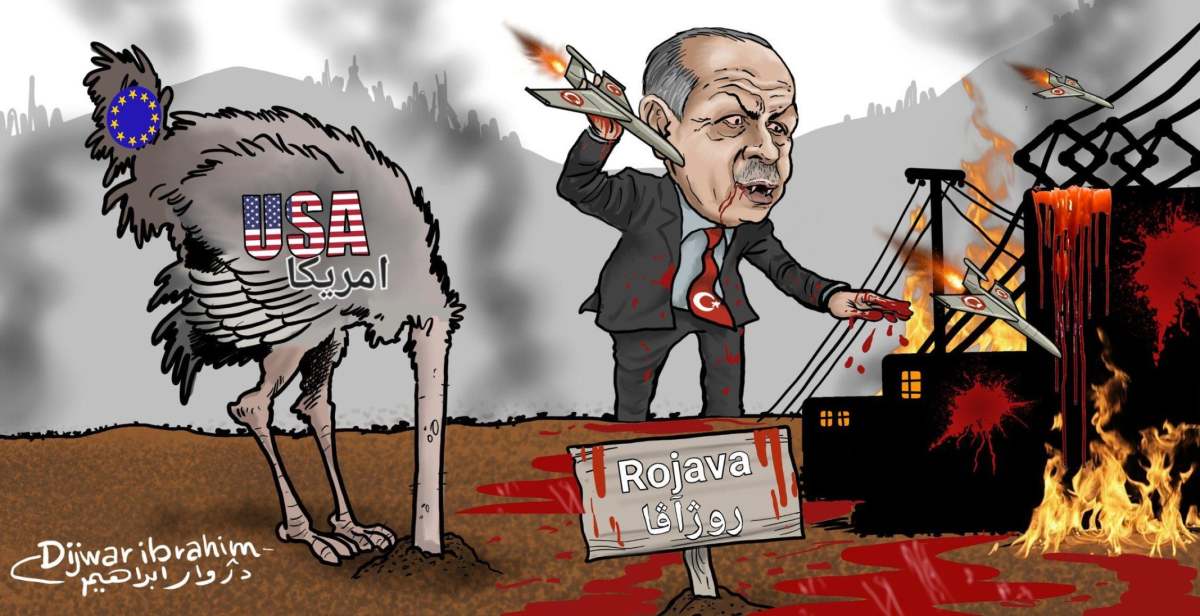
A political cartoon by Dijwar Ibrahim, depicting the US and EU as an ostrich with its head buried in the sand as Erdoğan destroys Rojava.
Human rights advocates have weighed in on the ongoing Turkish bombardments as well. Nadine Maenza, an American advocate for international religious freedom and a former chair at USCIRF, has questioned why the US government allows Turkey to continue to engage in war crimes against the Kurds, when such attacks benefit Iran, Assad, and ISIS while, according to her, running counter to US goals for peace and stability in the region. Maenza went on to condemn the Turkish assault on Rojava and its explicit targeting of civilian infrastructure and she has called for the international community to stand firm against ongoing Turkish war crimes against the Kurds.
Additionally, scholars such as Gerald Walker, an expert in global diplomacy and international relations, have argued that Turkey’s “attacks seem to be part of a strategy to displace the local population, furthering a policy of Turkification and extending Turkish control over this Syrian territory.” However, as Walker points out, while Turkey is attempting to gain further Syrian territory, these territories are explicitly Kurdish-dominated areas of the country. Turkey’s Syria policy is driven solely by its exterminationst aspirations towards the Kurds. This is despite the fact that the PYD and the SDF have not fired a single bullet or rocket towards the Turkish border. Rather it seems the repeated military losses that Turkey’s allied jihadists in Syria suffered at the hands of the Kurds continue to prompt Ankara’s resentful and vengeful anti-Kurdish policies across the Kurdish regions in northern Syria and Iraq (Western and Southern Kurdistan, respectively).
Other activists called for the urgent implementation of a No-Fly Zone in the region or for the US-led coalition to provide the Kurds with air defense systems and the necessary technology to protect themselves against the ceaseless Turkish bombardments.
In light of the total absence of international outcry about Turkey’s unhindered and unrestrained violence towards Rojava, it appears unlikely that such war crimes will cease anytime soon. As the world reels from the war in Gaza and South Africa’s ICJ case is played out across TV screens, the same international media outraged by Israel’s bombing of Palestinians, remains silent and apathetic as Turkey bombs Kurds and attempts to raze Rojava to the ground.
[:]

