
[:es]El mundo capitalista es una finca amurallada – Subcomandante Insurgente Moisés[:en]The Capitalist World is a Walled Plantation – Subcomandante Insurgente Moisés[:]
[:es]
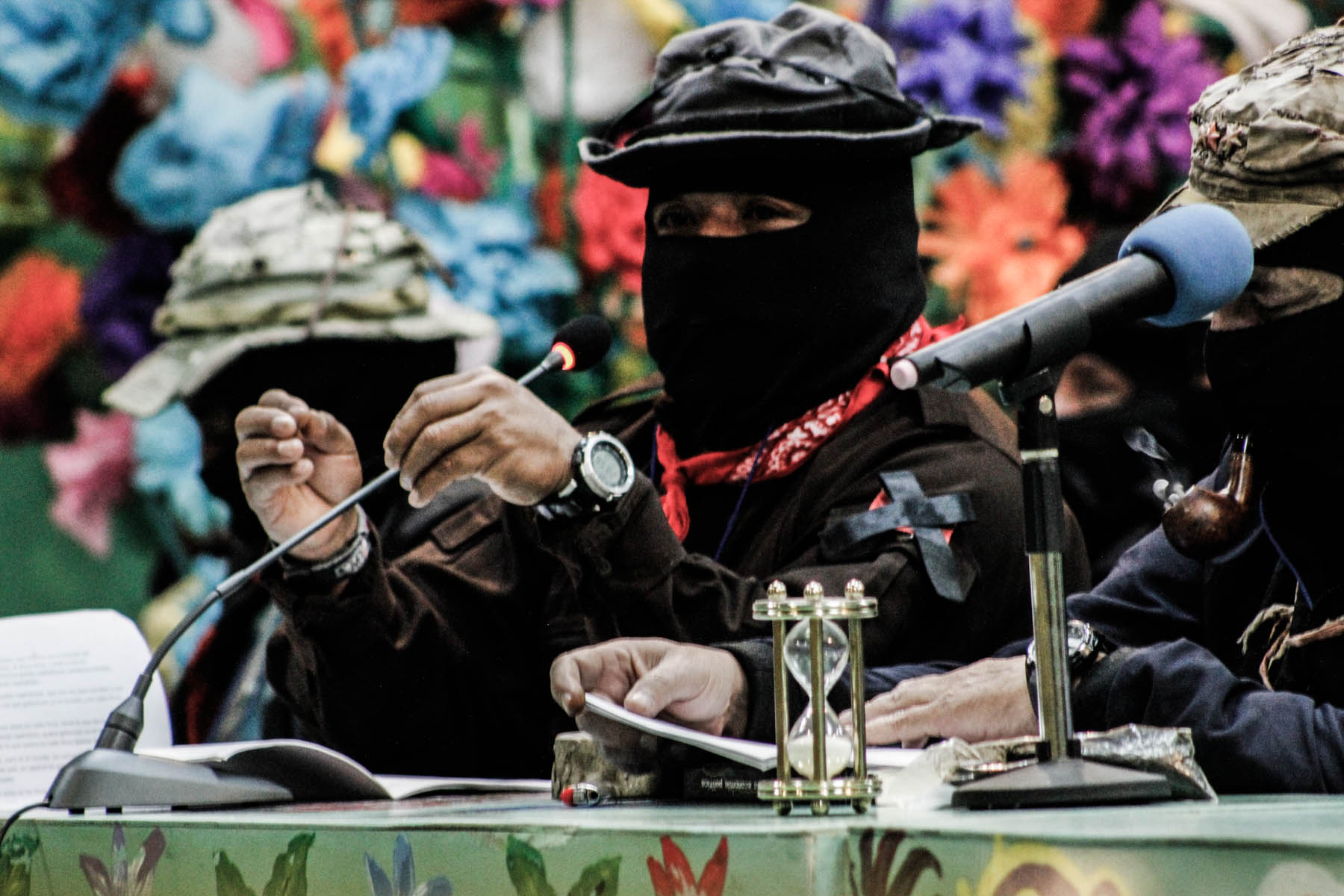
El mundo capitalista es una finca amurallada
Palabras del Subcomandante Insurgente Moisés
Seminario “Los muros del capital, las grietas de la izquierda”
Cideci / Universidad de la Tierra Chiapas
12 de abril de 2016
[podcast]https://radiozapatista.org/Audios/rzchiapas/supmoises.mp3[/podcast]
Buenas noches, buenas tardes, buenos días, según adónde nos escuchan.
Hermanos, hermanas, compañeros, compañeras:
Lo que les voy a platicar no es lo que creo, sino lo que nos platicaron nuestros bisabuelos y abuelos y bisabuelas y abuelas.
Platiqué con uno de nuestros bisabuelos que, él dice, que tiene 140 años. Según yo, mi calculo, por ahí de los 125 años. Tiene que uno estar ya muy pegado en el oído, para que te escucha lo que le preguntas.
Más o menos como veinte y tantos, entre bisabuelos y bisabuelas, que platiqué con ellos. Les estuvimos preguntando –porque estaban ahí compañeros del Comité Clandestino también—y, entonces, resulta que la parte que como estaba diciendo el Sub Galeano, viene una parte real de lo que nos platicaron ellos y ellas.
Por ejemplo, la teja que le hacían antes a los finqueros –o sea los dueños de las haciendas, los hacendados, el patrón como dicen ellos–, tienen por tarea que tienen que entrar costales de excremento del caballo. Y eso lo secan. Después de haber secado, los hacen polvo con un garrote de palo, los abollan. Y para eso, entonces, lo mezclan con el lodo para hacer la teja, para hacer los ladrillos o los adobes con los que se les construyó su casa a los patrones, los hacendados.
El bisabuelo dice que él se acuerda, porque es por tarea. Tarea quiere decir que tienen que entregar tantos costales cada uno de ellos. Lo que hacían es que aun cuando hace ratito había deshecho el caballo, la tienen que traer, escurriendo el agua en sus espaldas. La cosa es que es de entregar los costales de tarea que pide el patrón.
Entonces, aprendieron de ahí también para hacer sus casitas de ellos. Igual los usaron. Le dicen pared de lodo, bajareque, se le dice. Entonces, igual aprendieron pues ellos, pero es más chiquito, de doble.
Entonces, lo que les voy a platicar más es de ahí de donde viene la idea nuestra, como zapatistas que somos, que vemos y lo estudiamos cómo es que estamos ahora de los que nos explotan. Entonces, en resumido se los voy a decir porque eso es lo que nos va a ayudar a entender lo que pasó antes y cómo estamos hoy, y cómo será que seguirá.
Entonces, dicen nuestros abuelos, bisabuelos, bisabuelas y abuelas: el patrón es el dueño de las fincas, muchas fincas, muchas haciendas. Todos los patrones tienen sus caporales, sus mayordomos y sus capataces. Esos tres, cuatro con el patrón.
Nos cuentan que de las fincas hay de 15 mil, de 20 mil y de 25 mil hectáreas. Y que hay fincas de diferentes trabajos. Hay fincas, es un solo trabajo, cafetalera. Y hay fincas que son cafetalera, ganadería, de maíz, de frijol, de caña… diferentes trabajos pues.
Nos cuentan también su modo de cómo explotar. Nos cuentan de que hay finqueros, terratenientes o latifundistas que nunca les pagaron nada. Todo el tiempo de su vida se lo entregaron al trabajo. Otros nos cuentan que sólo el día domingo se lo daban para ellos; todos los demás días son para el patrón. Nos cuentan otros que les daban una semana para el patrón y una semana para ellos. Es una maña, es un truco, porque –nos cuentan– de que esa semana que supuestamente es para ellos, nuestros bisabuelos y bisabuelas, nos cuentan de que de lo que cosechan, de lo que encuentran esa semana (ya sea frijol, maíz, algunos animalitos que van juntando), a la hora de que venden tienen que darle la mitad al patrón y les queda pues la otra mitad.
Nos cuentan de que cuando el patrón quiere ver si está completo su ganado, tienen que ir a traerlo, acarreando pues los animales y encorralarlos. Nos cuentan de que, entonces, si falta alguno de sus animales del patrón, tienen que salir a buscarlo los encargados y tienen que entregarlo vivo o muerto. ¿Cómo pide el patrón, o sea el terrateniente, de que lo comprueba que está muerto? Tiene que traerle el pedazo del cuero, para que entonces el patrón se dé cuenta de que sí está muerto ya su animal. Si no los encuentran, tienen que buscarlos hasta que los encuentran ya sean vivos o muertos.
Y el patrón, cuando los saca a vender, entonces los organiza por grupos a los trabajadores, llevando tantas cabezas de animal. Ya sea de diez, veinte personas, hombres, con tantas cabezas de animal que tienen que llevar. El patrón los cuenta antes de salir y el patrón los cuenta al recibir donde quiere que llegue el animal. Cada persona tiene que entregar completo. Si no lo entrega completo, ellos lo tienen que pagar o el que está encargado.
Nos cuentan que el corral, cuando el patrón así lo quiere, es hecho de piedra, el corral. Y si no, es con madera labrada con hacha. Y dicen que tiene que ser madera de puro corazón. Quiere decir que es lo más duro de la madera, para que no se pudra luego. Entonces, no aceptan que sea tierno. El patrón no los recibe.
Nos cuentan también que cuando saca a vender a los puercos (no el patrón, sino el animal: los cuches, los marranos pues), igual lo hace como con el ganado. Nada más que ahí sí hay diferencia, dicen los abuelos y los bisabuelos. Dicen que tienen que llevar la partida en la noche, porque sienten calor los marranos. Entonces, su lámpara, su foco, como decimos nosotros, es el ocote. Llevan tercios de ocote para que sea su lámpara para caminar de noche. Igual, con cantidades de puercos de cada encargado. Y si es que entonces quieren avanzar de día, tienen que llevar cargando el agua para mojar a los marranos, o sea, para enfriarlos para que no sufran el calor.
Nos cuentan que las mujeres, las abuelas y las bisabuelas nos cuentan de que el patrón tiene su forma de cómo quiere. Por ejemplo, dicen las abuelas y las bisabuelas que cuando es trabajo fuerte tienen que ir las mujeres casadas. ¿Cuál es su trabajo? Moler café, moler sal por bultos. Y entonces nos cuentan que ahí van las mamás con sus hijos y para moler la sal tiene que ser con el metate de piedra. Y ahí están los caporales, los mayordomos y los capataces, y la patrona y el patrón. Ahí llevan su bebé y no dejan que atienda al bebé que está en su espalda llore y llore y llore, porque está ahí el patrón y ella tiene que sacar su tarea. Entonces, hasta que al patrón o la patrona se le viene su gana de ir al baño, es cuando aprovecha la mamá para amamantar a su hijo.
Nos cuentan que el patrón pide de que se vayan puras muchachas para atender ahí en su casa en la hacienda, para diferentes trabajos. Pero una de sus mañas del patrón es que escoge a una muchacha y le dice: “tú, quiero que vayas a tenderme la recámara”, las cobijas. Y a la hora que entra la muchacha, ahí va también el patrón a violarla. Pero, entonces, las escoge. Y nos cuentan también que si quiere, las agarra.
Nos cuentan también eso que ya les dije de que están moliendo el café, de que están moliendo la sal, la paga que le daba el patrón eran tres pedazos de carne de res, pero de las que están muertas. Ésa es la paga.
Nos cuentan también que a los niños también les dan trabajo. Nadie se salva de eso. Le dicen “portero”, pero no el portero de fútbol sino así le pusieron el nombre pues “portero”. Su trabajo de esos niños de seis años es moler el nixtamal sin calidra, que es para los perros, los puercos y los pollos. Terminando eso tienen que cargar agua, que muchas veces lo hicieron en sus espaldas con un barril, dicen. El barril es de madera que se le saca, se le hace un hueco, un hoyo, lo perforan pues. De 18 a veinte litros caben en ese barril. Es lo que tienen que cargar los niños, para que el patrón lave sus manos, la use para bañarse, para lo que quiera pues. Terminando eso, se encargan de traer leña. Terminando de traer leña, se encargan de desgranar el maíz.
Nos cuentan también que los viejitos, los que ya no pueden trabajar en el campo, las viejitas… nadie se salva. Los viejitos van a ir a traer una planta que le llamamos “ixchte”. Entonces, de lo que se encargan los viejitos es de rasparla para que salga el hilo. Un grupo se encarga de esto, de rasparlo. Y otro grupo de los viejitos se encarga de hacerlo hilo, en lazo. Y otro grupo de los viejitos se encarga de hacer las redes. Así está pues en serie el trabajo de los viejitos. ¿Y las viejitas? Un grupo se encarga de deshilachar el algodón. Y otro grupo se encarga de hacerlo en hilo y otro grupo se encarga de tejerlo para hacer manta. Y ese pedazo de manta que es la que después compran nuestros bisabuelos, nuestras bisabuelas, para taparse. Nos cuentan que la ropa que usaron era nada más para taparse la parte principal, nada más, no es así como estamos ahora.
Nos cuentan del castigo. El castigo, tienen de varias maneras. Una es que el patrón desde antes tiene revuelto el maíz con el frijol. Entonces, el patrón lo que hace es que los riega ahí en la tierra y te dice que tienes que separar el maíz y el frijol. Sabe –así nos cuentan—el patrón que no vas a poder. Porque además te da el tiempo. Y el tiempo que te da el patrón, dice: “yo voy a escupir, en el tiempo que se seca mi saliva, es el tiempo en que quiero que separes el maíz revuelto con el frijol”. Pues ¿uno cómo le va a hacer?
Entonces, como uno no puede con ese tipo de castigo, ahí al lado está preparado el terreno, donde tiene juntado el patrón piedritas. Ahí en ese lugar es donde uno se va a hincar, porque no pudiste separar el frijol revuelto con el maíz. Ahí vas a hincarte. Y no tienes que levantarte hasta el momento en que se le antoja al patrón. Si es que te levantas, es que no estás aceptando tu castigo. Entonces, si tú aguantas eso, entonces ahí es donde viene el chicote. Lo voy a decir tal cual como dijeron los abuelos. Dijeron de que entonces el patrón, cuando se les moría un toro, le sacaban la verga del toro y la secaban y ésa es la que usan para chicotear a sus trabajadores. Entonces, a la hora de que estás hincado ahí, viene el patrón a chicotearte y no tienes que levantarte, porque dicen –nos cuentan—que si te levantas, te va peor. Y dicen –nos cuentan—que tienes que levantarte por el dolor del chicote que te están dando y por el dolor de las rodillas que ya no aguantas y tienes que levantarte.
Y a la hora que te levantas, ahí están ya los caporales, los mayordomos y los capataces que son los que te agarran y te amarran las dos manos y los pies a las vigas de la casa hasta que al patrón se le acaba su gana de chicotear o hasta cuando se dan cuenta de que –como dicen los abuelos—queda uno mallugado. Eso quiere decir que te quedas desmayado, inconsciente ya. Entonces, hasta ahí te deja ya el patrón.
Nos cuentan que los trabajos que se hacen todo es por tarea. No hay nada que no sea por tarea lo que se hace. Y todo con los caporales, con los mayordomos y con los capataces. Nos cuentan por ejemplo del cafetal. Cuando es tiempo del corte del café, todos y todas y es por tarea la cantidad que tienes que entregar. Y los niños que no pueden, no alcanzan pues las matas del café donde está el grano, su trabajo es levantar todo lo que está caído. Cuando ya no es tiempo de cosecha del café, vienen los distintos trabajos: un grupo se encarga de limpiar el cafetal, o sea, el monte; otro grupo se encarga de lo que le dicen “encajado”, o sea, a cada mata de café tienen que hacerle un cajón donde le van a poner el abono; otro grupo se encarga de la limpiada de la mata del café, porque la mata tiene montecitos en su tallo y entonces tienen que quitarlos todos. Y dicen nuestros abuelos y bisabuelos –nos cuentan—de que la mano no puede, entonces, lo que hacen es que queman el olote del maíz, porque sale como su filito a la hora que se quema y con eso lo tallan, porque pasa el capataz a checar si queda bien. Y si no, tienes que volver. Y si no, al castigo.
Nos cuentan también que otro grupo se encarga de podar el café; no deben de estar bejucos ni montes en la mata del café. Nos cuentan también que hay otro grupo de “desombrada”, le dicen. O sea que si hay árboles arriba, tienen que quitar la sombra; sólo lo necesario, como dice el patrón.
Nos cuentan también de que en todas las fincas que hubo, que hay –porque sigue habiendo todavía—siempre está ahí la ermita, le dicen. Entonces, a la hora de que se van a su rezo, en esas sillas y bancas que hay ahí en ella no pueden sentarse nuestros bisabuelos. Si es que entonces están sentados ahí, los sacan a empujones. Y el sacerdote ahí lo está mirando; no dice nada. Sólo se sientan ahí los que son patrones o los que son mestizos. Y si quieren sentarse ellos, es el piso.
En las ciudades –nos cuentan– no permiten de que van a ir a vender lo poco de lo que tienen nuestros bisabuelos, nuestras bisabuelas. Nos cuentan de que es porque la ponen fea la ciudad. No permiten que se vayan en el centro. Entonces lo que hacen los mestizos es que tapan la orillada de la ciudad. Ahí les quitan todo cuando quieren hacerlo y si no les pagan lo que ellos quieren.
Nos cuentan los bisabuelos que en esos tiempos no existe carretera, mas que carreta con caballo. Entonces, cuando su mujer del patrón quiere ir a la hacienda, a la finca, no usa el caballo con la carreta, que porque “el animal es animal, no piensa”. Puede sufrir un accidente su mujer del patrón. Entonces, lo que hacen, igual: un grupo se van a la ciudad a traer cargando a su mujer del patrón. Pero aparte tienen que traer mercancía, entonces, se va un grupo y se turnan pues la carga. Y llegando en la hacienda, en la finca, se le pregunta a la mujer si no le pasó nada. Y aparte le preguntan a los que fueron de cargadores si es que no hubo algún accidente. Así para llegar y así para el regreso.
Así un montón de cosas más que nos contaron. Por ejemplo, ahí nos mostraron el centavo que les pagaban antes. Nos cuentan que cuando el patrón empezó a querer pagar un poco, que ganaban un centavo al día. Nos mostraron. Nos dijeron también de que ya no aguantaban los maltratos que les hacían. Dicen que, entonces, trataron de organizarse, de buscar tierra a donde ir a vivir. Entonces, los patrones, los terratenientes llegan a saber de que se escapan de la finca y empiezan a investigar a dónde fueron. Y nos cuentan los bisabuelos de que entonces son los mismos patrones que se disfrazan de ser soldados. Ellos van a ir entonces a desalojar, a destruir, a quemar, pues la casita que están construyendo, donde quieren vivir los bisabuelos y las bisabuelas.
Nos cuentan que así les pasó. Y es ahí donde le descubrieron que el patrón –porque uno de los bisabuelos había pasado en varias fincas ya—estaba disfrazado de soldado. Y nos cuentan de que les destruyeron las chocitas que tienen y los reunió a los que fueron a hacer el poblado y les dijeron: “¿quién encabezó esto?” Así dijeron los soldados: “¿quién encabezó esto? Si ustedes no van a decir quién lo encabezó, todos ustedes van a tener que ser castigados”. Entonces, ahí fue donde dijeron: “fulano de tal”, el que encabezó de huirse de la finca, de buscar dónde vivir. Entonces le dijeron: “vas a pagar 50 pesos”. Y nos cuentan de que para encontrar 50 pesos –el año les dije porque está diciendo el bisabuelo que tiene 140 años, quiere decir que 140 años atrás de hoy que estamos hablando–, entonces, nos dicen que para encontrar 50 pesos tiene que ser un año para encontrar 50 pesos.
Entonces se dieron cuenta de que está difícil de que alguien quiere encabezar para poder salvarse del sufrimiento. Pero también nos contaron de que entonces se dieron cuenta de que está así, entonces, lo que hicieron fue no decir quién fue, sino el grupo. Volvieron a construir… a buscar otro terreno pues y a construir sus casitas, pero ahora sí, todos son ellos los que se dirigieron. Nadie más de que alguien fue quien encabezó. O sea, se pasaron de colectivo. Es así como empezaron a lograr dónde vivir.
Entonces, ¿por qué estamos platicando esto? Nosotras, nosotros, las, los zapatistas vemos que hoy estamos entrando de nuevo en esto. En el capitalismo hoy no existen países. Así lo vemos. Lo va a convertir en finca al mundo. Los va a hacer en pedazos como de por sí así está, que decimos que el país México, el país Guatemala –como decimos–. Pero va a ser un grupo nada más de patrones-gobierno. Todos esos que dicen que es gobierno de Peña Nieto… Nah, nah… decimos nosotros. No es gobierno ya. Porque el que manda ya no es el que manda. El que manda son el patrón capitalista. Esos gobiernos que se dicen: el de Peña Nieto, el de Guatemala, que el de El Salvador y todo lo demás son capataces. Los mayordomos: los gobernadores. Los presidentes municipales son los caporales. Todo está al servicio del capitalismo.
Vemos de que entonces no se necesita mucho que estudiar de cómo darse cuenta de cómo está. Porque entonces, por ejemplo, esa ley, esa nueva ley de la estructura, nueva ley estructural que hicieron ya aquí en México, nosotros no lo creemos que son que lo hicieron los diputados y los senadores. No lo tragamos nosotros eso. Eso lo dictó el patrón: el capitalismo. Porque ellos son los que quieren hacer de nuevo, como lo hicieron sus tatarabuelos de ésos también. Pero ahora sí más peor.
Por eso hablamos en el principio de eso. Estamos hablando de que, por ejemplo, Absalón Castellanos Domínguez, el ex general, tenía fincas aquí en Chiapas y tenía finca o tiene finca en Oaxaca. Estamos hablando de 5 mil, de 10 mil hectáreas. Aquí, el capitalismo ahora, una finca, cuando el patrón capitalista dice: “voy en mi finca la mexicana, voy en mi finca la guatemalteca, voy en mi finca la haitiana, voy en mi finca la costarricense… todos los que son países capitalistas subdesarrollados va a ser la finca.
Quiere decir que el mundo lo va a hacer en finca el capitalismo, el patrón, el que quiere gobernar, la que quiere gobernar, si es que lo vamos a permitir. Y nuestra pregunta de ahí nosotros, nosotras, zapatistas: ¿por qué ellos –o sea los capitalistas–, por qué ellos sí cambian de cómo hacer la explotación? ¿Por qué nosotros no cambiamos de cómo luchar para salvarnos en esto?
Por eso les platiqué qué hicieron nuestros bisabuelos, a donde venimos los indígenas. Nos dijeron eso de que entonces fallaron cuando dijeron eso de que “fulano de tal nos dirigió”. Pero no dejaron. Buscaron una forma de seguir luchando para salir de donde está el patrón, y dijeron: “nadie nos dirigió”, “todos somos nosotros”.
Entonces, ¿por qué nosotros ahora? Porque el capitalismo ahora ya no sólo nosotros los que somos indígenas estamos sufriendo aquí en el mundo. Estamos sufriendo, ahora sí, del campo y de la ciudad. Es decir, indígenas y no indígenas. Entonces, ¿qué vamos a hacer?
Acá nosotros, las, los zapatistas que vivimos así pues ¡en la mierda del capitalismo! Que aún estamos luchando, que seguimos luchando y vamos a seguir luchando… Chiquito como estamos, pero estamos mostrando de que entonces –como nos enseñaron los bisabuelos—de que sí hay forma de cómo. Estamos con nuestra chiquita libertad. Falta pues que liberemos a México. Pero decimos que pues, entonces, ¿cómo nos vamos a liberar en el mundo?
Pero aquí, en este pedacito de mundo, en Chiapas, tienen su libertad los compañeros y las compañeras para lo que se les antoje hacer. Tienen en sus manos todo lo que significa el ser autónomo, independiente.
Pero, ¿cómo vamos a hacer?, ¿qué vamos a hacer? Porque ahora vemos eso que estamos diciendo de que el mundo se va a convertir, quiere convertirlo en su finca el capitalismo.
Entonces, ahí lo ven, ahí lo piensan, ahí lo analizan. Véanlo en donde viven, en donde están, si no están ahí en la mierda del capitalismo y qué hacer ahí con eso. Porque eso es lo que está haciendo el capitalismo ahora.
Y va a seguir su palabra el Subcomandante Insurgente Galeano.[:en]
The Capitalist World is a Walled Plantation
Words of Subcomandante Insurgente Moisés
Seminar “The Walls of Capital, the Cracks of the Left”
Cideci / Universidad de la Tierra Chiapas
Wednesday April 12, 2017
[podcast]https://radiozapatista.org/Audios/rzchiapas/supmoises.mp3[/podcast]
Good evening, good afternoon, good morning, according to where you’re listening from.
Brothers, sisters, compañeros, compañeras:
What I’m going to talk about today is not what I believe, but rather what our great-grandfathers and grandfathers and great-grandmothers and grandmothers told us.
I talked with one of our great-grandfathers who says he’s 140 years old. According to my calculations he’s around 125 years old. You have to get very close to his ear for him to be able to hear what you ask him.
I spoke with about 20-some of them, of our great-grandfathers and great-grandmothers. We were asking them– the compañeros from the Clandestine Committee were there too–and it turns out that part of what SupGaleano was saying is exactly what they told us about.
For example, for the bricks that they used to make for the plantation owners—that is, the owners of the haciendas, the hacendados they call them, or the patrón—they had to fill large sacks with horse manure. Then they dried them, and after having dried the sacks of manure, they turned the manure into dust using a heavy club to beat the sacks. Then they mixed that with mud to make the adobe bricks with which they built the plantation owner’s house.
This great-grandfather said that he remembers that the work was organized by quota. Quota means that each one of them had to turn in a certain number of sacks. So each time there was fresh horse manure, they had to bring it, with the water running down their backs. The point is that they had to turn in the number of sacks that the patrón demanded.
They learned how to make their own houses that way too, they used the same materials. They called it mud wall, mud construction is what it’s called. So, they learned to build this way, but their houses were much smaller, with just two rooms.
So, what I’m going to explain here further is where our ideas come from, as the Zapatistas we are—what we’re seeing and studying about how we are exploited today. In sum, I’m going to tell you this because this is what is going to help us to understand what happened before and what situation we’re in now, and what the future will hold.
Our grandfathers and great-grandfathers, great-grandmothers and grandmothers tell us that the patrón is the owner of the plantation,of many plantations, many haciendas. All the plantation-owners have their managers [caporales], foremen [mayordomos], and overseers [capataces]: those three, well four with the patrón.
They tell us that there are plantations of fifteen thousand hectares, of twenty thousand and twenty-five thousand hectares. There are plantations with different kinds of work, and some plantations that only produce one thing, like coffee. There are others that produce coffee, livestock, corn, beans, sugar, and lots of different things.
They tell us, too, about the methods of exploitation. They tell us that there are plantation owners, landowners, who never paid them anything, and they gave their whole lives to work. Others tell us that Sunday was the only day they had for themselves; all the other days were for the patrón. Still others tell us that they worked one week for the patrón and one week for themselves. But that it was a trick, a swindle, they tell us, because that week our great-grandfathers and great-grandmothers supposedly had for themselves, whatever they harvested that week (whether it was beans, corn, or a few animals they were able pull together), when it came time to sell, they had to give half to the patrón and they kept the other half.
They tell us that when the patrón wants to see if his herd of animals is complete, they had to go and get them, herding the animals and putting them in the corral. They tell us that if one of the patrón’s animals was missing, they had to go look for it and bring it back, dead or alive. How did the patrón, that is, the landowner, require that they prove that it was dead? They had to bring back a piece of its hide so that the patrón would know for sure that his animal was dead. If they couldn’t find it, they had to keep looking until they found it, dead or alive.
When the patrón took the livestock to market, he organized the workers into groups who were responsible for so many heads of livestock. Whether it was ten or twenty people, men, they had so many heads of livestock that they had to transport. The patrón would count them before leaving and he count them again upon arrival at the destination where the animals were taken. Each person had to deliver all of their livestock; if they didn’t account for every single one, they would have to pay for it, or the person in charge of that group would.
They tell us that the corral, if the patrón so desires, is made of stone. If not, it’s made of wood carved with an axe. And they say that it had to be pure heartwood. That means that it’s the hardest part of the wood, so that it doesn’t rot later. The patrón wouldn’t accept softer wood, he would refuse it.
They also tell us that when it was time to take the pigs to market (not the patrón, the animal: the hogs) it was the same process as with the cattle. But there was a difference, say the grandfathers and the great-grandfathers. They say they had to transport the load at night, because the hogs get overheated during the day. So their flashlight, their light source, was a torch made of ocote wood.[i] They carried bundles of ocote as their lamp to walk by night. The same as with the cows, each person was responsible for a certain number of pigs. And if they wanted to advance by day, they had to carry water with them to wet the hogs down, that is, to cool them off so they didn’t suffer in the heat.
The women, the grandmothers and the great grandmothers, tell us that the patrón had his way of how he liked things done. For example, the grandmothers and great-grandmothers say that when the work was difficult, it was always the married women who had to do it. What was their job? To grind coffee, to grind salt in bulk. They tell us that the mothers went with their children to grind salt, with a flat stone for grinding, a metate. And the managers, foremen, and overseers were right there, as well as the patrón and his wife. The women had their babies on their backs but weren’t allowed to take care of them, even though they cried and cried, because the patrón was there watching and the women had to meet their quota. It wasn’t until the patrón or his wife decided to go use the bathroom that the mother would have a chance to breastfeed her child.
They tell us that the patrón would ask for only young women to attend to him in his plantation house, to do different jobs. But one of the patrón’s tricks was to choose a young woman and say, “You, I want you to go and make up my bedroom,” to make the bed. And when the young woman went into the room, the patrón would follow to rape her. So he chose them one by one. And they tell us too that he would grab them whenever he wanted to.
They tell us also about what I already mentioned, that they were there grinding the coffee, grinding the salt, and the pay that the patrón would give them was three pieces of beef, but from animals that were already dead. That was their payment.
They also tell us that the children were given work too. No one escaped it. They called them porteros, keepers, but not the keepers like in soccer, they just called the children that. The job of those six-year-old children was to grind the nixtamal [partially cooked maize] without lime; this was for the dogs, the pigs, and the chickens. Once that was done they had to carry water, usually in a barrel on their backs we are told. The barrel was made of wood in which they would make a hole, that is, they would perforate it. The barrel held between 18 and 20 liters, and this is what the children had to carry so the patrón could wash his hands, use it to bathe, or whatever he wanted. Once that was finished, the children had to go and carry wood. After they brought the wood, they were responsible for de-kerneling the corn.
The elders tell us also that once the men got old and couldn’t work in the fields, and the older women too…well, nobody was free from work. The older men would go look for a plant that we call “ixchte.” The men would scrape it until a kind of thread was formed. One group would do this part. Another group of older men would then make the thread into a kind of rope. Another group would be responsible for turning that into nets. That was the work of the old men. And the older women? One group would be responsible for unraveling cotton. Another group would turn the cotton into thread and another group would weave the thread into cloth. And then that little piece of cloth is what our great-grandfathers and great-grandmothers would later have to buy to use as clothes. They tell us that the clothes they wore were just to cover the most necessary parts, nothing else, not like we are dressed today.
They also told us about punishment. There were various kinds of punishment. One was that the patrón would have some corn mixed with beans, and he would throw it on the ground and tell you to separate the corn from the beans. And the patrón knew—the elders tell us—that you weren’t going to be able to do it, because he would give you a a time limit. He’s say: “I’m going to spit and in the time that it takes my saliva to dry is the time you have to separate the corn from the beans.” But how were you going to pull that off?
Since you couldn’t possibly do this, there close by the patrón would have gathered some little rocks together, prepared a little piece of ground with rocks. That’s where he would make you kneel because you couldn’t separate the beans from the corn. So you had to kneel there and you couldn’t get up until the patrón decided to let you. And if you got up, that meant you were not accepting your punishment. So you had to endure kneeling there and thats where the whip came in. I’m going to tell you exactly what the grandfathers told me. They said that whenever one of the patrón’s bulls died, he’d have the penis cut off the bull, dried, and that’s what he used to whip the workers. So while you’re kneeling there, the patrón would come whip you and you couldn’t get up because—this is what they tell us—if you got up it would be worse. But they tell us that you had to get up because of the pain from the whip and and the pain from your knees—that it was intolerable and you just had to get up.
But the moment you got up, there were the managers, the foremen, and the overseers to grab you and tie your hands and feet to the beams of the house until the patrón got tired of whipping you or until he realized that—as our grandfathers say—you were beaten senseless. In other words, you had fainted or lost consciousness. That’s how he left you.
They tell us that all of the work that had to be done was by quota. There wasn’t any task that didn’t have a quota. And everything was under the watch of the managers, the foremen, and the overseers. They told us for example about the coffee fields. When it was time to harvest the coffee, everyone had a quota for how much coffee they had to turn in. The children who couldn’t pick coffee, who were too small to reach the coffee beans, their work was to pick up everything that fell on the ground. When it wasn’t coffee harvest time, there was other work: one group had to clear the coffee field, that is, the vegetation and weeds; another group was responsible for what’s called “crating,” that is, they had to make a kind of crate for each coffee bush that would hold the composted fertilizer; another group had to tend to the coffee bush, because it gets growths on its trunk which had to be removed. Our grandparents and great grandparents tell us that you couldn’t do it with your hands; you had to burn a corncob—because when you burn a corncob it develops a sharp edge and that’s what you use to clean the trunk. And the overseer would go around checking to make sure it was good enough, and if it wasn’t, you had to start over. If not, then punishment.
They also tell us that another group had to prune the coffee; that there couldn’t be vines or vegetation climbing up the coffee plant. They say there was also a group for “de-shading,” as they call it. That is, if there were trees above the coffee plants, they had to cut them back to remove the shade, only as much as necessary the patrón would say.
They also say that on all the plantations then—and now, because there are still some today—there was always an ermita, as they call it, a chapel. When it was time to go pray, our great-grandparents couldn’t sit on the chairs and benches in the chapel. If they sat there they would be physically pushed off. And the priest would be there watching, but wouldn’t say anything. Only the patrón and other mestizos could sit there. If our great-grandparents wanted to sit down, well then it was on the floor.
In the cities, our great-grandfathers and great-grandmothers tell us, they weren’t allowed to go sell the little they had. They say that they were told that they made the city ugly. They weren’t allowed to go to the center city; what the mestizos would do was close off the entries to the city at the outskirts and either just take everything [the indigenous people] had brought if they felt like it, or pay whatever they wanted for it.
Our grandparents tell us that there were no highways at that time, just wagons pulled by horses. So when the patrón’s wife wanted to go to the plantation, she wouldn’t use the horse and wagon, because “an animal is an animal, it doesn’t think,” and there could be an accident with her on board. So what they had to do was send a group to the city in order to carry the patrón’s wife back. But they also had to bring back goods, so a group would go and they take turns carrying her back. When they arrived at the plantation, the patrón’s wife would be asked if anything had happened to her, and they would ask those who carried her if they had had any accidents. They had to do this all the way to the plantation and all the way back.
They told us many more things. For example, they showed us a cent, which is what they were paid at that time. They say that when the patrón started to actually pay them something, he paid them one cent a day. They showed us the coin. They also said that at some point they couldn’t put up with the mistreatment anymore. So they tried to organize themselves, to look for land where they could live. The patrones found out that they had fled the plantation and begin to investigate where they had gone. Our grandparents say that the patrones dressed up like soldiers and went themselves to evict, destroy, to burn down the little house that our great-grandparents were building where they wanted to live.
That’s what they told us happened. And that’s how they found out that the patrón was disguised as a soldier—because one of our grandfathers had worked on various plantations. They say that [the patrones dressed as soldiers] destroyed the little huts they had built, that they got everyone together who had fled to create a community and asked them, “who headed this up?” That’s what the soldiers said, “whose idea was this? If you don’t tell us who’s leading this, all of you will be punished.” And the people said “it was so-and-so,” the one who led the escape from the plantation and the search for where to live. So they [the patrones] said to that person: “you have to pay 50 pesos.” Our great-grandparents say that to come up with 50 pesos—at that time, because this great-grandfather is 140 years old, so we’re talking about 140 years ago—at that time it would take a year to come up with 50 pesos.
So they realized that it would be difficult for someone to choose to lead an attempt to flee the suffering. But they also told us that once they realized this, what they did was not name anyone, but rather say that it was the group. They began to rebuild…they found another piece of land and began to build their houses again, but this time, with all of them leading. Nothing more about who would lead. That is, they became a collective. That’s how they began to start a life somewhere else.
So, why are we telling you about this? We as Zapatistas see that today we are re-entering this same scenario. In capitalism there are no countries, that’s how we see it. Capitalism is going to turn the whole world into a plantation. It will break everything up, as it already is—what we call the country of Mexico, the country of Guatemala, but it will all be under a group of governing patrones. All those who say things about Peña Nieto’s government…no, no, we say, it’s not a government. Because the person in charge is no longer the person in charge. The capitalist patrón is in charge. What are referred to as the governments of Peña Nieto, of Guatemala, of El Salvador, and elsewhere are just the managers. The governors are the foremen. The municipal presidents are the overseers. All of them act in the service of capitalism.
We see then that it doesn’t take a lot of study to see how things are. For example, this new law on structure, the new structural law that was passed here in Mexico: we don’t think this law was made by congressional representatives and senators. We don’t buy it. That law was mandated by the patrón: capitalism. They are the ones who want to do again what their own great-great-grandparents did. But now it’s even worse.
That’s why we are beginning with this topic. We are talking about, for example, Absalón Castellanos Domínguez, the ex-general, who had plantations here in Chiapas and had or has a plantation in Oaxaca. We’re talking about 5,000, 10,000 hectares. Here, in today’s capitalism, the capitalist patrón says: I’m going to my plantation Mexico, I’m going to my plantation Guatemala, I’m going to my planation Haiti, I’m going to my plantation Costa Rica… all of the capitalist underdeveloped countries are going to be plantations.
This means that the governing patrón, capitalism, is going to turn the entire world into its plantation, that is, if we allow it. Our question there as Zapatistas is: why do they—the capitalists—change their mode of exploitation? And why don’t we change our form of struggle to save ourselves from that?
That’s why I’ve been telling you about what our great-grandparents did, where we indigenous come from. They said that they made a mistake when they said “so-and-so led us.” But they didn’t give up. They searched for a way to continue struggling, for a way to escape from the patrón and they said, “nobody led us,” “we are all of us.”
So, why all of us now? Because under capitalism today, it is not only we indigenous who are suffering in the world. Now we are suffering in the countryside and the city, that is, indigenous and non-indigenous. So, what are we going to do?
We Zapatistas who live here in the shit of capitalism, we are still fighting, still struggling, and we will continue to struggle… small as we are, but we are showing—just like our great-grandparents taught us—that there is a way. We have our small freedom. We still have to liberate Mexico. But now we say, how will we liberate the world?
Here in this little piece of the world, in Chiapas, the compañeros and compañeras have their freedom, the freedom to do whatever they want to do. They have in their hands what it means to be autonomous, independent. So how are we all going to do it? What are we going to do? Because now we are seeing that the whole world is going to be turned into the capitalists’ plantation.
So then, look at this reality, think about it, analyze it. See how it works where you live, where you are; see if you are also living in the shit of capitalism and what to do about it. Because this is what capitalism is doing now.
Subcomandante Insurgente Galeano is going to continue.
[i] The wood of the ocote pine tree can be used as a light source as it catches fire at the stroke of a match and burns steadily.[:]

