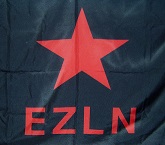
[:es]EZLN: Una casa, otros mundos[:en]EZLN: One House, Other Worlds[:]
[:es]
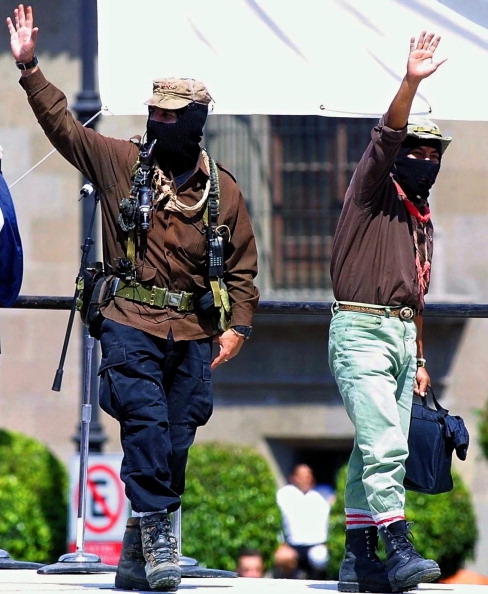
Foto: JORGE UZON/AFP/Getty Images
Julio-agosto-septiembre del 2016.
A quien corresponda:
Asunto: Invitación a “CompArte y ConCiencias por la Humanidad”.
Sí, lo sabemos. Días y noches donde la amargura parece ser el único horizonte. Pasos arrastrados por el dolor, la rabia, la indignación; tropezando cada tanto con las impertinentes miradas del cinismo y la desilusión; la estupidez entronizada en puestos gubernamentales y encuestas; la simulación como forma de vida; la mitomanía como táctica y estrategia; la frivolidad como cultura, arte, ciencia; el escalonado desprecio hacia lo diferente (“lo malo no es que exista lo otro, sino que se muestre”); la resignación a precio de mayoreo en el mercado político (“ni modo, sólo queda optar, ya no por lo menos malo, sino por lo menos escandaloso”). Sí, difícil, cada vez más difícil. Como si la noche se alargara. Como si el día postergara su paso hasta que no, nadie, nada, vacío el camino. Como si no hubiera respiro. El monstruo acechando en todos los rincones, campos y calles.
Y a pesar de todo eso, o precisamente por todo eso, le mandamos esta invitación.
Sí, parece que no viene al caso o cosa, pero nosotras, nosotros, zapatistas, le estamos convidando a usted para que participe en los festivales CompArte y ConCiencias por la Humanidad”. Así que, en cumplimiento de las formalidades, debemos enviarle una invitación. Algo que precise un calendario y una geografía, porque usted tiene su propio camino, su paso, su compañía, su destino. Y tampoco es cosa de agregar dificultades a las que usted ya enfrenta. Así que sí, en una invitación debiera señalarse el dónde y el cuándo.
Pero ya sabe usted lo que somos. Nuestro modo, pues. Y entonces la pregunta que, pensamos, tiene que responder una invitación, no es tanto el lugar y la fecha. Sino el por qué. Tal vez por eso esta invitación no cumple con las formalidades del caso y le llega a destiempo, o después o antes. Pero eso no importa, ya verá usted.
Entonces por eso es que es muy otra esta invitación, por eso es que, como parte esencial, tiene esta pequeña historia:
UNA CASA, OTROS MUNDOS.
Más que historia, podría ser leyenda. Es decir, no hay manera de confirmar la veracidad de lo que aquí se narra. En parte porque no se precisan ni calendarios ni geografías, es decir, pudo haber sido o no en cualquier lugar y en un tiempo indefinido; y también porque el supuesto no-protagonista de esta narración está muerto, finado, fallecido, difunto. Si estuviera vivo, bastaría preguntarle si dijo lo que aquí se dice que dijo. Cierto, es muy probable que, tenaz en su andarse por las ramas, se extendería él en la descripción de ese calendario impreciso.
Así que no tenemos la fecha precisa, les quedamos a deber el calendario y sólo diremos que hará ya más de dos décadas aproximadamente. ¿La geografía? Las montañas del sureste mexicano.
Nos lo contó el Comandante Tacho, aquella madrugada en que, dentro de una champa, se describía la casa del sistema, la casa del capital, la tormenta, el arca. La champa donde nació lo que después sería el semillero. Creemos que dieron un receso para café…. o suspendieron la reunión para continuar al día siguiente… A decir verdad, no lo recordamos bien. El asunto es que nos quedamos platicando con el Tacho y es él quien nos contó lo que ahora aquí les detallamos. Claro, cierto, hay un poco de trampa porque agregamos, arreglamos y acomodamos las palabras originales de Tacho. No por mal querencia, desprecio o ganas de remendar los recuerdos rotos, sino porque ambos, quienes ahora le escribimos a usted, conocíamos más del finado y podemos reconstruir así sus palabras y sentires. Va pues:
Habla el comandante Tacho:
“No muy me acuerdo cuándo, pero fue cuando el difunto Sup no estaba todavía difunto. Estaba el Sup como de por sí, desvelándose y fumando su pipa. Sí, mordisqueada la pipa, como de por sí. Estábamos dentro de la champa de la tal vez comandancia, aunque todavía no era champa. O sea que todavía no estaba terminada. O sea que no era comandancia todavía. Tal vez iba a ser, pero no todavía. Estábamos contando chistosadas. Sí, cosas que pasan en los pueblos, en las reuniones, en los trabajos de la lucha. El Sup de por sí sólo escuchaba, en veces se reía, en veces preguntaba para saber más. Antes de conocerlo yo no entendía. Ya más después comprendí que esas historias aparecían luego en los comunicados como cuentos. “Posdatas”, les decía él, creo. Yo una vez le pregunté por qué ponía como cuento lo que de por sí había pasado. Y él me dijo “es que no lo creen, piensan que invento o que imagino, entonces lo pongo como cuento porque no están preparados para conocer la realidad”.
Bueno, pero entonces ahí estábamos. Entonces él le preguntó al Sup…
Sí, Tacho ha usado el tercer pronombre del singular: “él”. Para aclarar le preguntamos si con “él” se refería al Sup. Nos respondió molesto: “no, él lo preguntó al Sup”. No quisimos insistir porque supusimos, tal vez erróneamente, que ahí no estaba lo importante de la historia, o que era sólo una pieza de un rompecabezas aún por armar. Así que el Comandante Tacho usó la palabra “él”. No “ella”, ni “yo”, ni “nosotros”. Dijo “él” para referirse a quien interrogaba al Sup.
“Oí Sup ¿y por qué, cada que se hace una casa, preguntas si se hace por usos y costumbres o por el método científico?”
Aquí Tacho se sintió en la necesidad de aclarar:
“Cada que hacíamos una champa, el finado SupMarcos llegaba y quedaba mirando las vigas y travesaños. Y siempre preguntaba: “Ese travesaño que estás poniendo ahí, ¿lo pones porque lo necesita la casa?” Entonces yo le respondía: “Sí, porque si no se pone, pues el techo se cae luego”. “Ah bueno”, decía el Sup,“pero ¿cómo lo sabes que, si no lo pones, se cae el techo?”. Yo me le quedaba viendo porque ya sabía que ahí no estaba el asunto. No era la primera vez que preguntaba. Entonces él seguía “Sí, ¿lo pones porque lo sabes científicamente que si no lo pones se cae, o lo pones por usos y costumbres?”. Yo le decía: “por usos y costumbres, o sea que así me enseñaron. Así hacía las casas mi papá y él aprendió con mi abuelo y así hasta muy lejos”. El Sup no quedaba contento, y siempre terminaba por subirse a la viga central, cuando no tenía todavía macizos los refuerzos, y, balanceándose como si montara un caballo, preguntaba “entonces si yo me subo aquí, ¿se va a caer la viga?” Y zas, tiro por viaje que se caía. Sólo decía “¡Ay!” y ahí en el suelo sacaba su pipa, la prendía y así tendido miraba al techo, con la cabeza recostada en la viga rota en el suelo. Sí, claro que nos reíamos todos.
Entonces es por eso que él le preguntó al Sup que por qué siempre preguntaba si usos y costumbres o método científico. Porque no una vez que pasó así. Siempre que se mudaba la comandancia y me tocaba dirigir la construcción de la nueva champa, así pasaba. Llegaba el Sup, preguntaba, le respondía, no quedaba conforme, se subía a la viga, se rompía, y al suelo.
(nota: comentando entre nosotros, concluimos que el calendario aproximado de lo que relata Tacho es en los primeros meses de 1995, cuando la persecución gubernamental contra nosotros, que es cuando la comandancia se mudaba continuamente, acompañando al pueblo de Guadalupe Tepeyac en el exilio. Fin de la nota y sigue hablando Tacho):
Entonces es para que entiendan por qué él le preguntó eso al Sup. Otras veces le había yo preguntado, pero no respondía cabal. No porque no quisiera, sino porque siempre lo llamaban en el radio en ese momento, o alguien más llegaba. Entonces yo también quería saber la respuesta.
El Sup lo quitó la pipa de la boca y la puso a un lado. Estábamos sentados en el suelo, como quien dice. Hacía mucho calor, como de por sí siempre que se va a venir una lluvia fuerte. Yo entendí que va a dilatar la respuesta. Porque cuando respondía rápido, el Sup ni siquiera se quitaba la pipa. O sea que hablaba como que muerde las palabras y salen como masticadas y aboyadas.
Entonces el Sup dijo… bueno, más bien me preguntó:
“Oí Tacho, ¿cuánto mide esta champa?”
“3 por 4”, le respondí rápido porque de por sí no es primera vez que hacía.
“¿Y si fuera de 6 por 8, ¿llevaría más travesaños de refuerzo?”, me preguntó.
“De por sí”, le respondí.
“¿Y si fuera de 12 por 16?”
No respondí rápido, así que el Sup se siguió:
“¿Y si fuera de 24 por 32? ¿Y si 48 por 64? ¿Y si 96 por 128?”
Ahí sí, les digo la mera verdad, pues me reí.
“Está muy grande esa casa, no sé”, le dije.
“Correcto”, dijo él, “se hacen las casas según la experiencia propia o heredada. Usos y costumbres, pues. Cuando se tiene que hacer una casa más grande, pues se pregunta o se prueba”
Pero, digamos que nunca se ha hecho una casa de 192 por 256…
Me reí justo antes de que el Sup completara:
“… kilómetros”
“Errr, ¿y quién quiere una casa tan grande?”, le dije entre risas.
Él encendió la pipa y luego dijo: “Bueno, más fácil ¿y si la casa fuera del tamaño del mundo?”
“No, pos está cabrón. Creo que no se puede imaginar una casa así de tan grande, ni para qué”, le dije ya más serio.
Se puede. Las artes pueden imaginar esa casa, y ponerla en palabras, en sonidos, en imágenes, en figuras. Las artes imaginan lo que parece imposible y, al imaginarlo, siembran la duda, la curiosidad, la sorpresa, la admiración, o sea, lo hacen posible.
“Ah, bueno”, le dije, “pero una cosa es imaginar y otra hacer. Creo no se puede hacer una casa así de tan grande”.
“Se puede”, dijo él y dejó a un lado la pipa rota.
Porque las ciencias saben cómo. Aunque nunca se haya hecho una casa del tamaño del mundo, las ciencias pueden decir, con certeza, cómo sería una construcción así. No sé cómo se llama, pero creo tiene que ver con resistencia de materiales, geometría, matemáticas, física, geografía, biología, química y no sé cuántas madres. Pero, aunque no se tenga la experiencia de antes, o sea, sin usos y costumbres, la ciencia sí puede decir cuántas vigas, refuerzos y travesaños se necesitan para hacer una casa del tamaño del mundo. Con el conocimiento científico se puede decir qué tan profundos los cimientos, qué tan altas y largas las paredes, qué ángulo debe tener el techo si es a dos aguas, para dónde tienen que estar las ventanas, según si frío o calor, dónde las puertas y cuántas, de qué material se debe hacer cada parte, y cuántas vigas y refuerzos debe tener y en dónde.
¿Estaba ya pensando el finado en la transgresión de la ley de gravedad y todas las líneas rectas que se encadenaban a ella? ¿Imaginaba o conocía ya la subversión del quinto postulado de Euclides? No, Tacho no se lo preguntó. Y, a decir verdad, nosotros dos tampoco se lo hubiéramos preguntado. Parece difícil que, en esos días sin mañana, con las aeronaves artilladas agitando cielo y tierra, hubiera tiempo para pensar en el arte, mucho menos en la ciencia.
Habían quedado todos en silencio, recuerda Tacho. Nosotros también. Después de un momento de silencio y tabaco, siguió:
El Sup volvió a tomar su pipa y vio con pena que el tabaco se había terminado. Buscó en sus bolsillos. Se sonrío y sacó una bolsita de plástico con un poco de hebras negras. Tardó en encender la pipa, creo porque el tabaco estaba húmedo. Después siguió:
Pero no me preocupa si las artes pueden imaginar esa casa, los colores que la vestirían, sus formas, sus sonidos, dónde el día, dónde la noche, dónde la lluvia, dónde el viento, dónde la tierra.
Tampoco me preocupa si la ciencia puede resolver cómo se puede hacer realidad. De por sí puede. Tiene los conocimientos… o los va a tener.
Lo que me preocupa es que esa casa, que es un mundo, no vaya a ser igual que éste. Que la casa sea mejor, más grande todavía. Que sea tan grande que en ella quepan no uno, sino muchos mundos, todos, los que ya hay, los que todavía van a nacer.
Claro, habrá que encontrarse con quienes hacen artes y ciencias. No va a ser fácil. En principio no van a querer, no por malquerencia, sino por desconfianza. Porque tenemos mucho en contra. Porque somos lo que somos.
Quienes son artistas creen que vamos a obligar su quehacer en tema, forma y tiempo; que en su horizonte artístico sólo deberá haber machos y hembras (nunca otroas), del poderoso proletariado exhibiendo músculos y miradas luminosas en imágenes, sonidos, danzas y figuras; que ni siquiera insinúen la existencia de lo otro; que si cumplen, cantos y alabanzas, que si no cumplen, el encierro físico o el repudio. O sea que les vamos a ordenar que no imaginen.
Quienes hacen ciencias creen que les vamos a pedir que diseñen armas mecánicas, electrónicas, químicas, biológicas, interestelares, de destrucción masiva o individual; que los vamos a obligar a formar colegios para superdotados mentales donde, por supuesto, estarán los descendientes de los mandos con un ingreso asegurado aún antes de ser concebidos; que se reconocerá la filiación política y no la capacidad científica; que si cumplen, alabanzas y cantos; que si no cumplen, el repudio o el encierro físico. O sea que les vamos a ordenar que no hagan ciencia.
Y, además, como somos pueblos originarios, un@s y otr@s piensan que lo que hacen ell@s es arte y cultura, y lo que hacemos nosotros es artesanía y ritual, que lo que en ell@s es análisis y conocimiento, en nosotros es creencia y superstición. Ignoran que nosotros pintamos colores que, cientos de años después, aún desafían los calendarios, que cuando en la “civilización” todavía creían que la tierra era el centro y ombligo del universo, nosotros ya habíamos descubierto astros y números. Creen que amamos la ignorancia, que nuestro pensamiento es simple y conformista, que preferimos creer en lugar de conocer. Que nosotros no queremos el avance, sino el retroceso.
O sea que, como quien dice, ni se miran ni nos miran.
El problema entonces va a ser convencerlos de que se miren como nosotros los miramos. Que se den cuenta de que, para nosotros, son lo que son y algo más: una esperanza.
Y las esperanzas, amigos y enemigos, no se compran, no se venden, no se obligan, no se encierran, no se matan.
Se quedó callado. Yo quedé esperando para ver si él le preguntaba algo más al Sup, pero como no dijo nada, entonces yo le pregunté: “¿Y entonces qué nos toca hacer a nosotros?” El Sup suspiró nomás y dijo:
A nosotros nos toca primero saber que esa casa es posible y necesaria. Y luego, pues bueno, lo más fácil: nos toca construirla. Y para eso necesitamos el saber, el sentir, la imaginación, necesitamos las ciencias y las artes. Necesitamos otros corazones.
Ya llegará el día en que nos encontremos con quienes hacen las artes y las ciencias. Ese día les daremos un abrazo y, como bienvenida, les recibiremos con una sola pregunta: “¿Y tú qué?”
Entonces yo como quién dice que no me quedé conforme y entonces lo pregunté al Sup: “y después de que nos encontremos con esa gente, ¿qué vamos a hacer? El Sup se sonrío y dijo:
Etcétera.
-*-
Ahí termina la historia o leyenda que nos contó el comandante Tacho esa madrugada.
Y todo esto viene al caso, o cosa, según, porque queremos invitarle a usted para que venga o, de alguna forma se haga presente en esta tierra que somos.
Y es que, como quien dice, tenemos esta curiosidad que cargamos desde hace muchos calendarios, y pensamos que tal vez usted acepte la invitación y nos ayude a resolver una duda:
¿Qué se necesita para construir una casa nueva, tan grande que en ella quepan no uno sino muchos mundos?
Es todo, o no, eso depende de usted.
Desde las montañas del Sureste Mexicano.
A nombre de los niños, ancianos, mujeres y hombres zapatistas.
Subcomandante Insurgente Moisés. Subcomandante Insurgente Galeano.
México, julio-agosto-septiembre del 2016.
Fuente: Enlace Zapatista
[:en]
Foto: JORGE UZON/AFP/Getty Images
One House, Other Worlds
July/August/September, 2016
To whom it may concern:
Subject: Invitation to “CompArte and ConCiencias for Humanity.”
Yes, we know. Days and nights go by in which bitterness is the only thing that appears on the horizon. Our steps drag along in pain, rage, and indignation, stumbling every so often over the impertinent gaze of cynicism and our own disappointment; over the stupidity exalted in government positions and polls; over simulation as a way of life; over the substitution of frivolity for culture, art, and science; over the multiple tiers of disrespect for the different (the problem isn’t that the other exists, but that it shows itself”); and over a wholesale resignation in the political market sphere (“oh well, the only option left is to choose not the lesser evil, but the least scandalous”). Yes, things are hard, harder every day. It is as if the night has become longer. It is as if the day has postponed its stride until no one and nothing is left, until the path is empty. It is as if there was no breath left. The monster lies in wait in every corner, countryside, and city street.
Despite all this, or precisely because of it, we send you this invitation.
It may seem that it is not the moment nor the matter at hand, but we Zapatistas invite you to participate in the festivals “CompArte and ConCiencias for Humanity.” So, respecting etiquette, we have to send an invitation. This should be something that details a calendar and a geography, because we know that you have your own path, your own pace, your own company on that path, and your own destiny. And we don’t want to add another difficulty to those that you already confront. Thus, an invitation must include the when and where.
But you know who we are. You know how we are, that is. And the question that we think an invitation must address is not the when and where, but rather the why. Perhaps that is why this invitation does not comply with the etiquette of the occasion and does not arrive on time, but rather too late or too early. But as you’ll see, it doesn’t matter. That is why this invitation is very other, and why it includes as a crucial element this little story:
One House, Other Worlds
It’s more of a legend than a story. That is, there’s no way to confirm the truthfulness of what is told here. This is partly because it details no specific calendar or geography; it could have happened, or not, in any undefined time or place. It is also because the supposed non-protagonist of this story is dead, deceased, done, defunct. If he was alive, we could just ask if he actually said what it says here that he said. And as he was always tenacious in his wanderings through the tree tops, it is likely that he would go on at length to describe this imprecise calendar.
In any case, since we don’t have the exact date, we’ll just say it was more than two decades ago. The geography? The mountains of the Mexican Southeast.
It was Comandante Tacho who told us the story in the wee hours of the morning at the EZLN headquarters. He was describing the house of the system, the home of capital, the storm, and the ark. We were in our headquarters, the headquarters where what would later become the seedbed/seminar was born. We think we took a coffee break… or that we adjourned the meeting in order to continue the next day… to tell you the truth, we don’t really remember. The point is that we were talking to Tacho and it was he who told us what we’re going to tell you now. There is of course a little bit of finagling involved because we have added to and rearranged Tacho’s original words. We did this not out of bad faith, disrespect, or an attempt to mend faulty memories, but because both of us who are writing now knew the deceased quite well and can reconstruct his words and feelings. Here goes:
This is Comandante Tacho speaking:
“I don’t remember very well when it was, but it was when the deceased Sup was not yet deceased. He was just the Sup, staying up all night and smoking his pipe. Yes, chewing on the pipe, as usual. We were in the shelter that was the EZLN headquarters, although it wasn’t a shelter because it wasn’t finished yet. That is, it wasn’t EZLN headquarters yet. Perhaps it was going to be, but not yet.
We were telling funny stories, things that happened in the communities, in the meetings, in the work of the struggle. The Sup was just listening, sometimes laughing, sometimes asking more about what happened. Before I really knew him I didn’t understand why. Later I realized that these accounts would appear later as stories in the communiques. I think he called them ‘postscripts.’ I asked him once why he called an account of what had really happened just a story. He said, ‘The thing is that they don’t believe the accounts, they think I am making things up or imagining things. So I write it like it’s a story because they are not ready to see the reality.’
Anyway, so there we were.
So then he asked the Sup…”
Yes, Tacho has used the third person singular: “he.” In order to clarify we asked him if by “he” he meant the Sup. “No,” he answered us, annoyed, “he asked the Sup.” We didn’t want to insist because we thought, perhaps mistakenly, that that wasn’t the point of the story, or that it was merely one piece of a puzzle still being sketched out. So Comandante Tacho used the word “he.” Not “she,” not “I,” not “we.” He said “he” in referring to the person who was questioning the Sup.
“Hey Sup, how come every time we are building a house, you ask if we are building it according to traditional custom or by scientific method?”
Here Tacho took the time to clarify:
“Every time that we built a house, the deceased SupMarcos would come and stare at the beams and rafters. Then he would always ask:
‘That crossbeam that you’re putting there, are you putting it there because it is necessary for the construction of the house?’ Then I would respond, ‘Yes, if you don’t put it there the roof will fall in.’
‘I see,’ the Sup said, ‘but how do you know that if you don’t put it there that the roof will fall in?’
I just looked at him because I knew that wasn’t the real question. It wasn’t the first time he had asked it. He continued, ‘do you put it there because you know scientifically that if you don’t the roof will fall in, or do you put it there because it is traditional custom to do so?’
‘Because it’s traditional custom,’ I answered him, ‘because that is how I was taught. That is how my father built houses, and he learned from my grandfather, and so on going way back.’ The Sup was not satisfied, and always ended up climbing up onto the central beam before the supports were finished and, balancing as if he were riding a horse, would ask, ‘so if I get up here, is the beam going to fall?’ And boom, he would fall. ‘Ouch!’ was the only thing he’d say. He’d take out his pipe from where he landed on the ground, light it, and with his head resting on the broken beam, gaze up at the roof. We would all laugh of course.
So that’s why he asked the Sup why the Sup was always asking about whether something was done by traditional custom or scientific method. The thing is that it wasn’t just that one time. Every time that our headquarters had to be moved and I had to oversee the construction of a new structure for the headquarters, that is what happened. The Sup would come, he would ask that question, I would respond, he wouldn’t be satisfied, he would climb up on the beam, it would break, and he would fall to the ground.”
(Note: in discussing this between the two of us, we have concluded that the approximate dates for what Tacho is recounting were the first months of 1995 when there was such heavy governmental persecution against us that we had to continually pick up and move our headquarters, accompanying the community of Guadalupe Tepeyac in exile. End of note and Tacho continues):
“I am telling you this so that you understand why he asked the Sup this question. At other times I had also asked him this question, but he hadn’t responded fully. It wasn’t that he hadn’t wanted to respond, but that always at that moment they called him on the radio, or someone came to talk to him. So I wanted to know the answer too.
The Sup took his pipe out of his mouth and put it to one side. We were sitting on the ground. It was very hot like it always is before a hard rain. I knew the answer would take a while, because when the Sup answered quickly, he didn’t even take the pipe out of his mouth; the words would just come out all chewed up.
So then the Sup said… well really, he asked:
‘Hey Tacho, how big is this house?’
‘3 by 4 [meters],’ I answered quickly, because it wasn’t the first time he asked.
‘And if it were 6 x 8, would it need more rafters for support?’ he asked me.
‘It would indeed,’ I responded.
‘And if were 12 x 16?’
I didn’t respond quickly, so the Sup continued:
‘And if it were 24 x 32? Or 48 x 64? What about 96 x 128?’
Then, to tell you the truth, I laughed. ‘That’s a really big house, I don’t know,’ I answered.
‘Correct,’ he said, ‘houses are made according to one’s own or one’s inherited experience. Traditions and customs, that is. To make a bigger house, one would have to ask or try something different.’
‘But let’s say that no one has ever built a house measuring 192 x 256…’
I laughed right before the Sup finished:
‘kilometers.’
‘Umm, who would want a house that big?’ I asked laughing.
He lit his pipe and said, ‘well, let’s make it easier: what if the house were the size of the world?’
‘Ah no, that’s rough. I don’t think we can imagine a house that big, nor what it would be for,’ I said, more serious now.
‘We can,’ he said. ‘The arts can imagine this house, and can put it into words, sounds, images, figures. The arts can imagine what seems impossible and, in this process of imagination, sew doubt, curiosity, surprise, admiration—that is, they make it possible.
‘Ah, okay,’ I replied, ‘but it’s one thing to imagine and another thing to do. I don’t think a house that big can be made.’
‘It can,’ he said, and put the broken pipe aside.
‘The sciences know how. Even if a house the size of the world has never been made, the sciences can say with certainty how a construction that size would be built. I don’t know what it’s called, but I think it has to do with the strength of the materials, geometry, economics, physics, geography, biology, chemistry, and who the hell knows what else.
But even without previous experience, without traditional customs, science can in fact say how many beams, supports, and rafters are needed to make a house the size of the world. Scientific knowledge can determine how deep the foundation needs to be, how high and how long the walls need to be, what angle the roof should have if it is a pitched roof, where the windows should be given the climate, how many doors there should be and where, what material should be used for each part, and how many beams and supports it must have and where.’”
Was the now-deceased already thinking about the transgression of the law gravity and all of the straight lines linked to it? Did he imagine or already know about the subversion of Euclid’s Fifth Postulate? No, Tacho didn’t ask him. To tell you the truth, the two of us wouldn’t have asked either. It is hard to imagine, in those days of no tomorrow, with warplanes shaking the earth and sky, that there was time to think about art, much less science.
Everyone remained silent, Tacho recalls. Us, too. After a moment of silence and tobacco, he continued:
“The Sup took up his pipe again and saw with sorrow that there was no more tobacco. He looked in his pockets. Smiling, he pulled out a little plastic bag with some black strands. It took him awhile to light the pipe, I think because the tobacco was damp. Then he continued:
‘But I’m not concerned about whether the arts can imagine this house, its colors, its shapes, its sounds, where the day comes in, where the night falls, where the rain falls, where the wind blows, where the earth sits.
Neither am I concerned about whether science can solve the problem of how to make it a reality. Of course it can. It has the knowledge… or it will.
What concerns me is that this house that is a world not be the same as the one we live in. The house must be better, even bigger. It must be so big that it can hold not one world but many, those that already exist and those yet to be born.
Of course, one would have to meet with those who do art and science. That won’t be easy. At first they won’t be willing to help, not because they don’t want to but because they will be skeptical. Because we have a lot going against us. Because we are what we are.
Those who are artists think that we will constrain the subject, form, and pace of their work; that their artistic horizon will hold only males and females (never others), members of the powerful proletariat showing off their muscles and bright shining gazes in images, sounds, dances, and figures; that they could not even insinuate the existence of the other; that if they comply they will receive praise and applause, and if not, seclusion or repudiation. In other words, they think we will command that they not imagine.
Those who do science think that we are going to ask them to create mechanical, electronic, chemical, biological, and interstellar weapons of mass (or individual) destruction. They think that we will force them to create schools for exceptional minds where of course one will find the descendants of those currently in power who have a salary guaranteed before they are ever conceived. They think that what will be recognized is political affiliation and not scientific capacity, and that if they comply they will receive praise and applause, and if not, seclusion or repudiation. In other words, they think that we will command them not to do science.
In addition, because we are indigenous peoples, there are some [un@s and otr@s] here and there who think that what they do is art and culture, and that what we do is folk art and ritual. They think that what for them is analysis and knowledge, for us is belief and superstition.
They are ignorant of the fact that we have produced colors that, hundreds of years later, still challenge calendars. They do not know that when “civilization” still believed that the earth was the center of the universe, we had already discovered celestial bodies and numerical systems. They think that we adore ignorance, that our thinking is simple and conformist, that we prefer to believe rather than to know. They think that we do not want advancement but rather regression.
In other words, they neither see themselves, nor do they see us.
The issue then is going to be to convince them to see themselves as we see them, to make them realize that, for us, they are what they are and also something else: hope. And hope, friends and enemies, cannot be bought, cannot be sold, cannot be coerced, cannot be contained, and cannot be killed.’
He fell silent. I waited to see if he would ask something else of the Sup, but since he didn’t say anything, I asked: ‘so what must we do?’ The Sup just sighed and said:
‘Our job is first of all to know that this house is possible and necessary. Then comes the easier part: to build it. For this task we need knowledge, feeling, imagination—we need the sciences and the arts. We need other hearts. The day will come when we will meet with those who make art and science. On that day we will embrace them and welcome them with one sole question: “And what about you?”’
I wasn’t satisfied with this answer though, and I asked the Sup: ‘And after we meet with these people, what are we going to do?’ The Sup smiled and said:
‘Etcetera.’”
_*_
That is where the story or the legend that Comandante Tacho told us that morning ends. All of this is relevant at the moment because we want to invite you to come, or to be present in some way, in this earth that we are.
We have this curiosity, you could say, that has been nagging at us over the course of many pages of the calendar and we think that perhaps you will accept this invitation and help us to resolve a particular doubt:
What do we need to build a new house, a house so big that it holds not one but many worlds?
That’s all. Or not, depending on you.
From the mountains of the Mexican Southeast.
In the name of the Zapatista children, elders, women, and men,
Subcomandante Insurgente Moisés
Subcomandante Insurgente Galeano
Mexico, July/August/September of 2016.
[:]


¡QUÉ PRECIOSA EDICIÓN! GRACIAS
Comentario by RUTH IBARRA — Sep-13-2016 @ 19:09
La voz y el mensaje necesaria extraordinario
Comentario by alberto david — Oct-09-2016 @ 16:10