
Marcos, el subcomandante innecesario
[:es].
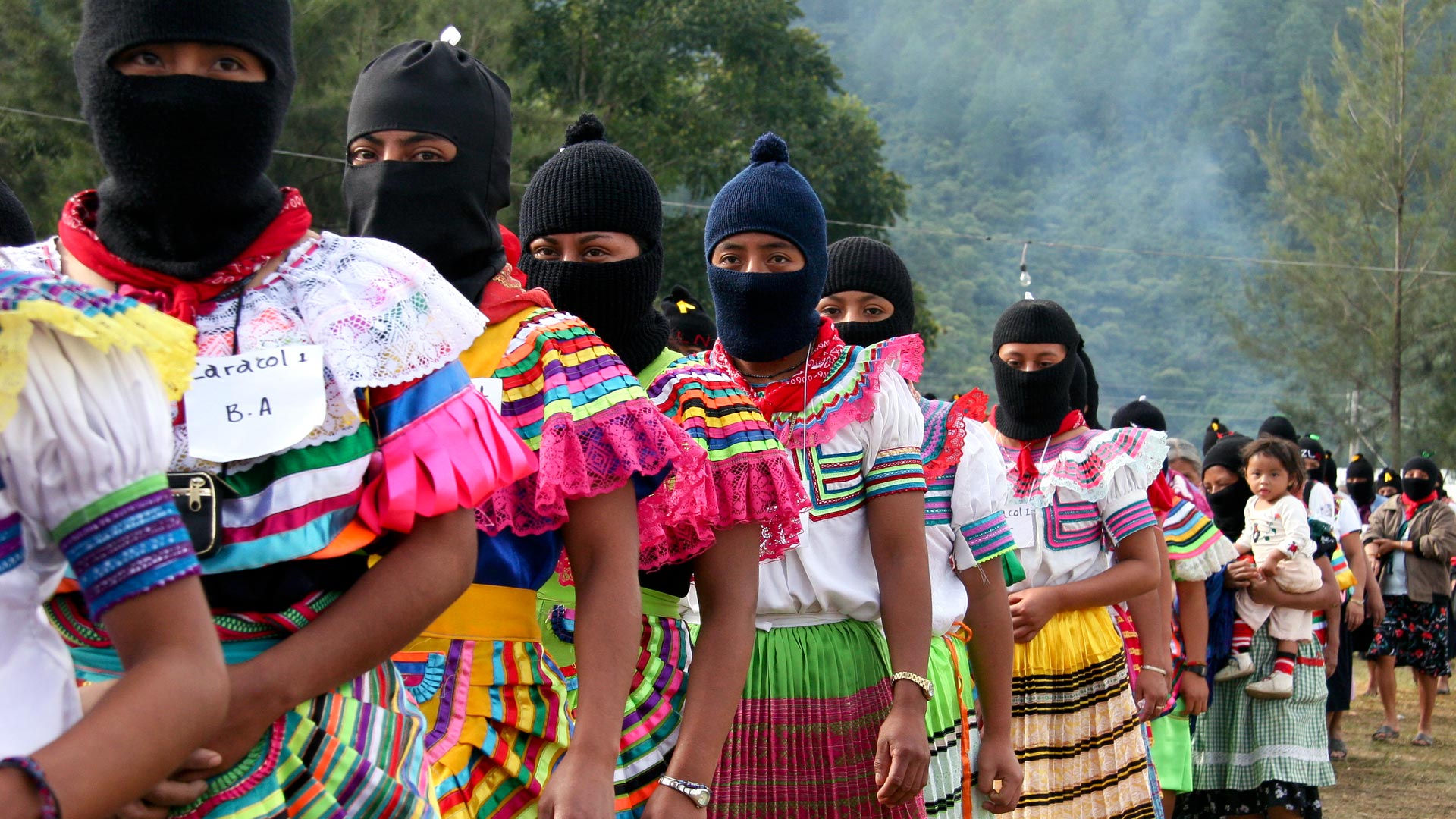
Sí, existe un lugar que se llama La Realidad.
La realidad es un caracol. Y los caracoles, como todo mundo sabe, son espirales. Como la vida, como la muerte, como la realidad.
En el caracol de La Realidad, la madrugada del 25 de mayo de 2014, el Subcomandante Insurgente Marcos, vocero y jefe militar del Ejército Zapatista de Liberación Nacional durante 20 años, reveló su propia irrealidad y anunció que, a partir de ese momento, dejaba de existir.
A La Realidad llegamos el día anterior cientos de mujeres y hombres de muchas partes de México y del mundo y miles de bases de apoyo zapatistas. Cargábamos, todas y todos, el dolor y la rabia por el asesinato brutal de José Luís Solís López, el maestro “Galeano”, las lesiones a otros 15 zapatistas y la destrucción de la escuela, la clínica y varios vehículos, durante un ataque paramilitar el 2 de mayo orquestado por el gobierno de Chiapas.
La caravana en la que viajamos más de 600 personas en 55 vehículos se extendía por más de un kilómetro en el camino que conduce al corazón de la Selva Lacandona. En el largo trayecto, la palabra que más presente estaba en las mentes de todos era “justicia”. En Los hermanos Karamazov, de Dostoievski, Iván cuenta la historia de un niño de ocho años que arroja una piedra que por accidente golpea la pata del perro favorito de un terrateniente. Como castigo, éste lo manda desnudar, lo hace correr y lanza sobre él a sus perros de caza, que lo destrozan frente a los ojos de la madre. ¿Justicia?, se pregunta Iván. ¿Qué justicia puede haber? ¿Qué castigo, por terrible que sea, puede compensar el sufrimiento del niño y el dolor de la madre? Pero entonces, si no hay castigo posible, ¿qué es la justicia? ¿Existe?
La Comandancia General del EZLN afirmó días antes que se haría justicia, pero dejó claro también que justicia y venganza no son lo mismo. Esa madrugada, poco antes de dejar de existir, Marcos dijo: “La justicia pequeña se parece tanto a la venganza. La justicia pequeña es la que reparte impunidad, pues al castigar a uno, absuelve a otros. La que queremos nosotros, por la que luchamos, no se agota en encontrar a los asesinos del compa Galeano y ver que reciban su castigo (que así será, que nadie se llame a engaño). La búsqueda paciente y porfiada busca la verdad, no el alivio de la resignación.” Pero, si la “justicia grande” no es el castigo, como bien entendió Iván Karamazov, ¿qué es? ¿Dónde está esa verdad?
Se trata de una cuestión filosófica pero, en La Realidad, la filosofía se hace al andar y se escribe con la sangre de los muertos. En La Realidad y en la realidad. Porque, ante la mortandad de la supuesta “guerra contra el narco” (120, 130, 150 mil asesinados, dependiendo de quién los cuente… ¿cuántos son demasiados?), ante la privatización de todos los bienes comunes y el despojo de tierras, recursos y vidas, ante la impunidad y el uso del “estado de derecho” para beneficio exclusivo del capital, ante la represión y la criminalización de la protesta, ante la destrucción sistemática del medio ambiente y de formas dignas de vida, ante el simulacro de ilusiones vacías montado por los medios masivos de comunicación, es necesario y urgente preguntarse qué es y qué puede ser la justicia.
Desde el inicio de su lucha, el EZLN se ha hecho esa pregunta. Cuando se levantaron en armas en 1994, llevaban diez años preparándose para la guerra como única opción ante 500 años de despojo, opresión y miseria. La guerra les permitió recuperar grandes extensiones de tierras que estaban en manos de terratenientes que mantenían a los indígenas en condiciones de semiesclavitud, y así iniciar la construcción de formas dignas de vida en territorios bajo su control. Sin la guerra, nada de lo que se construyó después hubiera sido posible.
Pero doce días después se acordó el cese al fuego y los zapatistas nunca volvieron a usar las armas. La respuesta de buena parte de la población mexicana al levantamiento había sido sorprendente. En el auge del proyecto neoliberal, mucha gente se identificó con las demandas zapatistas, y fue en buena parte gracias al movimiento ciudadano que se lograron frenar las masacres cometidas por el ejército mexicano. Pero lo que el pueblo reclamaba era vida, no guerra, y el EZLN supo escuchar. “Y en lugar de dedicarnos a formar guerrilleros, soldados y escuadrones, preparamos promotores de educación, de salud, y se fueron levantando las bases de la autonomía que hoy maravilla al mundo”, dijo Marcos esa madrugada del 25 de mayo. Desde entonces el mensaje ha sido claro: la justicia tiene que ver con la vida, no con la muerte.

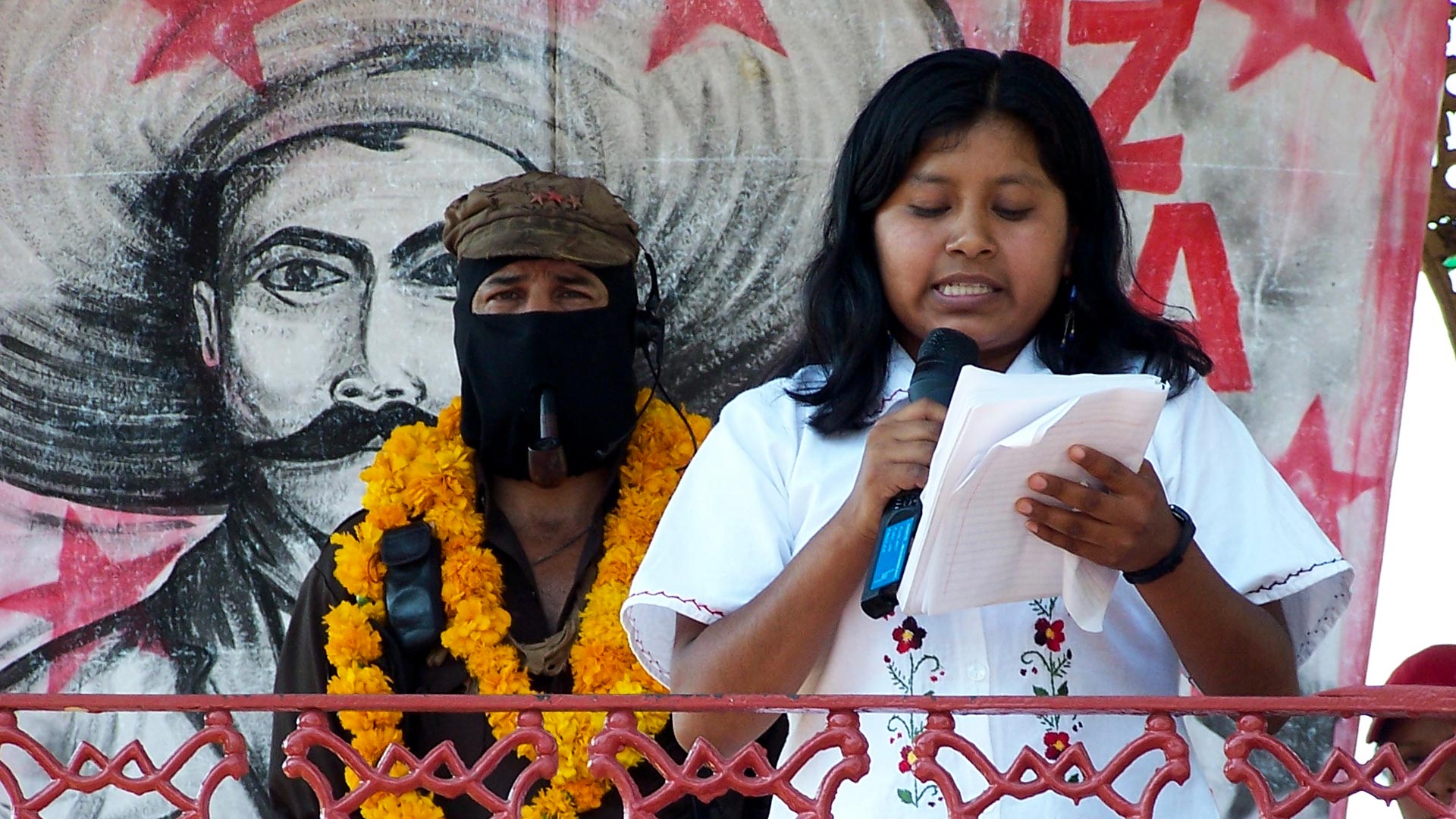
Subcomandante Marcos en La Otra Campaña. Tlapa, Guerrero (2006).
En febrero de 1996 se firmaron los Acuerdos de San Andrés, que garantizaban el autogobierno de los pueblos indígenas y su control de los recursos naturales. Pero el gobierno de Ernesto Zedillo no tenía la intención de cumplirlos, y las reformas constitucionales nunca se hicieron. En los años siguientes, el EZLN se dedicó a presionar al gobierno para obligarlo a cumplir los acuerdos. Estos esfuerzos culminaron en 2001 con la Marcha del Color de la Tierra, una movilización sin precedentes en México: 6 mil kilómetros recorridos en 37 días con la participación de millones de personas en más de 70 actos. La respuesta de los tres partidos políticos: la aprobación de una reforma constitucional que desconoció los Acuerdos de San Andrés.
A partir de ese momento, el EZLN le dio la espalda al gobierno y se dedicó de lleno a la construcción de la autonomía sin pedirle permiso a nadie. En 2003, anunciaron la creación de los caracoles —los centros administrativos y puntos de encuentro de las cinco grandes zonas del territorio zapatista— y las Juntas de Buen Gobierno, quizás el más audaz experimento en democracia participativa del planeta. Los zapatistas demostraban, en la práctica, que sí hay alternativas a la democracia electoral y al sistema liberal. Se aceleró entonces la construcción de la educación y la salud autónomas, los proyectos productivos, la participación de la mujer, la politización de la diferencia. Es imposible dar la importancia que se merece a la autonomía zapatista en unas cuantas líneas. Y, sin embargo, esta fase ha sido también la menos visible porque, cuando el EZLN cortó la comunicación con los de arriba, los medios le dieron la espalda: los zapatistas pasaron de moda.
La Sexta Declaración, a mediados de 2005, marcó otro parteaguas. Encaminada la autonomía en las comunidades (aunque falta lo que falta), el zapatismo se abrió al mundo con una propuesta política radical: la globalización de las resistencias. La formación y consolidación de una multiplicidad de autonomías locales, cada una según sus modos y tiempos, y su articulación de manera orgánica y no jerárquica para, así, conformar un sujeto político global contrahegemónico. Construir en la práctica “un mundo donde quepan muchos mundos” fuera de la lógica del capital. Y fue en la Sexta —“la más audaz y la más zapatista de las iniciativas que hemos lanzado hasta ahora”— donde, finalmente, el EZLN encontró verdaderos interlocutores: “Con la Sexta al fin hemos encontrado quien nos mira de frente y nos saluda y abraza, y así se saluda y abraza”.
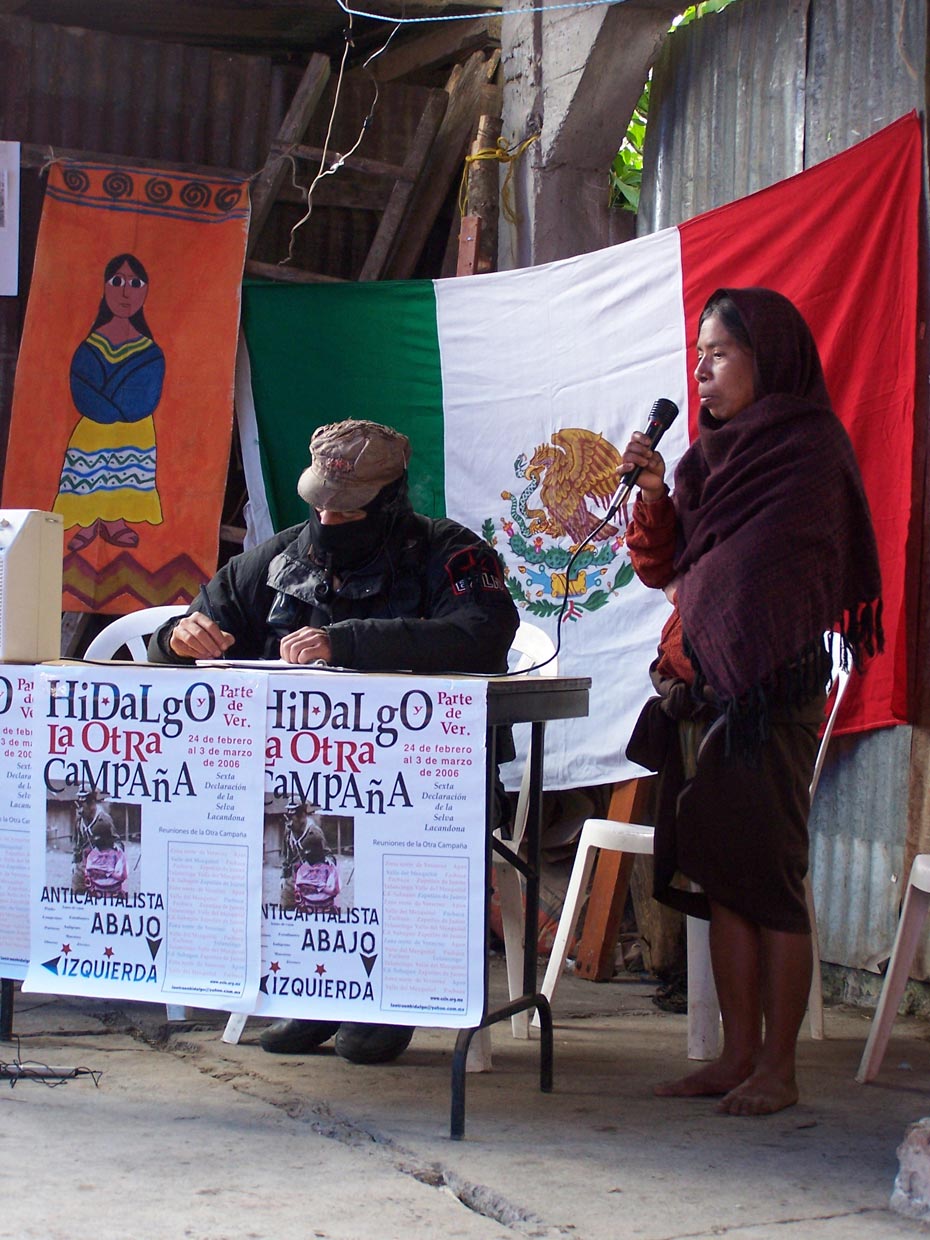
Subcomandante Marcos en La Otra Campaña. Huayacocotla, Veracruz (2006).
La primera iniciativa de la Sexta fue la gira de la Otra Campaña. En 2006, el Subcomandante Marcos recorrió todo el país, reuniéndose con organizaciones e individuos “de abajo y a la izquierda”, en una “anticampaña” que no buscaba obtener adeptos al zapatismo, sino motivar, a través del encuentro de los dolores, el surgimiento de movimientos autónomos. Fue también en esta gira que por vez primera se le dio la espalda a los medios comerciales y se impulsó seriamente a los “medios libres, alternativos, autónomos o como se llamen”. Si lo que se construía era un movimiento de abajo, la comunicación también sería desde abajo.
Siete años después surgió la “Escuelita de la libertad según l@s zapatistas”, quizás la más innovadora de sus iniciativas. En las tres sesiones realizadas hasta ahora, miles de personas de todas partes del mundo han convivido con familias zapatistas en las comunidades rebeldes, aprendiendo en la práctica la experiencia de la construcción de la autonomía, para regresar a sus lugares de origen con la responsabilidad de ir construyendo “otros mundos posibles”. Los alumnos y alumnas son invitados directamente por el EZLN o solicitan una invitación en base a su visión y trabajo político. De ser aceptados, se presentan el día acordado en San Cristóbal de Las Casas, de donde salen grandes caravanas a los cinco caracoles. Una vez en el caracol, a cada persona se le presenta la familia con la que vivirá cinco días y un “votán”, guardián o guardiana, que los acompañará todo el tiempo. De ahí parten al día siguiente rumbo a comunidades que, muchas veces, están a horas de distancia —en camionetas, caminando por veredas, en lancha— en la selva o en las montañas. La generosidad de esta iniciativa es inapreciable: la impresionante logística, los cuidados con la seguridad y la salud de miles de personas en un amplio territorio, la alimentación, la elaboración de los materiales didácticos, el esfuerzo y el corazón de miles de bases de apoyo zapatista, sin pedir nada a cambio, por la simple voluntad de compartir su experiencia de vida y sembrar esperanza.
En ese contexto, la “muerte” de Marcos da inicio a una nueva fase del proyecto zapatista. A Marcos —dijo Marcos— lo inventaron los zapatistas ante la ceguera racista del mundo que impedía (e impide), no sólo a la derecha sino a la intelectualidad de izquierda también, ver a los indios. La genialidad de Marcos el comunicador fue un instrumento para dar a conocer un movimiento que se rige por la ética. Su capacidad analítica, la sagacidad e ironía de su pluma y su manejo de los medios de comunicación permitieron que mucha gente viera la lucha zapatista y la hiciera suya. Al mismo tiempo, Marcos se convirtió en un “distractor”. Para muchos, el zapatismo es Marcos y Marcos es el zapatismo. Mientras el poder y los grandes medios concertaban esfuerzos para elevar y luego destruir la imagen de Marcos, los pueblos avanzaban en la construcción de la autonomía.
Pero ahora el personaje deja de ser necesario. Si desde hace años la política de arriba dejó de interesar al movimiento, si la incidencia en los grandes medios ya no es relevante, si la construcción desde abajo avanza en las comunidades y entre las organizaciones de la Sexta y de tantos movimientos autonomistas en el mundo… ¿qué necesidad hay de que Marcos siga existiendo? La “muerte” de Marcos marca varios cambios fundamentales. Desaparece el interlocutor de origen mestizo y urbano de un movimiento indígena y campesino. En su lugar, queda el nuevo vocero y jefe militar, el Subcomandante Insurgente Moisés, un brillante indígena tseltal de larga carrera, miembro del EZLN desde 1983. El mundo ya no podrá reducir el zapatismo a un amor u odio hacia Marcos: quien quiera verlo, tendrá que ver a los pueblos y su construcción de vida. Este cambio se refleja también en la estrategia de comunicación, iniciada con la Otra Campaña. En el evento en La Realidad el 24 y 25 de mayo, no se admitieron medios de paga, y el mundo tuvo que enterarse de la “muerte” de Marcos a través de los “medios libres, alternativos, autónomos o como se llamen”. A partir de ahora, la realidad zapatista sólo podrá mirarse desde abajo.
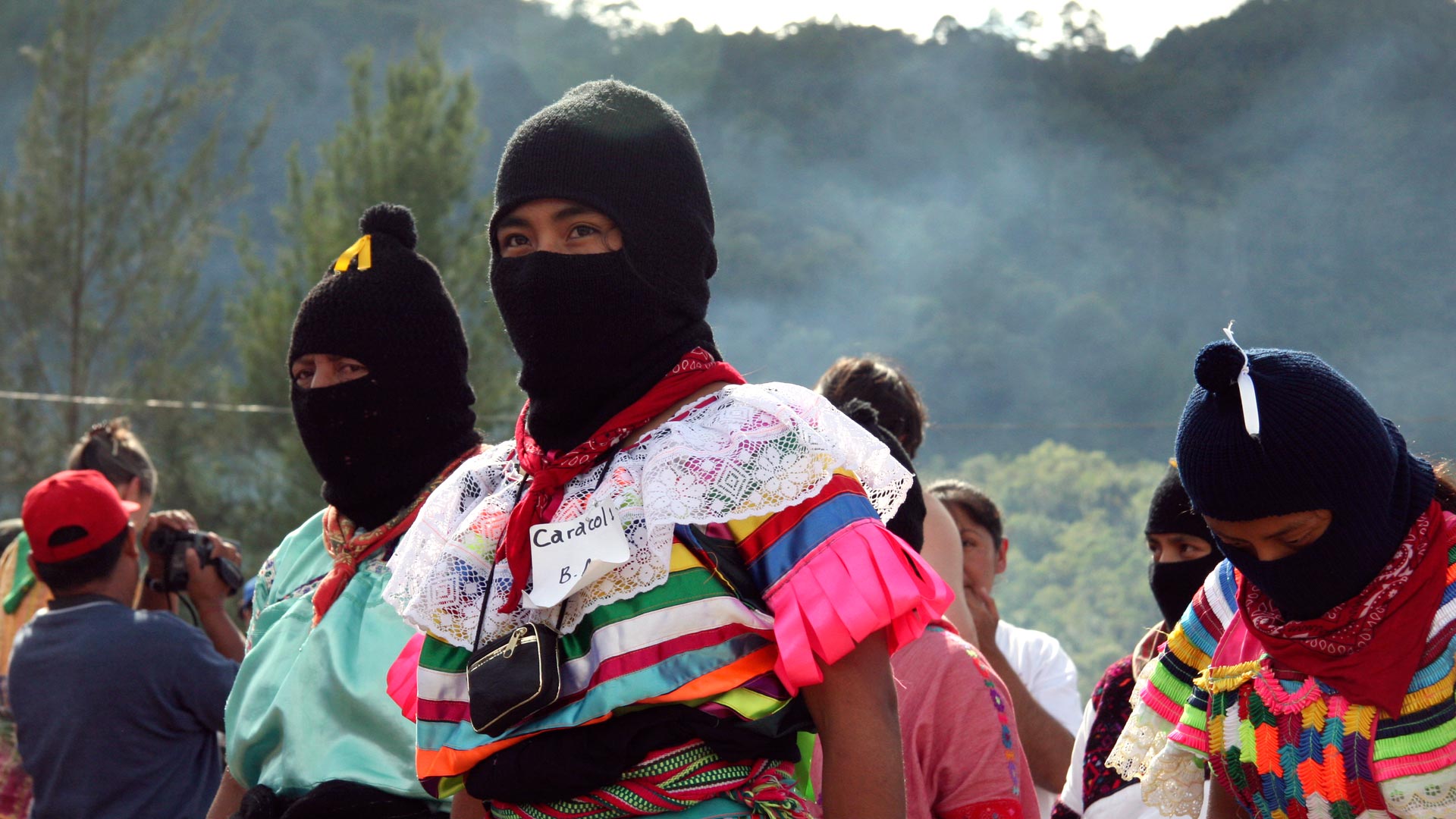
Encuentro de Mujeres. La Garrucha, Chiapas (2008).
Estos cambios surgen en el contexto de un proyecto articulado y preciso del Estado de adueñarse de todos los recursos, tierras y territorios del país para beneficio del capital, y de la reactivación de una guerra contra los zapatistas y contra todas las resistencias organizadas. En Chiapas, desde hace años se ha intentado explotar las riquezas del estado —el más rico en recursos naturales—, pero la resistencia de las comunidades indígenas, sobre todo zapatistas, lo ha impedido. Ahora, el gobierno federal, aliado al estatal, ha dado claras señales de que eso se acabó. En febrero de este año el presidente Enrique Peña Nieto inauguró el aeropuerto internacional de Palenque, pieza clave para el desarrollo megaturístico alrededor de las cascadas de Agua Azul y la reserva natural de Montes Azules. Al mismo tiempo, afirmó que ahora sí se construiría la autopista San Cristóbal-Palenque, detenida debido a la resistencia indígena, y anunció que el anteproyecto estaría listo en mayo (el mismo mes del ataque a La Realidad). Anunció también el inicio de la construcción de la presa hidroeléctrica de Chicoasén II, y las concesiones mineras se han multiplicado. Mientras eso, aumenta la paramilitarización. En enero de este año, 300 miembros de la organización CIOAC (Central Independiente de Obreros Agrícolas y Campesinos) Democrática atacaron a los zapatistas del ejido 10 de Abril, dejando varios heridos, algunos de gravedad. En marzo, un activista tseltal prozapatista del ejido de Bachajón, que se opone a la construcción de la autopista, fue brutalmente asesinado. Y el 2 de mayo la CIOAC Histórica atacó al caracol de La Realidad.
Dicha paramilitarización viene de la mano de proyectos de “desarrollo” y de “combate a la pobreza”, que canalizan fondos públicos para beneficiar a organizaciones contrarias a los zapatistas. No es casual que la “Cruzada Contra el Hambre” haya sido lanzada precisamente en el municipio de Las Margaritas, territorio controlado por la CIOAC. En La Realidad, el Subcomandante Moisés precisó los vínculos descubiertos por la investigación zapatista entre los dirigentes de la CIOAC y los diferentes niveles de gobierno estatal y federal. Tampoco es coincidencia que el ataque del 2 de mayo ocurra justo cuando el EZLN anuncia la “compartición” con los pueblos originarios —una versión especial de la “escuelita” para pueblos indígenas organizados de todo el país— y un seminario internacional sobre “Ética frente al despojo”. Ambos eventos tuvieron que ser cancelados debido al ataque. Aunque la paramilitarización no es nueva, esta agresión difiere de las anteriores por el hecho de atacar directamente a un caracol —el primero y más simbólico de todos— y destruir aquello que simboliza la construcción pacífica de otro mundo posible: la escuela, la clínica, vehículos usados en proyectos productivos. Una cosa está clara: al gobierno le amedrentan mucho menos las armas que la construcción de la vida fuera de su lógica de lucro y despojo.
El asesinato de Galeano (maestro de la Escuelita Zapatista), como bien dijo Marcos, fue un ataque a esa construcción de vida. Ante esa violencia, la Junta de Buen Gobierno pidió a la Comandancia General del EZLN que tomara cartas en el asunto, y ésta declaró que se haría justicia. Pero el castigo a los autores materiales es sólo una “justicia pequeña” que deja impunes a los verdaderos responsables y al sistema que les da origen. “La justicia grande”, dijo Marcos, “tiene que ver con el compañero Galeano enterrado. Porque nosotros nos preguntamos no qué hacemos con su muerte, sino qué debemos hacer con su vida”. Por eso, los zapatistas decidieron “desenterrar” a Galeano.
Cuando Marcos dejó de hablar, encendió su pipa, se levantó, caminó al fondo del templete y se desvaneció en la oscuridad. Los aplausos de miles de manos que siguieron fueron despedida y homenaje y tantas cosas más. Después el Subcomandante Moisés anunció que hablaría otro compañero, y entonces se escuchó en las bocinas la voz que hasta hacía unos momentos perteneció al Subcomandante Marcos:
—Buenas madrugadas tengan compañeras y compañeros. Mi nombre es Galeano, Subcomandante Insurgente Galeano. ¿Alguien más se llama Galeano?
Y miles de voces: “¡Yo soy Galeano! ¡Todos somos Galeano!”
—Ah, tras que por eso me dijeron que cuando volviera a nacer, lo haría en colectivo. Sea pues. Buen viaje. Cuídense, cuídennos. Desde las montañas del sureste mexicano, Subcomandante Insurgente Galeano.
El maestro Galeano había resucitado. Su resurrección en un ser colectivo no es sino la necedad de la vida de resurgir, cada vez más digna, de los escombros de la destrucción y la muerte. Es la justicia grande que ve más allá de la muerte individual para combatir la destrucción sistémica por medio de la lucha colectiva por la vida. Es la esperanza ante la desolación de un sistema perdido en la locura de su propia avaricia.
Publicado en: Revista Anfibia
Por Alejandro Reyes
Fotos: John Gibler
[:en].
Yes, there is a place called La Realidad (Reality).
Reality is a caracol (snail.) And caracoles, as everyone knows, are spirals. Like life, like death, like reality.
In the Caracol of La Realidad, in the early morning of May 25, 2014, Subcomandante Marcos, spokesperson and military leader of the Zapatista National Liberation Army for 20 years, revealed his own unreality and announced that, from then on, he would cease to exist.
The previous day hundreds of women and men from many parts of Mexico and the world and thousands of Zapatista support bases arrived in La Realidad. We carried, all of us, pain and rage over the brutal murder of José Luis Solís López, the teacher “Galeano”, the wounding of 15 other Zapatistas and the destruction of the school, the clinic and several vehicles during a paramilitary attack on May 2 orchestrated by the government of Chiapas.
The caravan, in which more than 600 people travelled in 55 vehicles, stretched for over a mile on the road that leads to the heart of the Lacandón Jungle. During the long journey, the word that was present in the minds of all was “justice.” In The Brothers Karamazov, by Dostoevsky, Ivan tells the story of an eight year old boy who throws a stone and accidentally hits the leg of the landowner’s favourite dog. As punishment, the landowner orders him to undress, makes him run and sets his hunting dogs on him, which destroy him in front of his mother’s eyes. Justice? Asks Ivan. What justice can there be? What punishment, however terrible it may be, can make up for the child’s suffering and the pain of the mother? But then, if there is no possible punishment, what is justice? Does it exist?
The General Command of the EZLN said days before that justice would be done, but also made it clear that justice and vengeance are not the same. That morning, shortly before ceasing to exist, Marcos said: “Small justice looks so much like revenge. Small justice is what distributes impunity; as it punishes one, it absolves others. What we want, what we fight for, does not end with finding Galeano’s murderers and seeing that they receive their punishment (make no mistake this is what will happen). The patient and obstinate search seeks truth, not the relief of resignation.” But if “great justice” is not punishment, as Ivan Karamazov understood well, what is it? Where is this truth?
It is a philosophical question, but in La Realidad, philosophy is made by walking and is written with the blood of the dead. In La Realidad and in reality. Because, before the death count of the alleged “war on drugs” (120, 130, 150 thousand killed, depending on who is counting … how many are too many?), before the privatization of all common ownership and the dispossession of land, resources and lives, before impunity and the use of the “rule of law” for the exclusive benefit of capital, before the repression and criminalization of protest, before the systematic destruction of the environment and of dignified ways of life, before the simulation of empty illusions mounted by the mass media, it is necessary and urgent to ask what is and what can be justice.
From the beginning of their struggle, the EZLN has asked that question. When they took up arms in 1994, they had been preparing for war for ten years as the only option to 500 years of dispossession, oppression and misery. The war allowed them to reclaim large tracts of land which were in the hands of by landowners who kept the indigenous in conditions of semi-servitude, and in this way began the construction of dignified ways of life in territories under their control. Without the war, nothing that was built afterwards would have been possible.
But twelve days after, a ceasefire was agreed and the Zapatistas never again returned to the use of arms. The response of most of the Mexican population to the uprising was one of surprise. At the height of the neoliberal project, many people identified with the Zapatista demands, and it was largely thanks to the citizen movement that it was possible to stop the massacres committed by the Mexican army. But what the people were calling for was life, not war, and the EZLN knew how to listen. “And rather than dedicating ourselves to training guerrillas, soldiers, and squadrons, we developed education and health promoters, who went about building the foundations of autonomy that today amaze the world,” Marcos said on this morning of 25 May. Since then, the message was clear: justice has to do with life, not death.
Subcomandante Marcos in the Other Campaign. Tlapa, Guerrero (2006).
In February 1996 the San Andrés Accords, guaranteeing the self-government of indigenous peoples and their control over natural resources, were signed. But the government of Ernesto Zedillo had no intention of fulfilling them, and constitutional reforms were never made. In the following years, the EZLN dedicated itself to pressurising the government to oblige it to comply with the agreements. These efforts culminated in 2001 with the March of the Colour of the Earth, an unprecedented mobilization in Mexico: 6000 kilometres in 37 days with the participation of millions of people in more than 70 events. The response of the three political parties: the adoption of a constitutional amendment that ignored the San Andrés Accords.
From that moment, the EZLN turned its back on the government and devoted itself to the construction of autonomy without asking anyone’s permission. In 2003, they announced the creation of the Caracoles, – the administrative centres and meeting places of the five large areas of Zapatista territory – and the Good Government Juntas, perhaps the boldest experiment in participatory democracy in the world. The Zapatistas proved, in practice, that yes there are alternatives to electoral democracy and the liberal system. They then speeded up the construction of autonomous education and health, productive projects, the participation of women, the politicisation of difference. It is impossible to give Zapatista autonomy the importance it deserves in a few lines. And yet, this phase is also the least visible because, when the EZLN broke the connection with those from above, the media turned their backs: the Zapatistas went out of fashion.
The Sixth Declaration, in mid-2005, marked another watershed. With autonomy walking in the communities (although what is missing is missing), the Zapatistas opened themselves to the world with a radical political proposal: the globalization of resistances. The formation and consolidation of a multiplicity of local autonomies, each one according to their ways and times, and their articulation in an organic and non-hierarchical way, to thereby form a counter-hegemonic global political subject. To build in practice “a world where many worlds fit” out of the logic of capital. And it was in the Sixth – “the boldest and most Zapatista of the initiatives which we have released so far” – where, finally, the EZLN found true partners, “With the Sixth at last have found those who look us in the eye and greet and embrace us, and so we welcome and embrace.”
Subcomandante Marcos in the Other Campaign. Huayacocotla, Veracruz (2006).
The first initiative of the Sixth was the tour of the Other Campaign. In 2006, Subcomandante Marcos travelled around the country, meeting with organizations and individuals “from below and to the left” in a “anti-campaign”, which did not seek to obtain adherents to the Zapatista movement, but to encourage, through the meeting of sorrows, the emergence of autonomous movements. It was also during this tour that for the first time they turned their back on the commercial media, and strongly encouraged the “free, alternative, independent media or whatever they’re called.” If what was being built was a movement from below, communication would also be from below.
Seven years later, the “Little School (Escuelita) of Freedom according to the Zapatistas” emerged, perhaps the most innovative of all their initiatives. In the three sessions held so far, thousands of people from all over the world have lived together with families in Zapatista rebel communities, learning in practice the experience of building autonomy, to return to their places of origin with the responsibility of going about building “other possible worlds.” The students are directly invited by the EZLN or request an invitation based on their vision and political work. Once they have been accepted, they present themselves on the agreed day in San Cristobal de Las Casas, from where great caravans leave for the five caracoles. Once in the caracol, each person meets with the family they will live with for five days and a “votán,” or guardian, who will accompany them all the time. They depart from there the next day heading towards communities that often are hours away – in vans, walking on trails, by boat -in the forest or in the mountains. The generosity of this initiative is immeasurable: the impressive logistics, the care for the safety and health of thousands of people over a wide area, feeding, preparation of teaching materials, the effort and the heart of thousands of Zapatista support bases, asking nothing in return, for the simple desire to share their life experience and to sow hope.
In this context, the “death” of Marcos begins a new phase of the Zapatista project. Marcos –said Marcos – was invented by the Zapatistas faced with the racist blindness in the world which prevented (and prevents), not only the right but also the intelligentsia of the left from seeing the Indians. The genius of Marcos the communicator was instrumental in revealing to the world a movement governed by ethics. His analytical ability, the sagacity and irony of his pen, and his handling of the media allowed many people to see the Zapatista struggle and make it their own. At the same time, Marcos became a “distraction.” For many, Zapatismo is Marcos and Marcos is Zapatismo. While power and the mainstream media were concentrating their efforts on raising and then destroying the image of Marcos, the people were advancing in the construction of autonomy.
But now the character is no longer necessary. If years ago the politics of above stopped being interested in the movement, if its appearance in the mainstream media is no longer relevant, if construction from below is advancing in the communities and between organizations of the Sixth and many autonomous movements in the world, what need is there… for Marcos to continue to exist? The “death” of Marcos marks several fundamental changes. Gone is the interlocutor of mestizo and urban origin of an indigenous and campesino movement. Instead, the new military leader and spokesman is Subcomandante Insurgente Moisés, a brilliant indigenous Tzeltal with a long career, member of the EZLN since 1983. The world can no longer reduce Zapatismo to “love or hate Marcos.” Whoever wants to see it, will have to see the people and their construction of life. This change is also reflected in the communication strategy, which began with the Other Campaign. In the event at La Realidad on 24 and 25 May, no paid media were admitted, and the world learned of the “death” of Marcos through the “free, alternative, independent media or whatever they’re called.” From now on, the Zapatista reality can only be viewed from below.
Women’s Encounter. La Garrucha, Chiapas (2008).
These changes arise in the context of an articulated and precise project of the state to take over all the resources, lands and territories for the benefit of capital, and of reviving a war against the Zapatistas and all the organized resistances. In Chiapas, it has tried for years to exploit the riches of the state — the richest in natural resources –, but the resistance of indigenous communities, especially the Zapatistas, has prevented this. Now the federal, allied to the state, government has given clear signs that that this is over. In February this year President Enrique Peña Nieto inaugurated the Palenque International Airport, a key element for the megatourism development around the waterfalls of Agua Azul and in the Montes Azules Natural Reserve. At the same time, he confirmed that now the San Cristóbal-Palenque highway, delayed due to indigenous resistance, would be built and announced that the blueprint would be ready in May (the same month as the attack on La Realidad). He also announced the start of the construction of the hydroelectric dam Chicoasén II, and mining concessions have multiplied. Meanwhile, paramilitarisation increases. In January this year, 300 members of the organization CIOAC-Democrática (“Democratic” Independent Central of Agricultural Workers and Campesinos) attacked the Zapatista ejido of 10 de Abril, leaving several injured, some seriously. In March, a Tseltal pro-Zapatista activist from the ejido Bachajón, which opposes the construction of the highway, was brutally murdered. And on May 2. CIOAC-Historica attacked the Caracol of La Realidad.
This paramilitarisation comes on the heels of projects of “development” and “poverty alleviation,” which channel public funds to benefit organizations opposed to the Zapatistas. It is no coincidence that the “Crusade against Hunger” has been launched precisely in the municipality of Las Margaritas, territory controlled by CIOAC. In La Realidad, Subcomandante Moisés detailed the links discovered by the Zapatista investigation between the leaders of CIOAC and different levels of the state and federal government. Neither is it a coincidence that the attack of May 2 occurred just when the EZLN were announcing the “sharing” with the original peoples, – a special version of the “escuelita” for the organised indigenous peoples around the country, and an international seminar on “Ethics in the Face of Dispossession.” Both events had to be cancelled due to the attack. Although the paramilitarisation is not new, this aggression differs from the previous ones in the fact that it was a direct attack on a caracol – the first and most symbolic of all – and destroyed that which symbolizes the peaceful construction of another possible world: the school, the clinic, vehicles used in productive projects. One thing is clear: the government is much less intimidated by arms than by the construction of life outside the logic of profit and dispossession.
The murder of Galeano (teacher at the Zapatista Escuelita), as Marcos well said, was an attack on this construction of life. Faced with such violence, the Good Government Junta requested the General Command of the EZLN to take action on the matter, and they said that justice would be done. But the punishment of the perpetrators is just a “small justice,” leaving unpunished the real culprits and the system that gives rise to them. “True justice,” said Marcos, “has to do with the buried compañero Galeano. Because we ask ourselves not what do we do with his death, but what do we do with his life.” Therefore, the Zapatistas decided to “bring Galeano back from the grave.”
When Marcos stopped speaking, he lit his pipe, got up, walked to the bottom of the platform and vanished into the darkness. The applause of thousands of hands that followed was a farewell, a tribute and so much more. Afterwards, Subcomandante Moisés announced that another compañero was going to say a few words, and then the voice was heard through the speakers that until a few moments before had belonged to Subcomandante Marcos:
“Good early morning compañeras and compañeros. My name is Galeano, Subcomandante Galeano. Is anyone else called Galeano?”
And thousands of voices: “I am Galeano! We are all Galeano!”
“Ah, that’s why they told me that, when I was reborn, it would be collectively. And so it should be. Have a good journey. Take care of yourselves, take care of us. From the mountains of the Mexican Southeast, Subcomandante Insurgente Galeano.”
The teacher Galeano had risen. His resurrection as a collective being is nothing more than the need for life to re-emerge, more dignified each time, from the debris of destruction and death. It is the big justice which looks beyond individual death to combat systemic destruction through the collective struggle for life. It is hope in the face of the desolation of a system lost in the madness of its own greed.
By Alejandro Reyes
Photos: John Gibler
Published originally in Spanish in: Anfibia Magazine
Translation: Dorset Chiapas Solidarity Group
[:]

