Noticias:News:

EZLN

image/svg+xml image/svg+xml
radio
Red Universitaria Anticapitalista

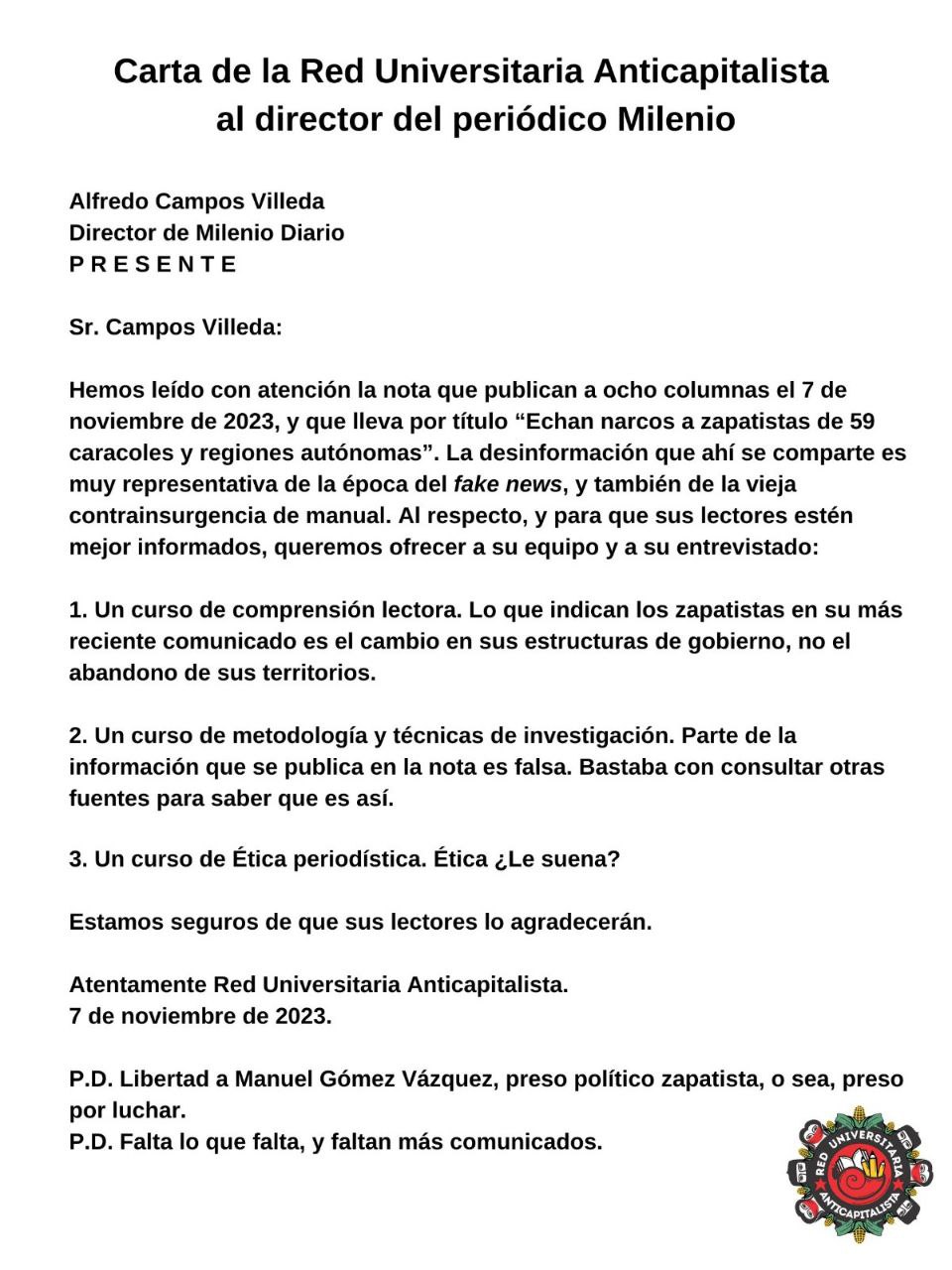
[:es]Carta de la Red Universitaria Anticapitalista al director del periódico Milenio[:]

[:es]

[:]

radio
Noticias de Abajo ML

[:es]Noticias de Abajo – 7 nov 2023[:en]No[:]

[:es]

Rompiendo Fronteras

  • PALESTINA: Un mes de genocidio en Palestina por el Estado de Israel y más de 70 años de ocupación militar. Más de 10 mil víctimas mortales, de las cuales más de 4 mil son infancias.
  • PANAMÁ: Tercera de semana de movilizaciones masivas en el contexto del paro contra la minería. Exigen cancelación de contrato minero.

Desde el ombligo del monstruo::.

  • CDMX: Otomies en resistencia y rebeldía resisten ante intento de desalojo en su lucha por la vivienda digna y contra el olvido. Bloquean avenida por más de 20 días y doblegan al gobierno. Tercer aniversario de la TomaINPI, ahora la Casa de los Pueblos.
  • GUERRERO: Costa de Guerrero es destruida por huracán Otis categoría 5. Ante ineficiencia del gobierno y militarización, el pueblo se organiza. Más de 800 cientos mil personas.
  • CHIAPAS: Comunicados zapatistas anuncian cambios en la estructura de sus autonomías y llaman a actividad en zona rebelde por los 30 años del levantamiento.
  • OAXACA: Convocan a Faena por los presos de Eloxochitlan de Flores Magón el 18, 19 y 20 de noviembre.
  • JALISCO: ¿A dónde van los desaparecidos? Ante una grave crisis de desapariciones forzadas en el país. Madres buscadoras de Jalisco encuentran un crematorio clandestino, el tercero en el estado.

[:]

radio
Avispa Midia

[:es]EZLN anuncia desaparición de municipios y autoridades autónomas[:]

[:es]Fuente: Avispa Midia

Por Sare Frabes

En marzo del 2022, miles de zapatistas se movilizaron simultáneamente en cinco municipios de Chiapas para protestar contra todas las guerras. Foto: Tercios compas / Enlace Zapatista

El pasado domingo (5), el Ejército Zapatista de Liberación Nacional (EZLN), a través del cuarto comunicado difundido durante el último mes, tras meses sin declaraciones oficiales, anunció la desaparición de los Municipios Autónomos Rebeldes Zapatistas (MAREZ), así como las Juntas de Buen Gobierno (JBG).

El documento, firmado por el Subcomandante Insurgente Moisés, afirma que la decisión de los pueblos zapatistas se “realiza después de un largo y profundo análisis crítico y autocrítico”, así como tras consultar a las comunidades autónomas de Chiapas.

En consecuencia, el EZLN comunicó la invalidez de todos los sellos, membretes, cargos, representaciones y futuros acuerdos con cualquier MAREZ o JBG; los acuerdos sostenidos antes de esta fecha se mantendrán hasta el final de su vigencia . También compartieron que los Caracoles permanecerán cerrados al exterior hasta nuevo aviso.

“Las razones y el proceso por el que se tomó esta decisión se las iremos platicando poco a poco en los escritos siguientes. Sólo les adelanto que esta valoración, en su fase final, se inició hace unos 3 años. También les iremos explicando cómo es y cómo se ha ido gestando la nueva estructura de la autonomía zapatista”, contextualiza el vocero zapatista.

Chiapas: completo caos

El vocero zapatista detalla que las principales ciudades de Chiapas viven “en un completo caos. Las presidencias municipales están ocupadas por lo que nosotros llamamos ‘sicarios legales’ o ‘Crimen Desorganizado’. Hay bloqueos, asaltos, secuestros, cobro de piso, reclutamiento forzado, balaceras. Esto es efecto del padrinazgo del gobierno del estado y la disputa por los cargos que está en proceso. No son propuestas políticas las que se enfrentan, sino sociedades criminales”, asevera el comunicado.

(Continuar leyendo…)

radio
Subcomandante Insurgente Moisés

[:es]EZLN | Cuarta Parte y Primera Alerta de Aproximación. Varias Muertes Necesarias[:en]EZLN | Fourth Part and First Approach Alert. Several Necessary Deaths.[:]

[:es]

Cuarta Parte y Primera Alerta de Aproximación.
Varias Muertes Necesarias.

Noviembre del 2023.

A las personas que suscriben la Declaración por la Vida:

  Les comunicamos lo siguiente:

PRIMERO. – Desde hace algunos meses, después de un largo y profundo análisis crítico y autocrítico, y de consultar a todos los pueblos zapatistas, se decidió la desaparición de los Municipios Autónomos Rebeldes Zapatistas (MAREZ) y las Juntas de Buen Gobierno.

SEGUNDO. – Todos los sellos, membretes, cargos, representaciones y acuerdos con el nombre de cualquier MAREZ o de cualquiera de las Juntas de Buen Gobierno, son inválidos a partir de este momento. Ninguna persona se puede presentar como miembro, autoridad o representante de cualquier MAREZ o Junta de Buen Gobierno. Los acuerdos sostenidos antes de esta fecha, con Organizaciones No Gubernamentales, organizaciones sociales, colectivos, grupos e instancias de solidaridad en México y el mundo se mantienen hasta la expiración de los mismos, pero no se podrán hacer nuevos acuerdos con estas instancias de la autonomía zapatista, por la simple razón de que ya no existen.

TERCERO. – Se mantienen los Caracoles, pero permanecerán cerrados al exterior hasta nuevo aviso.

CUARTO. – Las razones y el proceso por el que se tomó esta decisión, se las iremos platicando poco a poco en los escritos siguientes. Sólo les adelanto que esta valoración, en su fase final, se inició hace unos 3 años. También les iremos explicando cómo es y cómo se ha ido gestando la nueva estructura de la autonomía zapatista.

Todo eso, y más cosas, irán apareciendo en el momento oportuno.

QUINTO. – Les avisamos que haremos una celebración con motivo de los 30 años del inicio de la guerra contra el olvido. Esto en los meses de diciembre del 2023 y enero del 2024. Están invitadas todas las personas que firmaron la “Declaración por la Vida”.

  Sin embargo, es nuestro deber, al mismo tiempo que se les invita, desalentarles. Contrario a lo que informa y desinforma la prensa oficialista, autodenominada cool-progre-buena-ondita, las principales ciudades del suroriental estado mexicano de Chiapas están en un completo caos. Las presidencias municipales están ocupadas por lo que nosotros llamamos “sicarios legales” o “Crimen Desorganizado”. Hay bloqueos, asaltos, secuestros, cobro de piso, reclutamiento forzado, balaceras. Esto es efecto del padrinazgo del gobierno del estado y la disputa por los cargos que está en proceso. No son propuestas políticas las que se enfrentan, sino sociedades criminales.

  Entonces, pues claro les decimos que, a diferencia de otros años, no es seguro.

  San Cristóbal de las Casas, Comitán, Las Margaritas y Palenque, por mencionar algunas cabeceras municipales, están en manos de uno de los cárteles del crimen desorganizado y en disputa con otro. Esto es constatado por la llamada industria hotelera, turística, restaurantera y de servicios. Quienes trabajan en estos lugares lo saben y no lo han denunciado porque están amenazados y, además, saben que es inútil cualquier petición, porque las autoridades estatales y municipales son las que delinquen y no tienen llenadera en la robadera que están haciendo.

  En las comunidades rurales el problema es más grave aún. Eso lo gritan quienes las habitan en todas las regiones de Chiapas, particularmente en toda la franja fronteriza con Guatemala.

  Lo que se lee, escucha y se ve en la mayoría de los medios locales y nacionales, es sólo un eco malo y sinvergüenza, de las redes sociales del gobierno del estado. La verdad es que las autoridades oficiales son el problema. Sí, como en el resto del país.

  Las fuerzas militares y policíacas federales, estatales y locales, no están en Chiapas para proteger a la población civil. Están con el único objetivo de frenar la migración. Ésa es la orden que vino desde el gobierno norteamericano. Como es su modo, han convertido la migración en un negocio. El tráfico y la trata de personas es un negocio de las autoridades que, mediante la extorsión, el secuestro y compraventa de migrantes, se enriquecen desvergonzadamente.

  Entonces, pues no les aconsejamos que vengan. A menos, claro, que se organicen muy bien para hacerlo.

  Entonces, aunque no les esperamos, les invitamos. Las fechas tentativas de las conmemoraciones son entre el 23 de diciembre del 2023 y el 7 de enero del 2024, siendo la celebración central los días 30-31 de diciembre y 1-2 de enero. Luego les diremos el lugar. O sea que sí queremos que vengan, aunque no lo recomendamos.

  Aunque no lleguen, no preocupar. Igual les mandaremos fotos y videos.

  Bueno, eso si todavía hay mundo para esas fechas.

  Ahí lo vean.

Desde las montañas del Sureste Mexicano.

Subcomandante Insurgente Moisés.
México, noviembre del 2023.

[:en]

Fourth Part and First Approach Alert.
Several Necessary Deaths.
November 2023

To the people who subscribe the Declaration for Life:

We inform you of the following:

FIRST. – A few months ago, after a long and profound critical and self-critical analysis, and after consulting all the Zapatista towns, it was decided to disappear the Zapatista Rebel Autonomous Municipalities (MAREZ) and the Good Government Juntas.

SECOND. – All seals, letterheads, positions, representations and agreements with the name of any MAREZ or any of the Good Government Juntas are invalid from this moment on. No person can present themselves as a member, authority or representative of any MAREZ or Good Government Junta. The agreements held before this date, with Non-Governmental Organizations, social organizations, collectives, solidarity groups and instances in Mexico and the world are maintained until their expiration, but new agreements cannot be made with these bodies of Zapatista autonomy, for the simple reason that they no longer exist.

THIRD. – The Caracoles remain, but they will remain closed to the outside world until further notice.

FOURTH. – We will tell you the reasons and process by which this decision was made little by little in the following texts. I can only tell you that this evaluation, in its final phase, began about 3 years ago. We will also explain to you what the new structure of Zapatista autonomy is like and how it has been developing.

All that, and more things, will appear at the right time.

FIFTH. – We inform you that we will hold a celebration to mark the 30th anniversary of the beginning of the war against oblivion. This, in the months of December 2023 and January 2024. All people who signed the “Declaration for Life” are invited.

However, it is our duty, while inviting you, to discourage you. Contrary to what the official press, self-proclaimed cool-progre-chill, reports and misinforms, the main cities of the southeastern Mexican state of Chiapas are in complete chaos. The municipal presidencies are occupied by what we call “legal hitmen” or “Disorganized Crime.” There are blockades, assaults, kidnappings, “cobro de piso”, forced recruitment, shootings. This is the effect of the protection of the state government and the dispute over the political charges that is in process. What is being confronted are not political proposals, but rather criminal societies.

So, of course we tell you that, unlike other years, it is not safe.

San Cristóbal de las Casas, Comitán, Las Margaritas and Palenque, to mention some municipal seats, are in the hands of one of the disorganized crime cartels and in dispute with another. This is confirmed by the so-called hotel, tourism, restaurant and service industries. Those who work in these places know this and have not reported it because they are threatened and, furthermore, because they know that any request is useless, because the state and municipal authorities are the ones who commit crimes and know no limit in the robbery they are doing.

In rural communities the problem is even more serious. This is what is being shouted by those who live in all the regions of Chiapas, particularly in the entire border strip with Guatemala.

What is read, heard and seen in the majority of local and national media is just a bad and shameless echo of the state government’s social networks. The truth is that the official authorities are the problem. Yes, like in the rest of the country.

Federal, state and local military and police forces are not in Chiapas to protect the civilian population. They have the sole purpose of stopping migration. That is the order that came from the North American government. As is their way, they have turned migration into a business. Human trafficking is a business of the authorities who, through extortion, kidnapping and buying and selling of migrants, shamelessly enrich themselves.

So, we do not advise you to come. Unless, of course, you organize yourselves very well to do so.

So, although we are not waiting for you, we are inviting you. The tentative dates of the commemorations are between December 23, 2023 and January 7, 2024, the central celebration being December 30-31 and January 1-2. We will tell you the place afterwards. That is to say, we do want you to come, although we don’t recommend it.

Even if you don’t arrive, don’t worry. We will still send you photos and videos.

Well, that is if there still is a world in those dates, anyway.

See it for yourselves.

From the Mountains of the Mexican Southeast
Subcomandante Insurgente Moisés
Mexico, November 2023.

[:]

radio
Capitán Insurgente Marcos

[:es]Comunicado EZLN | Tercera Parte: Dení[:en]EZLN | Third Part: Dení[:]

[:es]

Tercera Parte: Dení.

  Decía el finado SupMarcos que no se podían entender las razones del alzamiento sin conocer antes la historia de Paticha, la niña menor de 5 años que se le murió en brazos por falta de una pastilla para la fiebre. Yo ahora les digo que no podrán entender lo que luego les explicará con detalle el Subcomandante Insurgente Moisés si no conocen la historia de Dení.

  Dení es una niña indígena, de sangre y raíz maya. Es hija de una insurgenta y un insurgente indígenas zapatistas. Cuando nació, hará hace unos 5 años, le pusieron ese nombre para honrar la memoria de una compañera que murió hace muchos años.

  A Dení la conoció el finado SupGaleano cuando era un Patz. O sea un tamalito, por lo gorda que estaba. De hecho, así le decía el Sup: “Patz”. Ahora es flaquita, porque anda de un lado para otro. Dení, cuando las insurgentas se reúnen para hacer un trabajo, se pone, según ella, a darles clases de salud autónoma. Y dibuja unos garabatos que, según explicó luego, son unas promotoras de salud. Ella dice que son mejores las promotoras porque luego los hombres no entienden de “como mujeres que somos”. Sostiene firmemente que, para ser promotora de salud, tiene que vas a saber inyectar pero que no te duela. “Porque, ¿qué tal que necesitas inyección y no quieres porque te duele?”

  Ahora estamos en una reunión de las jefas y jefes zapatistas. El padre y la madre de Dení no están presentes, pero la niña llegó siguiendo al Tzotz y a la Pelusa, que están echados a los pies del Subcomandante Insurgente Moisés y, al parecer, están atentos a lo que se dice.

  Alguien está explicando:

  “Aquí está presente Dení y ella es, digamos, la primera generación. Dentro de 20 años, Dení va a tener una cría mujer y le va a poner de nombre “Denilita”, ella sería la segunda generación. Denilita, 20 años después, va a concebir una niña que se va a llamar “Denilitilla”, es la tercera generación. Denilitilla, llegada a sus 20 años, va a procrear una niña que se va a llamar “Denilititilla”, sería la cuarta generación. Denilititilla, al cumplir los 20, va a parir una niña y la va a llamar “Denilí”, la quinta generación. Denilí a los 20 años de edad, va a tener una niña que se va a llamar “Dení Etcétera”, que viene siendo la sexta generación. Dení Etcétera, 20 años después, o sea dentro de 120 años, va a tener una niña que no alcanzamos a ver qué nombre tiene, porque ya está retirado su nacimiento en el calendario, pero ella es la séptima generación.”

  Aquí interviene el Subcomandante Insurgente Moisés: “Entonces nosotros tenemos que luchar para que esa niña, que va a nacer en 120 años, sea libre y sea lo que le dé la gana ser. Entonces no estamos luchando para que esa niña sea zapatista o partidista o lo que sea, sino que ella pueda elegir, cuando tenga juicio, cuál es su camino. Y no sólo que pueda decidir libremente, también y, sobre todo, que se haga responsable de esa decisión. Es decir, que tome en cuenta que todas las decisiones, lo que hacemos y lo que dejamos de hacer, tienen consecuencias. Entonces se trata de que esa niña crezca con todos los elementos para tomar una decisión y para hacerse responsable de sus consecuencias.

  O sea que no le eche la culpa al sistema, a los malos gobiernos, a sus papás y mamás, a sus familiares, a los hombres, a su pareja (sea hombre o mujer o lo que sea), a la escuela, a sus amistades. Porque eso es la libertad: poder hacer algo sin presiones u obligado, pero respondiendo de lo que se hizo. O sea sabiendo las consecuencias desde antes.”

  El SubMoy voltea a mirar al ahora difunto SupGaleano, como diciendo “te toca”. El difunto que todavía no es difunto (pero que ya sabe que pronto lo será), prevé que algún día habrá que platicar eso a extraños e inicia:

  “¿Esa Dení a la N Potencia ya no hablará mal de los pinches hombres? Sí lo va a hacer, como de por sí. Pero no van a ser sus argumentos que porque se burlaron de ella, la despreciaron, la violentaron, la acosaron, la violaron, la golpearon, la desaparecieron, la asesinaron, la descuartizaron. No, va a ser por cosas y asuntos normales, como que el pinche hombre echa pedos en la cama y apesta la cobija; o que no le atina a la taza del baño; o que eructa como becerro; o que se compra la playera de su equipo favorito, se pone pantalones cortos, calcetas y zapatos especiales de fútbol, para luego sentarse a ver los partidos mientras se atasca de palomitas con harta salsa picante; o que pone mucho cuidado en elegir el “outfit” que va a usar por décadas: su playera preferida, sus pants favoritos, y sus chanclas predilectas; o porque no suelta el control de la televisión; o que no le dice que la quiere, aunque ella sabe que la quiere, pero no sobra un recordatorio de vez en cuando.”

  Entre quienes escuchan, las mujeres mueven afirmativamente la cabeza como diciendo “de por sí”; y los varones sonríen con nerviosismo.

  El SubMoy sabe que es su maña del SupGaleano y que ahora va a pasar, en lo que se llama “solidaridad de género”, a mal hablar de las mujeres, así que interrumpe justo cuando el ahora finado está diciendo: “Pero es que las mujeres…”

  “Bueno”, dice el SubMoy, “ahora estamos hablando de una niña que va a nacer dentro de 120 años y nos vamos a concentrar en eso”. El que intuye que será finado se sienta, lamentando no haber podido exponer su brillante tesis contra las mujeres. El SubMoy continúa:

  “Entonces tenemos que pensar en esa niña. Ver lejos, pues. Y, mirando eso que parece muy lejano, hay que ver qué tenemos que hacer para que esa niña sea libre.

  Y esto es importante porque ya tenemos encima la tormenta. La misma de la que advertimos hace casi 10 años. Lo primero que vemos es que la destrucción viene más rápido. Lo que pensamos que pasaría dentro de 10 años, ya está aquí.

  Ustedes lo han explicado ya aquí. Nos han contado lo que ven en sus zonas Tzeltal, Tzotzil, Cho´ol, Tojolabal, Mame, Zoque, Quiché. Saben ya lo que está pasando con la madre tierra porque viven y trabajan en ella. Saben que está cambiando el tiempo. “El clima”, como dicen los ciudadanos. Que llueve cuando no toca, que está la seca cuando no toca. Y así. Saben que las siembras ya no se pueden decidir como nuestros anteriores, porque el calendario viene chueco, cambiado pues.

  Pero no sólo. También vemos que los comportamientos de los animales cambiaron, aparecen en zonas que no es su costumbre y en temporadas que no les toca. Aquí y en las geografías de pueblos hermanos, aumentan los que llaman “desastres naturales” pero que son consecuencia de lo que hace y deja de hacer el sistema dominante, o sea el capitalismo. Hay lluvias, como de por sí, pero ahora son más fieras y en lugares y temporadas que no son las de antes. Hay sequías muy terribles. Y ahora pasa que, en una misma geografía – por ejemplo aquí en México-, en un lado hay inundaciones y en otro hay sequía y se quedan sin agua. Hay fuertes vientos que es como si el viento se pusiera bravo y dijera su “ya basta” y quiere tumbar todo. Hay temblores, volcanes, plagas como nunca antes. Como si la madre tierra dijera que hasta aquí nomás, que ya no. Como si la humanidad fuera una enfermedad, un virus que hay que sacar afuera vomitando destrucción.

  Pero, además de que se ve que la madre tierra está como inconformada, como protestando, pues está lo más peor: el monstruo, la Hidra, el capitalismo, que está como loco robando y destruyendo. Ahora quiere robarse lo que antes no le importaba y sigue destruyendo lo poco que queda. El capitalismo ahora produce la miseria y a quienes huyen de ella: los migrantes.

  La Pandemia del COVID, que todavía sigue, mostró la incapacidad de todo un sistema para dar una explicación real y para tomar las medidas necesarias. Mientras morían millones, unos pocos se hicieron más ricos. Ya se asoman otras pandemias y las ciencias ceden el paso a las pseudo ciencias y las charlatanerías convertidas en proyectos políticos de gobierno.

  Vemos también lo que llamamos el Crimen Desorganizado, que son los mismos malos gobiernos, de todos los partidos políticos, que se esconden y se pelean por el dinero. Este Crimen Desorganizado es el principal traficante de drogas y personas; el que se queda con la mayor parte de los apoyos federales; el que secuestra, asesina, desaparece; el que hace negocio con la ayuda humanitaria; el que extorsiona, amenaza y cobra derecho de piso con impuestos que son para que un candidato o candidata digan que ahora sí van a cambiar las cosas, que ahora sí se van a portar bien.

  Vemos a pueblos originarios hermanos que, cansados de desprecios, burlas y mentiras, se arman para defenderse o para atacar a los caxlanes. Y los ciudadanos espantándose, siendo que ellos mismos, con su modo de mierda, alimentaron ese odio que ahora sufren y que ya no tiene control. Como en la soberbia Jovel, cosechan lo que sembraron.

  Y también vemos con tristeza que pelean mismo entre indígenas de mismas sangre y lengua. Pelean entre sí por tener los miserables apoyos de los malos gobiernos. O por quitarse lo poco que tienen o que llega. En lugar de defender la tierra, pelean por limosnas.

-*-

  Todo esto se lo avisamos a los ciudadanos y a los originarios hermanos hace casi 10 años. Habrá quién hizo caso, y hay muchos que ni en cuenta. Como que vieron y ven todavía como que todo ese horror les queda muy lejos, en tiempo y en distancia. Como que sólo ven lo que tienen enfrente. No ven más lejos. O ven, pero no les importa.

  Como ya sabemos, en todos estos últimos años, nos hemos estado preparando para esta oscuridad. 10 años llevamos preparándonos para estos días de dolor y de pena para quienes somos todos los colores que somos de la tierra. 10 años revisando autocríticamente lo que hacemos y lo que no hacemos, lo que decimos y callamos, lo que pensamos y miramos. Nos hemos preparado a pesar de traiciones, calumnias, mentiras, paramilitares, cercos informativos, desprecios, rencores y ataques de quienes nos reprochan no obedecerlos.

  En silencio lo hicimos, sin bullas, tranquilos y serenos porque miramos lejos, como de por sí nos enseñaron nuestros anteriores. Y allá afuera gritándonos que miremos aquí nomás, sólo un calendario y una geografía. Muy pequeñito lo que nos quieren hacer mirar. Pero como zapatistas que somos, nuestro mirar es del tamaño de nuestro corazón, y nuestro caminar no es de un día, un año, un sexenio. Nuestro paso es largo y deja huella, aunque no se mire ahorita o ignoren y desprecien nuestro camino.

  La sabemos bien que no ha sido fácil. Y ahora está más peor todo, y como quiera debemos mirar a esa niña dentro de 120 años. O sea que tenemos que luchar por alguien que no vamos a conocer. Ni nosotros, ni sus hijos, ni los hijos de sus hijos, y así. Y tenemos que hacerlo porque es nuestro deber como zapatistas que somos.

  Vienen muchas desgracias, guerras, inundaciones, sequías, enfermedades, y en medio del colapso tenemos que mirar lejos. Si los migrantes ahora son miles, pronto serán decenas de miles, después cientos de miles. Vienen peleas y muerte entre hermanos, entre padres e hijos, entre vecinos, entre razas, entre religiones, entre nacionalidades. Arderán las grandes construcciones y nadie sabrá decir por qué, o quién, o para qué. Aunque parece que ya no, pero sí, se va a poner peor.

  Pero, así como cuando trabajamos la tierra, desde antes de la siembra, vemos la tortilla, los tamales, el pozol en nuestras casas, así tenemos que ver ahora a esa niña.

  Si no miramos a esa niña que ya está con su mamá, pero dentro de 120 años, entonces no vamos a entender lo que estamos haciendo. No lo vamos a poder explicar a nuestros mismos compañeros. Y mucho menos lo van a entender los pueblos, organizaciones y personas hermanas de otras geografías.

  Ya podemos sobrevivir a la tormenta como comunidades zapatistas que somos. Pero ahora se trata no sólo de eso, sino de atravesar ésta y otras tormentas que vienen, atravesar la noche, y llegar a esa mañana, dentro de 120 años, donde una niña empieza a aprender que ser libre es también ser responsable de esa libertad.

  Para eso, mirando esa niña allá a los lejos, vamos a hacer los cambios y ajustes que hemos estado discutiendo y acordando en común en estos años, y que ya consultamos con todos los pueblos zapatistas.

  Si alguien piensa que vamos a recibir un premio, o una estatua, o un museo, o unas letras de oro en la historia, o paga, o agradecimiento; pues ya va siendo hora de que busque por otro lado. Porque lo único que vamos a recibir es que, cuando ya vamos a morir, podremos decir “hice mi parte” y saber que no es mentira.

-*-

  Quedó en silencio el Subcomandante Insurgente Moisés, como esperando que alguien saliera. Nadie lo hizo. Siguieron discutiendo, aportando, planeando. Llegó la hora de la comida y llegaron a preguntar que cuándo van a parar para descansar.

  El Subcomandante Insurgente Moisés respondió: “Al rato, dentro de 120 años”.

-*-

  Les voy a ser sincero, como de por sí. Yo, el capitán, puedo soñar con ese momento en que una niña nace sin miedo, que es libre y que se hace responsable de lo que hace y de lo que no hace. Puedo también imaginarlo. Incluso podría escribir un cuento o una historia de eso. Pero estas mujeres y hombres que tengo enfrente y a un lado, indígenas zapatistas todos de raíz maya, mis jefas y jefes, no sueñan, ni imaginan a esa niña. Ellos y ellas la ven, la miran. Y saben lo que tienen qué hacer para que esa niña nazca, camine, juegue, aprenda y crezca en otro mundo… dentro de 120 años.

  Como cuando miran la montaña. Hay en su mirada algo, como si miraran más allá en el tiempo y en el espacio. Miran la tortilla, los tamales y el pozol en la mesa. Y saben que no es para ellos, sino para una niña que ni siquiera está en la intención de quienes serán sus padres, porque no han nacido. Ni ellos, ni los padres de ellos, ni sus abuelos, ni sus bisabuelos, ni sus tatarabuelos, y así hasta 7 generaciones. Siete generaciones que empiezan a contar desde esta Dení, la Dení Primera Generación.

  A fe mía que lo vamos a lograr. Sólo que vamos a tardar un poco de tiempo, pero no mucho tampoco.

  Apenas poco más de un siglo.

Desde las montañas del sureste mexicano.


Capitán Insurgente Marcos.

México, noviembre del 2023.

P.D.- Cada bomba que cae en Gaza, cae también en las capitales y las principales ciudades del mundo, sólo que todavía no se han dado cuenta. De los escombros nacerá el horror de la guerra de mañana.

P.D. VARIAS GUERRAS ANTES (la víspera, hace casi 120 años):

“¿No sería mejor declarar la guerra francamente?

  El profesor contestó con sencillez: -Nuestro Gobierno quiere, sin duda, que sean los otros los que la declaren. El papel de agredido es siempre el más grato y justifica todas las resoluciones ulteriores, por extremadas que parezcan. Allá tenemos gentes que viven bien y no desean la guerra. Es conveniente hacerles creer que son los enemigos los que nos la imponen, para que sientan la necesidad de defenderse. Sólo los espíritus superiores llegan a la convicción de que los grandes adelantos únicamente se realizan con la espada, y que la guerra, como decía nuestro gran Treitschke, es la más alta forma del progreso.Los Cuatro Jinetes del Apocalipsis (1916). de Vicente Blasco Ibáñez (España 1867-1928).

 [:en]

Third Part: Deni

The late SupMarcos said that the reasons for the uprising could not be understood without first knowing the story of Paticha, the girl under 5 years old who died in his arms due to lack of a fever pill. I now tell you that you will not be able to understand what Insurgent Subcommander Moisés will later explain to you in detail if you do not know the history of Deni.

Dení is an indigenous girl, of Mayan blood and Mayan roots. She is the daughter of an “insurgenta” and an “insurgente” indigenous Zapatistas. When she was born, about 5 years ago, they gave her that name to honor the memory of a woman comrade who died many years ago.

The late SupGaleano met Dení when she was a Patz. In other words, a tamalito, because of how fat she was. In fact, that’s what the Sup called her: “Patz.” Now she is skinny, because she walks from one place to another. When the insurgents meet to do a job, Dení begins, according to her, to give them autonomous health classes. And she draws some doodles that, as she later explained, are health promoters. She says that female promoters are better because from time to time, men do not understand “as women that we are.” She firmly posits that, to be a health promoter, one has to know how to inject in a way that does not hurt. “Because, what if you need an injection and you don’t want to, because it hurts?”

Now we are in a meeting of the Zapatista leaders. Dení’s father and mother are not present, but the girl arrived following Tzotz and Pelusa, who are lying at the feet of Subcomandante Insurgente Moisés and, apparently, are paying attentiont to what is being said.

Someone is explaining:

“Deni is present here and she is, let’s say, the first generation. In 20 years, Dení will have a female offspring and she will name her “Denilita”, she would be the second generation. Denilita, 20 years later, is going to conceive a girl who will be called “Denilitilla”, she is the third generation. Denilitilla, now 20 years old, is going to have a girl who will be called “Denilititilla”, she would be the fourth generation. Denilititilla, when she turns 20, will give birth to a girl and will call her “Denilí”, the fifth generation. At 20 years old, Denilí is going to have a girl who will be called “Dení Etcétera”, she is the sixth generation. «Deni Etcetera, 20 years later, that is, in 120 years, will have a girl whose name we cannot see, because her birth date has already been removed from the calendar, but she is the seventh generation.»

Here Subcomandante Insurgente Moisés intervenes: “So we have to fight so that that girl, who is going to be born in 120 years, is free and is whatever she wants to be. So we are not fighting for that girl to be a Zapatista or a ‘partidista’ or whatever, but rather for her to be able to choose, when she has judgment, what her path is. And not only that she can decide freely, but also and, above all, that she takes responsibility for that decision. That is, take into account that all decisions, what we do and what we don’t do, have consequences. So, this is about that girl is able to grow up with all the elements to make a decision and to take responsibility for its consequences.


That is to say, that she doesn´t blame the system, the bad governments, her parents, her relatives, the men, her partner (whether male or female or whatever), the school, her friendships. Because that is freedom: being able to do something without pressure or obligation, but being responsible for what was done. In other words, knowing the consequences beforehand.”

SubMoy turns to look at the now deceased SupGaleano, as if to say “your turn.” The deceased who is not yet deceased (but who already knows that he will soon be), foresees that one day he will have to talk about this to strangers and begins:

“Will that Deni to the N Power no longer speak ill of the darned men? Yes, she is going to do it, as usual. But her arguments will not be that because they made fun of her, despised her, violented her, harassed her, raped her, beat her, disappeared her, murdered her, dismembered her. No, it’s going to be because of normal things and issues, like the darned man farting in the bed and stinking the blanket; or that he doesn’t hit the toilet bowl; or that he burps like a calf; or that he buys his favorite team’s shirt, puts on shorts, socks, and special soccer shoes, and then sits down to watch the games while stuffing himself with popcorn with lots of hot sauce; or that he takes great care in choosing the “outfit” that he will wear for decades: his favorite t-shirt, his favorite pants, and his favorite flip-flops; or because he doesn’t let go of the television control; or that he doesn’t tell her that he loves her, even though she knows that he loves her, but a little reminder is not bad from time to time.»

Among those listening, the women nod their heads affirmatively as if to say “well, yeah, as usual”; and the men smile nervously.

The SubMoy knows that it is SupGaleano’s trick and that now he is going to start, in what he calls “gender solidarity”, to ill speak about women, so he interrupts him just when the now deceased is starting to say: “But the thing is that the women…»

“Well,” says SubMoy, “now we’re talking about a girl who’s going to be born in 120 years and we’re going to focus on that.” The one who senses that he will be dead sits down, regretting not having been able to present his brilliant thesis against women. The SubMoy continues:

“Then we have to think about that girl. To see far, pues. And, looking at what seems very far away, we need to see what we have to do for that girl to be free.

And this is important because the storm is already upon us. The same one we warned about almost 10 years ago. The first thing we see is that the destruction comes faster. What we thought would happen in 10 years is already here.

You have already explained it here. You have told us what you see in your Tzeltal, Tzotzil, Cho’ol, Tojolabal, Mame, Zoque, Quiché areas. You already know what is happening with Mother Earth because you live and work on it. You know that the weather is changing. “The climate”, as the citizens say. That it rains when it’s not the time for it, that it is dry when it’s not supposed to. And so. They know that sowings can no longer be decided like our previous ones did, because the calendar is crooked, changed, pues.

But not only. We also see that the animals’ behaviors have changed, they appear in areas that are not their custom and in seasons that are not their turn. Here and in the geographies of brother peoples, what they call “natural disasters” increase, but they are a consequence of what the dominant system, that is, capitalism, does and does not do. There is rain, as usual, but now it is fiercer and in places and seasons that are not the same as before. There are very terrible droughts. And now it happens that, in the same geography – for example here in Mexico -, on one side there are floods and on the other there is drought and they are left without water. There are strong winds, as if the wind became angry and said “ya basta” and wanted to knock everything down. There are earthquakes, volcanoes, plagues like never before. As if Mother Earth were saying that’s it, no more. As if humanity were a disease, a virus that must be taken outside, vomiting destruction.

But, in addition to seeing that Mother Earth is as if dissatisfied, as if protesting, there is the worst part: the monster, the Hydra, capitalism, which is like crazy stealing and destroying. He now wants to steal what he didn’t care about before and continues destroying the little that remains. Capitalism now produces misery and those who flee from it: migrants.

The COVID Pandemic, which is still ongoing, showed the inability of an entire system to give a real explanation and to take the necessary measures. While millions died, a few became richer. Other pandemics are already looming and the sciences give way to pseudo-sciences and quackery turned into political projects for government.

We also see what we call Disorganized Crime, which are the very same bad governments, from all political parties, that hide and fight over money. This Disorganized Crime is the main trafficker of drugs and people; the one who gets the majority of federal supports; the one who kidnaps, murders, disappears; the one who makes business with humanitarian aid; the one who extorts, threatens and collects “derecho de piso” with taxes that are used so that a candidate may say that now things are going to change, that now they are going to behave well.

We see brother indigenous peoples who, tired of scorn, mockery and lies, arm themselves to defend themselves or to attack the Caxlanes. And the citizens are getting scared, when it was them, with their shitty ways, who fueled that hatred that they now suffer and that no longer has control. Just as in the proud Jovel, they reap what they sow.

And we also see with sadness that they fight even among indigenous people of the same blood and language. They fight among themselves to get the miserable supports of bad governments. Or to take away from one another the little they have or that arrives. Instead of defending the land, they fight for alms.

-*-

​We warned the citizens and the original brothers of all this almost 10 years ago. There will be those who paid attention, and there are many who did not even take us into account. As they saw and still see as if all that horror was very far away, in time and distance. As if they only saw what’s in front of them. They don’t see any further. Or they see, but they don’t care.

As we know, in all these past years, we have been preparing for this darkness. For 10 years we have been preparing for these days of pain and sorrow for those of us who are all the colors of the earth. 10 years self-critically reviewing what we do and what we don’t do, what we say and don’t say, what we think and look at. We have prepared ourselves despite betrayals, slander, lies, paramilitaries, information sieges, contempt, resentment and attacks from those who reproach us for not obeying them.

We did it in silence, without noise, calmly and serenely because we looked far away, as our previous ones taught us todo. And out there yelling at us to just look here, just a calendar and a geography. What they want to make us look at is very small. But as Zapatistas that we are, our gaze is the size of our heart, and our journey is not one day, one year, one six-year period. Our step is long and leaves a mark, even if we do not look at it now or ignore and despise our path.

We know well that it has not been easy. And now everything is worse, and anyway we must look at that girl in 120 years. In other words, we have to fight for someone we are not going to know. Neither us, nor her children, nor her children’s children, and so on. And we have to do it because it is our duty as Zapatistas that we are.

Many misfortunes are coming, wars, floods, droughts, diseases, and in the midst of collapse we have to look far away. If migrants now number in the thousands, soon they will be tens of thousands, then hundreds of thousands. Fights and death will come between brothers, between parents and children, between neighbors, between races, between religions, between nationalities. The great buildings will burn and no one will be able to say why, or who, or for what. Although it seems like not anymore, but yes, it’s going to get worse.

But, just as when we work the land, before planting, we see the tortilla, the tamales, the pozol in our homes, so we have to see that girl now.

If we don’t look at that girl who is already with her mother, but in 120 years, then we won’t understand what we are doing. We are not going to be able to explain it to our own colleagues. And much less will be understood by people, organizations and sister people from other geographies.

We can now survive the storm as Zapatista communities that we are. But now it is not only about that, but about going through this and other storms that will come, it’s about surviving the night, and reaching that morning, 120 years from now, where a girl begins to learn that being free is also being responsible for that freedom.

For that, looking at that girl there in the distance, we are going to make the changes and adjustments that we have been discussing and agreeing on together in these years, and that we have already consulted with all the Zapatista peoples.

If someone thinks that we are going to receive a prize, or a statue, or a museum, or some golden letters in history, or payment, or gratitude; well, it’s time for him to look elsewhere. Because the only thing we are going to receive is that, when we are about to die, we will be able to say “I did my part” and know that it is not a lie.

-*-

Subcomandante Insurgente Moisés remained silent, as if waiting for someone to walk out. Nobody did. They continued discussing, contributing, planning. Lunch time arrived and they came to ask when they were going to stop to rest.

Subcomandante Insurgente Moisés answered: “After a while, within 120 years.”


-*-

I’m going to be honest with you, as usual. I, the captain, can dream of that moment when a girl is born without fear, that she is free and that she takes responsibility for what she does and what she does not do. I can also imagine it. I could even write a short story or a tale about it. But these women and men that I have in front of me and by my side, Zapatista indigenous people all of Mayan roots, my bosses, do not dream or imagine that girl. They see her, they look at her. And they know what they have to do so that that girl is born, walks, plays, learns and grows in another world… in 120 years.

Just as clearly as when they look at the mountain. There is something in their gaze, as if they were looking beyond time and space. They look at the tortilla, the tamales and the pozol on the table. And they know that it is not for them, but for a girl who is not even in the intention of those who will be her parents, because they have not been born. Neither them, nor their parents, nor their grandparents, nor their great-grandparents, nor their great-great-grandparents, and so on up to 7 generations. Seven generations that begin to count from this Dení, the First Generation Dení.

I tell you, we are going to achieve it. It’s just that it’s going to take a little time, but not much either.

Just a little over a century.

From the mountains of the Mexican southeast.

Capitán Insurgente Marcos.

Mexico, November 2023.

P.S.- Every bomb that falls in Gaza also falls in the capitals and major cities of the world, it’s just yhat they haven’t realized it yet. From the rubble the horror of tomorrow’s war will be born.

P.S. SEVERAL WARS BEFORE (the day before, almost 120 years ago):

– “Wouldn’t it be better to declare war frankly?

The professor answered simply: -Our Government undoubtedly wants others to declare it. The role of the victim is always the most pleasant and justifies all subsequent decisions, no matter how extreme they may seem. Over there we have people who live well and do not want war. It is convenient to make them believe that it is the enemies who impose it on us, so that they feel the need to defend themselves. Only superior spirits come to the conviction that great advances are only achieved with the sword, and that war, as our great Treitschke said, is the highest form of progress.The Four Horsemen of the Apocalypse (1916). by Vicente Blasco Ibáñez (Spain 1867-1928).[:]

radio
Capitán Insurgente Marcos

[:es]EZLN | Segunda Parte: ¿Los muertos estornudan?[:en]EZLN – Second Part: Do the Dead Sneeze?[:]

[:es]

Segunda parte: ¿Los muertos estornudan?

Octubre del 2023.

Murió el SupGaleano. Murió como vivió: infeliz.

Eso sí, tuvo cuidado de, antes de fallecer, regresar el nombre a quien es carne y sangre heredada del maestro Galeano. Recomendó mantenerlo con vida, es decir, luchando. Así que Galeano seguirá caminando en estas montañas.

Por lo demás, fue algo sencillo. Empezó a tararear algo como “ya sé que estoy piantao, piantao, piantao”, y, justo antes de expirar, dijo, o más bien preguntó: “¿Los muertos estornudan?”, y ya. Ésas fueron sus últimas palabras. Ninguna sentencia para la historia, ni para una lápida, ni para una anécdota contada frente al fogón. Sólo esa pregunta absurda, anacrónica, extemporánea: “¿Los muertos estornudan?”

Quedó luego quieto, suspendida la respiración cansada, los ojos cerrados, los labios al fin silenciados, las manos crispadas.

Nos fuimos. Casi al salir de la champa, ya en el quicio de la puerta, escuchamos un estornudo. El SubMoy me volteó a ver y yo a él, con un “salud” apenas insinuado. Ninguno de los dos había estornudado. Volteamos a donde estaba el cuerpo del finado y nada. El SubMoy sólo dijo “buena pregunta”. Yo no dije ni una palabra, pero pensé “seguro ha de andar con la luna rodando por Callao”.

Eso sí, nos ahorramos el entierro. Aunque perdimos el café y los tamales.

-*-

Yo sé que a nadie le interesa una muerte más, y menos la del ahora finado SupGaleano. En realidad, les cuento esto porque él dejó ese poema de Rubén Darío con el que inició esta serie de textos. Obviando el evidente guiño a la Nicaragua que resiste y persiste – incluso podría verse como una referencia a la actual guerra del Estado de Israel contra el pueblo de Palestina, pero, en el momento de su muerte, no se había reiniciado el terror que hoy sobrecoge al mundo-, dejó esa poesía como referencia. Más bien como respuesta a alguien que preguntó cómo explicar lo que ahora pasa en Chiapas, México y el mundo.

Y, claro, como un discreto homenaje al maestro Galeano -de quien heredó el nombre-, dejó lo que él llamó un “control de lectura”:

¿Quién empezó? ¿Quién es culpable? ¿Quién es inocente? ¿Quién el bueno y quién el malo? ¿En qué posición está Francisco de Asís? ¿Fracasa él, o el lobo, o los pastores, o todos? ¿Por qué el de Asís sólo concibe que se haga un acuerdo basándose en que el lobo renuncie a ser lo que es?

Aunque esto fue hace meses, el texto concitó alegatos y discusiones que se mantienen hasta la actualidad. Así que les describo una de ellas:

Es como una especie de reunión o asamblea o algo como mesa de debates. Está lo mejor de cada casa: doctos especialistas en todo, militantes e internacionalistas de todas las causas menos de la de su geografía, espontáneos con doctorado en redes sociales (la mayoría), y uno que otro que, al ver la bulla, se acercó a ver si regalaban cubetas, gorras o playeras con el nombre del partido que fuere. No eran pocos los que se acercaron para aclararse de qué iba todo ese embrollo.

– “¡Usted no es mas que un agente del sionismo expansionista e imperial!”-, gritaba uno.

– “¡Y usted es sólo un propagandista del terrorismo árabe musulmán fundamentalista!” -, respondía otro, furioso.

Ya había habido varios conatos de bronca, pero no había pasado, todavía, de unos empujones modelo “nos vemos a la salida”.

Se llegó a ese punto, porque estuvieron analizando el poema de Rubén Darío “Los Motivos del Lobo”.

No todo había sido un intercambio de adjetivos, puyas y malas caras. Empezó como todo en esos lares: con buenos modales, frases contundentes, “intervenciones breves” – que solían durar media hora o más -, y derroche de citas y notas de pie de página.

Puro varón, claro, porque el debate era organizado por el llamado “Club de Toby Hipertextual”

“El Lobo es el bueno”, dijo alguien, “porque él sólo mataba por hambre, por necesidad”.

“No”, argumentó otro, “es el malo porque mataba ovejas, que eran el sustento de los pastores. Y él mismo reconoció que “en veces comió cordero y pastor”.

Uno más: “los malos son los pobladores, porque no mantuvieron el acuerdo”.

El de más allá: “la culpa es de Asís, que consigue el acuerdo pidiéndole al lobo que deje de ser lobo, lo que es cuestionable, y luego no se queda para mantener el pacto”.

Más acá: “Pero Asís señala que el ser humano es malo por naturaleza”.

Se reiteran en uno y otro lado. Pero se ve que, si se hiciera una encuesta en este momento, el lobo tendría una cómoda ventaja de dos dígitos sobre el poblado de pastores. Pero una hábil maniobra en redes sociales, consiguió que el hashtag “loboasesino” fuera TT muy por encima de #mueranlospastores. Así que fue claro el triunfo de los influencers pro pastores frente a los pro lobo, aunque sólo en las redes sociales.

Hubo alguno que argumentó en favor de dos Estados conviviendo en el mismo territorio: el Estado Lobo y el Estado Pastor.

Y otro por un Estado Plurinacional, con lobos y pastores, conviviendo bajo un mismo opresor, perdón, quise decir bajo un mismo Estado. Otro le respondió que eso era imposible, dados los antecedentes de cada parte.

Un señor de traje y corbata se levanta y pide la palabra: “Si Rubén (así dijo obviando el Darío), siguió a partir de la leyenda de Gubbio, entonces podemos hacer lo mismo. Demos continuación al poema:

Los pastores, haciendo uso de su legítimo derecho a defenderse, atacan al lobo. Primero destruyendo su madriguera con bombardeos, para luego entrar con tanques e infantería. Me parece, colegas, que el final está cantado: la violencia terrorista y animal del lobo es aniquilada y los pastores pueden seguir su bucólica vida, trasquilando ovejas para una poderosa firma transnacional que elabora ropa para otra igualmente poderosa firma multinacional que, a su vez, le debe a una institución financiera internacional todavía más poderosa; lo que llevará a los pastores a convertirse en eficientes obreros de sus propias tierras -eso sí, con todas las prestaciones laborales de ley-, y elevará ese poblado a niveles del primer mundo, con modernas autopistas, altos edificios y hasta un tren turístico donde visitantes de todo el mundo podrán apreciar las ruinas de lo que antes fueron prados, bosques y manantiales. El aniquilamiento del lobo traerá paz y prosperidad a la región. Claro, morirán algunos animales, no importa el número ni la especie, pero sólo son daños colaterales perfectamente olvidables. Después de todo, no se le puede pedir a las bombas que distingan entre un lobo y una oveja, ni que limite su onda expansiva para no dañar aves y árboles. Se conquistará la paz y nadie extrañará al lobo.

Alguien más se levanta y señala: “Pero el lobo tiene apoyo internacional y habitaba ese lugar con antelación. El sistema cortó árboles para los campos de pastura, y eso alteró el equilibrio ecológico, reduciendo el número y especie de los animales que el lobo consumía para vivir. Y es de esperar que los descendientes del lobo tomarán justa venganza”.

“Ah, entonces el lobo también mataba a otros seres. Es igual que los pastores”, replica alguien.

Así siguieron, dando tan buenos argumentos como los que aquí se señalan, plagados de ingenio, derroches de erudición y muchas referencias bibliográficas.

Pero la mesura no duró mucho: se pasó de lobo y pastores a la guerra Netanyahu – Hamás y la discusión fue subiendo de tono hasta llegar a lo que encabeza esta anécdota, cortesía postmortem del ahora finado SupGaleano.

Pero en ese momento, al final de la sala, se levantó una mano pequeña pidiendo la palabra. El moderador no alcanzaba a ver de quién era la mano, así que concedió la palabra “a la persona que está levantando la mano allá al fondo”.

Todos voltearon a mirar y estuvieron a punto de dar un grito de escándalo y reprobación. Era una niña que cargaba un oso de peluche que casi le igualaba en tamaño, y portaba blusa blanca con bordados y un pantalón con un gatito cerca del tobillo derecho. En fin, el clásico “outfit” para una fiesta de cumpleaños o algo así.

La sorpresa fue tal que todos guardaron silencio y mantenían las miradas en la niña.

Ella se puso de pie sobre la silla, pensando que así la escucharían mejor y preguntó:

“¿Y las crías?”

La sorpresa se hizo entonces murmullo condenatorio: “¿cuáles crías? ¿de qué habla esta niña? ¿Quién diablos dejó entrar a una mujer a este sagrado recinto? Y peor, ¡es una mujer niña!”

La niña se bajó de la silla y, siempre cargando su osito de peluche con claros signos de obesidad -el oso, se entiende-, se dirigió a la puerta de salida diciendo:

“Las crías. O sea, las crías del lobo y las crías de los pastores. Sus pichitos, pues. ¿Quién piensa en las crías? ¿Con quién voy a platicar? ¿Y dónde vamos a jugar?”

Desde las montañas del Sureste Mexicano.

Capitán Insurgente Marcos.

México, octubre del 2023.

P.D.- Libertad incondicional para Manuel Gómez Vázquez (tomado como rehén desde 2020 por el gobierno estatal de Chiapas) y José Díaz Gómez (rehén desde el año pasado), indígenas bases de apoyo zapatistas presos por eso, por ser zapatistas. Ya luego no pregunten quién sembró lo que cosechen.

P.D.- Huracán OTIS: Centro de acopio para los pueblos originarios en el estado de Guerrero:en el domicilio de la Casa de los Pueblos “Samir Flores Soberanes”, ubicado en Av. México-Coyoacán 343, colonia Xoco, Alcaldía Benito Juárez, Ciudad de México, C.P. 03330. Depósitos y transferencias bancarias en apoyo a estos pueblos y comunidades en la cuenta Número 0113643034, CLABE 012540001136430347, código SWIFT BCMRMXMMPYM, del banco BBVA México, sucursal 1769. A nombre de: “Ciencia Social al Servicio de los Pueblos Originarios”. Teléfono: 5526907936.

[:en]

Second Part: Do dead people sneeze?

October 2023

SupGaleano died. He died just as he lived: unhappily.

Of course, he took care, before passing away, of returning the name to the one who is flesh and blood inherited from Master Galeano. He recommended keeping him alive, that is to say, fighting. So Galeano will continue walking in these mountains.

In all other regards, it was something simple. He started humming something like “I know I’m piantao, piantao, piantao”, and, just before he expired, he said, or rather asked: “Do dead people sneeze?”, and that’s it. Those were his last words. No sentence for history, nor for a tombstone, nor for an anecdote told in front of a fire. Only that absurd, anachronistic, extemporaneous question: “Do the dead sneeze?”

He then remained still, his tired breathing suspended, his eyes closed, his lips finally silenced, his hands clenched.

We left. Almost as we left the ‘champa’, already at the doorway, we heard a sneeze. SubMoy turned to look at me and I at him, with a barely hinted “bless you.” None of us had sneezed. We turned back to see where the deceased’s body lay and nothing. SubMoy just said “good question.” I didn’t say a word, but I thought «he must surely be hanging with the moon walking down Callao.»

Then of course, we spared the funeral. Although we lost the opportunity for coffee and tamales.

-*-

I know that no one is interested in another death, and least of all that of the now deceased SupGaleano. In truth, I tell you this because he left that poem by Rubén Darío with which he began this series of texts. If we ignore the obvious hint to the Nicaragua that resists and persists – it could even be seen as a reference to the current war of the State of Israel against the people of Palestine, but, at the time of his death, the terror that overwhelms the world today had not restarted-, he left that poetry as a reference. More as a response to someone who asked how to explain what is happening now in Chiapas, Mexico and the world.

And, of course, as a discreet tribute to maestro Galeano –from whom he inherited the name-, he left what he called a “reading report”:

Who started it? Who is to blame? Who is innocent? Who is the god guy and who is the bad guy? In what position is Francis of Assisi? Who failed: him, the wolf, the shepherds or all of them? Why does the man from Assisi can only conceive making an agreement based on the wolf giving up being what he is?

Even though this happened months ago, the text sparked allegations and discussions that continue to this day. So, I will describe one of them:

It is a kind of meeting or assembly or some sort of roundtable. The best of each house is there: learned specialists in everything, militants and internationalists of all causes except of those in their own geography, spontaneous people with a PhD in social networks (the majority), and one or two who, upon seeing the noise, approached to see whether they were giving away buckets, caps or t-shirts with the name of whatever political party it was. There were quite a few who came near to find out what all the fuss was about.

“You are nothing more than an agent of expansionist and imperial Zionism!,” shouted one.

“And you are just a propagandist of fundamentalist Arab Muslim terrorism!,” responded another, furiously.

There had already been several outbreaks of quarrel, but it had not yet gone beyond a “meet you outside” kind of pushing and shoving.

That point was reached because they were analyzing Rubén Darío’s poem “Los Motivos del Lobo”.

Not everything had been an exchange of adjectives, jabs and bad faces. It started like everything else in those parts: with good manners, forceful phrases, “brief interventions” – which usually lasted half an hour or more –, and a great deal of quotes and footnotes.

Purely male, of course, because the debate was organized by the so-called “Toby’s Hipertextual Club”

“The Wolf is the good guy,” someone said, “because he only killed out of hunger, out of necessity.”

“No,” argued another, “he is evil because he killed sheep, which were the shepherds’ sustenance. And he himself admitted that “sometimes he ate lamb and shepherd.”

And another: “the bad guys are the people from the village, because they didn’t fulfill the agreement.”

One sitting over there: «it’s Assisi’s fault, who gets the agreement by asking the wolf to stop being a wolf, which is questionable, and then doesn’t stay to hold the pact.»

And one sitting over here: “But Assisi points out that human beings are bad by nature.”

They reaffirm themselves on both sides. But it turns out that, if a poll were taken right now, the wolf would have a comfortable double-digit lead over the shepherd village. But a clever maneuver on social networks managed to get the hashtag “killer wolf” to be TT far above #deathtotheshpherds. So, the triumph of the pro-shepherd influencers over the pro-wolf influencers was clear, although only on social networks.

There were some who argued in favor of two States coexisting in the same territory: the Wolf State and the Shepherd State.

And some others for a Plurinational State, with wolves and shepherds, living under the same oppressor, sorry, I meant under the same State. Another responded that this was impossible, given the background of each party.

A man in a suit and tie stands up and asks to speak: “If Ruben (he said this, ignoring the Darío bit), followed the legend of Gubbio, then we can do the same. Let’s continue the poem:

The shepherds, using their legitimate right to defend themselves, attack the wolf. First by destroying his burrow with bombings, and then by entering with tanks and infantry. It seems to me, colleagues, that the end is set: the terrorist and animal violence of the wolf is annihilated and the shepherds can continue their bucolic life, shearing sheep for a powerful transnational corporation that makes clothing for another equally powerful multinational corporation that, in turn , owes an even more powerful international financial institution; which will lead the shepherds to become efficient workers on their own lands – yes, with all the legal labor benefits -, and will elevate that village to first world levels, with modern highways, tall buildings and even a tourist train where Visitors from all over the world will be able to appreciate the ruins of what once were meadows, forests and springs. The annihilation of the wolf will bring peace and prosperity to the region. Sure, some animals will die, no matter the number nor the species, but they are just perfectly forgettable collateral damages. After all, bombs cannot be asked to distinguish between a wolf and a sheep, nor to limit their blast wave so as not to damage birds and trees. Peace will be achieved and no one will miss the wolf.”

Someone else stands up and points out: “But the wolf has international support and inhabited that place in advance. The system cut down trees for pasture fields, and that altered the ecological balance, reducing the number and species of animals that the wolf consumed to live. And it is to be expected that the descendants of the wolf will take fair revenge.”

“Ah, so the wolf also killed other beings. “He’s just like the shepherds,” someone replies.

Thus, they continued, giving as good arguments as those indicated here, full of wit, a wealth of erudition and many bibliographical references.

But the restraint did not last long: it went from wolf and shepherds to the Netanyahu – Hamas war and the discussion escalated until it reached what heads this anecdote, postmortem courtesy of the now deceased SupGaleano.

But at that moment, at the back of the room, a small hand was raised asking to speak. The moderator couldn’t see whose hand it was, so he gave the floor «to the person who is raising his hand back there.»

Everyone turned to look and was about to shout out in scandal and disapproval. It was a girl who was carrying a teddy bear, almost equal to her in size, and she was wearing a white blouse with embroidery and pants with a kitten near her right ankle. Anyways, the classic “outfit” for a birthday party or something like that.

The surprise was such that everyone remained silent and kept their eyes on the girl.

She stood up on the chair, thinking that this way they would hear her better and asked:

“What about the kids?”

The surprise then turned into a condemning murmur: “Which kids? What is this girl talking about? Who the hell let a woman enter this sacred precinct? And worse, she is a girl-woman!”

The girl got down from the chair and, always carrying her teddy bear with clear signs of obesity – the bear, of course -, headed to the exit door saying:

«The kids. That is, the pups of the wolf and the pups of the shepherds. Their little babies, ‘pues’. Who thinks about the kids? Who am I going to talk to? And where are we going to play?”

From the mountains of the Mexican southeast.

Captain Insurgent Marcos.

Mexico, October, 2023.

P.S.- Unconditional freedom for Manuel Gómez Vázquez (taken hostage since 2020 by the state government of Chiapas) and José Díaz Gómez (hostage since last year), indigenous Zapatista bases imprisoned for that reason, for being Zapatistas. Afterwards, don’t ask who sowed what you reap.

P.S.- OTIS Hurricane: Collection center for indigenous peoples in the state of Guerrero: at the address of the “Casa de los pueblos ‘Samir Flores Soberanes’”, located at Av. México-Coyoacán 343, colonia Xoco, Alcaldía Benito Juárez, Ciudad de México, C.P. 03330. Deposits and bank transfers in support of these towns and communities in the account number 0113643034, CLABE 012540001136430347, SWIFT code BCMRMXMMPYM, BBVA bank in Mexico, branch 1769. In the name of: “Ciencia Social al Servicio de los Pueblos Originarios”. Phone number: 5526907936.

 [:]

radio
CONGRESO NACIONAL INDÍGENA | EJÉRCITO ZAPATISTA DE LIBERACIÓN NACIONAL

[:es]En apoyo a nuestros hermanos originarios en Guerrero[:en]In Support of our Originary Brothers in Guerrero[:]

[:es]

EN APOYO A NUESTROS HERMANOS ORIGINARIOS EN GUERRERO

Octubre del 2023.

A LOS PUEBLOS Y GOBIERNOS DE MÉXICO Y DEL MUNDO:
A LA SEXTA NACIONAL E INTERNACIONAL:
A LOS MEDIOS DE COMUNICACIÓN:

Con mucha consternación hemos visto como el huracán Otis golpeó con furia inusitada las costas del estado de Guerrero, provocando la muerte de decenas de seres humanos y la destrucción de pueblos y ciudades. Nuestrxs hermanxs de la Organización Campesina de la Sierra del Sur, en el municipio de Coyuca, estado de Guerrero, e integrantes del Congreso Nacional Indígena, nos han informado del daño que este huracán ha causado en las comunidades indígenas y campesinas de dicho estado y en particular en los pueblos de la Costa Grande de dicha entidad.

Este huracán no es un fenómeno atípico, como lo señalan los medios de comunicación y los malos gobiernos, es producto directo de la destrucción provocada por el capitalismo, por el daño, cada vez mayor, que las grandes empresas y las políticas de los gobiernos, provocan a nuestra Madre Tierra. Lo atípico no es el huracán, lo atípico es este violento sistema que se sostiene con base en guerras, en pandemias y en la explotación y el despojo descarnados de millones y millones de seres humanos y de la naturaleza.

Frente a estos acontecimientos tan graves ocurridos en Guerrero, observamos como el gobierno de la mal llamada cuarta transformación concentra sus apoyos en los grandes hoteleros y comerciantes del puerto de Acapulco, mientras se olvida de las miles de familias pobres, principalmente campesinas, que están siendo afectadas por Otis.

Sabemos que, como acostumbran los malos gobiernos, éstos van solo a burlarse de nuestro sufrimiento, a tomarse una fotografía sobre los escombros y a lucrar sobre el dolor de los pueblos en desgracia, por lo que llamamos a los hombres y mujeres de buen corazón, a los colectivos de la Sexta Nacional e Internacional y a los pueblos de México y del mundo, a solidarizarnos y a concentrar alimentos no perecederos y medicamentos en apoyo a los pueblos originarios del estado de Guerrero afectados, en el domicilio de la Casa de los Pueblos “Samir Flores Soberanes”, ubicado en Av. México-Coyoacán 343 colonia Xoco, Alcaldía Benito Juárez, Ciudad de México, CP03330, así mismo llamamos a  realizar depósitos y transferencias bancarias en apoyo a estos pueblos y comunidades en la cuenta Número 0113643034, CLABE 012540001136430347, código SWIFT BCMRMXMMPYM, del banco BBVA México a nombre de: Ciencia Social al Servicio de los Pueblos Originarios.

MÉXICO, A 27 DE OCTUBRE DE 2023

ATENTAMENTE

POR LA RECONSTITUCIÓN INTEGRAL DE NUESTROS PUEBLOS
NUNCA MAS UN MÉXICO SIN NOSOTROS

CONGRESO NACIONAL INDÍGENA
EJÉRCITO ZAPATISTA DE LIBERACIÓN NACIONAL

[:en]

IN SUPPORT OF OUR ORIGINARY BROTHERS IN GUERRERO

October 2023

TO THE PEOPLES AND GOVERNMENTS OF MEXICO AND THE WORLD:
TO THE SIXTH NATIONAL AND INTERNATIONAL:
TO THE MEDIA:

With great concern we have seen how Hurricane Otis has hit the coasts of the state of Guerrero with unusual fury, causing the death of dozens of human beings and the destruction of towns and cities. Our brothers and sisters from the Organización Campesina de la Sierra del Sur, in the municipality of Coyuca, state of Guerrero, and members of the Congreso Nacional Indígena (National Indigenous Congress), have informed us of the damage that this hurricane has caused in the indigenous and peasant communities of said state and particularly in the towns of the Costa Grande of said entity.

This hurricane is not an atypical phenomenon, as media and bad governments are saying, it is a direct product of the destruction caused by capitalism, of the increasingly greater damage that large companies and government policies, cause to our Mother Earth. What is atypical is not the hurricane, but rather this violent system that is sustained on wars, pandemics and the stark exploitation and dispossession of millions and millions of human beings and nature.

Faced with these serious events that occurred in Guerrero, we observe the way in which the government of the so-called fourth transformation concentrates its support on the large hoteliers and merchants of the port of Acapulco, while forgetting the thousands of poor families, mainly peasants, who are being affected by Otis.

We know that, as bad governments are used to, they will only mock our suffering, they will take a picture standing over the rubble and profit from the pain of peoples in misfortune, which is why we call on good-hearted men and women, we call out to the collectives of the Sixth National and International and the peoples of Mexico and the world, to show solidarity and to concentrate non-perishable food and medicines in support of the affected indigenous peoples of the state of Guerrero, at the address of the Casa de los Pueblos “Samir Flores Soberanes”, located at Av. México-Coyoacán 343 colonia Xoco, Alcaldía Benito Juárez, Ciudad de México, CP03330, likewise, we call for deposits and bank transfers to be made in support of these towns and communities in the following account Number: 0113643034, CLABE 012540001136430347, SWIFT code BCMRMXMMPYM, of the BBVA bank in Mexico, in the name of: Social Science at the Service of Native Peoples.

MEXICO, OCTOBER 27, 2023

FOR THE INTEGRAL RECONSTITUTION OF OUR PEOPLES
NEVER AGAIN A MEXICO WITHOUT US

NATIONAL INDIGENOUS CONGRESS
ZAPATISTA ARMY OF NATIONAL LIBERATION

[:]

radio
EZLN

[:es]Comunicado EZLN | Primera parte: LOS MOTIVOS DEL LOBO[:en]EZLN – First part: The Motives of the Wolf[:]

[:es]

Primera Parte:


LOS MOTIVOS DEL LOBO.
Rubén Darío.
Nicaragua.

El varón que tiene corazón de lis,
alma de querube, lengua celestial,
el mínimo y dulce Francisco de Asís,
está con un rudo y torvo animal,
bestia temerosa, de sangre y de robo,
las fauces de furia, los ojos de mal:
el lobo de Gubbio, el terrible lobo,
rabioso, ha asolado los alrededores;
cruel ha deshecho todos los rebaños;
devoró corderos, devoró pastores,
y son incontables sus muertes y daños.

Fuertes cazadores armados de hierros
fueron destrozados. Los duros colmillos
dieron cuenta de los más bravos perros,
como de cabritos y de corderillos.

Francisco salió:
al lobo buscó
en su madriguera.
Cerca de la cueva encontró a la fiera
enorme, que al verle se lanzó feroz
contra él. Francisco, con su dulce voz,
alzando la mano,
al lobo furioso dijo: – ¡Paz, hermano
lobo! – El animal
contempló al varón de tosco sayal;
dejó su aire arisco,
cerró las abiertas fauces agresivas,
y dijo: – ¡Está bien, hermano Francisco! –
¡Cómo! –exclamó el santo-. ¿Es ley que tú vivas
de horror y de muerte?
¿La sangre que vierte
tu hocico diabólico, el duelo y espanto
que esparces, el llanto
de los campesinos, el grito, el dolor
de tanta criatura de Nuestro Señor,
no han de contener tu encono infernal?
¿Vienes del infierno?
¿Te ha infundido acaso su rencor eterno
Luzbel o Belial?
Y el gran lobo, humilde: ¡Es duro el invierno,
y es horrible el hambre! En el bosque helado
no hallé qué comer; y busqué el ganado,
y en veces comí ganado y pastor.
¿La sangre? Yo vi más de un cazador
sobre su caballo, llevando el azor
al puño; o correr tras el jabalí,
el oso o el ciervo; y a más de uno vi
mancharse de sangre, herir, torturar,
de las roncas trompas al sordo clamor,
a los animales de Nuestro Señor.
Y no era por hambre, que iban a cazar.

Francisco responde: En el hombre existe mala levadura.
Cuando nace viene con pecado. Es triste.
Mas el alma simple de la bestia es pura.
Tú vas a tener
desde hoy qué comer.
Dejarás en paz
rebaños y gente en este país.
¡Que Dios melifique tu ser montaraz!
Está bien, hermano Francisco de Asís.

Ante el Señor, que todo ata y desata,
en fe de promesa tiéndeme la pata.

El lobo tendió la pata al hermano
de Asís, que a su vez le alargó la mano.
Fueron a la aldea. La gente veía
y lo que miraba casi no creía.
Tras el religioso iba el lobo fiero,
y, baja la testa, quieto le seguía
como un can de casa, o como un cordero.

Francisco llamó la gente a la plaza
y allí predicó.
Y dijo: He aquí una amable caza.
El hermano lobo se viene conmigo;
me juró no ser ya vuestro enemigo,
y no repetir su ataque sangriento.
Vosotros, en cambio, daréis su alimento
a la pobre bestia de Dios. ¡Así sea!,
contestó la gente toda de la aldea.
Y luego, en señal
de contentamiento,
movió testa y cola el buen animal,
y entró con Francisco de Asís al convento.

Algún tiempo estuvo el lobo tranquilo
en el santo asilo.
Sus bastas orejas los salmos oían
y los claros ojos se le humedecían.
Aprendió mil gracias y hacía mil juegos
cuando a la cocina iba con los legos.
Y cuando Francisco su oración hacía,
el lobo las pobres sandalias lamía.
Salía a la calle,
iba por el monte, descendía al valle,
entraba en las casas y le daban algo
de comer.  Mirábanle como a un manso galgo.
Un día, Francisco se ausentó. Y el lobo
dulce, el lobo manso y bueno, el lobo probo,
desapareció, tornó a la montaña,
y recomenzaron su aullido y su saña.
Otra vez sintióse el temor, la alarma,
entre los vecinos y entre los pastores;
colmaba el espanto los alrededores,
de nada servían el valor y el arma,
pues la bestia fiera
no dio treguas a su furor jamás,
como si tuviera
fuegos de Moloch y de Satanás.

Cuando volvió al pueblo el divino santo,
todos lo buscaron con quejas y llanto,
y con mil querellas dieron testimonio
de lo que sufrían y perdían tanto
por aquel infame lobo del demonio.

Francisco de Asís se puso severo.
Se fue a la montaña
a buscar al falso lobo carnicero.
Y junto a su cueva halló a la alimaña.

En nombre del Padre del sacro universo,
conjúrote -dijo-, ¡oh lobo perverso!,
a que me respondas: ¿Por qué has vuelto al mal?
Contesta. Te escucho.
Como en sorda lucha, habló el animal,
la boca espumosa y el ojo fatal:
-Hermano Francisco, no te acerques mucho…
Yo estaba tranquilo allá en el convento;
al pueblo salía,
y si algo me daban estaba contento
y manso comía.
Mas empecé a ver que en todas las casas
estaban la Envidia, la Saña, la Ira,
y en todos los rostros ardían las brasas
de odio, de lujuria, de infamia y mentira.
Hermanos a hermanos hacían la guerra,
perdían los débiles, ganaban los malos,
hembra y macho eran como perro y perra,
y un buen día todos me dieron de palos.
Me vieron humilde, lamía las manos
y los pies. Seguía tus sagradas leyes,
todas las criaturas eran mis hermanos:
los hermanos hombres, los hermanos bueyes,
hermanas estrellas y hermanos gusanos.
Y así, me apalearon y me echaron fuera.
Y su risa fue como un agua hirviente,
y entre mis entrañas revivió la fiera,
y me sentí lobo malo de repente;
mas siempre mejor que esa mala gente.
Y recomencé a luchar aquí,
a me defender y a me alimentar.
Como el oso hace, como el jabalí,
que para vivir tienen que matar.
Déjame en el monte, déjame en el risco,
déjame existir en mi libertad,
vete a tu convento, hermano Francisco,
sigue tu camino y tu santidad.

El santo de Asís no le dijo nada.
Le miró con una profunda mirada,
y partió con lágrimas y con desconsuelos,
y habló al Dios eterno con su corazón.
El viento del bosque llevó su oración,
que era: Padre nuestro, que estás en los cielos…

Diciembre de 1913.

[:en]First part:

The Motives of the Wolf
Rubén Darío
Nicaragua

The man with heart of lis,
cherub’s, celestial tongue,
the minimal and sweet Francis of Assisi,
finds himself with a rude and grim animal,
fearful beast, of blood and theft,
furious jaws, evil eyes:
the wolf of Gubbio, the terrible wolf,
rabid, has devastated the land;
has cruelly destroyed all the flocks;
has devoured the lamb, has devoured the shepherds,
deaths and damages he has caused are countless.

Strong hunters armed with irons,
were destroyed. The hard fangs
accounted for the toughest dogs
as if they were goatlings and baa-lambs.

Francis went out:
and searched for the wolf
at his burrow.
Near the cave, he found the enormous beast,
who, upon seeing him, ferociously jumped
at him. Francis, with his sweet voice,
and raising his hand,
told the furious wolf: – Peace, brother
wolf! – The animal
gazed at the man with the rough sackcloth;
let down his surly air,
closed the aggressive open jaws,
and said: –Alright, brother Francis! –
What is this! –exclaimed the saint—. Is it the law that you live
by horror and death?
The blood spilt
by your diabolical snout, the grief and terror
that you spread, the crying
of peasants, the screams, the pain
of so many creatures of Our Lord,
should they not contain your diabolical bitterness?
Do you come from hell?
Have, perhaps, Luzbel or Belial,
instilled you with their eternal resentment?
And the great wolf, humbly: Winter is hard,
and hunger is horrible! In the frozen forest
I found nothing to eat; so, I searched for cattle,
and sometimes ate cattle and shepherd.
The blood? I saw more than one hunter
on his horse, carrying a goshawk
on his fist; or running behind the wild boar,
the bear or the deer; and I saw more than one
get stained in blood, hurt, torture,
from the hoarse trunks to the deaf clamor,
the animals of Our Lord.
And it was not due to hunger that they were hunting.

Francis answers: There is bad yeast in man.
When he is born, he comes with sin. It is sad.
But the simple soul of the beast is pure.
You will have,
from this day onward, something to eat.
You will leave in peace
herds and people in this country.
May God mellow your wild being!
Alright, brother Francis.

Before the Lord, who binds all and unties all,
in faith of promise, give me your paw.

The wolf gave his paw to the brother
of Assisi, who in return gave his hand.
They walked to the village. People saw,
and what they saw, they almost could not believe.
Behind the religious man went the fierce wolf,
and, with a low head and still, it followed him,
as a house dog, or a lamb.

Francis called the people to the square,
and there he preached.
And said: Here is an amiable hunt.
Brother wolf comes with me;
he swore to me not to be your foe,
and not to repeat its bloody attack.
You, in exchange, will feed
this poor creature of God. Amen!
Answered the people form the whole village.
And then, as a sign
of contentment,
the good animal moved head and tail,
and entered the convent with Francis of Assisi.

For some time, the wolf remained quiet
in the holy asylum.
His large ears listened to the psalms
and his light eyes became moist.
It learned a thousand talents and played a thousand games
When he went to the kitchen with the laymen.
And when Francis prayed,
the wolf, the poor sandals, caressed.
He went out to the street,
he went to the hill, came down to the valley,
came into the houses, and was given
some food. They saw him as a gentle greyhound.
One day, Francis went away. And the sweet wolf,
the meek and good wolf, the honest wolf,
disappeared, went back to the mountain,
and his howling and fury began again.
Again, there was fear, there was alarm,
among neighbors and shepherds;
filled the surroundings with fear,
courage and arms were no good,
for the fierce beast,
never gave truce to his fury,
as if he had
the fires of Moloch and Satan.

When the divine saint came back to the village,
all came to him with complaints and tears,
and with a thousand wails they gave testimony,
of what they suffered and lost
by that infamous demon wolf.

Francis of Assisi went grave.
He went to the mountain
To look for the false butcher wolf.
And found the vermin by his cave.
In the name of the father of the holy universe,
I conjure you – he said –, Oh wicked wolf!,
to answer to me: why have you gone back to evil?
Answer. I hear you.
As in a deaf struggle the animal spoke,
the foaming mouth and the fatal eye:
– Brother Francis, do not come too near…
I was quiet there in the convent;
I visited the village,
and if they gave me something, I was happy,
and ate meekly.
But I started to see that in all of the houses
there was envy, anger and rage,
and in every face burnt fathoms
of hatred, lust, infamy and lies.
Brothers made war to brothers,
the weak lost, the evil won,
female and male were like dogs and bitches,
and then came the day when they all hit me with sticks.
They saw me humble, I licked their hands
and feet. I followed your sacred laws,
all creatures were my siblings:
brother men, brother oxen,
sister stars and brother worms.
And thus, they hit me and threw me out.
And their laughter was like boiling water,
and the beast revived within my gut,
and I suddenly felt a bad wolf again;
but always better than those bad people.
And restarted to fight here,
to defend myself and to feed myself.
As the bear does, as the wild boar does,
that in order to live they have to kill.
Leave me in the mountain, leave me in the crag,
let me be at my liberty,
go back to your convent, brother Francis,
go back to your way and sanctity.

The holy man from Assisi said nothing.
Looked at the wolf with a profound gaze,
and parted with tears and heartbroken,
and spoke to the eternal God with his heart.
The wind from the forest carried his prayer,
which said: Our father who art in Heaven…

December 1913

[:]

radio
Subcomandante Insurgente Moisés

[:es]EZLN: De siembras y cosechas[:en]Of sowings and reapings[:]

[:es]Fuente: Enlace Zapatista

EJÉRCITO ZAPATISTA DE LIBERACIÓN NACIONAL.
MÉXICO.

Octubre del 2023.

Hace casi 15 años, en nuestra palabra se advirtió la pesadilla.  Fue en un semillero y fue por la voz del finado SupMarcos que hablamos.  Va:

De siembras y cosechas
(enero de 2009)

  Tal vez lo que voy a decir no venga al caso de lo que es el tema central de esta mesa, o tal vez sí.

  Hace dos días, el mismo en el que nuestra palabra se refirió a la violencia, la inefable Condoleezza Rice, funcionaria del gobierno norteamericano, declaró que lo que estaba pasando en Gaza era culpa de los palestinos, por su naturaleza violenta.

  Los ríos subterráneos que recorren el mundo pueden cambiar de geografía, pero entonan el mismo canto.

  Y el que ahora escuchamos es de guerra y de pena.

  No muy lejos de aquí, en un lugar llamado Gaza, en Palestina, en Medio Oriente, aquí al lado, un ejército fuertemente armado y entrenado, el del gobierno de Israel, continúa su avance de muerte y destrucción.

  Los pasos que ha seguido son, hasta ahora, los de una guerra militar clásica de conquista: primero un bombardeo intenso y masivo para destruir puntos militares “neurálgicos” (así les dicen los manuales militares) y para “ablandar” las fortificaciones de resistencia; después el férreo control sobre la información: todo lo que se escuche y vea “en el mundo exterior”, es decir, externo al teatro de operaciones, debe ser seleccionado con criterios militares; ahora fuego intenso de artillería sobre la infantería enemiga para proteger el avance de las tropas a nuevas posiciones; después será el cerco y sitio para debilitar a la guarnición enemiga; después el asalto que conquiste la posición aniquilando al enemigo, después la “limpieza” de los probables “nidos de resistencia”.

  El manual militar de guerra moderna, con algunas variaciones y agregados, está siendo seguido paso a paso por las fuerzas militares invasoras.

  Nosotros no sabemos mucho de esto y, es seguro, hay especialistas sobre el llamado “conflicto en Medio Oriente”, pero desde este rincón algo tenemos que decir:

  Según las fotos de las agencias noticiosas, los puntos “neurálgicos” destruidos por la aviación del gobierno de Israel son casas habitación, chozas, edificios civiles.

 No hemos visto ningún bunker, ni cuartel o aeropuerto militar, o batería de cañones, entre lo destruido. Entonces nosotros, disculpen nuestra ignorancia, pensamos que o los artilleros de los aviones tienen mala puntería o en Gaza no existen tales puntos militares “neurálgicos”.

  No tenemos el honor de conocer Palestina, pero nosotros suponemos que en esas casas, chozas y edificios habitaba gente, hombres, mujeres, niños y ancianos, y no soldados.

Tampoco hemos visto fortificaciones de resistencia, sólo escombros.

  Hemos visto, sí, el hasta ahora vano esfuerzo de cerco informativo y a los distintos gobiernos del mundo dudando entre hacerse patos o aplaudir la invasión, y una ONU, ya inútil desde hace tiempo, sacando tibios boletines de prensa.

  Pero esperen.  Se nos ha ocurrido ahora que tal vez para el gobierno de Israel esos hombres, mujeres, niños y ancianos son soldados enemigos y, como tales, las chozas, casas y edificios donde habitan son cuarteles que hay que destruir.

  Entonces seguramente los fuegos de artillería que esta madrugada caían sobre Gaza eran para proteger de esos hombres, mujeres, niños y ancianos, el avance de la infantería del ejército de Israel.

  Y la guarnición enemiga a la que quieren debilitar con el cerco y sitio que se está tendiendo en torno a Gaza no es otra cosa que la población palestina que ahí vive. Y que el asalto buscará aniquilar a esa población. Y que cualquier hombre, mujer, niño o anciano que logre escapar, escondiéndose, del asalto previsiblemente sangriento, será luego “cazado” para que la limpieza se complete y el jefe militar al mando de la operación pueda reportar a sus superiores “hemos completado la misión”.

  Disculpen de nuevo nuestra ignorancia, tal vez lo que estamos diciendo no venga, en efecto, al caso, o cosa, según. Y que en lugar de estar repudiando y condenando el crimen en curso, como indígenas y como guerreros que somos, deberíamos estar discutiendo y tomando posición en la discusión sobre si “sionismo” o “antisemitismo”, o que en el principio fueron las bombas de Hamás.

  Tal vez nuestro pensamiento es muy sencillo, y nos faltan los matices y acotaciones tan necesarios siempre en los análisis, pero, para nosotras, nosotros, zapatistas, en Gaza hay un ejército profesional asesinando a una población indefensa.

  ¿Quién que es abajo y a la izquierda puede permanecer callado? 

-*-

¿Sirve decir algo? ¿Detienen alguna bomba nuestros gritos? Nuestra palabra, ¿salva la vida de algún niño palestino?

  Nosotros pensamos que sí sirve, que tal vez no detengamos una bomba ni nuestra palabra se convierta en un escudo blindado que evite que esa bala calibre 5.56 mm o 9 mm, con las letras “IMI” (“Industria Militar Israelí”) grabadas en la base del cartucho, llegue al pecho de una niña o un niño, porque tal vez nuestra palabra logre unirse a otras en México y el mundo y tal vez primero se convierta en murmullo, luego en voz alta, y después en un grito que escuchen en Gaza.

  No sabemos ustedes, pero nosotros y nosotras, zapatistas del EZLN, sabemos lo importante que es, en medio de la destrucción y la muerte, escuchar unas palabras de aliento.

  No sé cómo explicarlo, pero resulta que sí, que las palabras desde lejos tal vez no alcanzan a detener una bomba, pero son como si se abriera una grieta en la negra habitación de la muerte y una lucecita se colara.

  Por lo demás, pasará lo que de por sí va a pasar. El gobierno de Israel declarará que le propinó un severo golpe al terrorismo, le ocultará a su pueblo la magnitud de la masacre, los grandes productores de armamento habrán obtenido un respiro económico para afrontar la crisis y “la opinión pública mundial”, ese ente maleable y siempre a modo, volteará a mirar a otro lado.

  Pero no sólo. También va a pasar que el pueblo Palestino va a resistir y a sobrevivir y a seguir luchando, y a seguir teniendo la simpatía de abajo por su causa.

  Y, tal vez, un niño o una niña de Gaza sobrevivan también. Tal vez crezcan y, con ellos, el coraje, la indignación, la rabia. Tal vez se hagan soldados o milicianos de alguno de los grupos que luchan en Palestina. Tal vez se enfrente combatiendo a Israel. Tal vez lo haga disparando un fusil. Tal vez inmolándose con un cinturón de cartuchos de dinamita alrededor de su cintura.

  Y entonces, allá arriba, escribirán sobre la naturaleza violenta de los palestinos y harán declaraciones condenando esa violencia y se volverá a discutir si sionismo o antisemitismo.

Y entonces nadie preguntará quién sembró lo que se cosecha.

Por los hombres, mujeres, niños y ancianos del Ejército Zapatista de Liberación Nacional.

Subcomandante Insurgente Marcos.

México, 4 de enero del 2009.  

-*-

  Quienes eran menores de edad entonces, hace casi 15 años, y sobrevivieron, pues…

Hay quienes fueron responsables de sembrar lo que hoy se cosecha, y hay quien, impune, repite la siembra.

Quienes apenas hace unos meses justificaron y defendieron la invasión de la Rusia de Putin a Ucrania, aduciendo su “derecho a defenderse de una amenaza potencial”, ahora deben estar haciendo malabares (o apostando al olvido) para invalidar ese argumento frente a Israel.  Y viceversa.

Hoy hay, en Palestina e Israel -y en todo el mundo-, niños y jóvenes aprendiendo eso que enseñan los terrorismos: que no hay límites, ni reglas, ni leyes, ni vergüenzas.

Ni responsabilidades.

-*-

  Ni Hamás ni Netanyahu.  El pueblo de Israel pervivirá.  El pueblo de Palestina pervivirá.  Sólo necesitan darse una oportunidad y empeñarse en ella.

Mientras tanto, cada guerra seguirá siendo sólo el preludio de la siguiente, más feroz, más destructiva, más inhumana.

Desde las montañas del Sureste Mexicano.

Subcomandante Insurgente Moisés.
México, octubre del 2023.[:en]October, 2023

Almost 15 years ago, in our words, the nightmare was forwarned. It was during a Semillero and it was through the voice of the deceased SupMarcos that we spoke. Here it goes:

Of sowings and reapings
(January 2009)

Maybe, what I am about to say has nothing to do with the main theme of this roundtable, or maybe it has.

Two days ago, the same day in which our word spoke of violence, the ineffable Condoleezza Rice, US government official, declared that what was going on in Gaza was the fault of the Palestinians, due to their violent nature.

The subterranean rivers that run through the world are able to change their geography, but they sing the same song.

And the river we now listen to sings of war and grief.

Not far from here, in a place called Gaza, in Palestine, in the Middle East, just next door, a heavily armed and trained army, from the Israeli government, continues its advance of death and destruction.

The steps it has followed so far are those of a classic military war of conquest: first a massive and intense bombardment to destroy “neuralgic” military posts (so they are called by military manuals) and to “soften up” resistance fortifications; then an iron grip on information: everything that is heard and seen “in the outside world”, that is to say, outside of the theatre of operations must be selected according to military criteria; now intense artillery fire over enemy infantry to protect the advance of troops to their new positions: after that an encirclement and siege to weaken the enemy garrison; then an assault to conquer the position by annihilating  the enemy; finally, the “cleansing” of the probable “nests of resistance”.

The military manual of modern warfare, with some variations or additions, is being followed step by step by invading military forces.

We don’t know much about this, and it is certain that there are specialists on the so called “conflict in the Middle East”, but from this corner, we have something to say:

According to the photos from news agencies, the “neuralgic” military posts destroyed by the Airforce of the Israeli government are houses, huts, civil buildings.

We have not seen any bunkers, barracks, military airports or cannon batteries among what has been destroyed. Then, we think, excuse our ignorance, that either the aircraft gunners have bad aim or in Gaza there are no such “neuralgic” military posts.

We don’t have the honor of having visited Palestine, but we suppose that in those houses, huts and buildings used to live people, men, women, children and elderlies, and not soldiers.

We have not seen resistance fortifications either, only debris.

What we have seen, is the so far futile effort to cordon off information and several governments of the world wavering between playing the fool or applauding the invasion, and a UN, already useless way back, publishing lukewarm press releases.

But wait. It now occurs to us that perhaps, for the Israeli government, these men, women, children and elderly people are enemy soldiers and, as such, the huts, houses and buildings where they live in are barracks that need to be destroyed.

And the enemy garrison that they want to weaken with the encirclement and siege of Gaza is none other than the Palestinian population living there. And that the assault will seek to annihilate that population. And that any man, woman, child or elderly person who manages to escape, by hiding from the predictably bloody assault, will then be «hunted down» so that the cleansing can be completed, and the military chief in command of the operation can report to his superiors «we have completed the mission.»

Excuse our ignorance again, perhaps what we are saying is, in fact, beside the point. And that instead of repudiating and condemning the crime in progress, as indigenous people and as warriors that we are, we should be discussing and taking a position on the discussion about  whether it’s  «Zionism» or «anti-Semitism», or that it was the Hamas bombs that started it.

Perhaps our thoughts are very simple, and we lack the nuances and the always very necessary marginal notes in the analysis, but, for us Zapatistas, in Gaza there is a professional army assassinating a defenseless population.

Who from below and to the left can remain silent?

-*-

Is it useful to say something? Do our screams stop any bombs? Is our word saving the life of a  Palestinian child?

We think that it is useful, maybe we will not stop a bomb nor will our word become an armored shield that prevents that 5.56 mm or 9 mm caliber bullet, with the letters «IMI» («Israeli Military Industry») engraved on the base of the cartridge, from reaching the chest of a girl or a boy, but maybe our word will manage to join with others in Mexico and the world and maybe first it will become a murmur, then a loud voice, and then a cry that will be heard in Gaza.

We don’t know about you, but we Zapatistas of the EZLN know how important it is, in the midst of destruction and death, to hear a few words of encouragement.

I don’t know how to explain this, but it turns out that words from afar may not be enough to stop a bomb, but they are as if a crack opened in the black room of death for a small light to slip through.

Otherwise, what will happen will happen. The Israeli government will declare that it has dealt a severe blow to terrorism, it will hide the magnitude of the massacre from its people, the big producers of weapons will have gotten an economic break to face the crisis and «world public opinion,» that malleable entity, always in tune with the situation, will turn to look the other way.

But not only. It will also happen that the Palestinian people will resist and survive and continue fighting, and continue to have sympathy for their cause from those below.

And perhaps a boy or girl from Gaza will survive too. Perhaps they will grow and, with them, anger, indignation, rage. Perhaps they will become soldiers or partisans for one of the groups fighting in Palestine. Maybe he or she will face combat against Israel. Maybe he or she does it by firing a rifle. Maybe by blowing himself up with a belt of dynamite sticks around his waist.

And then, up there, someone will write about the violent nature of the Palestinians and make statements condemning that kind of violence and there will be another debate about whether Zionism or anti-Semitism.

And then no one will ask who sowed what was reaped.

On behalf of the men, women, children and elderly of the Zapatista Army of National Liberation.
Subcomandante Insurgente Marcos
Mexico, 4rth of January 2009.

-*-

Those who were children then, almost 15 years ago, and who survived, well…

There are those who were responsible for sowing what is now being reaped, and there are those who, with impunity, repeat the sowing.

Those who just a few months ago justified and defended Putin’s Russia’s invasion of Ukraine, arguing its «right to defend itself from a potential threat», must now be juggling (or betting on forgetfulness) to invalidate that argument in relation of Israel.  And vice versa.

Today, in Palestine and Israel -and all over the world- there are children and young people learning what terrorisms teach: that there are no limits, no rules, no laws, no shame.

And no responsibilities.

-*-

Neither Hamas nor Netanyahu. The people of Israel will prevail. The people of Palestine will prevail. They only need to give themselves a chance and work hard at it.

Meanwhile, each war will continue to be only the prelude to the next, more ferocious, more destructive, more inhumane.

From the mountains of the Mexican Southeast,

Subcomandante Insurgente Moisés.
Mexico, October 2023.

 [:]

radio
Frayba

[:es]Libertad para el preso político Manuel Gómez Vázquez[:]

[:es]Desde diciembre de 2020, Manuel Gómez Vázquez, joven maya tseltal, base de apoyo del EZLN, ha estado preso injustamente por un delito que no cometió. Fue falsamente acusado por autoridades comunitarias, torturado por éstas y después procesado penalmente bajo la intervención en complicidad de la Fiscalía de Justicia Indígena, quien participó en la prolongación de su detención, desaparición forzada y fabricación de pruebas en su contra.

La prisión de Manuel Gómez Vázquez es parte de un patrón sistemático de criminalización a defensores indígenas por parte del gobierno de Chiapas, por medio de acusaciones falsas, tortura, utilización de testigos falsos y otros medios, con la intención de castigar ejemplarmente la defensa de los derechos humanos, de la tierra y del territorio.

(Ve el sitio especial del Frayba “Fábrica de Culpables – Detención Arbitraria“.)

[:]