[:es]SupGaleano – Preludio: Los relojes, el Apocalipsis y la hora de lo pequeño[:en]Prelude: Timepieces, The Apocalypse, and the Hour of the Small – SupGaleano[:]
[:es]
PRELUDIO: LOS RELOJES, EL APOCALIPSIS Y LA HORA DE LO PEQUEÑO.
Seminario “Los muros del capital, las grietas de la izquierda”
Cideci / Universidad de la Tierra Chiapas
12 de abril de 2016
[podcast]https://radiozapatista.org/Audios/rzchiapas/supgaleanouno.mp3[/podcast]
12 de abril del 2017.
Buenas tardes, noches, días, madrugadas.
Queremos agradecer a las compañeras y compañeros del CIDECI-UniTierra el que, con generosidad compañera, hayan brindado nuevamente éste su espacio para que podamos reunirnos. Y a los equipos de apoyo de la Comisión Sexta que se encargan del transporte (esperamos que no se vuelvan a perder), la seguridad y la logística en este evento.
Queremos agradecer también la participación de quienes en estas jornadas nos acompañarán con sus reflexiones y análisis en este seminario que hemos llamado “Los Muros del Capital, las Grietas de la Izquierda”. Así que gracias a:
Don Pablo González Casanova.
María de Jesús Patricio Martínez.
Paulina Fernández C.
Alicia Castellanos.
Magdalena Gómez.
Gilberto López y Rivas.
Luis Hernández Navarro.
Carlos Aguirre Rojas.
Arturo Anguiano.
Christian Chávez.
Carlos González.
Sergio Rodríguez Lascano.
Tom Hansen.
También y de manera especial, agradecemos y saludamos a los medios libres, autónomos, independientes, alternativos o como se llamen, a elloas y a su esfuerzo por darle vuelo a la palabra y que lo que aquí se reflexione llegue a otras partes.
-*-
Hemos decidido iniciar nosotras, nosotros, zapatistas, este seminario o encuentro que forma parte de la campaña mundial “Contra los Muros de Arriba, las Grietas abajo (y a la izquierda)”, para permitir así que quienes nos seguirán en la palabra puedan deslindarse, criticar, o simplemente hacerse los occisos, u occisas, según.
Por eso estamos solos en esta mesa, sólo acompañados por Don Pablo González Casanova. Y él está aquí por varias razones: una es que él ya está más allá del bien y el mal, y, lo ha demostrado a lo largo de 23 años, no le ocupa ni le preocupa que lo reconvengan por andar en malas compañías. Otra razón es de por sí siempre él dice lo que piensa. Él les puede decir, y dirá verdad, que nunca le hemos impuesto ni la visión ni el enfoque, por eso es que no pocas veces no sólo no coincide con nuestro pensamiento, sino que es bastante crítico. Tan es así que la clave con la que nos referimos a él en nuestras comunicaciones internas, para que el enemigo no sepa que hablamos de él, es “Pablo Contreras”. Lo consideramos un compañero, uno más entre quienes somos lo que somos y como somos. Nos enorgullece la compañía de su paso, su palabra crítica y, sobre todo, su compromiso sin tibiezas ni dobleces.
Nuestra palabra de hoy la hemos preparado con el Subcomandante Insurgente Moisés de modo que sea hilada, o al menos eso pretende.
Sé bien que tenemos fama de ser poco serios y bastante irresponsables, además de, claro, irreverentes, empecinados y descaradamente desmadrosos; que luego nos da por contar cuentos cuando la ocasión amerita solemnidad y trascendencia y la academia exige “el análisis concreto de la realidad concreta”. En fin, que somos transgresores de la responsabilidad, las buenas maneras y la urbanidad civilizada.
Pero, a pesar de eso, les voy a pedir que se pongan serios porque lo que vamos a decir hoy, provocará un alud de descalificaciones y ataques.
Bueno, uno más, aparte del ya protagonizado por la histeria ilustrada de la izquierda institucional que, ingenua, piensa que llegará al Poder, ahora sí, porque ha conseguido tempranamente lo que ya se anunciaba, es decir, se ha convertido en un clon de lo que dice combatir, corrupción incluida. Ese progresismo ilustrado que ha elevado a conceptos de las ciencias sociales categorías tales como “complot”, “mafia del poder” y que prodiga perdones, absoluciones y amnistías cuando de arriba se trata, y sentencias y condenas cuando al abajo se refiere. Eso sí, hay que reconocer que esa izquierda ilustrada es de deshonestidad valiente, porque no teme hacer el ridículo una y otra vez para convencerse a sí misma y a los feligreses de temporada que “regenerar” es sinónimo de “reciclar” en lo que a la clase política y empresarial se refiere.
Lo que queremos decirles puntualmente hoy es breve, e iniciaremos expresándolo en algunas de las lenguas originarias que se hacen palabra en nuestro paso:
Tiene la palabra chol la Comandanta Amada.
Tiene la palabra tojolabal la Comandanta Everilda.
Tiene la palabra tzotzil la Comandanta Jesica.
Tiene la palabra tzeltal la Comandanta Miriam.
Tiene la palabra castilla la Comandanta Dalia.
Lo que han dicho las compañeras y compañeros, en español se puede traducir como “Vete a la chingada Trump”, pero no lo voy a decir así para que no me acusen de prosaico y grosero. Entonces lo traduciremos con un lacónico: “Fuck Trump”.
Establecido lo más importante y serio que tenemos que decir en este seminario o como se llame esta reunión que, en realidad, tiene como objetivo principal darle a Don Pablo González Casanova un abrazo colectivo, ahora podemos pasar a lo que no es tan importante: nuestro pensamiento.
-*-
LOS RELOJES.
El tiempo, siempre el tiempo. Relojes. Segundos, minutos, horas, días, semanas, meses, años, lustros, décadas, siglos. El tic tac frenético de la bomba del Capital, el terrorista por excelencia, ahora amenazando a la humanidad entera. Pero también el tiempo vuelto calendario y modo, según cada quien, según la lucha de abajo y a la izquierda, resistencia y rebeldía.
Hace 21 años, en los llamados Diálogos de San Andrés, desesperada porque el zapatismo debía consultar hasta el más mínimo acuerdo con los pueblos, la delegación gubernamental cuestionaba a la delegación zapatista sobre sus relojes. Palabras más, palabras menos, les reclamaban: “Ustedes hablan mucho de que el tiempo zapatista y traen relojes digitales y tienen la misma hora que nuestros relojes”. Las carcajadas de los Comandantes Tacho y Zebedeo resonaron entonces en el pequeño cuarto donde se realizaban las pláticas.
Ésa fue la respuesta zapatista al cuestionamiento gubernamental. En un costado, como miembros de la Comisión Nacional de Intermediación, atestiguaban, entre otros, Don Pablo González Casanova, y un artista de la palabra; el poeta Juan Bañuelos, quien falleció hace unos días y que, en uno de los acompañamientos que hizo con la delegación en el dilatado trayecto hasta La Realidad zapatista, junto al también hoy finado SupMarcos defendió “Los Versos del Capitán” de Pablo Neruda, que alguien atacaba por ser “poesía demasiado política”. “Eso no es poesía”, argumentaba el de la diatriba, “es un panfleto”.
Siguió el silencio en el trayecto. Juan Bañuelos miraba las montañas, tal vez hilando en su pensamiento el poema “El Correo de la Selva” en el que, contra lo que se ha dicho, no habla de sí mismo, sino de quien hacía de correo entre la CONAI y el EZLN, arriesgando vida, libertad y bienes en los tiempos aciagos de la traición zedillista de 1995 (uno de sus operadores, Esteban Moctezuma Barragán, es hoy uno de los absueltos y elevado a dirigente estratégico de punta del “cambio verdadero”).
Por su parte, me imagino que el difunto SupMarcos respiraba aliviado al avistar territorio zapatista y tal vez, en un murmullo premonitorio, recitaba para sí los últimos versos de “La Carta en el Camino” de Pablo Neruda, el poema con el que cierra el libro “Los versos del Capitán”.
“Y así esta carta se termina
sin ninguna tristeza:
están firmes mis pies sobre la tierra,
mi mano escribe esta carta en el camino,
y en medio de la vida estaré
siempre
junto al amigo, frente al enemigo,
con tu nombre en la boca
y un beso que jamás
se apartó de la tuya.”
-*-
Sobre el tema del tiempo (el “timming” dicen los obesos y perezosos tanques del pensamiento de arriba), nos han querido criticar y catalogar. Por ejemplo, nos han dicho que, en la era digital, nosotras, nosotros, zapatistas, somos como esos relojes que funcionan con muelles, engranes y resortes, y a los que hay que darles cuerda manual.
“Anacrónicos”, dijeron. “El pasado que viene a pedir cuentas”, sentenciaron. “El rezago histórico”, murmuraron. “Un pendiente de la modernidad”, amenazaron.
Bueno, con nuestro acostumbrado sentido de la oportunidad, les decimos que no somos como un reloj de cuerda manual en la era de los smartwatch, que te miden las calorías consumidas y consumadas, el ritmo cardíaco, además de que te dicen si te mueves bien o mal cuando los cuerpos desnudos repiten la, ésa sí anacrónica, ceremonia del encuentro de pieles y humedades. Son tan modernos y avanzados esos relojes que en ellos, a veces, hasta puedes ver qué hora es.
Cierto, es ésta una época donde la realidad virtual aventaja con mucho a la realidad real y cualquier imbécil puede simular sapiencia gracias a que las redes sociales le permiten encontrar ecos igualmente necios y cínicos; época donde la pretendida originalidad de la antipatía se anula al hacerse patente que la impertinencia, la ignorancia y la pedantería es una “individualidad” que es compartida por millones de nicknames, como si la estupidez no fuera sino un solitario ser multicuentas, y la misoginia del Calderón y la Calderona tienen sus pares en todo el universo de las redes sociales, incluso en quienes, con maestrías y doctorados en la izquierda bien portada e institucional, se refieren a la posible vocera del Concejo Indígena de Gobierno con el sarcástico mote de “la Tonantzin”.
Pero lo que en la derecha es delito denunciable jurídicamente, en la izquierda institucional es un gracioso comentario que no merece ser penado, sino celebrado. Aunque se vista de única e irrepetible, y dirija un suplemento, la imbecilidad es la más común y corriente de las características humanas en el espectro político de un arriba en el que las diferencias se diluyen incluso en las encuestas.
Pero en esta era tecnológica que nos contempla con reprobación burlona, nosotras, nosotros, zapatistas, somos más bien como un reloj de arena.
Un reloj de arena que, aunque no pide actualización cada 15 minutos y no requiere tener saldo activo para funcionar, tiene que renovar una y otra vez su limitado conteo.
Aunque poco práctico e incómodo, como de por sí somos los zapatistas, las zapatistas, el reloj de arena tiene sus ventajas.
Por ejemplo, en el podemos ver el tiempo transcurrido, ver el pasado, tratar de entenderlo.
Y podemos ver, también, el tiempo que viene.
No se puede entender el tiempo zapatista si no se entiende la mirada que le lleva la cuenta en un reloj de arena.
Por eso, les hemos traído aquí, por esta única ocasión, dama, caballero, otroa, niña, niño, este reloj de arena al que hemos bautizado como modelo “No sabes nada John Snow”.
Véalo usted, aprecie la perfección en sus líneas curvadas que recuerdan que el mundo no es redondo y sin embargo se mueve, da vueltas, y, como dijo Mercedes Sosa en su tiempo, “cambia, todo cambia”.
Véalo usted y entienda que no nos entiende, pero que no importa; que, como luego se dice, no hay pedo, porque no es hacia nuestro modo arcaico (que, más que pre moderno, es prehistórico) donde le pedimos que mire, no. Es más allá hacia donde necesitamos su vigilancia.
Porque entendemos que a usted le piden que ponga atención a ese breve instante en que un granito de arena llega al reducido pasaje para caer y sumarse a los instantes que se acumulan en eso que llamamos “pasado”.
Porque eso le insinúan, le aconsejan, le piden, le ordenan, le mandan: viva el instante, viva ese presente que ya puede reducir aún más con la más alta y sofisticada tecnología. No piense en el tiempo que ya yace en el ayer, porque en el vértigo de la modernidad, es lo mismo “hace un segundo” que “hace un siglo”.
Pero, sobre todo, no se asome a lo que viene después.
Y, claro, nosotras, nosotros, a contrapelo, de contreras nomás, de mulas pues (sin agraviar a nadie en particular, cada quien con su cada cual), estamos analizando y cuestionando al granito de arena que, anónimo, está en medio de los demás, esperando su turno para colarse por el angosto túnel, al mismo tiempo que miramos al que yace abajo y a la izquierda en lo que llamamos “pasado”, preguntándose el uno y el otro qué rayos tienen qué ver ellos en esta plática sobre los muros del Capital y las grietas de abajo.
Y nosotras, nosotros, con un ojo en el gato y otro en el garabato, o sea el perro, con lo que el “gato-perro” se convierte en herramienta de análisis en el pensamiento crítico, y deja de ser la constante compañía de una niña que se imagina sin miedo, libre, compañera.
Pero no es al zapatismo al que le invitamos tratar de entender o de explicar. Aunque, claro, si usted quiere reiterar su torpeza, limitación y dogmatismo anti o pro, pues quiénes somos nosotros para impedirlo.
Y entonces le decimos que no, que no valemos la pena, que el zapatismo es sólo una lucha más entre muchas. Si acaso la más pequeña en cuanto a su número, su impacto, su trascendencia.
Aunque, eso sí, acaso la más irreverente si la referimos al enemigo que ha elegido, a su aspiración, su objetivo, su horizonte, su necio empeño en construir un mundo donde quepan muchos mundos, todos, los que están, los que nacerán.
Y todo esto mientras, con absurda obstinación, volteamos una y otra vez el reloj de arena, como si quisiéramos decirles, decirnos, que eso es la lucha: algo donde no hay descanso, donde se debe resistir y no abrir las puertas de la prudente cobardía que, con el letrero de “SALIDA”, aparecen a lo largo de todo el camino.
La lucha es algo donde hay que estar atento al todo y a las partes, y estar listas, listos, porque ese último granito de arena no es el último, sino el primero, y que hay que darle vuelta al reloj de arena, porque ahí no está el hoy, sino el ayer y, sí, tiene usted razón, también el mañana.
Así que ahí tiene usted el secreto del método zapatista para el análisis y la reflexión: ni siquiera usamos un reloj de cuerda manual, sino que es un reloj de arena.
Claro, se entiende, qué se puede esperar de quienes ahora sostienen que en esta época, además de la lógica del dinero, está globalizada la señora madre de Donaldo Trump porque en todo el planeta se la recuerdan, se la mencionan, es decir, se la mientan.
O tal vez usamos un reloj de arena porque nuestro afán de entender no es interés académico, científico o descriptivo, o pretendido y torpe tribunal que piensa que sabe todo y puede opinar de todo, porque, es sabido y lo confirman las redes sociales, cualquier tontería encuentra seguidores, y se conforman los rebaños para el pastor que, a su vez, es parte del rebaño de otro pastor y así les va.
No, nuestro interés es subversivo. Combatimos al enemigo. Queremos saber cómo es, cuál es su genealogía, su “modus operandi” podríamos decir siguiendo a Elías Contreras, un finado comisión de investigación del EZLN, que sostenía que el capitalismo era un criminal y que la realidad entera en el mundo era la escena del crimen y como tal debería ser estudiada y analizada.
Y ahora se me ocurre que las pistas dejadas por Elías Contreras, las dejadas por el ahora finado SupMarcos, las que nosotras, nosotros, zapatistas, les vamos dejando a usted, dama, caballero, otroa, niña, niño, jóvenes aunque no en el calendario pero sí en la mirada, son, todas, señales para un camino.
Y el truco, la maña como dice el SubMoy, la “magia” como decía el SupMarcos, está en que esas pistas no son para que nos encuentren, nos descubran, nos atrapen. Son, según este apunte que he encontrado en el baúl de los recuerdos del SupMarcos y que ahora releo desconcertado, para que no sólo encuentren el espejo, sino para que vayan construyendo la respuesta, su respuesta suya de usted, a la pregunta apocalíptica que lo abofeteará en el rostro, sin importar su color, su género o transgénero, su creencia o descreencia, sus filias y fobias políticas e ideológicas, su modo, su tiempo, su geografía.
La pregunta que anuncia el apocalipsis más terrible y maravilloso: ¿Y tú qué?
El apocalipsis que, según cuenta la niña autodenominada Defensa Zapatista, es de género. “Va en su cuenta de los pinches hombres” sentencia cada que puede, venga o no al caso, esta niña que sueña con completar su equipo de fútbol.
“Ya está cabal todo, aunque el balón está un poco como bollado, como que lo pegaron en su cabeza y la tiene llena de chipotes”, me responde la niña a una pregunta que ni siquiera pensé.
“Y, claro, falta completar el equipo, pero no preocupas Sup, ya vamos a ser más, de repente dilata, pero ya vamos a ser más”, me dice tratando de tranquilizarme mientras en el caracol esperamos, inquietos, que encuentren al equipo de apoyo que está perdido.
El Subcomandante Insurgente Moisés murmura “mta, creo que tenemos que hacer un equipo de apoyo para el equipo de apoyo, porque siempre les pasa algo”, mientras Defensa Zapatista trata de convencerme de que busque entre ustedes a prospectos para corretear detrás de un balón deforme por un potrero hoy lleno de garrapatas y una que otra nauyaca, y apenas hace unos días brillando por el agua encharcada de una lluvia a la que, es seguro, le falla el reloj porque nada tenía qué hacer en abril.
Las indicaciones que recibo de la niña distan de ser sencillas. El equipo no necesita portero, posición ocupada, lo sé, por un viejo caballo tuerto que se diferencia de los demás en que no tiene lazo, ni marca, ni dueño alguno y mastica despreocupado una botella de plástico vacía en la que ya no se nota la marca de conocido refresco de cola.
La posición de defensa, es obvio, también ya está cubierta. Y el equipo tiene un extremo izquierdo que más bien parece un gato… o un perro, que, bueno, ahí va el mouse de la compu del SubMoy, y ahí va persiguiéndolo el Monarca gritando “¡pinche perro!” y la insurgenta Erika aclara que no es perro, y el Monarca “gato, entonces”. “Tampoco” , dice la Erika que sólo quiere asegurarse de que el gato-perro escape ileso, y lo logra.
También forma parte de la siempre incompleta alineación el Pedrito, quien, según entiendo por el esquema que Defensa Zapatista despliega frente a mí, es una especie de líbero multi posiciones. “Es que acaso obedece el Pedrito”, me aclara, “un día quiere ser portero, otro día delantero, defensa que ni lo sueñe” advierte la niña. Luego añade: “pero así son de por sí los pinches hombres que un rato dicen una cosa y al otro rato anda vete”, mientras me mira con los ojos entrecerrados y pone su mejor cara de “Fuck Trump y hazte a un lado no te vaya yo a salpicar o ahí lo veas si tú también”.
Antes de salir, Defensa Zapatista me resume: “Oí Sup, no cualquiera, eh, tiene que ser de disciplina y de lucha, porque si no luego se desmayan rápido y en el equipo sólo resistencia y rebeldía”. Yo no quise desilusionarla, pero tan sólo el requisito de disciplina deja fuera a todos los equipos de apoyo y a todos, todas y todoas loas presentes, empezando, claro, por Pablo Contreras aquí presente.
Para el finado SupMarcos, según me enteré después de su muerte y rescatando sus letras, el apocalipsis no es el espejo ni la pregunta, sino la respuesta. “Ahí”, escribió con su torpe letra de niño mal aplicado y reprobado perene en caligrafía, “Ahí es donde el mundo se acaba… o comienza”.
Ya volveré en otra ocasión sobre estas hojas manchadas de humedad y tabaco que, junto con otras y en un baúl de tela corroída y rota, me entregó el SupMarcos momentos antes de su muerte, con una lacónica sentencia: “Ahí lo veas”.
La misma frase me la repitió cuando bajaba del templete en La Realidad, aún caliente sobre la tierra la sangre de mi hermano muerto, el maestro Galeano, cuando, como premonición de lo que vendría después, la única luz era la de la lluvia que rompía la lógica de ese mayo ya pasado en calendarios.
No, no hablaré de ese escrito. O no todavía. Tampoco del que acabo de encontrar y que, desafiante, tiene este breve título: “De cómo Durito decidió abrazar la noble profesión de la Andante Caballería y se dio en recorrer el mundo desfaciendo entuertos, socorriendo al desvalido, rescatando al oprimido, apoyando al débil y arrancando suspiros libidinosos en las recatadas doncellas, así como resoplidos de envidia en los machines. Informes, presupuestos sin compromiso y contrataciones en Hojita de Huapac #69”.
Sí, coincido con ustedes, es un título tan modesto como su protagonista.
Pero no se los leeré ahora, y no porque no quiera escuchar las sonrisas que les arrancaría esa historia, escrita con el puño y letra del finado y con la sola aclaración de lugar y fecha: “Campamento Watapil, Sierra del Almendro, abril de 1986” se alcanza a leer, es decir, hará unos 30 años, sino porque ahora no viene al caso o cosa, según.
Claro, usted se está encabronando porque, piensa, para qué se las estoy dando a desear si ni-mais-palomas-naranjas-podridas-niguas-nones-nel-pastel, que ahorita no les voy a leer la historia de título tan breve como clarificador, pero déjeme decirle que esos papeles encontrados en el baúl del SupMarcos me hicieron recordar algo ocurrido cuando no se cumplía aún, en el reloj de La Realidad, la hora de su muerte:
El SupMoy y el ahora finado SupMarcos regresaron de la reunión con el Comité Clandestino Revolucionario Indígena-Comandancia General del EZLN, celebrada en uno de los galerones del caracol de La Realidad, y me mandaron llamar.
Yo entendí que había llegado la hora en los dos relojes que el ahora difunto portaba desde el primero de enero de 1994. Porque yo sabía que su muerte se había ya decidido, pero no el cuándo. El que me mandaran llamar sólo significaba una cosa: el fallecimiento era inminente y me daría él las últimas instrucciones antes de mi nacimiento.
El SupMoy se tuvo que retirar y quedé solo con el SupMarcos.
Él me entregó una pequeña maletita de tela, vieja y mal parchada, sin decirme nada más.
Yo pregunté qué hacía con eso y él sólo me respondió que yo sabría qué hacer llegado el momento. Asentí en silencio.
Después me dio las indicaciones de la ubicación de un buzón de montaña donde, me dijo, tenía guardados varios libros.
Ahora me vienen a la memoria: las antologías poéticas de León Felipe y Miguel Hernández, el Romancero Gitano de García Lorca, los dos tomos del Quijote, “Los versos del capitán” de Pablo Neruda, una edición bilingüe de sonetos de William Shakespeare, “Historias de Cronopios y de Famas” de Julio Cortázar, y otros que ahora no recuerdo.
Se me hizo raro que en su última voluntad, tuviera lugar en su pensamiento para recomendar el rescate de unos libros que, lo más probable, ya estarían hechos pedazos por la humedad y la hormiga arriera.
Debo haber hecho algún gesto porque él se sintió obligado a explicar: “No hay soledad más desesperanzadora que un libro sin quien lo lea”.
Yo no dije nada, sólo escribí en clave los datos del buzón.
Luego, él me pregunto como de por sí era su modo en las indicaciones finales: “¿Dudas, preguntas, angustias, inconformidades, mentadas de menta o de las otras?”.
Quedé pensando.
“Tengo pregunta”, le dije, pero no porque la tuviera, sino para darme tiempo y poder pensar algo.
Él aguardó en silencio.
Y no sé por qué le pregunté de Durito.
Si, ya lo sé, debería haberle preguntado otras cosas, por ejemplo, las razones de su muerte, o la siempre urgente pregunta de “¿qué sigue?”. Pero no, le pregunté de Durito.
¿Por qué elegiste como personaje a un insecto? Lo del Viejo Antonio lo entiendo, lo mismo con los niños y niñas, pero ¿un insecto? Y peor, ¡un escarabajo! Los escarabajos que hay acá son de los que hacen su nido con estiércol y ahí tienen sus crías.
Él encendió la pipa y respondió entre bocanadas de humo:
“En primer lugar, como te enterarás en unos minutos, ellos no son los personajes, sino yo. Y en lo que se refiere a Don Durito, pues es el pequeño, débil e insignificante que se levanta, se rebela y desafía todo, incluido su destino impuesto.”
“En lo que se refiere al estiércol, los escarabajos no son los únicos que en estas tierras trabajan con estiércol y hasta lo usan para sus casas. También los indígenas. Bueno, eso antes de nuestro alzamiento.”
Sí, hablamos de otras cosas, pero no porque fuera un interrogatorio, sino porque el inicio del funeral se iba retrasando y el SupMarcos de por sí así hacía, que mientras pensaba en algo se ponía a platicar de cualquier cosa o de lo que le preguntaban, como si necesitara ocupar su pensamiento en varias cosas a la vez para poder resolver la principal.
De ésas otras cosas, no sé, tal vez, es un supositorio, ya les contaré en otra ocasión. O no, saber.
Pero lo de la liga entre el escarabajo y los indígenas zapatistas, tal vez lo entiendan mejor en las historias que ahora siguen en la voz del SupMoy.
Le paso entonces la palabra a nuestro jefe y vocero, el Subcomandante Insurgente Moisés, quien recién viene de lo más profundo de la selva lacandona, a donde fue para explicarnos por qué el mundo capitalista semeja una finca amurallada.
Muchas gracias.
SupGaleano.
México, abril del 2017.[:en]
Prelude: Timepieces, The Apocalypse, and the Hour of the Small
Subcomandante Insurgente Galeano
Seminar “The Walls of Capital, the Cracks of the Left”
Cideci / Universidad de la Tierra Chiapas
April 12, 2017
[podcast]https://radiozapatista.org/Audios/rzchiapas/supgaleanouno.mp3[/podcast]
Good afternoon, evening, day, morning.
We want to thank the compañeras and compañeros of CIDECI-UniTierra for having offered, with compañero generosity, this, their space, once again in order that we can meet here; as well as the support teams for the Comisión Sexta [Sixth Commission of the EZLN] who are in charge of transportation (we hope they don’t get lost again), logistics, and security for this event.
We also appreciate the participation of those who will accompany us with their reflections and analysis in this seminar which we’ve called “The Walls of Capital, the Cracks of the Left.” So thank you to:
Don Pablo González Casanova.
María de Jesús Patricio Martínez.
Paulina Fernández C.
Alicia Castellanos.
Magdalena Gómez.
Gilberto López y Rivas.
Luis Hernández Navarro.
Carlos Aguirre Rojas.
Arturo Anguiano.
Christian Chávez.
Carlos González.
Sergio Rodríguez Lascano.
Tom Hansen.
In addition, we’d like to offer special thanks and greetings to the free, autonomous, independent, alternative, or whatever they’re called media, for their efforts in giving words wings and allowing what is reflected on here to reach other shores.
-*-
We Zapatista men and women have decided that we should begin this seminar or meeting, which forms part of the world campaign “Against the Walls Above, The Cracks Below (And to the Left),” so that those who follow us in speaking here can distance themselves, criticize, or simply play dumb, according to their preference.
That’s why we’re alone on this panel, accompanied only by Don Pablo González Casanova. He is here for several reasons: one is that he is beyond good and evil, and, as he has demonstrated throughout the last 23 years, it doesn’t bother him one bit if he is criticized for hanging out with “bad company.” Another reason is that he always says what he thinks. He can tell you, and he’d be telling the truth, that we have never imposed on him a vision or a focus; that’s why not just a few times he’s not only disagreed with us, but been quite critical. This fact is so pronounced that the code with which we refer to him in our internal communications, so that the enemy doesn’t know we’re talking about him, is “Pablo Contrarian.” We consider him a compañero, another one of us who is what we are and how we are. We’re proud to be accompanied by his step, his critical words and, above all, his commitment free of duplicity and indifference.
With Subcomandante Insurgente Moisés, we’ve prepared our remarks today so that they are threaded together, or at least that’s what we’ve tried to do.
I know well that we have a reputation for not being serious and in fact quite irresponsible, not to mention, of course, irreverent, stubborn, and shameless trouble makers: often we start telling stories when the occasion merits solemnity and transcendence and the academy demands “concrete analysis of the concrete reality.” In sum, we’re transgressors of responsibility, good manners, and civilized urbanity.
But despite that, I’m going to ask you to get serious because what we say today is going to provoke a flood of attacks and disqualifications.
Well, one more attack, besides the one already carried out by the cultured hysteria of the institutional left which naively thinks it will take Power, finally, because it’s been able to achieve early on what was predicted, that is to say, it has become a clone of that which it claims to combat, corruption included. It is that cultured progressivism which has elevated as social science concepts categories like “conspiracy,” “mafia of power”[i] and which offers pardons, absolutions, and amnesty when it’s those above who are in question, and convictions and sentences where those below are concerned. That much is for sure, it must be recognized that the cultured left is brave in its dishonesty, unafraid to play the fool time and time again to convince itself and this season’s followers that “regeneration” is synonymous with “recycling” as far as the political and corporate class is concerned.
What we want to say to you today is brief, and we will begin by expressing it in a few of the originary languages that become words along our path:
The Chol will be spoken by Comandanta Amada.
The Tojolabal will be spoken by Comandanta Everilda.
The Tzotzil will be spoken by Comandanta Jesica.
The Tzeltal will be spoken by Comandanta Miriam.
The Spanish will be spoken by Comandanta Dalia.
What the compañeros and compañeras have said can be translated into Spanish as “Vete a la chingada Trump,” but I’m not going to say it that way so no one can accuse me of being vulgar. So we’ll translate it laconically as: “Fuck Trump.”
Having established the most important and serious thing we have to say in this seminar, or whatever you want to call this meeting which really has as its principal objective to give Don Pablo González Casanova a collective embrace, we can now proceed to that which is not so important: our thought.
-*-
Time Pieces
Time, always time. Clocks. Seconds, minutes, hours, days, months, years, lustrums, decades, centuries. The frenetic tic-tac of Capital’s bomb, terrorist par excellance, now threatening all of humanity. But also time turned calendar and custom, according to each people, according to the struggle from below and to the left, resistance and rebellion.
Twenty-one years ago, in the so-called San Andrés Dialogues, exasperated because Zapatismo insisted on consulting the communities on even the smallest proposed agreements, the government delegation questioned the Zapatista delegation about its watches. Their complaint went more or less like this: “You all talk a lot about Zapatista time but you’re wearing digital watches that read the same time as our clocks.” The uproarious laughter of Comandantes Tacho and Zebedo reverberated in the small room where the dialogues were taking place.
That was the Zapatista answer to the government’s questioning. Off to the side, several people bore witness as members of the National Intermediation Commission, among them Don Pablo González Casanova, and an artist of the word: the poet Juan Bañuelos, who passed away a few days ago. The latter, on one of the trips he made accompanying the delegation on the lengthy journey into Zapatista Reality [the village of La Realidad], together with the also now deceased SupMarcos, defended The Captain’s Verses by Pablo Neruda, which someone had attacked for being “poetry that’s too political.” “That’s not poetry,” the critic argued in his diatribe, “it’s a political pamphlet.”
Silence followed on the journey. Juan Bañuelos looked out at the mountains, perhaps stringing together in his mind the poem “El Correo de la Selva” [“Jungle Mail”] in which, contrary to what has been said, he is not talking about himself but rather about those who acted as couriers between the CONAI (National Intermediation Commission) and the EZLN, risking their lives, their freedom, and their possessions in that ill-fated time of the zedillista betrayal of 1995 (one of the betrayal’s operatives, Esteban Moctezuma Barragán, is today among those who have been absolved and elevated to strategic director of “real change”[ii]).
For his part, I imagine that the deceased SupMarcos breathed a sigh of relief upon catching sight of Zapatista territory and perhaps, in a prescient murmur, recited to himself the last lines of “La Carta en el Camino” [“The Letter on the Road”] by Pablo Neruda, the poem which concludes the book The Captain’s Verses.
“And so this letter ends
with no sadness:
my feet are firm upon the earth,
my hand writes this letter on the road,
and in the midst of life I shall be
always
beside the friend, facing the enemy,
with your name in my mouth
and a kiss that never
broke away from yours.”
-*-
With regard to the topic of time (or “timing” [English in original] as the obese and lazy think tanks of above would say), they’ve wanted to criticize and categorize us. For example, they’ve told us that in the digital age, we Zapatistas are like those clocks that tell time with gears and clocksprings and which you have to wind by hand.
“Anachronistic,” they said. “The past that’s come to collect its dues,” they declared. “Historical backwardness,” they murmured. “An unfinished task of modernity,” they threatened.
Well, with our usual sense of good timing, we say to them that we’re not like a manually-wound watch in the era of the smartwatch, which measures calories consumed and consummated, your heart rate, as well as telling you whether you’re moving well or badly in that encounter of naked bodies repeating that, now yes, anachronistic ceremony of the meeting of skins and humidities. Those watches are so modern and advanced that sometimes you can even use them to see what time it is.
It’s true, this is an age where virtual reality far outstrips real reality and any imbecile can act like he knows something thanks to social networks which allow him to find equally stubborn and cynical echos; an age where the attempted originality of antipathy is made null and void when it becomes clear that impertinence, ignorance, and smugness are an “individuality” shared by millions of screennames, as if stupidity were none other than a single being with multiple accounts, and the misogyny of Calderón and la Calderona[iii] is paralleled in the whole universe of social networks, including by those who, with Master’s degrees and doctorates on the well-behaved and institutional Left, refer to the possible spokeswoman of the Indigenous Governing Council with the sarcastic nickname of “the Tonantzin.”[iv]
But what on the Right is a legally punishable crime, on the institutional Left is a funny comment that doesn’t deserve to be punished but rather celebrated. Although it might dress itself up as unique and unrepeatable, and may be the director of a newspaper pullout section, imbecility is the most run-of-the-mill of human characteristics on the political spectrum above where differences are diluted even in polls.
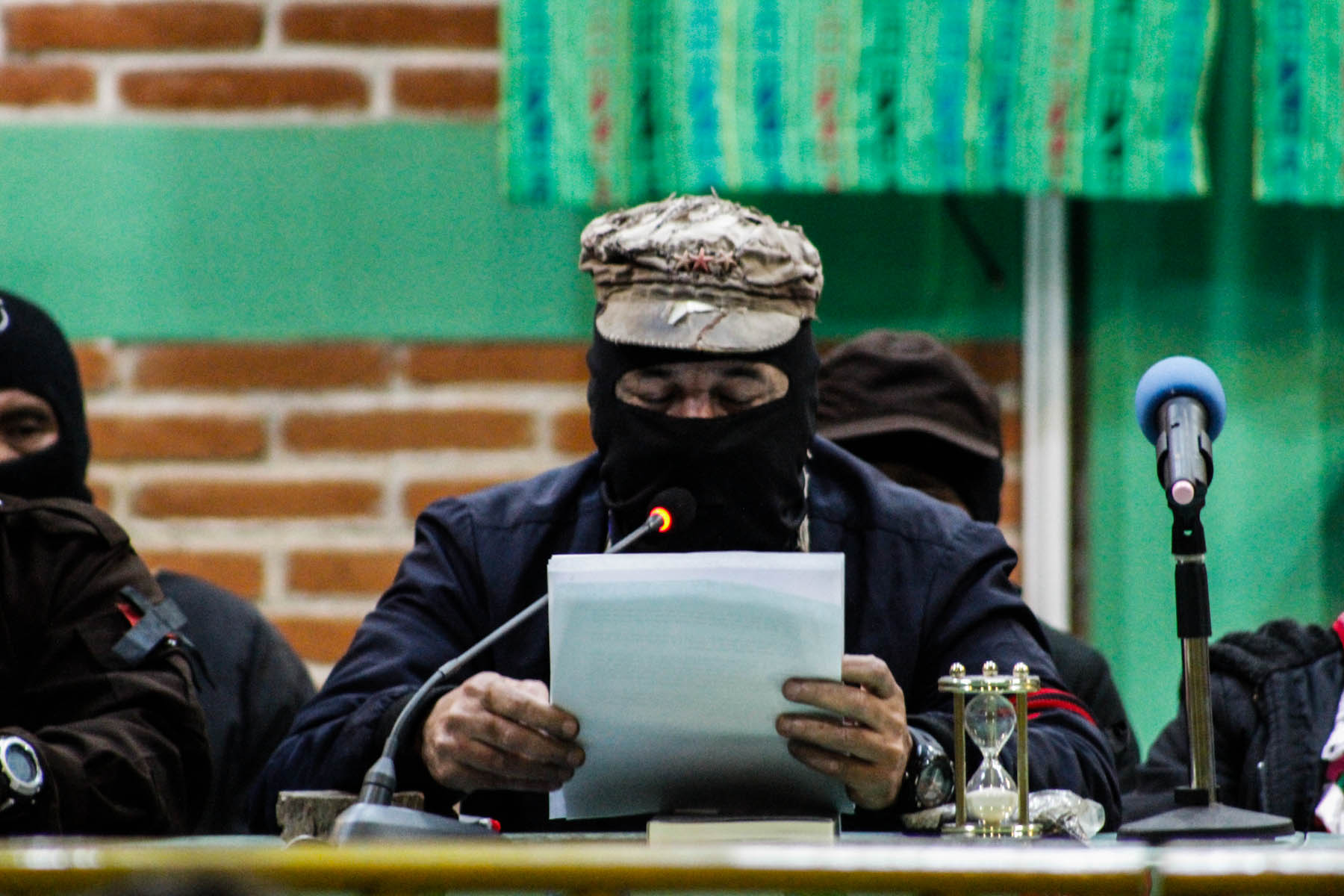
But in this technological era that looks upon us with mocking reproach, we Zapatistas are more like an hourglass. An hourglass that, although it doesn’t request an update every 15 minutes and doesn’t require you to have credit on your phone to work, does have to renew its limited countdown over and over again.
Although not very practical and somewhat uncomfortable, just like us Zapatistas, the hourglass has its advantages. For example, in it we can see the time that has gone by, the past, and try to understand it. And we can see, too, the time that is coming.
Zapatista time cannot be understood without understanding the gaze that keeps track of time with an hourglass. That’s why, on this one and only occasion, we’ve brought here for you, madam, sir, other [otroa], little girl, little boy, this hourglass which we’ve baptized the “You know nothing, Jon Snow”[v] model.
Look at it, appreciate the perfection in its curved lines that remind one that the world isn’t round and that despite that it moves, it turns, and, as Mercedes Sosa said in her time, “things change, everything changes.”
Look at it and understand that you do not understand us, but that it doesn’t matter: and, as they say, it’s no big deal, because it’s not toward our archaic customs (which, more than premodern, are prehistoric) that we ask you to look, no. It’s farther beyond where we need your vigilance.
Because we understand that they ask you to pay attention to that brief instant in which a tiny grain of sand arrives to the narrow passage in order to then fall and join the other moments that accumulate in what we call the “past.”
That’s what they insinuate, they advise, they ask, they order, they command you to do: live in the moment, live in the present which can now be even further reduced with the highest and most sophisticated technology. Don’t think about the time that already lies in yesterday, because in the vertigo of modernity, “a second ago” is the same as “a century ago.” And above all, don’t look at what’s coming.
Of course, we Zapatistas, stubbornly, against the grain, just to be contrary (without insulting anybody in particular, to each his own), are analyzing and questioning the tiny grain of sand that exists anonymously in the middle of all the others, waiting its turn to get in line in the narrow tunnel, and at the same time looking at the grains that lie below and to the left in what we call the “past,” asking each other what the heck they have to do with this presentation about the walls of Capital and the cracks below.
And we have one eye on the cat and the other on the meat hook,[vi] or rather the dog, with which the “cat-dog” becomes a tool of analysis in critical thought and ceases to be the constant company of a little girl who imagines herself without fear, free, a compañera.
But it’s not Zapatismo that we’re inviting you to try to understand or explain. Although, of course, if you want to reiterate your laziness, limitations, and dogmatism anti- or pro-, well who are we to stop you.
So we say to you that no, we’re not worth the trouble, that Zapatismo is just one struggle among many. Perhaps the smallest in terms of its number, its impact, its transcendence. Although it’s true, it is perhaps the most irreverent of them all if we’re talking in terms of the enemy it has chosen, in terms of its aspiration, its objective, its horizon, and its stubborn insistence on building a world where many worlds fit, all of them, those that exist and those yet to be born.
And all the while, with absurd obstinacy, we turn the hourglass over and over again as if we wanted to tell you, tell ourselves, that this is the struggle: something where there is no rest, where one has to resist and not open the doors of prudent cowardice which mark the entirety of the path with signs reading “EXIT.”
The struggle is something that requires you to pay attention to the whole and to the parts, and to be ready because that last grain of sand isn’t the last, but rather the first, and that the hourglass must be turned over because it contains not today, but yesterday, and yes, you’re right, tomorrow too.
So there you have the secret to the Zapatista method of analysis and reflection: we don’t even use a wind-up clock, but rather an hourglass.
Of course, it’s understandable, what can you expect from those who insist that in this day and age, not just the logic of money but also Donald Trump’s dear mother has been globalized because the whole world over is thinking of her and mentioning her, that is to say, insulting her.
Or maybe we use the hourglass because our passion for understanding is not an academic, scientific or descriptive interest, nor a feigned and sluggish tribunal that thinks it knows everything and can opine about everything because, as is well-known and as the social networks confirm, any foolishness finds followers and flocks are formed for the pastor who, in turn, is part of the flock of another pastor and so on.
No, our interest is subversive. We combat the enemy. We want to know what the enemy is like, its genealogy, its modus operandi we could say following Elías Contreras, a deceased EZLN investigator who insisted that capitalism was a criminal and that all of reality and the world were the scene of the crime and should be studied and analyzed as such.
It occurs to me now that the clues left by Elías Contreras and the now defunct SupMarcos, those that we Zapatistas now leave for you madam, gentlemen, otroa, little girl, little boy, young people not with regards to the calendar but rather with regards to the the gaze, are signs, all of them, to indicate a path.
The trick, the hustle as SubMoy says, the “magic” as SupMarcos used to say, is in the fact that those clues are not for you to find us, discover us, trap us. According to this note I’ve found in a trunk of SupMarcos’ memorabilia that I’ll reread disconcertedly now, they are not only so that you find a mirror, but rather for you to go about building an answer, your answer, to the apocalyptic question that will slap you across the face, irrespective of your color, gender or transgender, your belief or disbelief, your political and ideological philias and phobias, your customs, your time, your geography.
The question that announces the most terrible and marvelous apocalypse: And what about you?
It’s an apocalypse of gender, according to the little girl who calls herself Defensa Zapatista. “This is the fault of fucking men,” she declares at every opportunity, whether or not it has anything to do with the subject at hand, this little girl who dreams of completing her football team.
“It’s all going great, even though the ball is a little deflated, like it got hit a lot and it has a bunch of bumps on its head,” responds the girl to a question I hadn’t even thought of.
“And, of course, the team isn’t complete yet but don’t you worry Sup, soon there’ll be more of us, sometimes it takes a while but soon there’ll be more of us,” she says trying to calm me while we wait anxiously in the caracol for them to find the support team that got lost.
Subcomandante Insurgente Moisés murmurs, “Son of a…I think we need to form a support team for the support team, because something always happens to them,” while Defensa Zapatista tries to convince me to look for, among you all, prospects for someone to run around behind a deformed ball in a pasture that today is full of ticks and a nauyaca snake here and there, and that just a few days ago was bright with water puddled after a rain whose watch is surely broken because April is not its time to fall.
The directions that I receive from the girl are far from simple. The team doesn’t need a goalie, a position which is occupied, I know, by an old one-eyed horse who is differentiated from the rest in that he has neither rope, nor brand, nor owner and who chews unconcerned on an empty plastic bottle on which you can no longer read the brand of a well-known soda-pop.
The defender position, obviously, is also already covered. And the team has a far left that actually looks like a cat… or a dog, that, well, there goes SubMoy’s computer mouse, and there goes el Monarca yelling “fucking dog!” and insurgenta Erika clarifies that it’s not a dog, and el Monarca says “Cat, then!” “Not that, either,” says Erika, who just wants to make sure that the cat-dog escapes unscathed, which it manages to do.
Also part of the always incomplete formation is Pedrito, who, as I understand from the diagram that Defensa Zapatista unfolds in front of me, is a sort of multi-position sweeper. “The thing is that Pedro hardly ever listens,” she clarifies for me, “one day he wants to be a goalie, the next day a forward, and he better not even dream of being defender” warns the girl. Then she adds: “but that’s just how men are, one minute they say one thing and the next minute they tell you to scram,” while she looks at me with narrowed eyes and puts on her best “Fuck Trump and get out of the way before you get pulled in and just wait and see what happens to you too” face.
Before leaving, Defensa Zapatista summarizes for me: “Hey Sup, not just anyone, huh? They have to be disciplined and committed to the struggle because otherwise they’ll go weak real fast and on the team it’s pure resistance and rebellion.” I didn’t want to disappoint her, but just the requirement of discipline eliminates all the support teams and all those present here [todoas], starting, obviously, with Pablo Contrarian here.
For the deceased SupMarcos, according to what I discovered after his death and by rescuing his papers, the apocalypse is neither the mirror nor the question, but rather the answer. “That,” he wrote with the awkward handwriting of an undisciplined schoolboy who always flunked penmanship, “That is where the world ends… or begins.”
I will return on another occasion to these papers stained with moisture and tobacco that, together with many others in a trunk of corroded and torn fabric, SupMarcos gave to me moments before his death, with a laconic: “See what you can do with that.”
He repeated the same phrase to me when he came down off the stage in La Realidad, the blood of my dead brother, the teacher Galeano, still warm on the earth, when, like a premonition of what was to come, the only light was that of the rain that broke the logic of that May some calendars ago.
No, I won’t talk about that writing. Or not yet. Nor will I talk about the one I just found and which, defiant, has this brief title: “On how Durito decided to embrace the noble profession of Knight Errant and took to traveling the world righting wrongs, rescuing the vulnerable, aiding the oppressed, supporting the weak and conjuring libidinous sighs from rescued damsels as well as snorts of envy from macho guys. Information and no-obligation estimates at #69 Hojita de Huapac.”
Yes, I agree with you all, it’s a title as modest as its protagonist.
But I won’t read it to you now, and not because I don’t want to see the smiles that that story would bring you—written as it was by the deceased in his own hand and with only the place and the date as clarifications: you can just make out “Watapil encampment, Almond Mountain, April, 1986,” that is to say, about 30 years ago—but because it’s not related to the present topic.
Of course, now you’re getting mad because you’re thinking, why am I getting your hopes up if no-way-josé-nada-zip-zilch-zero, if right now I’m not going to read you the story with the title as brief as it is clear, but let me tell you that those papers found in SupMarcos’ trunk reminded me of something that happened when, on the clocks of La Realidad, the hour of his death had not yet struck:
SupMoy and the now deceased SupMarcos returned from a meeting with the Indigenous Revolutionary Clandestine Committee-General Command of the EZLN, held in one of the warehouses of the caracol La Realidad, and they sent for me.
I understood that the hour had arrived on the two watches that the now deceased had carried since the first of January, 1994. Because I knew that his death had been decided, but not when. The fact that they sent for me only meant one thing: his passing was imminent and he would give me the final instructions before my birth.
SupMoy took his leave and I was left alone with SupMarcos. He gave me a small suitcase made of fabric, old and badly patched, without saying anything to me.
I asked what I was supposed to do with it and he only responded that I would know what to do when the time came. I nodded in silence.
Afterwards he gave me instructions for the location of a hidden mountain “mailbox” where, he said, he had stored several books.
They’re coming back to me now: the poetic anthologies by León Felipe and Miguel Hernández, the Romancero Gitano by García Lorca, the two volumes of Quijote, The Captain’s Verses by Pablo Neruda, a bilingual edition of Shakespeare’s sonnets, Cronopios and Famas by Julio Cortázar, and others that I don’t remember now.
It seemed strange to me that in his last wish he had room in his thoughts to recommend the rescue of some books that had probably already been destroyed by the humidity and the leaf-cutter ants.
I must have made a face because he felt obliged to explain: “There is no more desperate loneliness than that of a book with no one to read it.”
I didn’t say anything, I just wrote down, in code, the location of the “mailbox.”
Then, as was his was way after giving final directions, he asked me: “Doubts, questions, anxieties, disagreements, insults, or other?”
I thought for a moment. “I have a question,” I told him, not because I had one but rather to give me time to be able to think of something.
He waited in silence. And I don’t know why I asked him about Durito. Yes, I know, I should have asked him other things, for example, the reasons for his death, or the always urgent question, “What’s next?” But no, I asked him about Durito.
Why did you choose an insect as a character? The thing about el Viejo Antonio I get, the same with the boys and girls, but an insect? Worse, a beetle! The beetles around here make their nest in dung and that’s where they raise their babies.
He lit his pipe and responded between mouthfuls of smoke: “In the first place, as you will find out in a few minutes, it’s not they who are the characters, but I. And as far as Mr. Durito is concerned, he’s the little, weak and insignificant one who rises up, rebels and challenges everything, including the destiny that has been imposed on him.”
“In reference to the dung, beetles are not the only ones who in these parts work with dung and even use it for their houses. The indigenous, too. Well, that was before our uprising.”
Yes, we talked about other things, not because it was an interrogation but rather because the beginning of the funeral was delayed and SupMarcos was just like that, while he thought about something he would talk about anything or about what he was asked about, as if he needed to occupy his thoughts with several things at once to be able to resolve the most important thing.
Of those other things, I don’t know, perhaps, it’s a guess, maybe I’ll tell you on another occasion. Or not, who knows. But the part about the link between the beetle and the Zapatista indigenous, maybe you’ll understand it better in the stories that follow in the voice of SupMoy.
I cede the floor to our leader and spokesperson, Subcomandante Insurgente Moisés, who has just come from the deepest depths of the Lacandona Jungle, where he went in order to be able to explain to us why the capitalist world is like a walled plantation.
Thank you very much.
SupGaleano.
Mexico, April 2017.
[i]“The mafia of power” is a phrase used by the Mexican politician and now three-time presidential candidate Andrés Manuel López Obrador (AMLO) and his political party, Morena, to refer to a group Mexican politicians and businessmen who he claims have undue influence over the course of Mexican politics and the economy. http://expansion.mx/economia/2011/11/04/la-mafia-del-poder-segun-amlo
[ii]“Real change” is another of AMLO’s catchphrases; as of January 2017, Estéban Moctezuma Barragán had joined AMLO’s team: http://www.reforma.com/aplicacioneslibre/articulo/default.aspx?id=1031184&md5=425255fe226a900e78e74ef27c689968&ta=0dfdbac11765226904c16cb9ad1b2efe
[iii]“La Calderona” is a nickname given by the EZLN to the wife of ex-president Felipe Calderón (2006-2012), Margarita Zavala, a member of the National Action Party (PAN) who announced in June 2015 that she will run for president of Mexico in 2018.
[iv]Used here mockingly by critics of the CNI proposal, “Tonantzin” is the Aztec (Mexica) goddess worshipped at Tepeyac and which provided the syncretic basis for the Virgin of Guadalupe.
[v]A reference to the Game of Thrones TV series.
[vi] The saying “con un ojo en el gato y otro en el garabato,” literally with one eye on the cat and the other on the meat hook” is a metaphor (referencing meat canning and domestic cats around the kitchen) meaning to keep an eye on two things at once, to be attentive and vigilant of two things at the same time to avoid a possible risk or problem.[:]

