
[:es]La democracia participativa impulsa al movimiento en contra de la gentrificación en El Barrio, Nueva York[:en]Participatory Democracy Drives Anti-Gentrification Movement in New York’s El Barrio[:]
[:es]
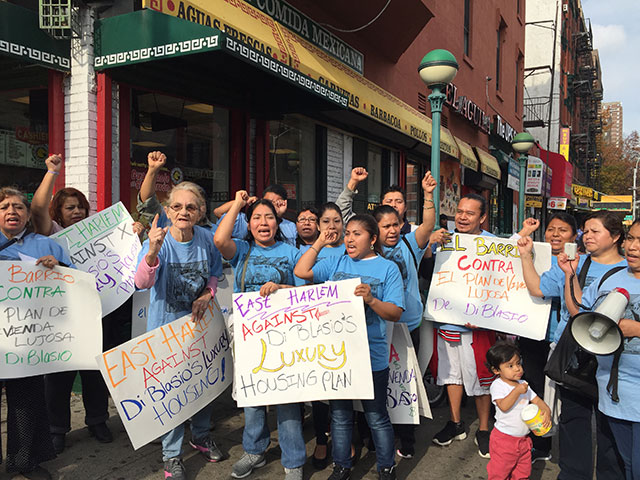
Miembros del Movimiento por Justicia del Barril en conferencia de prensa denuncian el plan de “viviendas de lujo” del alcalde de Nueva York, Bill de Blasio. (Foto: Janice Aredondo)
Por Jessica Davies, Truthout
Publicado en inglés en Truthout.
Hace once años, en una zona conocida como El Barrio en el este de Harlem, Nueva York, unos residentes de la comunidad, miembros de quince familias de inmigrantes, todas ellas mujeres, se juntaron para buscar lograr viviendas dignas en su comunidad. Luchaban contra la gentrificación y el desplazamiento, y los abusos de un propietario privado que estaba tratando de obligarlas a abandonar sus hogares con el fin de atraer a inquilinos ricos y transformar a El Barrio querido en donde vivían. Estas mujeres no tenían experiencia previa de cómo organizar, pero se escucharon y se apoyaron mutuamente, y en diciembre de 2004, formaron Movimiento por Justicia del Barrio (Movimiento).
Increíblemente, Movimiento ahora cuenta con 954 miembros, en 95 comités de edificio. El ochenta por ciento de los miembros son mujeres, y las mujeres son la fuerza impulsora detrás de la organización. Movimiento se compone de inquilinos de bajos ingresos, que son inmigrantes; muchos también son indígenas. Obligados por la pobreza a abandonar a su país de origen, han construido una comunidad fuerte en El Barrio y están decididos a no dejarse ser desplazados otra vez. Ellos saben que su lucha es contra el sistema neoliberal representado por los propietarios abusivos, especuladores de propiedades, corporaciones multinacionales, políticos corruptos y las instituciones gubernamentales que buscan desplazarlos de su comunidad.
“Todos compartimos un enemigo común y se llama neoliberalismo,” dijo Oscar Domínguez, miembro del Movimiento por Justicia del Barrio, en el primer Encuentro por la Humanidad y en contra del Desplazamiento. “El neoliberalismo desea dividirnos e impedirnos combinar nuestras fuerzas. Derrotaremos esto al continuar uniendo a nuestra comunidad entera hasta lograr una verdadera liberación para todas y todos.”
La organización está construida alrededor de los principios de autonomía, autodeterminación y democracia participativa. Esto significa que se basa en una forma de organización horizontal y carece de dirigentes.
“Creemos que los que sufren la injusticia de primera mano deben diseñar y dirigir sus propias luchas por la justicia,” dijo Diana Vega, un miembro de Movimiento.
El objetivo es crear espacios donde el pueblo pueda reunirse como comunidad para compartir sus problemas. De esta manera ellos pueden ponerse de acuerdo sobre las soluciones y es la propia comunidad que tiene el poder. No depender de nadie para decirles qué hacer, creen ellos, crea una base sólida que nunca puede ser destruida.
La forma de organización de Movimiento está basada en consultar a la comunidad. Miembros van de puerta en puerta, edificio por edificio, cuadra por cuadra, conociéndose mutuamente, construyendo relaciones. Se forman comités en cada edificio de apartamentos, y una vez que todo el edificio sea organizado, se convierten en miembros. Cada edificio se pone de acuerdo sobre sus propias acciones y formas de lucha. Movimiento también está profundamente comprometido a luchar contra todas las formas de discriminación y respetar las diferencias de cada quien. Sobre todo, esto significa escucharse entre uno y el otro.
El grupo opera sobre muchos niveles. Así como el tocar puertas, organizan asambleas del pueblo, diálogos comunitarios, divulgación de volantes en las calles, reuniones caseras y votación de toda la comunidad. Organiza protestas, marchas y acciónes directas. Hacen un uso inteligente de los medios de comunicación, dan entrevistas, charlas, organiza foros públicos. Utilizan tácticas tales como acciones judiciales y denuncias públicas. Tras las consultas al nivel comunitario hace campañas sobre temas específicos.
Estos asuntos se explican en la invitación que el Movimiento por Justicia del Barrio envió para su quinto Encuentro por la Humanidad y en contra del Desplazamiento:
“Juntos, hacemos de nuestra dignidad una resistencia y luchamos contra las acciones de los propietarios capitalistas y de las grandes empresas transnacionales que están desalojando a las familias pobres de nuestro vecindario. Luchamos a nivel local y más allá de las fronteras. Luchamos contra los políticos locales que se niegan a mandar obedeciendo al pueblo. Luchamos contra las instituciones gubernamentales que legalizan y hacen cumplir un sistema global económico, social y político que busca destruir la humanidad.”
La organización enfrenta muchos desafíos. La gran mayoría de sus miembros no habla inglés y han tenido pocas oportunidades para la educación. Tienen poco acceso al internet, los medios de comunicación e información; muy pocos de ellos tienen computadoras. Se ven obligados a trabajar diez a catorce horas diarias, seis a siete días a la semana, así como también tener todas las responsabilidades de la vida familiar. Esto significa que no es fácil para ellos también asistir a reuniones de cuatro o cinco horas para tomar decisiones, y es difícil para que todos se reúnan al mismo tiempo. Porque todos deben ser consultados, y todas las decisiones tomadas colectivamente, puede tomar mucho tiempo para llegar a un acuerdo. Pero a pesar de todas estas dificultades, el compromiso y los logros de los miembros han sido notables.
En consonancia con sus principios, Movimiento no acepta ningún financiamiento gubernamental y no trabaja con políticos o partidos políticos. Los miembros saben que es esencial crear puentes con otras comunidades ignoradas, olvidadas y marginadas, incluyendo mujeres, migrantes, lesbianas, pueblos indígenas, los homosexuales, lesbianas y la comunidad transgénero y construir relaciones con los miembros de estas organizaciones, que también luchan contra las múltiples formas de opresión.
La construcción de una comunidad de solidaridad y una cultura de resistencia
Hace once años, quienes ahora son miembros de Movimiento se desconocían mutuamente, no tenían ninguna comunión con los demás habitantes de su edificio. Ahora se resisten, se organizan y juntos celebran victorias – han construido comunidad, amistad, amor, confianza y solidaridad y transformado sus vidas.
Durante los últimos 11 años, los miembros de Movimiento han ganado numerosas victorias contra los propietarios brutales y las corporaciones multinacionales que tratan de arrebatarles de sus hogares y destruir su comunidad; han desafiado a instituciones de la ciudad; han construido una cultura de resistencia y una comunidad de solidaridad; han formado fuertes lazos con sus hermanas en lucha en muchos rincones del mundo, y su lucha inspiradora continúa.
Los miembros del Movimiento celebraron el once aniversario de su lucha comunitaria dirigido por mujeres, el 8 de marzo de este año, el Día Internacional de la Mujer. Durante el evento, proyectaron este filme para conmemorar su lucha contra el desplazamiento:
Muchos de los miembros de esta organización notable creen que su mayor logro ha sido la construcción de una cultura de resistencia, lo que ha llevado a un sentido de identidad y autoestima, ser parte de algo que les da un propósito y significado. Una nueva generación de niñas y niños está creciendo en un entorno increíble de lucha comunitaria, de marchar y de toma de decisiones colectivas, lo cual hace un impacto duradero en sus vidas y brilla a través de su espíritu de comunidad vibrante. La fuerza de la comunidad que Movimiento ha creado se refleja en el hecho sorprendente que ninguno de sus miembros ha sido desplazado a lo largo de los últimos once años. No es extraño que el periódico Village Voice eligió a Movimiento como el “Mejor movimiento basada en el poder del pueblo en la ciudad de Nueva York”.
Aprendiendo y compartiendo luchas dignas
Cuando Movimiento fue fundado en diciembre de 2004, sus miembros comenzaron a buscar otras luchas dignas de las cuales aprender. Cuando leyeron la Sexta Declaración de la Selva Lacandona de los Zapatistas, lanzada en junio de 2005, dijo Domínguez a Truthout, los miembros encontraron en ella “un espejo de nosotros mismos”. Desde entonces han desarrollado su propia forma del Zapatismo urbano y siguen mirando a sus compañeras y compañeros Zapatistas como una fuente de inspiración en su lucha diaria por la justicia y liberación colectiva, mientras que ofrecen su solidaridad a cambio. Como siempre con las mujeres en frente, Movimiento ha aplicado en su propia lucha local las herramientas y formas de organización extraídas de las y los Zapatistas.
Las luchas y los logros actuales
En septiembre de 2015, las mujeres de Movimiento por Justicia del Barrio se unieron con personas que luchan por la justicia en todo el mundo, y dieron testimonio ante el Tribunal Internacional de Conciencia de los Pueblos en Movimiento, que se celebró en la ciudad de Nueva York. Las mujeres hablaron sobre la lucha de las mujeres migrantes contra el despojo que conduce a la migración forzada, en primer lugar, y luego sobre el desplazamiento vicioso de la vivienda, que se lleva a cabo a través de la rezonificación de las ciudades entre los ricos y los pobres.
Después de esto, en octubre, Movimiento fue la única organización que fue seleccionado para participar en la primera Conferencia sobre la Libertad de las Mujeres que se realizó a escala mundial, completamente digital. Mujeres de los cinco continentes presentan sus luchas a través de las voces y experiencias únicas de las mujeres de color (de América Latina, y / o de raza negra, y / o asiática y / o pueblos indígenas) que tienen poca o ninguna representación, y que han sido privados de sus derechos, no sólo por el patriarcado, pero también a través de racismo y otras formas de opresión. La presentación del Movimiento fue el filme Las Mujeres de El Barrio Luchando por la Libertad y contra el Desplazamiento.
El 31 de enero de 2016, el quinto Encuentro por la Humanidad y en contra del Desplazamiento se llevó a cabo en la ciudad de Nueva York, organizada por Movimiento. Fue “una encuentro en la que la gente humilde y sencilla que están directamente afectados y que luchan contra la gentrificación tendrán el espacio para el diálogo entre sí sin intermediarios y con respeto a su lucha común.” Un testimonio del poder de la organización de base, el Encuentro se centró en la lucha en contra del desplazamiento en la ciudad de Nueva York y en todo el mundo, y los representantes de más de 90 organizaciones compartieron sus luchas y sus sueños.
La invitación oficial al evento ofreció estas palabras sobre su propósito:
“Estamos luchando por la vivienda, por educación, por salud, por la libertad, por justicia, por amor, por una voz, por un espacio para existir, por la paz, por respeto, por nosotros mismos, por nuestra comunidad, por la dignidad…para la humanidad. Aquí estamos en resistencia en nuestro rincón del mundo. Juntos construiremos un mundo donde quepan muchos mundos.”
El Encuentro puso de relieve una de las principales luchas emprendidas por las mujeres del Movimiento en el último año y medio – la lucha en contra del plan destructivo de rezonificación que el Alcalde de Nueva York, Bill de Blasio, se pretende imponer desde arriba. Si se aprueba, este plan va a provocar un desplazamiento generalizado de largo plazo de miembros de la comunidad de bajos ingresos desde su querido El Barrio. Estrenada en el Encuentro fue el nuevo filme La Lucha de la Comunidad del Este de Harlem en contra del Plan de Rezonificación del Alcalde.
El filme documenta la oposición de los pobladores del este de Harlem a un plan de rezonificación en el que el 100% de las unidades será inaccesible a los residentes de bajos ingresos de El Barrio. El 75% serán apartamentos de lujo a precio del mercado, y el otro 25% quedará completamente inaccesible a los residentes de bajos ingresos de El Barrio, porque los residentes no cumplen con el ingreso mínimo necesario para alquilarlos. Su oposición es el resultado de la extensiva consulta de la comunidad del este de Harlem —organizada por Movimiento por Justicia del Barrio—, que fue una consulta democrática conducida por la comunidad sobre el plan de rezonificación del alcalde, la cual tuvo lugar durante casi un año, y en la que los pobladores analizaron el plan y diseñaron cuál es su postura —una unánime oposición por parte de los miles que participaron a todo el plan del alcalde de rezonificación — y su propia propuesta: un plan de diez puntos para la administración del Alcalde de Blasio para preservar la vivienda de renta estabilizada. Las mujeres dirigentes de Movimiento por Justicia del Barrio seguirán luchando hasta que su plan se lleva a cabo en beneficio de todas las personas humildes de la ciudad de Nueva York.
Han expresado este compromiso en su declaración de su visión:
“Luchamos para que: los mares y las montañas serán de quienes los habitan y los cuidan.
Los ríos y los desiertos serán de quienes los habitan y los cuidan.
Los valles y las quebradas serán de quienes los habitan y los cuidan.
Las viviendas y las ciudades serán de quienes en ellas viven y las cuidan.
Nadie será dueño de más tierra de la que pueda cultivar.
Nadie será dueño de más casas de la que pueda habitar.”
[:en]
Members of Movement for Justice in El Barrio at a press conference denouncing New York City Mayor Bill de Blasio’s “luxury housing” rezoning plan. (Photo courtesy of Janice Aredondo)
By Jessica Davies, Truthout.
Eleven years ago, in an area known as El Barrio in East Harlem, New York, community residents of 15 immigrant families, all of them women of color, came together to seek dignified housing in their community. They were struggling against gentrification and displacement, and the abuses of a private landlord who was trying to force them out of their homes in order to attract wealthier tenants and transform the neighborhood they lived in and loved. These women had no previous organizing experience, but they listened to and supported each other, and in December 2004, they formed Movement for Justice in El Barrio (Movement).
Astonishingly, Movement now has 954 members in 95 building committees. Eighty percent of the members are women, and it is the women who are the driving force behind the organization. The membership consists of low-income tenants who are immigrants and people of color; many are also Indigenous. Forced by poverty to leave their beloved native countries, they have built a strong community in El Barrio, and are determined not to allow themselves to be displaced again. They understand clearly that their fight is against the neoliberal system represented by the abusive landlords, property speculators, multinational corporations, politicians and government institutions that seek to displace them from their much-loved community.
“We all share a common enemy and it is called neoliberalism,” said Oscar Dominguez, a member of Movement for Justice in El Barrio, at the first Encuentro for Humanity and Against Displacement. “Neoliberalism wishes to divide us and keep us from combining our forces. We will defeat this by continuing to unite our entire community until we achieve true liberation for all.”
The organization is built around the principles of autonomy, self-determination and participatory democracy. This means that it is based on a horizontal form of organizing and has no leaders.
“We believe that those who suffer injustice firsthand must design and lead their own struggles for justice,” said Diana Vega, a Movement member.
The aim is to create spaces where people can come together as a community to share their problems. In this way, they can agree on the solutions, and it is the community itself that has the power. Not being dependent on anyone to tell them what to do, they believe, creates a strong base that can never be destroyed.
The basis of Movement’s organizing is consulting the community. Members go door-to-door, building-by-building, block-by-block, getting to know each other, and constructing relationships. Committees are formed in each building, and once the whole building is organized, they become members. Each building agrees on its own actions and means of struggle. Movement is also deeply committed to fighting all forms of oppression and to respecting each other’s differences. Above all, this means listening to one another.
The group operates on many levels. As well as door knocking, it has town hall meetings, community dialogues, street outreach, house meetings and community-wide votes. It organizes protests, marches and direct actions. It makes clever use of the media, gives interviews and charlas (talks) and organizes community-wide gatherings. It uses tactics such as court actions and public denunciations. Following the community consultations, it campaigns on specific issues.
These issues are spelled out in the invitation that Movement for Justice in El Barrio sent out for its fifth Encuentro for Humanity and Against Displacement:
Together, we make our dignity resistance and we fight back against the actions of capitalist landlords and multinational corporations who seek to displace poor families from our neighborhood. We fight back locally and across borders. We fight back against local politicians who refuse to govern by obeying the will of the people. We fight back against the government institutions which enforce a global economic, social and political system that seeks to destroy humanity.
The organization faces many challenges. Most of its members speak no English. They have little access to the internet. Very few of them have computers. They are forced to work 10- to 14-hour days, six to seven days a week, as well as having all the responsibilities of family life. This means that it is not easy for them to also attend four or five hour meetings to make decisions, and it is difficult for everyone to come together at the same time. Because everyone must be consulted, and all decisions made collectively, it can take a long time to come to an agreement. But in spite of all these difficulties, the commitment and achievements of the members have been remarkable.
In line with its principles, Movement accepts no government funding, and has no involvement with politicians or political parties. Members know it is essential to create bridges with other ignored, forgotten and marginalized communities, including women, migrants, lesbians, people of color and the transgender community, and to build relationships with members of organizations that also fight against multiple forms of oppression.
Building a Community of Solidarity and a Culture of Resistance
Eleven years ago, those who are now members of Movement did not even know each other. They had no fellowship with the other inhabitants of their building. Now, they resist, organize and celebrate victories together — they have built community, friendship, love, confidence and solidarity and have transformed their lives.
During the last 11 years, Movement has won victories against brutal landlords and multinational corporations that have tried to displace them and destroy their community. They have challenged city institutions. They have created and continue to build a culture of resistance and a community of solidarity. They have formed strong bonds with their sisters in struggle in many corners of the world, and their inspirational struggle continues.
Members of Movement celebrated the 11th anniversary of their women-led community struggle this year on March 8, International Women’s Day. During the event, they screened this short film to commemorate their struggle against displacement:
Many of the members of this remarkable organization believe that their greatest achievement has been to build a culture of resistance, which has led to a sense of identity and self-worth, being part of something that gives them purpose and meaning. A new generation of children is growing up in an amazing environment of organizing, marching and of collective decision-making, which makes a lasting impact on their lives, and shines through in their vibrant community spirit. The strength of the community that Movement has created is reflected in the astonishing fact that not one of its members has been displaced over the last 11 years. It is no wonder that the Village Voice chose Movement as the “Best Power to the People Movement in New York City.”
Learning From and Sharing Dignified Struggles
When Movement was founded in December 2004, its members began to look for other dignified struggles from which to learn. When they read the Zapatista Sixth Declaration of the Lacandon Jungle, released in June 2005, members found in it “a mirror of ourselves,” Dominguez told Truthout. Since that time, they have developed their own form of urban Zapatismo, and continue to look to their Zapatista compañeras and compañeros as inspiration in their daily struggle for justice and collective liberation, while offering their solidarity in return. As always with the women at the forefront, Movement members have incorporated tools and ways of organizing learned from the Zapatistas into their own local struggle.
Current Struggles and Achievements
In September 2015, the women of Movement for Justice in El Barrio joined people who are fighting for justice all over the world, and gave testimony before the International Tribunal of Conscience of Peoples in Movement, which was held in New York City. The women spoke about the struggle of migrant women against the dispossession that leads to forced migration in the first place, and then about the vicious displacement from housing, which takes place in order to rezone cities between the rich and the poor.
This was followed in October by Movement being the only organization to be chosen to participate in the groundbreaking first worldwide online Women’s Freedom Conference, where women from five continents presented their struggles through the unique voices and experiences of women of color who have little or no representation, and who have been deprived of their rights not only by patriarchy, but also through racism and other forms of oppression. Movement’s presentation was the film El Barrio Women Fighting for Freedom and Against Displacement.
The official invitation to the event offered these words about its purpose:
We are struggling for housing, for education, for health, for freedom, for justice, for love, for a voice, for a space to exist, for peace, for respect, for ourselves, for our community, for dignity … for humanity. Here we stand in resistance in our corner of the world. Together we will build a world where many worlds fit. Un mundo donde quepan muchos mundos.
The Encuentro highlighted one of the main struggles undertaken by the women of Movement over the last year and a half — the struggle against the destructive rezoning plan that New York City Mayor Bill de Blasio is attempting to impose from above. If enacted, this plan will cause widespread displacement of long-term, low-income community members from their beloved El Barrio. Premiered at the Encuentro was the new film The East Harlem Community Fight Against the Mayor’s Rezoning Plan.
They have expressed this commitment in their vision statement:
We fight so that:
The oceans and mountains will belong to those who live in and take care of them.
The rivers and deserts will belong to those who live in and take care of them.
The valleys and ravines will belong to those who live in and take care of them.
Homes and cities will belong to those who live in and take care of them.
No one will own more land than they can cultivate.
No one will own more homes than they can live in.
[:]

