
Comandanta Miriam – 6 de mayo de 2015Comandanta Miriam – 6 May 2015
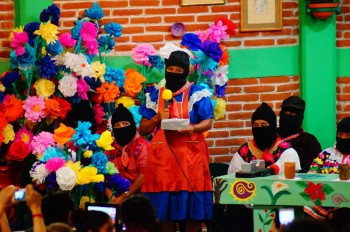
Escucha aquí: [podcast]https://radiozapatista.org/Audios/pensamiento/6mayo_comandanta-miriam.mp3[/podcast]
Mayo 7 de 2015
Buenas noches, compañeras y compañeros.
Yo también me toca platicarles un poco cómo es la situación de las mujeres antes de 1994.
Desde la llegada de los conquistadores sufrimos la triste situación de las mujeres. Nos despojaron nuestras tierras, nos quitaron nuestra lengua, nuestra cultura. Es así donde entró la dominación del caciquismo, terratenientes, entra la triple explotación, humillación, discriminación, marginación, maltrato, desigualdad.
Listen here: [podcast]https://radiozapatista.org/Audios/pensamiento/6mayo_comandanta-miriam.mp3[/podcast]
Comandanta Miriam
Good evening compañeros and compañeras.
I also have the chance to talk to you a bit about what the situation was for women prior to 1994.
Women suffered through a very sad situation since the arrival of the conquistadors. They stole our land and took our language, our culture. This is how the domination of caciquismo [local despotism] and landowners came into being alongside a triple exploitation, humiliation, discrimination, marginalization, mistreatment, and inequality.
Porque los pinches patrones nos tenía como si fuera que somos el dueño de ellos, nos mandaba a hacer todo el trabajo en las haciendas, sin importar si tenemos hijos, maridos o si estamos enfermas. No nos pregunta si estamos enfermas, si no llegamos a trabajar manda su muchacho o el esclavo, a dejar el maíz enfrente de la cocina para que hiciéramos la tortilla para ellos.
Y así pasó mucho tiempo, trabajamos en la casa del patrón. Molemos la sal porque la sal no era así como ahora, la sal que viene así fina, sino que la sal que antes usaban son grandes, son bolas grandes y lo tenían que moler las mujeres; y llegaban a moler la sal para el ganado, y a sacar la cáscara del café cuando es tiempo de cosecha de café. Si entra a las 6 de la mañana, sale a las 5 de la tarde. Todo el día tiene que dejar listo los bultos de café que le toca hacer a una mujer.
Es así que trabajaron las mujeres. Así trabajaron las mujeres con maltrato, con cargar el agua, y la miseria, o sea que le dan una paga miserable, sólo le dan un puñito de sal o un puñito de café molido, es el pago que le dan a las mujeres.
Y así pasando los años que las mujeres sufrían, y cuando nosotros, cuando nosotras, a veces lloran nuestros hijos y amamantamos a nuestros hijos, nos gritan, nos burlan, nos insulta físicamente, que no sabemos nada, que somos inútiles, estorbo para ellos. No nos respetan, nos usan como si fuera objeto.
Ellos hacen lo que le da la gana a una mujer, porque escogen a las mujeres bonitas o a las muchachas bonitas como su amante y dejar hijos por donde quiera, que no le importa qué sufren las mujeres, lo trata como si fuera animal con sus hijos que crecen sin padre.
Nos venden como si fuéramos una mercancía, todo esto en el tiempo del acasillamiento, nunca hubo descanso para nosotras.
Voy a platicar un poco del acasillamiento. Acasillamiento es que llegan en las haciendas o en el rancho, llegan con su familia y quedan ahí, y trabajan para el patrón, porque los hombres son los que trabajan sembrar el café, limpiar el café, cosechar el café, limpiar el potrero, sembrar el zacate, todo eso, hacer la milpa, el frijolar, pero era para el patrón; los hombres trabajan eso.
Pero aparte hay otra cosa que les puedo platicar, como el acasillamiento, aparte hay que le decimos mozo o esclavos, que de por sí siempre va a estar en la hacienda, mujeres y hombres. Pero esos hombres o mujeres que son esclavos o mozos, que quedan ahí en la hacienda, son hombres y mujeres que a veces no tienen familia. Llega una familia nada más a trabajar en esa hacienda y a veces enferman el papá, la mamá, y muere, y quedan niños huérfanos y el patrón lo toma esos niños y lo crecen ahí en la hacienda. ¿Y qué hacen esos niños? No es porque lo adopta como hijo adoptivo sino como esclavo. Esos niños crecen y le da ese trabajo, si tiene mascota el patrón, o sea tiene sus mascotas, el perro, el mono, cualquier cosa de animales, y le da de cuidar a su mozo, lo cuida. Donde va el mono ahí tiene que ir, ahí tiene que cuidar, tiene que bañar, tiene que limpiar donde duerme, así pasa.
Ya después, cuando hace fiesta el patrón, como antes llegaban los curas en las haciendas grandes, y los patrones como lo bautizan sus hijos, o cumpleaños, o casamiento de sus hijas en las haciendas, le da casamiento los curas. Ya después hacen convivios y esos mozos les dicen que cuidara la puerta mientras ellos están haciendo fiesta, conviviendo junto con sus compadres, sus amigos, todo eso, mientras el mozo cuida la puerta, no lo deja entrar ni un perro ahí donde se están conviviendo. Todo el día tiene que estar, según cuánto dura su fiesta de un patrón.
Y la esclava son ellas que hacen la comida, que lavan los platos, que cuidan el hijo del patrón o cuida sus hijos de sus amigos de los patrones.
Así vive la gente ahí en las haciendas, y no es porque le da de comer lo que comen también en el convivio, sino que tienen que tomar pozol si hay pozol, frijol si hay frijol, sólo lo que comen ellos mientras ellos comen cosas buenas, pero con sus amigos.
Ya después, cuando el patrón quiere salir a una ciudad, de su hacienda a una ciudad que tiene que caminar 6 días, y se va el mozo, o si tiene hijos los patrones, a veces tienen hijos pero son inválidos, el mozo tiene que cargar el hijo del patrón a llevar a la ciudad. Y si vuelve a regresar en la hacienda la patrona tiene que ir otra vez el mozo allá y traer otra vez a su hijo cargando.
Y como cosechan café, todo lo que cosechan en la hacienda, y ese mozo tiene que estar al tanto con las mulas, con los machos, no sé si conocen los caballos, tienen que ensillar, desensillar su caballo del patrón, ordeñar el ganado y llevar las cargas hasta en la ciudad donde vive el patrón. Si vive en Comitán tienen que ir a dejar hasta en Comitán, sale en la hacienda y tiene que ir porque le dicen que son arrieros. Y así sufrieron muchos hombres y mujeres esclavas en ese tiempo.
Sí hay matas de árboles frutales ahí dentro de la hacienda, si se trepan ahí a cortar dicen que no lo dejan cortar, lo tienen que bajar echando chicote, no sé si saben, el látigo, le pegan, no puede cortar las frutas sin permiso del patrón porque todo lo que cosecha lo lleva a la ciudad. Es así que sufrieron los hombres y las mujeres.
Después de tanto sufrimiento de las mujeres o la explotación del acasillamiento, se dieron cuenta los hombres de cómo los maltrataban a sus mujeres. Unos pensaron que mejor salir de la hacienda de acasillamiento. Uno por uno fueron saliendo y se refugiaron a las montañas porque quedaron los cerros, o sea los finqueros no acapararon la tierra de los cerros, sino quedó, y ahí se fueron a refugiarse. Como que pensaron que es mejor salir para que no sigan sufriendo las mujeres en esa hacienda.
Ya después cuando ya están en las montañas algunos pasó mucho tiempo así, y después se dieron cuenta que es mejor juntarse y formar una comunidad, y así volvieron a regresar en las montañas. Se juntaron, platicaron y lo formaron una comunidad donde pueden vivir. Así formaron la comunidad.
Pero otra vez cuando ya están en las comunidades, como el patrón, o sea el acasillado trae otra idea, como lo trataron con el patrón los hombres, como que traen arrasando malas ideas también los hombres, y aplica dentro de la casa como el patroncito de la casa. No es cierto que se liberó las mujeres sino que ya son los hombres que fueron el patroncito de la casa.
Y otra vez las mujeres quedaron en la casa como si fuera cárcel, que no salen otra vez las mujeres, quedaron ahí encerradas otra vez.
Ya cuando nacen niñas no somos bienvenidas en este mundo, porque somos mujeres, porque nació una niña, o sea como que no nos quiere. Pero si nace un varón todavía festejan todavía los hombres, contentos se ponen porque son hombres. O sea, trae una mala costumbre de los patrones. Así pasó mucho tiempo. Después, como nacen las mujeres, es que como son inútiles las mujeres y si nace el niño ellos pueden hacer todo el trabajo.
Pero lo bueno, lo que hicieron, es que no perdieron para formar la comunidad, empezaron a nombrar sus representantes de la comunidad, y empezaron a hacer reuniones, convivieron juntos. Lo bueno es que no le quitaron esa idea, no le quitaron sino que vinieron otra vez. Los patrones y la conquista quisieron desaparecer su cultura, pero se equivocaron porque sí pudieron formar su comunidad.
También los hombres porque es el que manda en la casa y las mujeres es el que obedece lo que dice el hombre. Y si te dice que vas a casar, es que vas a casar, o sea no te va a preguntar si quieres casar con el hombre que te viene a pedir, porque el papá ya tomó el trago, o sea ya tomó antes el trago y te obliga a mandar con el hombre que no quieres.
Es así como venimos sufriendo otra vez con los esposos, porque nos dicen que las mujeres sólo sirven para la cocina, sólo sirve para atender el esposo, sólo sirve para cuidar los hijos, y como los hombres de por sí no abrazan a sus hijos, o sea no apoyan a las mujeres, sino que sólo te da tu hijo y qué le importa cómo lo vas a crecer tu hijo. Y como -voy a hablar en la realidad como pasó durante años- a veces las mujeres decimos que cada año nace un bebé, cada año y medio nace un bebé, o sea como estaturitas crecen los niños, de un año, al año y medio ya está otro, así, escaloncito crecen los niños. Pero el papá no le importa si está sufriendo la mujer porque la mujer tiene que cargar leña, tiene que hacer milpa, tiene que asear la casa, tiene que barrer, cuidar los animales, tiene que lavar la ropa, tienen que cuidar el niño, el pañal, todo eso, todo es trabajo de mujeres.
Por eso decimos que sufrimos la triple explotación de la mujer, porque la mujer tiene que estar a las tres o cuatro de la mañana en la cocina, dependiendo cuántas horas lleva para ir a trabajar el trabajadero de los hombres, tienen que levantar temprano para hacer el pozol, el café, el desayuno del hombre. El hombre se va a trabajar, regresa en la tarde el hombre, quiere que ya está cargado su agua, servido su agua donde va a bañar; baña el hombre, sale a pasear, a jugar, la mujer queda otra vez en la casa todo el día, hasta en la noche como esta hora no ha dormido todavía la mujer, hasta las 8 duerme la mujer.
Y es así que venimos sufriendo mucho. No le importa al hombre si estás enfermo, cómo te sientes, no te pregunta y así pasó. Así vivieron en realidad, así vivieron las mujeres, nosotros no echamos mentira porque lo vivieron.
Ya después cuando vas en una iglesia o un centro ceremonial donde hacen fiesta van también las mujeres, a veces va, pero con la cabeza agachada. O sea no debes levantar tu cabeza, tienes que caminar así agachada, ni voltear en los lados, tapar la cabeza con el rebozo así, como que así queda tu carita ahí.
Así pasó mucho tiempo que lo traía arrastrando el hombre esas malas ideas, esas malas enseñanzas. Así pasó, compañeros. Como que no somos nada. Como que sólo los hombres sí pueden ser autoridades, pueden salir en las calles y pueden participar.
No había escuela. En algunas comunidades hubo escuela después pero tampoco no fuimos a la escuela porque somos mujeres, no nos dejan ir a la escuela porque si nos vamos a la escuela nos dicen que sólo vamos a buscar marido ahí, y mejor aprender a trabajar en la cocina porque de por sí vamos a tener marido y tenemos que aprender todo cómo atender un esposo.
Y cuando nos pega, cuando nos insulta nuestro esposo, no podemos reclamar. Y si pedimos auxilio con otras instituciones del mal gobierno son los más peores, porque apoyan a los hombres, les dan más razón a los hombres y nosotros quedamos calladas, humilladas, avergonzada por ser mujer.
No tuvimos el derecho en la reunión de participar, que nos dicen que somos una tonta, inútil, que no servimos para nada. Nos dejan en la casa. No tuvimos la libertad.
Y no hay atención a la salud, aunque había clínicas, hospitales del mal gobierno, o sea como que no nos atiende porque no sabemos hablar la castilla, y a veces nos regresamos y muchas mujeres y niños mueren de enfermedades curables porque de por sí no somos nada para ellos, porque nos discriminan porque somos indígenas, nos dicen que somos indios pata rajada, que no podemos entrar en las clínicas, en los hospitales, porque no nos dejan, sólo le dan atención a otra gente que son de dinero.
Todo esto sufrimos en carne propia. Nunca tuvimos la oportunidad de decir lo que sentimos por muchos años, por la enseñanza de los conquistadores y de los malos gobiernos.
Es todo, compañeros. Continúa la otra compa.
The fucking bosses had us as if they were our owners; they sent us to do all the work on the haciendas, without caring if we had children, husbands, or if we were sick. They never asked if we were sick; if we didn’t make it to work, they sent their servant or slave to leave the corn in front of the kitchen so that we would make tortillas for them.
Much time passed like this, with us working in the bosses’ house. We ground the salt because the salt then was not the same as it is now, now it comes finely ground. The salt we used before came in large balls, and we women had to grind it. Women also ground the salt for the livestock, and shelled coffee when it was coffee harvest time. If we started at 6 in the morning, we finished at 5 in the evening. Women had to keep preparing the bags of coffee throughout the whole day.
This is how the women worked. Women were mistreated in their work, carrying water and all of that and paid miserably; they were only given a little handful of salt or a handful of ground coffee, that was the payment given to the women.
Years passed and women suffered like this. And when our babies cried and we nursed them, we were yelled at, made fun of, insulted physically; they said that we didn’t know anything, that we were useless, that we were a bother to them. They didn’t respect us and they used us as if we were objects.
They did whatever they wanted to a woman; they chose the pretty women or the pretty girls as their lovers, and left children all over the place; they didn’t care that the women suffered, they treated them like animals, with their children growing up without a father.
They sold us as if we were commodities during the acasillamiento[i]; there was never rest for us women.
I’m going to talk a little bit about the acasillamiento. Acasillamiento refers to when people go to the haciendas or ranches with their families and stay there and work for the boss. The men were the ones who did the work of planting coffee, cleaning the coffee fields, harvesting the coffee, clearing the pastures, planting the grass, all this work, taking care of the corn and bean fields. The men did this work for the boss.
Apart from this, there is another thing I could tell you about the acasillamiento, which are the mozos or slaves there, men and women who are always going to live on the hacienda. Those men or women that are slaves or mozos, who live at the hacienda, are men and women that sometimes don’t have family. For example, a family comes just to work on the hacienda, and sometimes the dad and mom get sick and die and the children are orphaned. The boss takes these children and raises them on the hacienda. And what do these children do? Its not like the bosses adopt them as an adoptive child, but rather as a slave. Those children grow and this is the work they are given: if the boss has a pet, or pets, such as a dog, a monkey, or some kind of animal, the boss has the mozo take care of it, care for the animal. Wherever the monkey goes, that’s where the child is; they have to take care of it, bathe it, clean where it sleeps. That’s how it works.
Later, when the boss has a party—because before the priests would come to the large haciendas of the bosses and baptize their children, or for a birthday, or to perform a marriage ceremony for his daughters—and afterwards they would have parties and tell the mozos to guard the door. They would have the mozo watch the door while they were celebrating with their colleagues and friends. The mozo guards the door, he can’t let even a dog come into where they are partying, and he has to be there all day, for as long as the boss’s party keeps going.
And the women slaves were the ones who made the food, washed the dishes, and took care of the boss’s son, or the children of the boss’s friends.
That is how the people on the haciendas lived, and they didn’t get to eat what was eaten at the gatherings; they had to drink pozol[ii] if there was pozol, eat beans if there were beans. That was all they ate, meanwhile the boss ate the good stuff, but with his friends.
Later, when the boss wanted to go to the city, from his hacienda to a city that is, say, a 6-day walk, the mozo would go along. If the boss had children—sometimes the children are disabled—the mozo had to carry the boss’s child to the city. And if the boss’s wife came to the hacienda, the mozo goes again and carries the child back again.
And when they harvested coffee, in any harvest on the hacienda, the mozo had to be tending to the mules. I don’t know if you know about horses, but the mozo had to saddle and unsaddle the boss’s horse, herd the cattle, and take the loads to the city where the boss lives. If he lives in Comitán the mozo had to go all the way to Comitán. He had to leave the hacienda and go as the mule-driver. This is how many enslaved men and women suffered during that time.
If there are fruit tree orchards inside the hacienda and one of them climbed up to pick some fruit, the bosses wouldn’t let them. They got them down by whipping them, I don’t know if you know how the lash works; they would hit them with it. They can’t pick fruit without the boss’s permission because the entire harvest was to be taken to the city. This is how the men and women suffered.
After so much suffering by women and the exploitation during the acasillamiento, the men started realizing how their women were being mistreated. Some thought it better to leave the hacienda. One by one they started leaving and taking refuge in the mountains because these hill lands were not claimed by the plantation owners. So they took refuge there. They thought it better to leave so that the women would not continue to suffer on the hacienda.
After awhile in the mountains—and many spent a long time there—they realized that it was better to join together and form a community, and that’s how they came to live that way. They got together, talked, and formed a community where they could live. That is how they formed the community.
But again, once they were living in the communities, those ideas that came from the boss or the acasillado were brought in. It’s as if the men drug these bad ideas along with them and applied them inside the house. They acted like the little boss of the house. It’s not true that the women were liberated then, because the men became the little bosses of the house.
And once again the women stayed at home as if it was a jail. Women didn’t go out; they were shut in their houses once again.
When girls are born, we are not welcomed into the world because we are women; when a little girl was born, it is as if we were not loved. But if a boy was born, the men celebrated and were content because they are men. They brought this bad custom from the bosses. That’s how it was for a long time. When girls were born they acted as if women were useless, and if a boy was born, as if they could do all of the work.
But one good thing they did was that they did not lose the memory of how to form a community; they began to name community representatives and hold meetings and gatherings together. It was good that this idea was not lost, it wasn’t taken away and it came to life again. The bosses and the conquest wanted to make this culture disappear, but the bosses were wrong, because the people could still form their community.
Another thing is that the man gives the orders in the house and the women obey what he says. And if he tells you that you’re going to get married, you have get married. He’s not going to ask you if you want to get married to the man who came to ask for your hand; your father already accepted the liquor they offered, he drank it already and this obligates you to go with this man that you do not love.
This is how we came to suffer once again with our husbands because they told us that women are only useful in the kitchen, or to take care of their husbands, or to take care of the children. The men didn’t hold their children; they didn’t support the women. They only gave you the child, and then who cares how the child is raised. And—I’m going to talk about how it really was for years—we women often say that a baby was born every year, every year and a half, growing up like a little staircase, every year or year and a half there is another one. But the father didn’t care if his wife was suffering because she had to carry firewood, plant the cornfield, clean the house, sweep, take care of the animals, wash the clothes, take care of the children, change the diapers, and all of that. All of that was women’s work.
This is why we say that we suffered triple exploitation as women. Women had to be awake and in the kitchen at 3 or 4 in the morning, depending on how much time the men needed to get to their fields. The women had to get up early to make pozol, coffee, and breakfast for the men. The men go to work, and when they come back in the afternoon they want the water for their bath to have been carried up to the house already and be ready for them to bathe. The men bathe and then leave the house to walk around, to play, and the women are once again stuck at home the whole day, until the night—around this time right now—the women are still awake; they don’t go to sleep until 8.
So we were really suffering. The men didn’t care if you were sick, or how you felt, they didn’t ask—that’s just how it was. That is how women really lived; we’re not lying because that is how we lived.
When you would go to church or a ceremonial center for a festival, and women did go sometimes, you had to lower your head. You couldn’t raise your head, you had to walk with your head bowed, without turning to the sides, and covering your head with the rebozo [shawl] like this, so that just your face shows.
A lot of time went by like this, during which men dragged along these bad ideas, these bad learnings. That is how it happened, compañeros. As if we were nothing. As if only the men could be authorities, only the men could go into the street and participate.
There was no school. Later on in some communities there was school, but we didn’t go because we were women; they didn’t let us go to school because if we went they’d say that we only went to school to find a husband. And that it was better to learn to work in the kitchen because if we were indeed going to have a husband, we needed to learn how to take care of him.
And when our husband hit us, when he insulted us, we couldn’t complain. If we asked for help from the other institutions of the bad government they were much worse because they defended the men, and said the men are right; and so we remained silent, humiliated, and embarrassed at being women.
We didn’t have the right to come to meetings to participate, and they said that we were stupid, useless, and that we weren’t worth anything. They left us at home. We did not have freedom.
There was no health care. Even where there were clinics and hospitals that belonged to the bad government, they wouldn’t see us because we didn’t know how to speak Spanish. And sometimes we had to return to our homes, and many women and children died of curable diseases; we weren’t worth anything to them, and they discriminated against us because we were indigenous. They said that we were just dirty barefoot indians, and we couldn’t enter the clinics or hospitals. They wouldn’t let us, they only took care of people with money.
All this we suffered in our own flesh. We never had the opportunity to say what we felt for many years, because of the teachings of the conquistadores and the bad governments.
That is all, compañeros. Another compa will continue.
[i] Indicates the time period in which the caciques, or local land bosses, held great expanses of land and had almost total power over the indigenous workers in a kind of indebted servitude.
[ii] Pozol is a drink made from ground maize mixed with water and often consumed in the Mexican countryside as a midmorning or midday meal.

