[:es]La última mantecada en las montañas del sureste mexicano[:en]The Last Muffin in the Mountains of the Mexican Southeast[:]
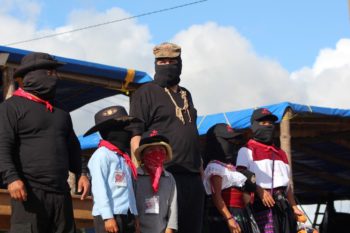
[:es](Cuento leído durante la clausura del “CompARTE por la vida y la libertad 2018” en el Caracol de Morelia, Torbellino de nuestras palabras, montañas del sureste mexicano.)
Escucha aquí: [podcast]https://radiozapatista.org/wp-content/uploads/2018/08/Cierre-comparte-2018-discurso-galeano.mp3[/podcast]
LA ÚLTIMA MANTECADA
EN LAS MONTAÑAS DEL SURESTE MEXICANO.
Tal vez fue por una serie de sucesos aleatorios, sin liga aparente entre ellos, que la tragedia se gestó.
O quizás fue una simple coincidencia, una suerte de azar infortunado. Como si el destino se diera en alimentar los rumores sobre su existencia, arrojando las piezas de un rompecabezas sobre, claro, las cabezas rotas de humanos y máquinas.
O acaso la Tormenta (ésa que el zapatismo insiste en señalar y que, como en todo lo que dice, nadie más repara), había incurrido en un “spoiler”, un pequeño adelanto de lo que se avecinaba. Como si, en el software incoherente con el que parece funcionar la realidad, se hubiera colado un aviso urgente, un “warning” inadvertido, una señal que sólo podría ser detectada e interpretada por los más avezados vigías que, en los rincones del mundo, se empeñan en otear horizontes que, de tan lejanos, ni siquiera aparecen como variable en las frenéticas estadísticas del sistema mundial. Después de todo, las estadísticas sirven para señalar tendencias que borran dramas cotidianos. ¿Qué es, después de todo, el asesinato de una mujer? Una de numeral. Una más es una menos. Las estadísticas dirán que se necesitan varios, muchos de esos asesinatos “de género” para incidir apenas en una tendencia: la del desbocado cabalgar del sistema hacia el abismo, derrapando sobre sangre, lodo, escombros, mierda, destrucción. ¿En el horizonte? La guerra. ¿En el sendero andado? La guerra. Porque en el sistema capitalista la guerra es el origen, el camino y el destino.
En fin, tal vez desvarío. Porque éste es un cuento y hay que cuidar que no se cuelen en él reflexiones tendenciosas, malas ideas, malsanos pensamientos, cavilaciones ociosas, provocaciones.
Quienes padecieron alguna vez el ver una película con el finado SupMarcos, cuentan que era insoportable. Bueno, no sólo era insoportable en eso, pero estoy hablando de ver películas. Bastaba que en el filme apareciera un arma de fuego para que el difunto pusiera “pausa” y se diera una larga y ociosa exposición sobre rasancia, energía, alcance, poder de fuego, y las breves o largas parábolas que un proyectil trazaba en su ruta hacia “el objetivo”. Poco importaba que, en ese momento pausado, la trama se fuera a resolver, o que quienes veían el filme se angustiaran sin saber si el héroe (o la heroína, no olvidar la equidad de género) se salvaba o no. No, ahí estaba el inútil derroche de erudición: “ésa es una carabina M-16, calibre 5,56 mm NATO, nombrado así para diferenciar las municiones fabricadas por los países de la Organización del Atlántico Norte, de las del Pacto de Varsovia, y etcétera, etcétera”. Claro, la compañía cinéfila no sabía qué hacer: si demostraba interés, el finado podría extenderse; si, en cambio, mostraba indiferencia, el difunto podría interpretar que no había sido claro y se explayaría más, llegando, claro, a la guerra fría. Y entonces el SupMarcos se sentía obligado a explicar que el término “guerra fría” era un oxímoron, una argucia del sistema para obviar la muerte y la destrucción que habían marcado esa época. Seguía entonces con lo de “cuarta guerra mundial”, y así hasta que las palomitas se enfriaban o se habían convertido en un amasijo de maíz palomero con salsa “Valentina”.
Bueno, ya me estoy poniendo igual. El asunto era que, si el SupMarcos asistía a la función, había que ver las películas o las series dos veces: una para padecer las interrupciones, la otra para entender la trama. Por esto digo que un cuento es un cuento y no una plática política. Aunque Defensa Zapatista use lo de “plática política” para ocultar las muestras de “violencia de género” que, en forma de zapes, le aplica al estoico Pedrito, el niño que, sin saberlo ni pretenderlo, asume el papel de némesis de la niña y su indefinible gato-perro.
¿En qué estaba? Ah, sí, en los por qué de lo que les narraré más adelante.
El asunto es que, esa madrugada, confirmé lo que me temía: se habían acabado las mantecadas. Todas. Incluso la reserva estratégica (destinada a hacer frente al previsible apocalipsis zombi, a una invasión extraterrestre, o a la caída de un meteorito), estaba en ceros.
¿Qué fue lo que pasó? Pues, como en las tragedias griegas y en los corridos mexicanos, no pasa nada hasta que pasa.
La Doña Juanita, atrincherada en la cocina del CIDECI, en San Cristóbal de Las Casas, Chiapas, México, se había declarado en huelga: nada de tamales, nada de cuche (cerdo, en Chiapas), nada de tacos y garnachas, nada de batidillos ricos en carbohidratos, grasas y colesteroles. Y, oh desgracia, nada de mantecadas. Que ahora pura comida sana, o sea verduras, verduras y más verduras. Que nada de que nada. Que resistencia y rebeldía. Que muera la comida chatarra y el fast food.
Cuando me enteré, mandé un enlace para convencer a Doña Juanita de que hiciera una excepción; que la entendía, pero que había yo leído en un libro que las mantecadas eran muy nutritivas; que si ella hacía mantecadas, todo iba a quedar “entre nous”, que no se iba a publicar. El enlace regresó desconsolado: ni siquiera pudo hablar con Doña Juanita, quien estaba fortificada, junto con sus compas de la cocina, cantando el “no, no, nos moverán, y el que no crea que haga la prueba, no nos moverán”. Le pregunté al enlace que qué había hecho él. Dijo que se puso a cantar, que se oía bien bonito el coro y agarró una guitarra y acompañó el himno.
Yo no me dejé derrotar por cuestiones que adjudiqué al rubro “de género”. Después de todo, Doña Juanita es mujer y hay cosas que las mujeres no entienden.
Recurrí entonces al arma ultra secreta del ezetalene: el compa Jacinto Canek.
Muy lejos de estas montañas, pero enclavado en otras, el compa Jacinto Canek le sabe a la cocina. Hace maravillas con apenas unas cuantas ollas y sartenes. Pero tiene un don especial para el pan. Se rumora que hay gente que viaja desde los más diversos rincones del mundo para probar sus panes. Como una muestra de la “otra globalización”, su repostería ha deleitado el paladar de 5 continentes.
“El secreto está en que hay que echarle muchos huevos”, me confesó un día el compa Jacinto Canek mientras esperábamos, yo impaciente, que salieran las mantecadas del horno. Aunque él se refería a los panes, yo dije casi como reflejo: “como a todo, Don Jacinto, como a todo”.
Por una cuestión de solidaridad de género, confiaba yo en que el compa Jacinto Canek haría honor a su nombre de lucha y aportaría una salida a la grave crisis que se avizoraba.
Una misión de tal trascendencia requería una postura drástica. Con el fin de acallar las críticas que ya adivinaba de las feministas, le encargué a la insurgenta Erika que fuera hasta las tierras donde Jacinto Canek defendía a capa y espada sus secretos culinarios.
Le dije a la Erika que tenía ella una misión muy importante. Que debía ir donde Jacinto Canek y debería relatarle una leyenda: los más primeros dioses, los que nacieron el mundo, crearon las mantecadas para que los humanos se dieran una idea de lo que era el paraíso. Pero luego llegó el pinche sistema capitalista con sus Bimbo-Marinela, la Tía Rosa, Wonder y etcétera, y corrompieron el sagrado manjar de los dioses.
Que quienes hacían pan artesanal eran los custodios de la memoria, los que resguardaban el santo grial que permitía la comunicación entre humanos y dioses.
Por supuesto que la insurgenta Erika me preguntó qué cosa era “santo grial”. Le dije que era algo muy importante, sagrado, que de eso dependía el destino de la humanidad.
La Erika se burló diciendo “Nah, qué va a ser, seguro lo inventaste, Sup, nomás porque quieres mantecadas”.
Yo puse cara de “me ofendes”, y la despaché con las amonestaciones de rigor.
Después de jornadas que imagino agotadoras, la insurgenta Erika regresó con una gran bolsa de pan. No pude evitarlo: aplaudí. Y debo confesar que mis hermosos ojos se humedecieron agradecidos.
Sin responder al saludo de la Erika, le arrebaté la bolsa y vacié su contenido en la mesa. Nada. Había conchas, trenzas, orejas, moños, polvorones, bolillos, teleras, chilindrinas, marquesotes, pan de elote, empanadas, hojaldras (sin agraviar a quienes leen), cemitas, donas, y hasta el mal llamado “pan de amor”. Pero ni una mantecada, ni una sola.
El horror.
Me derrumbé sobre la silla, con un sabor amargo llenándome la vida.
Entonces la insurgenta Erika sacó de su morraleta otra bolsa, más pequeña. Envuelta con plásticos y papeles, apareció ¡una mantecada!
“Que sólo alcanzó a hacer ésa”, me aclaró la Erika, “que ya no hizo más porque está echando baile con su mujer. Que a ver hasta cuándo”.
Se fue la insurgenta Erika.
Con extremo cuidado, como si de una valiosa pieza de fino cristal se tratara, coloqué la mantecada sobre la mesa.
Con todo eso de la Tormenta, la Hidra y el apocalipsis-todo-incluido de mi hermano bajo protesta, me puse ídem y sentencié:
“He aquí la última mantecada en las montañas del sureste mexicano”.
No sabía si comerla o hacerle un altar, un homenaje premonitorio a lo que eso significaba: el fin de una época, la inapelable sentencia del destino, el enojo de dioses desconocidos, el desdén avistado en una mirada deseada, el daño colateral de la guerra capitalista.
La miré, sí. La miré con lujuria mal disimulada. Con cuidado mis dedos apenas rozaron sus contornos azucarados, la hendidura circular que enaltecía el seno unívoco del ser unigénito, la voluptuosa figura que no sólo decía sino que gritaba: “soy una mantecada, pero no cualquier mantecada, soy la última mantecada”.
En eso estaba yo, o sea que calculando si en la tienda cooperativa tendrían conocido refresco de cola con el cual honrar la última mantecada, cuando, como si faltara ratificar la desgracia, aparecieron en la puerta…
Defensa Zapatista y el gato-perro.
Me puse de pie tan rápido como pude y, tratando de tapar con el cuerpo el obscuro objeto de mi deseo, empecé a balbucear incoherencias:
“Eh, no, no hay una mantecada sobre la mesa. No, no la estoy escondiendo. No, no hay nada detrás mío. Eh, hace mucho calor, y el zancudo está muy bravo, creo que va a llover. ¿Piensas que va a llover?”
Creo que Defensa sospechó algo, porque me dio la vuelta como si tal y vio la mantecada.
Me miró con reprobación y sentenció:
“Tienes que compartir, Sup”.
El gato-perro ladró o maulló, a saber, pero supongo que apoyando a Defensa Zapatista.
Imagino que sintiéndose convocada por la palabra “mantecada”, apareció, a saber de dónde, una niña que trataba de alcanzar la mantecada con una manita mientras con la otra sostenía un osito de peluche.
La aparté de la mesa y, siguiendo el modo del finado, le pregunté:
“¿Tú quién eres?, no te conozco”.
“Yo me llamo Esperanza y me apedillo “zapatista” y éste es un mi osito y tenemos hambre”.
Al escuchar el nombre de la niña, yo no dejé de apreciar la reiteración de las paradojas en estas tierras.
La Esperanza Zapatista se retiró después de varios intentos de lo que la nueva teoría social llamaría “acumulación por despojo de mantecadas”, una fase aún en desarrollo del capitalismo.
Defensa y el gato-perro me miraban con más de 500 años de reclamos, esperando lo imposible: que yo les compartiera la última mantecada de las montañas del sureste mexicano.
“No se puede”, me defendí con torpeza, “sólo hay una. Viera que hay dos o más pues se puede repartir, pero como sólo hay una, pues no se puede compartir, sólo es para uno”.
Subrayé el “uno” para marcar la diferencia de género: el “uno” dejaba fuera a Defensa Zapatista, a Esperanza y al gato-perro, el cual, si no sabe si es perro o gato, menos va a saber si es masculino o femenino.
Siguiendo la quinta ley de la dialéctica (nota: la primera ley de la dialéctica es “todo tiene que ver con todo”; la segunda es “una cosa es una cosa y otra cosa es no me chingues”; la tercera es “chingue su madre el universo y la materia”; la sexta es “no hay problema lo suficientemente grande como para no darle la vuelta”)…
Les decía que la quinta ley de la dialéctica señala que “siempre puede llover sobre mojado”, y, para confirmarla, reapareció la Esperanza Zapatista, ahora acompañada de dos niños zapatistas: uno portaba un sombrero vaquero más grande que él y se presentó con un “yo soy el Pablito”; el otro traía un sombrero modelo “Don Ramón en el Chavo del 8”, aunque también parecía un casco de estambre, y dijo que él era “Amado, el Amado Zapatista” (quise darle un zape por suplantarme).
Viéndome en desventaja numérica, analicé mis posibilidades:
Podía, por ejemplo, ponerme en el clásico “modo matanga dijo la changa”, tomar la mantecada y huir en lo que, en la teoría militar, se llama “repliegue estratégico”.
Opción desechada: el comando infantil zapatista me tenía rodeado.
Podía atropellarlos, siguiendo el modo del Fondo Monetario Internacional frente a gobiernos progres y no progres, pero corría el riesgo de tropezar y que el santo grial cayera. Eso le daría ventaja al gato-perro, cuya habilidad para tomar lo caído ya había sido demostrada en otro cuento que les narraré en otra ocasión.
Opté entonces por la demagogia en boga y, dirigiéndome al comando infantil, les solté:
“Miren, tienen que entender la coyuntura, la correlación de fuerzas no es favorable. No es tiempo para radicalismos. Es mejor una transición pausada. Esperar, por ejemplo, a que haya más mantecadas y entonces sí. Pero ahora ustedes deben esperar con paciencia. Por ejemplo, si ya hay una niña que se llama “Defensa Zapatista” y otra que se llama “Esperanza Zapatista”, puede ser que haya una que se llame “Paciencia Zapatista”. Entonces, vayan a buscarla y, cuando la encuentren, le echan la plática política y entonces pues ya vemos”.
“No hay”, respondió Defensa Zapatista, y agregó con malicia: “pero hay una compañerita que se llama “Calamidad”, o sea que es “La Calamidad Zapatista”. Ahí lo veas si la traemos.”
Un estremecimiento sacudió por entero mi sensual cuerpo.
Desesperado, me di cuenta de que mis argumentos no convencían.
Imaginé entonces el cataclismo terminal: una multitud de niñas y niños zapatistas rodeando mi champa, la otrora comandancia general del ezetaelene; insultos en diferentes lenguas de origen maya; Defensa Zapatista ordenando “traigan ocote”; Esperanza sacando, a saber de dónde, un encendedor, mientras su osito, os lo juro, se transformaba en “Chuky, el muñeco diabólico”; el gato-perro ladrando y maullando; el Pedrito bailando con la promotora de educación y el Pablito cantando la del moño colorado y el Amado haciendo la segunda voz (sí, los varones siempre en otro canal); los ocotes encendidos democratizándose; las primeras llamas lamiendo las tablas y creando un cerco de fuego dentro del cerco infantil; y yo, heroico, abrazando la mantecada, dispuesto a morir antes de entregar “my tresaure” a esa masa irreverente que apenas levantaba unos palmos del suelo.
Era inútil tratar de dividirlos y llevarlos a enfrentarse entre sí: la mantecada los unía y yo no podía cederla.
Podría, es cierto, arrojarla y, aprovechando la confusión, buscar refugio. Pero dudo que se abalanzaran por la mantecada. Seguro seguirían su tradición de compartir incluso lo poco que tienen, tal y como la pandilla del finado SupMarcos hacía después de asaltar la tienda “La Nana Zapatista” en La Realidad ídem.
Pero ni hablar, era mi mantecada. Ella y yo estábamos unidos por el destino. En mis pensamientos rondaban los antiguos escritos (que yo redacté): “en el principio de los tiempos, los dioses crearon la mantecada y vieron que la mantecada era buena y entonces crearon al Sup para que de ella se regocijara y se la zampara sin compartir”. Ergo, la mantecada era de mi propiedad por mandato divino y esos enanos y enanas herejes pretendían despojarme de ella, cometiendo así el más grande pecado: desafiar la propiedad privada de la mantecada, que, como todos saben porque viene en todos los libros de historia, es el fundamento de la civilización, el orden y el progreso.
El futuro de mi mundo estaba en juego. Si yo compartía mi mantecada, la humanidad volvería a la edad de piedra, a un mundo sin internet, sin redes sociales, sin las películas y series en stream y, horror de horrores, sin helado de nuez.
Entendí entonces que en mi hermoso y bien formado cuerpo residía la última oportunidad del ser humano.
Si yo compartía la mantecada, cosas terribles podrían suceder. Por ejemplo, las mujeres podrían rebelarse. No una, ni dos. Todas. Millones de Defensas, Esperanzas y Calamidades Zapatistas surgiendo por todos los rincones del planeta.
El apocalipsis.
La destrucción total del mundo tal y como lo conocemos.
El fin de los tiempos.
La catástrofe final.
Me estremecí.
Entonces cometí un error del que no me cansaré de arrepentirme: sin que fuera necesario, solté:
“Además, es la última”.
“¡La última!”, repitió la niña con alarma y sorpresa.
Quedó pensando Defensa Zapatista. Yo sentí un escalofrío recorrer todo mi voluptuoso cuerpo. Nada hay más temible que una niña pensando.
Defensa Zapatista rompió el silencio:
“Está bueno, entonces vamos a jugar y quien gane se queda con la mantecada”.
Yo quise alegar que no tenía por qué jugar a nada apostando mi mantecada, porque era mía, mía de mí-me-conmigo, my tresaure, el producto de mi esfuerzo… (bueno, el esfuerzo había sido del compa Jacinto Canek, pero por solidaridad de género y en su representación, me tocaba a mí).
Mientras construía el alegato de mi defensa, la ídem zapatista, añadió:
“Y en honor del gato-perro aquí presente, el juego va a ser “gato”. Quien gane, gana la mantecada”.
Al escuchar eso, suspendí en la cabeza mi brillante disertación jurídico-gastronómica, y pregunté:
“¿Gato? ¿Ése que se juega con bolitas y cruces y gana el que hila una línea horizontal, vertical o diagonal?”
“Éste”, dijo la niña y trazó en su cuaderno la cruz de paralelas del “gato”, el juego de mi infancia que, al jugarlo unas veces, se adivinaba sin ganador.

“El tres en línea, también conocido como Ceros y Cruces, tres en raya (en Perú, España, Ecuador y Bolivia), juego del gato, Triqui (en Colombia), Cuadritos, Gato (en Chile y México),Triqui traka, Equis Cero, Tic-Tac-Toc (en Estados Unidos), es un juego de lápiz y papel entre dos jugadores: O y X, que marcan los espacios de un tablero de 3×3 alternadamente.”
Yo hice con rapidez mis cálculos y aventuré:
“¿Y si hay empate?”
Defensa Zapatista miró al gato-perro. El gato-perro miró a Defensa Zapatista. Esperanza miró a ambos. Pablito y Amado miraron la mantecada.
Después de unos segundos, el gato-perro ladró-maulló. La niña Defensa, dirigiéndose al animalito, preguntó:
“¿Estás seguro?”
El gato-perro resopló con aires de “no sé qué te hace dudar de mí”.
La niña me dijo entonces: “si hay empate, la mantecada queda con quien la tenía al principio”.
“O sea yo”, dije asegurándome de que no hubiera trampas jurídicas en el acuerdo.
“Sí”, dijo despreocupada Defensa Zapatista.
“Bueno”, dije yo, saboreando de antemano por partida doble: el triunfo de género y la mantecada que no era cualquier mantecada, era la última mantecada en las montañas del sureste mexicano.
“Entonces, ¿empiezas tú o yo?”, le pregunté a la niña mientras sacaba una hoja en blanco y mi plumón negro con tinta indeleble.
“Yo no voy a jugar. Reclamo juicio por combate. Elijo al gato-perro aquí presente como mi campeón. Él va a luchar en mi lugar”, respondió Cersei, perdón, Defensa Zapatista.
“De acuerdo”, dije confiado. Después de todo, eso me aliviaría de las críticas de género por haberle ganado a una niña, y el gato-perro, bueno, era un gato-perro, así que no había nada qué temer.
El animalito se trepó de un salto a la mesa de madera, apartó con un ademán despectivo el papel y, con lo que yo creí era una sonrisa burlona, sacó sus uñas y, como un relámpago, trazó sobre la superficie de la mesa el campo de batalla.
Así las cosas, saqué mi navaja de montaña y desplegué su afilada hoja con un brillo maléfico en la mirada.
En el relámpago de la hoja de metal, el universo entero pareció detenerse, como si su movimiento o inmovilidad futuros dependiera de lo que en esa vieja mesa de madera se dirimía: cara o cruz, vida o muerte, sombra o luz, mantecada o caos.
Ok, exagero, pero el gato-perro y quien esto relata intercambiamos las mismas miradas que, por siglos, intercambian los contrincantes que saben que, en un enfrentamiento, no sólo se juegan la vida, sino el mañana entero.
El gato-perro tendió la mano, bueno, la garra, como cediéndome el inicio, al menos así lo interpreté.
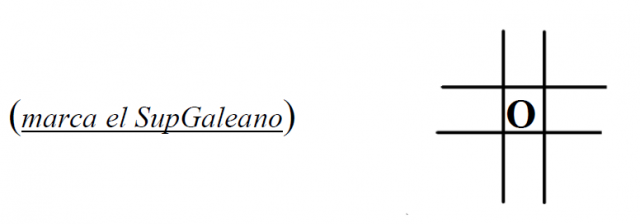
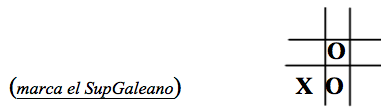
Con decisión, emulando a Kasparov, tracé mi bolita en el centro. Aunque yo sabía que el centro no conduce a nada, pensaba yo para mis adentros que, en este caso, un empate era una victoria, porque la mantecada permanecería con su legítimo dueño, es decir, con mi estómago.
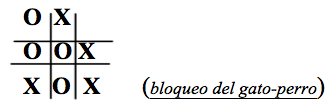
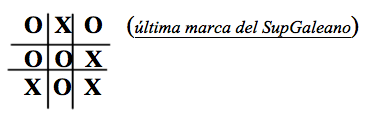
“¡Un momento! Le falta una tirada al gato-perro”.
“Pero ya está lleno”, dije como protesta.
El gato-perro sonrió con picardía y, con sus uñas más afiladas, trazó lo no previsto: como si un mundo nuevo dibujara, agregó extensión al diagrama:
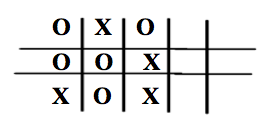
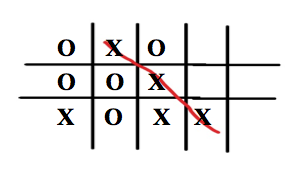
Salieron corriendo, con Defensa Zapatista levantando al aire la mantecada como si una bandera universal ondeara.
Antes de irse, Esperanza Zapatista, haciendo honor a su paradoja, se acercó y me palmeó en la espalda mientras me decía:
“No preocupas Sup. Yo luego te platico cómo sabía el pancito ése que te derrotó el gato-perro”.
Se fue también la Esperanza y, con ella, mi última ídem.
Mientras les miraba alejarse, pensé que ése es el problema con el zapatismo, créanme: si sus sueños y aspiraciones no caben en este mundo, imaginan otro nuevo… y sorprenden con sus empeños por lograrlo.
Y no sólo con el zapatismo.
En el planeta entero nacen y crecen rebeldías que se niegan a aceptar los límites de esquemas, reglas, leyes y preceptos.
Porque no son sólo dos los géneros, ni siete los colores, ni los puntos cardinales son cuatro, ni uno el mundo.
Así como Defensa Zapatista, el gato-perro y la pandilla formada por el Pedrito, el Pablito y el Amado, nosotras, nosotros, nosotroas sólo tenemos un objetivo: cuidar la Esperanza Zapatista.
Si este mundo no da para eso, pues habrá que hacer otro, uno donde quepan muchos mundos.
Con estos pensamientos, yo suspiré y le dije al espejo: “debiste haber compartido”.
-*-
Tan-tan.
Desde el caracol Torbellino de Nuestras Palabras, montañas del sureste mexicano, planeta tierra.
El SupGaleano.
9 de Agosto del 2018,
en el 15 aniversario de los caracoles zapatistas
y las Juntas de Buen Gobierno.
[:en](Story read at the close of the “CompARTE for Life and Freedom 2018” arts festival in Morelia, Caracol “Whirlwind of our Words,” mountains of the Mexican Southeast.)
Listen here (in Spanish): [podcast]https://radiozapatista.org/wp-content/uploads/2018/08/Cierre-comparte-2018-discurso-galeano.mp3[/podcast]
It may have been a string of random events, without any apparent relation between them, that brought about this tragedy.
It may have been merely a coincidence, a bit of bad luck, as if destiny decided to feed rumors of its existence by dropping pieces of a jigsaw puzzle onto the now-cracked open heads of humans and machines.
Or maybe the Storm itself (yes, that storm that Zapatismo insists on calling attention to and, like most things we say, no one else seems to notice) revealed a spoiler, a hint of what is coming. It was as if the incoherent software on which reality apparently runs suddenly flashed an urgent warning, an unexpected alert, a signal so subtle that it was only noticed by the most experienced lookouts, those who focus on examining horizons so distant that they don’t even appear as factors in the frenetic statistics of the global system. After all, statistics function to show tendencies deeper than the drama of the day-to-day. What’s one murdered woman? A number: one more statistic, one less woman. Statistically speaking, you’d need more, many more of these “gendered” murders to even suggest evidence of a tendency—which would be that of the system’s runaway gallop toward the abyss, skidding through blood, mud, ash, shit, and destruction. What’s on the horizon? War. What’s down the beaten path? War. In the capitalist system, war is the starting point, the ending point, and everything in between.
But maybe I’m just talking madness. After all, this is a story, and one has to be careful not to veer into biased reflections, dangerous ideas, morbid thoughts, idle musings, or provocations.
Those who had to suffer through watching a movie with the late SupMarcos can tell you that it was intolerable. The truth is he was intolerable in various respects, but for now I’m talking about watching movies. Any time a firearm appeared onscreen he’d hit pause and launch into a long and pointless discussion about trajectory, distance, force, firepower, and the various shorter or longer geometric curves a projectile could take en route to its “objective.” During that pause he didn’t care how the plot was going to play out, or if other viewers were anxious to know if the hero (or the heroine, musn’t forget gender equity) would be saved; he’d just delve into his hopelessly erudite explanations: “that one is a M-16 rifle, NATO 5.56-caliber—named as such to differentiate between munitions manufactured in countries belonging to NATO versus those of the Warsaw Pact, etc. etc.” The rest of the movie-watchers never knew what to do: if they showed interest, he might go on even longer; if they looked disengaged, he might think he hadn’t been sufficiently clear and thus expound further, always eventually ending up, of course, at the Cold War. At that point SupMarcos would always feel obliged to explain that the term “cold war” was an oxymoron, the system’s way to hide the death and destruction that characterized that period. From there he would delve into the “fourth world war” and on and on until the popcorn got cold and turned into mush with hot sauce.
Huh, looks like I’m doing the same thing now. The thing is that if SupMarcos came to watch a movie, you knew you’d have to watch it twice: once to suffer through the interruptions, and a second time to understand the plot. That’s why I always insist that a story is a story and not a political discussion, although “political discussion” is also used by Defensa Zapatista as a cover for the “gender violence” she inflicts on the stoic Pedrito who, without his knowledge or intention, has become the nemesis of the girl and her undefinable cat-dog.
What was I saying? Oh, right, I was telling you why I was going to tell you what I’m going to tell you.
It was in the wee hours of that fateful night that I confirmed what I had long feared to be true: the honeybuns were all gone. All of them. Even the strategic reserve—meant to withstand the predictable zombie apocalypse, an alien invasion, or a falling meteorite—was null.
How did this happen? Well, that’s just the thing, just like in Greek tragedies and Mexican corridos, everything’s okay…until it’s not.
Doña Juanita, holed up in the CIDECI kitchen in San Cristóbal de Las Casas, Chiapas, Mexico, had gone on strike: no tamales, no pork, no tacos or street food, no carb-rich, fat-laden or cholesterol-ridden milkshakes. And, heaven help us, no honeybuns. Now she was dead set on serving all healthy food: in other words, vegetables, vegetables, and more vegetables. She would have no discussion about it—she claimed it was part of resistance and rebellion: down with junk food and fast food.
When I found out, I sent an emissary to convince Doña Juanita to make an exception: to say that I understood her point of view, but that I had read a book about the nutritional value of honeybuns. Then I tried another tactic: that if she would make honeybuns, we’d keep it between the two of us—I wouldn’t tell anyone. The emissary came back looking totally defeated: he hadn’t even been able to talk to Doña Juanita. She and her compañeros had fortified their position in the kitchen and were singing, “We shall not be moved, and if there’s any doubt just try it out! We shall not be moved![i] I asked my emissary what he had done in the face of this. He said that the chorus was really catchy, so he had grabbed a guitar and started singing along. Me on the other hand, I don’t just roll over on issues that fall under the rubric of “gender.” After all, Doña Juanita is a woman and there are some things women just don’t understand.
At that point I resorted to the ee-zee-ele-en’s super-secret weapon: our compañero Jacinto Canek. Far, far from these mountains but deep in others, our compañero Jacinto Canek knows all about things pertaining to the kitchen. He works wonders with just a few pots and pans. But he has a special gift with regard to bread. It is said that people travel from all over the world to try his bread. As a demonstration of “another globalization,” his baking has delighted the palate of people across the five continents.
“The secret is that you have to put a lot of huevos[ii] into it,” Jacinto Canek confessed to me one day while we waited, me rather impatiently, for some honeybuns to come out of the oven. He meant into the bread, but I said, “like with everything, Don Jacinto, like with everything.” I had faith that our compañero Jacinto Canek, as a matter of gender solidarity, would honor his nom de guerre[iii] and offer a solution to the very serious crisis at hand.
A mission of such transcendental importance required drastic measures. In order to ward off the criticism I could already see coming from the feminists, I sent Insurgenta Erika to the distant lands where Jacinto Canek protected his culinary secrets at all costs.
I told her she was on a very important mission, that she had to find Jacinto Canek and tell him about the legend of the first gods, the ones who gave birth to the world and created honeybuns so that humans would have some idea of what paradise was. But then the fucking capitalist system showed up with its Bimbo-Marinela, Tia Rosa, Wonder Bread and all that, corrupting the sacred delicacies of the gods. Those who make artisanal bread are effectively the guardians of memory, protecting the Holy Grail that provided for communication between humans and gods.
Insurgenta Erika of course asked me what on earth a “Holy Grail” was. I told her it was something very important—sacred, in fact—and that the entire future of humanity depended on it. Erika scoffed, saying, “Oh, please, you for sure made that up, Sup: you’re just trying to get your hands on some honeybuns.”
I put on my “I’m-so-offended” face and sent her off with a firm warning.
After what I imagine was an exhausting journey, Insurgenta Erika came back with a huge bag of homemade bread. I applauded, I couldn’t avoid it. I have to admit that my beautiful eyes teared up with gratitude. I didn’t even return Erika’s greeting, but grabbed the bag from her and emptied its context onto the table. Nothing. There were croissants, cupcakes, muffins, elephant ears, cinnamon rolls, long johns, cornbread, donuts, everything. But no honeybuns, not a single one.
The horror.
I collapsed into my chair, bitterness filling my mouth.
Just then Insurgenta Erika took another bag out of her backpack, a smaller one. And there it was, all wrapped up in plastic and paper: a honeybun!
“He only managed to make this one,” Erika explained. “He couldn’t make more because he was about to go dancing with his wife. He said he didn’t know when he’d get around to making more.”
Erika left. With extreme care, as if it were fine crystal, I placed the honeybun on the table. With the Storm, the Hydra, and the All-Inclusive-Apocalypse on my mind, I assumed a formal posture and declared:
“Here lies the last honeybun in Southeastern Mexico.”
I didn’t know if I should eat it or put it on an altar, with a homage to what it represented: the end of an era, destiny’s unappealable mandate, the anger of unknown gods, a glimpse of disdain from a desired eye, the collateral damage of the capitalist war.
I looked at it—oh, yes, I looked at it with undisguised lust. My fingers brushed lightly over its sugared curves, the circular cleft that gave rise to the single bosom of the unisex being, the voluptuous figure that not only spoke but shouted: “I am a honeybun, not just any honeybun, but the only honeybun.”
I was busy with that, and pondering whether the cooperative store would have that well-known cola with which I could honor this last honeybun, when, as if to complicate what was already a tragedy, Defensa Zapatista and the cat-dog appeared at the door. I stood up as quickly as I could, using my body to try to shield the obscure object of my desire as I stammered incoherently:
“Uh, no, there is no honeybun on the table. No, I’m not hiding it. Of course there’s nothing behind me. Wow, it’s hot, and the mosquitos are out in force: I think it’s going to rain. Do you think it’s going to rain?”
I think Defensa suspected something because she walked right up and around me and saw the honeybun. She looked at me sternly and declared:
“You have to share, Sup.”
The cat-dog barked or meowed or who knows what, but I suppose in agreement with Defensa Zapatista.
Out of the blue, apparently convoked by the very word “honeybun,” another little girl appeared, reaching over the table to try to grab the honeybun with one little hand while holding on to her teddy bear with the other. I pulled her away from the table and, in true SupMarcos fashion, asked her:
“Who are you? I don’t know you.”
“My name is Esperanza [Hope] and my last name is ‘Zapatista’ and this is my little bear and we’re hungry.”
Upon hearing the little girl’s name, I once again appreciated the continuous paradoxes of these lands.
Esperanza Zapatista backed away after various attempts at what new theoretical frameworks would call “accumulation by dispossession of honeybuns,” a still-developing phase of capitalism.
Defensa and the cat-dog looked at me with over 500 years of demands in their eyes, awaiting the impossible: that I share with them the last honeybun in the Mexican Southeast.
“I can’t,” I defended myself awkwardly, “there’s only one. If there were two or more we could divvy them up, but there’s only one, enough for one person, and that one person, well, he can’t share one honeybun.”
I emphasized the masculine pronoun to purposely leave out Defensa Zapatista, Esperanza, and the cat-dog—I mean, we don’t even know if it’s a dog or cat, much less if it’s male or female.
In accordance with the fifth law of the dialectic (note: the first law of the dialectic is “Everything is related to everything else”; the second law is “To share is one thing; don’t fuck with me is quite another”; the third is “Fuck matter and the universe”, and the sixth is, “There’s no problem too big to be turned around”)…
Anyway, I was telling them that the fifth law of the dialectic states that “There’s no problem so big that it can’t get worse”, and as if to ratify it right there on the spot, Esperanza Zapatista reappeared, now accompanied by two little Zapatista boys: one had on a cowboy hat that was bigger than he was and introduced himself as Pablito; the other had on a hat resembling that of Don Ramon on “El Chavo del Ocho”[iv], which also looked kind of like a wool helmet, and introduced himself as Amado [literally “beloved”], The Amado Zapatista.” (I wanted to swat him for trying to take over my role.)
Seeing that I was outnumbered, I evaluated my options:
I could, for instance, take the “finders-keepers, losers-weepers” approach, that is, grab the honeybun and flee, or in military terminology, execute a “strategic retreat.” But I had to discard this option: the Zapatista kid-commando had me surrounded.
I could plow through them, IMF-style (they’ve trampled both progressive and not-progressive governments), but I’d run the risk of stumbling and dropping the Holy Grail. That would give the cat-dog the advantage—its ability to snarf down whatever falls is demonstrated in another story that I’ll tell you another time.
So I opted for the current demagoguery in fashion and addressed myself to the kid-commando:
“Look, analyze the current historical conjuncture—the correlation of forces is not on your side. This is no time for radicalism; it is a moment of gradual transition. You should wait, for example, until there are more honeybuns, at which point, yes, of course you can have some. But right now you need to wait patiently. If there is a little girl named ‘Defensa Zapatista’ [Zapatista Defense] and another named ‘Esperanza Zapatista,’ [Zapatista Hope] well then maybe there’s another little girl named ‘Paciencia Zapatista’ [Zapatista Patience]. So go look for her, and when you find her, give her a political talking-to and then we’ll see.”
“There isn’t,” Defensa Zapatista responded, adding maliciously, “but there is a little girl named ‘Calamidad,’ so that would make her full name ‘Calamidad Zapatista’ [Zapatista Calamity]. You want us to bring her?”
A shiver ran down my succulent body. I realized with desperation that my arguments weren’t working.
I imagined the potential final cataclysm: a multitude of little Zapatista girls and boys surrounding my hut, the former General Command of the ee-zee-el-en, yelling insults in various Mayan languages. I could imagine Defensa Zapatista giving the order, “Bring the kindling”, Esperanza wielding a lighter (who knows where she got that) while her teddy bear, I swear it, transformed before my very eyes into “Chucky.” The cat-dog would be barking and meowing, Pedrito would be dancing with the education promotora, Pablito singing the “The Girl with the Red Bow” and Amado harmonizing (yeah I know, the guys are always off in outer space). The kindling would begin to catch, the first flames licking the walls and forming a circle of fire within the circle of kids, and there I’d be, heroically clutching my honeybun, willing to die rather than give up “my treasure” [English in the original] to this irreverent mob barely a couple feet tall.
It was pointless to try to divide and conquer them; the honeybun united them and I could not give it up.
I could have hurled it out to them and used the ensuing confusion to seek refuge. But I had my doubts that they would pounce on the honeybun—they would probably follow their tradition of sharing any little bit they had, just like the late SupMarcos’ kid-gang used to do after robbing the “Nana Zapatista” store in [the Zapatista community of] La Realidad.
Forget it, it was my honeybun: we were united by destiny. Ancient verses ran through my mind: “In the beginning, the gods created the honeybun and they saw that it was good. Then they created the Sup so that he could delight in the honeybun and scarf it down without sharing.” Ergo, the honeybun was my property by divine right and these disrespectful little midgets were trying to steal it from me, thus committing the gravest of sins: challenging private property rights over the honeybun, which is, as everybody knows because that’s what the history books say, the foundation of civilization, order, and progress.
The future of the world was at stake. If I shared the honeybun, humanity would return to the stone age, a world without internet, social media, films, streaming series’, and, horror of horrors, without pecan praline ice cream.
I realized then that within my beautiful and shapely body lay the last opportunity of humankind.
If I shared the honeybun, terrible things could happen. For example, women could rebel. Not one, not just a couple, but all of them: millions of Zapatista Defensas, Esperanzas, and Calamidades, rising up all over the planet.
The apocalypse. The destruction of the world as we know it. The end of time. The final catastrophe. I shivered.
Then I committed a mistake that I will always regret. I blurted out, completely unnecessarily:
“Plus, it’s the last one.”
“The last one!” Defensa Zapatista repeated with alarm. She fell silent, thinking, and another shiver ran down my voluptuous body. There is nothing more terrifying than a little girl deep in thought. Suddenly she broke the silence:
“Okay fine, then what we’ll do is play a game and whoever wins gets the honeybun.”
I wanted to object that I had no reason to play anything and gamble my honeybun because it was already mine, ALL MINE, my treasure, the fruit of my labor…(okay, the labor technically was Jacinto Canek’s, but in his place and out of gender solidarity, it fell to me). As I was preparing my legal defense, Defensa Zapatista added:
“In honor of the cat-dog [gato-perro] here, the game we’re going to play is ‘gato’ [tic-tac-toe]. Whoever wins gets the honeybun.”
Upon hearing this I paused the brilliant juridical-gastronomical defense I was developing in my head and asked:
“Gato? That game with the x’s and o’s where whoever makes a horizontal, vertical, or diagonal line wins?”
“That’s the one,” the little girl replied, and drew the tic-tac-toe pattern in her notebook. It was a game I remembered from my childhood, and which I knew from playing had no winner.
For those of you of the “digital generation,” I’ll save you the trouble of looking it up on Wikipedia: “Tic-tac-toe (also known as noughts and crosses or Xs and Os) is a paper-and-pencil game for two players, X and O, who take turns marking the spaces in a 3×3 grid. The player who succeeds in placing three of their marks in a horizontal, vertical, or diagonal row wins the game.”
I calculated quickly in my head and ventured:
“What if there’s a tie?”
Defensa Zapatista looked at the cat-dog. The cat-dog looked back at her. Esperanza looked at both of them. Pablito and Amado looked at the honeybun. After a moment the cat-dog bark-meowed. Defensa Zapatista paused, asking it, “Are you sure?”
The cat-dog snorted as if to say, “How could you doubt me?”
The little girl turned to me and said: “If there’s a tie, the person originally in possession of the honeybun keeps it.”
“Me, that is,” I said to make sure there were no juridical tricks in this agreement.
“Correct,” Defensa Zapatista said without concern.
“Deal,” I said, savoring my anticipated double triumph: the gender victory and the honeybun that wasn’t just any honeybun, but the last honeybun in the mountains of the Mexican Southeast.
“So who goes first?” I asked the little girl as I took out a blank page and my black indelible ink pen.
“Oh I’m not playing. I call for a trial by combat and declare the cat-dog my champion. He will fight in my place,” declared Cersei[v], I mean Defensa Zapatista.
“Fine,” I answered confidently. In the end, that arrangement would relieve me of all the gender-based critiques that would have plagued me for having beaten a little girl, and the cat-dog, well, it was just that, a cat-dog, so there was nothing to worry about.
In a single leap, the little animal landed on the table, disdainfully pushing the paper aside and, with what I’m almost sure was a mocking smile, extended its claws to draw on the surface of the table, lightning-fast, the battlefield:
Don’t get me wrong—I don’t care about the scratches on the table, I mean, it’s already covered with tobacco burns and ink stains, but it seemed to me a little unprofessional on behalf of the cat-dog. Nevertheless, I pulled out my pocket knife and switched open its blade with an evil gleam in my eye.
The entire universe seemed to rest on the metal blade, as if its future movement or lack thereof depended on what played out on this wooden table: heads or tails, life or death, shadow or light, honeybun or chaos.
Oh, fine, I’m exaggerating, but the cat-dog and I exchanged the same looks that have for centuries passed between opposing sides when they know that in this battle not only one’s life but the whole future is at stake.
The cat-dog gestured with its hand, well, its paw, as if to cede to me the first move. At least that’s how I interpreted it.
Firmly, emulating Kasparov,[vi] I drew my first circle in the center. I know of course that the center takes us absolutely nowhere, but I thought in this case a tie would be a victory because the honeybun would remain with its legitimate owner—my stomach.
SupGaleano’s move:
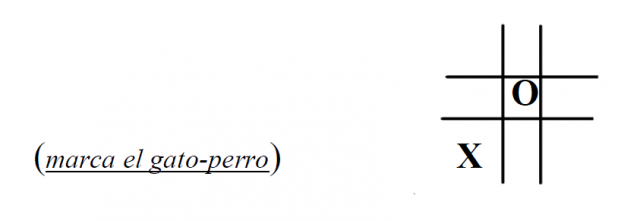
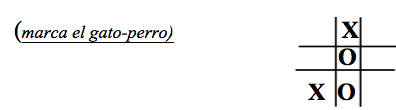
The cat-dog, as if trying to get the whole Sixth on his side, played below and to the left:
I wanted to keep the cat-dog’s suffering minimal, so I played the center again, but from below—you know, the progressive trend these days:
The cat-dog, as was to be expected and without hesitation, played the above center, as if to say that the center from above always neutralizes the center from below:
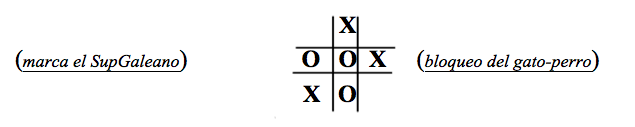
I attacked from the left flank, wanting to catch the cat-dog off-guard, but it blocked me again:
Finally, and seeing the tie shaping up, I tried for the diagonal route from above to below, left to right, you know, social democracy in decay style:
Another block from the cat-dog:
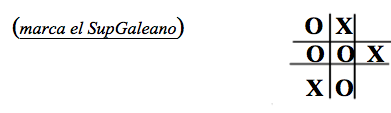
I filled in the above right spot, a mere technicality since the tie was imminent and my triumph uncontestable:
I was ready to stow the honeybun safely away in my possession when Defensa Zapatista exclaimed:
“Hey, wait a minute. The cat-dog still has one more turn.”
“But the diagram is full,” I said in protest.
The cat-dog smiled slyly and, with its sharpest claws, did something totally unexpected: as if drawing a new world, it added an extension to the diagram:
Slowly, with morbid pleasure, it scratched an “x” in the new space and, I swear it, the wooden table creaked in mourning as the cat-dog drew the diagonal line of triumph:
“We won!” Defensa Zapatista yelled and grabbed the honeybun as the little animal jumped up and down in circles.
They both ran out the door, with Defensa Zapatista holding the honeybun in the air as if it were a universal flag.
Before following them, Esperanza Zapatista, honoring her paradoxical name, came over to me and patted me on the back:
“Don’t worry, Sup. Later I’ll tell you how that honeybun the cat-dog won from you tasted.”
She left too, and with her my last hope.
As I watched them run off into the distance, I thought that this is precisely the problem with Zapatismo: believe me, if its dreams and aspirations don’t fit in this world, it imagines another…and surprises everyone with its attempts to bring it into being.
And it’s not just Zapatismo.
Across the whole planet are born and grown rebellions that refuse to accept the limits of diagrams, rules, laws, and norms.
There are not just two genders, nor seven colors, nor four cardinal points on the compass, nor one world.
Just like Defensa Zapatista, the cat-dog, and the gang made up of by Pedrito, Pablito, Amado, and us [nosotros, nosotras, nosotroas], we only have one objective: to take care of Esperanza Zapatista.
And if it can’t be done in this world, well then we’ll have to make another, one where many worlds fit.
With that thought in mind, I sighed and said to the mirror: “You should have just shared.”
-*-
The end.
From the caracol Whirlwind of our Words, mountains of the Mexican Southeast, Planet Earth.
SupGaleano.
August 9, 2018
15th anniversary of the Zapatista caracoles and the Juntas de Buen Gobierno [Good Government Councils]
[i] The African-American spiritual “I shall not be moved” was translated into Spanish as “No nos moverán” in the 1930s during the Chicano movement and has since become a protest song in its own right, “We shall not be moved”. The lyrics sung here come from a 1996 take on “No nos moverán” by Mexican punk bank Vantroi, in a song that references the Zapatistas.
[ii] Literally “eggs,” but used as slang for “balls.”
[iii] Jacinto Canek was an 18th century Mayan Revolutionary who fought against the Spanish in the Yucatan Peninsula.
[iv] Popular, widely syndicated Mexican sitcom.
[v] Cersei Lannister, the fictional character and unscrupulous queen of the series of fantasy novels by George R. R. Martin, A Song of Ice and Fire, adapted for TV as Game of Thrones.
[vi] Garry Kasparov, Russian chess grandmaster widely considered to be the best chess player in the world.[:]


Y si todos y todas y todoas, lucharamos por su mantecada y juntos y juntas convivieramos para comerla y disfrutarla, seria un mundo nuevo muy chido…Saludos Sub. Que Esperanza Zapatista, siga produciendo mas rayitas al gato…
Comentario by Violeta Santiago Santiago — Ago-28-2018 @ 04:08
fuera de contexto en lamismalinea… mister presidente nos cagamos en su muro….
Comentario by www.comuna ssssssss. — Sep-06-2018 @ 13:09