[:es]Alquimista SupGaleano: “La culpa es de la flor”[:en]The Flower is to Blame[:]
[:es]
“La culpa es de la flor”
Escucha el audio: [podcast]https://radiozapatista.org/Audios/dia2_galeanoponencia.mp3[/podcast]
27 de diciembre del 2016.
“El 30 de febrero de este año de 2016, la revista electrónica sueca especializada en temas científicos, “River´s Scientist Research Institute”, publicó un estudio que, tal vez, habrá de revolucionar las ciencias y su aplicación al entorno social.
Un grupo de científicos, encabezados por los doctores suecos Stod Sverderg, Kurt Wallander y Stellan Skarsgard, presentaron un complejo análisis multidisciplinario que llega a una conclusión que sonará escandalosa: hay una relación directa entre el aumento en la cantidad y calidad de los movimientos feministas y la disminución de la tasa de natalidad.
Combinando métodos de estadística, embriología, biología molecular, genética y análisis conductual, los científicos establecen que el aumento en la diversidad y beligerancia del feminismo, provoca una inhibición de la libido en los varones, lo que reduce la frecuencia de la actividad sexual reproductiva.
Pero no sólo. Análisis de laboratorio establecen que los espermatozoides de los varones expuestos a la actividad feminista son más débiles que los de los varones que no están expuestos. Lo que se conoce como astebizisoermia, o síndrome del “espermatozoide perezoso”, tiene más presencia en la población masculina de las sociedades donde el feminismo ocupa un lugar protagónico en las relaciones sociales. Según la prestigiada publicación citada, el doctor Everet Bacstrom, del “Rainn Wilson Institute”, con sede en Londres, Inglaterra, confrontó los resultados de la investigación con una muestra de varones europeos, de clase media, WASP, y obtuvo la misma conclusión.
Por su parte, las activistas feministas europeas, Chloë Sevigny y Sarah Linden, consultadas por la publicación, declararon que todo no era más que una sucia maniobra de lo que llamaron “el cientificismo patriarcal”.
Mientras tanto, el centro internacional de consultoría para gobiernos “Odenkirk Associated”, declaró, a través de sus voceros, James Gordon y Harvey Bullock, que recomendarían a los gobiernos de los países del primer mundo, cito textualmente, “inhibir el activismo y la beligerancia de los grupos feministas”, para así elevar la tasa de natalidad en los países desarrollados. Así mismo, declararon que recomendarán a los gobiernos de los países del Tercer mundo, principalmente en África y Latinoamérica, alentar el surgimiento y participación de grupos feministas, principalmente en zonas marginadas, de modo que se reduzca la tasa de natalidad en esos sectores, evitando así que proliferen los disturbios sociales.
Consultadas al respecto, las asesoras de la Comunidad Económica Europea, Stella Gibson y Gillian Anderson, se negaron a confirmar o desmentir que el citado estudio será la base de la nueva política internacional de Europa para con el tercer mundo.”
Bien, esto que les he leído es un ejemplo del nuevo periodismo científico. Aunque es mi autoría total, se los damos como regalo de fiestas decembrinas. Tómenlo y hagan un experimento: publíquenlo.
No recurran a la prensa escrita. Salvo el que esto escribe y un cada vez más reducido número de personas, ya nadie lee los periódicos y revistas para informarse. Vaya, ni siquiera quienes escriben en esos medios los leen, sólo consultan las referencias que de sus textos se hagan en redes sociales; y más, son las redes sociales quienes les dictan el tema que deben tratar. Hace apenas unos meses, leí a un “líder de opinión” y “analista especializado”, preguntar a sus “seguidores” el tema que debía tratar en su columna periodística: “fav, si sobre la candidata del Consejo Nacional Indigenista” (me cae que así escribió), “rt, si sobre el gran camarada y dirigente, sol de nuestra ruta y preclaro constructor del porvenir”. No necesito decirles que ganaron los rt.
No, si quieren tener “repercusión mediática” recurran, como fuente primaria de difusión, a las redes sociales.
Busquen a una estrella de las redes sociales, por ejemplo, un adolescente tuitstar con cientos de miles de seguidores, alguien preocupado siempre por darle a sus fans materiales que promuevan la tolerancia crítica, el debate racional y la reflexión profunda (cosas que, es evidente, se encuentran en abundancia en esa estimulante red social). Alguien como, por ejemplo, John M. Ackerman (253 mil seguidores). Sí, ya sé que dije que un adolescente, y el señor John Ackerman ya tiene sus kilómetros recorridos, pero estoy hablando de edad mental, así que sean comprensivos.
Luego “síganlo” y consigan que no los bloquee. Esto es muy sencillo, no necesitan escribir nada medianamente inteligible. Basta con llenar su “time line” de rt´s de todas las grandes y sólidas verdades que emanan del teclado del susodicho. Y tampoco eso es complicado, porque pueden configurar su cuenta de ustedes para que dé rt en automático.
Bien, ahora sólo necesitan convencer a ese “influencer” que ponga una breve referencia al citado estudio, y sus cientos de miles de seguidores, en automático, le darán fav y rt.
Así el estudio “científico” será un éxito y será la base de futuros análisis, coloquios, mesas redondas y entrará a la abultada biblioteca de las teorías de la conspiración.
No, no tendrán que preocuparse de que alguien se tome la molestia de analizar críticamente la nota supuestamente científica y se dé cuenta de lo siguiente:
.- Febrero no tiene 30 días.
.- “River” es una serie policial británica en la que protagonista, John River, es interpretado por el sueco Stellan John Skarsgård.
.- Stod Sverderg y Kurt Wallander, son personajes de la serie policial sueca “Wallander”.
.- Everet Bacstrom, es el nombre del protagonista de la serie policial “Bacstrom”, y Rainn Wilson es el nombre del actor.
.- Chloë Sevigny es el nombre de la actriz que protagoniza, en el papel de Catherine Jensen, la serie policial danesa “Those Who Kill”
.- Sarah Linden es el nombre de la protagonista de la serie policial estadunidense The Killing, con la actriz Mireille Enos.
.- Bob Odenkirk es el nombre del actor principal de la serie “Better Call Saul”, supuestamente la precuela de Breaking Bad.
.- James Gordon y Harvey Bullock son personajes de la serie “Gotham”.
.- La Comunidad Económica Europea no existe más, desapareció en 2009 para dar paso a Unión Europea.
.- Y Stella Gibson y Gillian Anderson, son respectivamente el personaje protagónico y la actriz que desempeña ese papel en la serie “The Fall”.
Ahí disculpen si mi pronunciación del inglés está lejos de la etiqueta de coloquios científicos internacionales, y más bien parece de “wet back” de los años 40´s, pero la solidaridad con los migrantes latinos que padecen la pesadilla Trump tiene caminos insospechados y no siempre evidentes. En todo caso, quienes lean y no escuchen estas palabras, no tendrán por qué ligar nada con el horror que ya se vive al norte del río Bravo.
Claro, hubiera bastado que cualquiera de ustedes “googleara” las principales referencias para darse cuenta de que el supuesto “estudio científico” descrito, es un completo fraude.
-*-
¿Tiene qué preocuparse la ciencia de esos fraudes que reducen el quehacer científico a una caricatura de consumo masivo?
¿Creen que sólo deben enfrentarse a la religión y al creacionismo? La religión es la religión, no pretende ser científica. En cambio, la pseudociencia sí es un problema mayor. Si creen que están en la época de la Ilustración, y son felices ridiculizando los paradigmas religiosos y ganando las encuestas de popularidad de la televisión en stream, donde se enfrentan ateos contra creyentes, no se han dado cuenta del boquete que las ciencias tienen bajo la línea de flotación.
Las pseudociencias o ciencias falsas no sólo ganan cada vez más seguidores, se están convirtiendo ya en una explicación aceptada de la realidad.
Si no me creen, tomen una terapia de cuarzo y de balance bioenergético. O inscríbanse en un diplomado de “Teoría de la Ciencia”, en la división de estudios superiores de una universidad respetable, y sorpréndanse de que deben cursar una materia que se llama “filosofía científica” (el oximorón que les persigue desde aún antes de las leyendas de Prometeo, Sísifo y Teseo).
Créanlo o no, los tiempos oscuros que se vienen, llevan ya a las ciencias, del banquillo de los acusados, al patíbulo social.
Ya volveré en otra ocasión sobre este punto más en extenso.
Pero ahora esto viene al caso, o cosa, según, porque, así como ustedes tienen que confrontar la invasión de esas ciencias falsas, nosotras, nosotros zapatistas enfrentamos eso y algunas cosas más.
-*-
En nuestra participación en la primera sesión general de ayer, les presenté algunas de las preguntas que mis compañeras y compañeros que han sido seleccionados como alumnas y alumnos suyos, prepararon.
No son mis preguntas. Si fueran mías, hubieran sido de otro estilo. Serían preguntas tipo: ¿Qué relación hay entre la sopa de calabaza y la deficiencia cognitiva?, ¿Cuáles son cualidades nutritivas de ese portento alimenticio que es el helado de nuez?, ¿las inyecciones son una forma pseudocientífica de la tortura?, etcétera.
Así que lo único que hice con las preguntas de mis compas fue agruparlas. Quité algunas preguntas porque supuse que serían respondidas en las exposiciones y por otra razón que, si da tiempo, les explicaré.
Estas 200 compañeras y compañeros, 100 mujeres y 100 hombres, fueron seleccionados para asistir, es decir, responden a colectivos. Su presencia aquí no obedece a interés o beneficio personal. Al regresar, deben responder a sus colectivos sobre lo que este encuentro fue, lo que aprendieron o no, lo que entendieron o no. O sea que están obligados a socializar el conocimiento. Esta es la razón por la que ven que estos compas escriben y escriben en sus cuadernos y se consultan entre sí, con una agitación que dudo que encuentren en su alumnado en la academia.
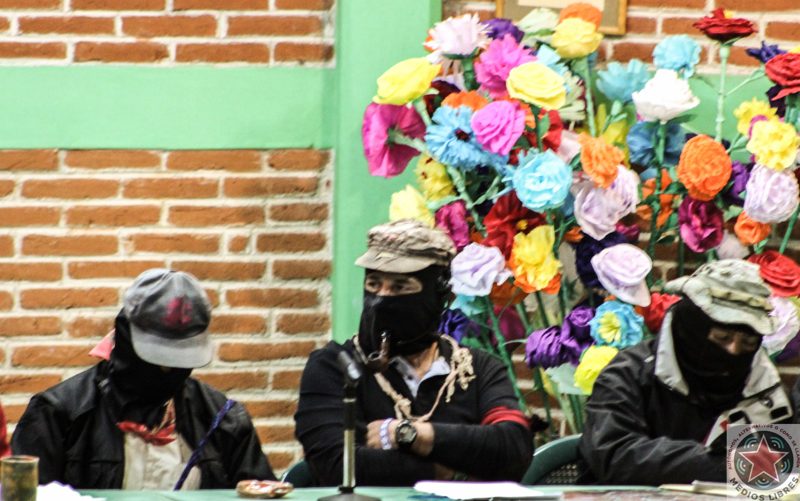
Con esto quiero decirles que, aunque aparentemente ustedes están confrontando a 200 encapuchados y encapuchadas, en realidad sus palabras llegarán a decenas de miles de indígenas de diferentes lenguas originarias.
Sí, da un poco de miedo. O mucho, según.
El interés por la ciencia en las comunidades zapatistas es legítimo, real. Pero es relativamente nuevo, no ha sido siempre así. Responde a una de las transformaciones que nuestra lucha ha experimentado, a nuestro proceso de construcción de nuestra autonomía, es decir, de nuestra libertad.
Esto se los explicará más en extenso el compañero Subcomandante Insurgente Moisés en la sesión de mañana. Por ahora sólo me detendré en un par de detalles:
1.- Las comunidades indígenas zapatistas, representadas aquí por estos 200 transgresores del estereotipo del indígena que reina en la derecha y la izquierda institucional, no conciben este encuentro como un evento único. Para que me entiendan: no es una aventura pasajera. Ellos, los pueblos zapatistas, esperan que este primer encuentro sea el inicio de una relación estable y duradera. Esperan seguir en contacto con ustedes, mantener un continuo intercambio. O como dicen en los pueblos: “que no sea la primera ni la última vez”.
2.- El modo de nuestro modo. Para que no se desesperen y para que entiendan por qué no hay preguntas después de cada exposición, permítanme explicarles cuál es nuestro modo como alumnas y alumnos.
Nosotras, nosotros, no nos planteamos problemas individuales. Como alumnado funcionamos también en colectivo. Cada quien hace sus apuntes, luego de la clase o la plática, se reúne el colectivo y se completan los apuntes tomando lo de todos. Así, si alguna o alguno se distrajo o entendió otra cosa, los demás le completan o le aclaran. Por ejemplo, en la ponencia de ayer, la del físico que leyó la Doctora, hay una parte donde él señala que alguien pudiera decir que no hay avances en las ciencias, comparando con países desarrollados, porque en México somos indios. Un compa zapatista estaba bastante molesto porque, según él, el físico nos estaba criticando como indígenas que somos y nos echaba la culpa del nulo avance científico en nuestro país. En la recapitulación colectiva le aclararon que no el físico decía eso, sino que el físico criticaba a los que decían eso.
Con las preguntas ocurre lo mismo. Primero se preguntan entre ellos sus dudas. Así, buena parte de ellas se aclaran porque son producto de que no escucharon, o no apuntaron bien o no entendieron lo que se decía. Otro tanto de las preguntas las responden entre sí. Y ya entonces quedan las preguntas que sí son dudas colectivas.
Yo sé que a ustedes les puede parecer un proceso engorroso y tardado, y que más de una, uno se desilusione pensando que no participamos, o que no supo captar la atención de nosotros. Se equivoca: después de que se reúnan los colectivos de cada zona, escribirán las preguntas que les surgieron y se las haremos llegar por el mismo medio por el que se les invitó a este encuentro. Al menos mientras acordamos un medio y un modo para estar comunicados.
Claro, todo esto parte del convencimiento nuestro de que este encuentro es el primero de muchos, y que todas, todos ustedes mantendrán comunicación con sus alumnas y alumnos, y, a través de ellas y ellos, con decenas de miles de zapatistas.
Entonces, tengan paciencia. Al menos la misma con la que acometen sus investigaciones y experimentos, o con la que desesperan a que les aprueben el presupuesto para sus proyectos.
Dicho lo anterior, permítanme proponerles la metodología zapatista por excelencia: responder a una pregunta con otra pregunta.
Así, tendrían que iniciar sus respuestas con una pregunta fundamental: ¿por qué están preguntando eso?
Bien, les explico. Debido al modo del zapatismo, nuestra acción en las comunidades no pretende hegemonizar ni homogeneizar. Esto es: no nos relacionamos sólo entre zapatistas, ni pretendemos que todos lo sean. Mientras nuestros tropiezos y errores son sólo nuestros, nuestros logros y avances los compartimos con quienes no son zapatistas e incluso con quienes son antizapatistas. Para entender el porqué de eso, sería necesario estudiar nuestra historia, algo que rebasa con mucho las pretensiones de este encuentro.
Por ahora baste con decir que, por ejemplo, los promotores de salud apoyan también a partidistas. Así que, si un promotor de salud está vacunando, no es extraño que se tope con partidistas que se niegan porque, argumentan, las vacunas no son naturales, porque son venenosas, porque enferman, porque meten males en el cuerpo y otras supercherías que se deben, lo que sea de cada quien, al fraude que es el sistema gubernamental de salud. En efecto, los mayores y mejores promotores de la mala salud en las comunidades partidistas, son las autoridades gubernamentales.
Por eso, frente a los dichos de los partidistas, la promotora de salud busca cómo argumentar y convencer de que sí es buena la vacuna. Por eso es lógico que una de las preguntas que les leí ayer sea: ¿Científicamente es necesario vacunarse y por qué, o hay medios y/o formas para sustituir las vacunas por otras cosas? Por ejemplo, las enfermedades de tosferina, sarampión, viruela, tétano, etc. Con esta pregunta, les están pidiendo más argumentos.
Igual es con los promotores de educación, las locutoras de radio comunitaria, las autoridades y las coordinaciones de colectivos.
Otro ejemplo: cuando en una comunidad una persona se convulsiona o se enferma y presenta síntomas extraños, los partidistas empiezan a decirse que es que alguien hizo brujería. Como las acusaciones de brujería suelen terminar en linchamientos, los zapatistas se esfuerzan en convencer a los partidistas de que no hay tal cosa, que las convulsiones tienen una explicación científica y no mágica, y que no es brujería sino epilepsia lo que provoca esos ataques. Por eso les preguntan de lo sobrenatural, las ciencias ocultas, la telepatía, etcétera. No hay estadísticas de esto, pero más de un partidista le debe al neozapatismo el no haber sido linchado por brujería, mal de ojo, y cosas parecidas.
Están también las preguntas sobre tópicos de los que han recibido visiones contradictorias. Por ejemplo, los transgénicos. Hay quien les dice que son perjudiciales y hay quien dice que no, o que no como se cree. Entonces los compas piden pruebas científicas, y no consignas, de una u otra posición.
El día de ayer, la bióloga nos platicaba de una encuesta que realizó, me parece, en redes sociales. Nos dijo que alguien le respondió que participaría cuando incluyera entre las opciones algo como “la ciencia es un mal”.
Bueno, a las comunidades zapatistas llega todo tipo de gente. La mayoría a decirnos lo que debemos o no hacer. Llega gente, por ejemplo, que nos dice que es bueno vivir en casas con piso de tierra y paredes de bajareque y barro; que es bueno andar descalzos; que todo eso nos beneficia porque nos pone en contacto directo con la madre naturaleza y recibimos así, directamente, los efluvios benéficos de la armonía universal. No se reían pensando que estoy caricaturizando, estoy transcribiendo textualmente una valoración de un exalumno de la escuelita zapatista.
“La modernidad es mala”, dicen, e incluyen en ella el calzado, el piso, las paredes y el techo de material, y la ciencia.
Claro, la ciencia no tiene mucho a su favor. De su mano llegan las minas a cielo abierto, las maquinarias para levantar hoteles y fraccionamientos, los cultivos impuestos con dádivas y programas gubernamentales de “progreso”.
Se dice que la religión llegó a las comunidades indígenas con la espada, cierto. Pero se olvida que las pseudociencias y las anticiencias llegan de la mano de la buena vibra, el naturismo como neo-religión, el esoterismo como “sabiduría ancestral”, y las microdosis como neo-medicina.
Yo comprendo que esas cosas funcionen en los establecimientos hípsters de San Cristóbal de Las Casas o de los Coyoacanes más cercanos a su corazón, y que suenen bien mientras se dan un toquecín (prexta pa la orquexta), bebiendo smartdrinks y consumiendo drogas blandas. Ok, cada quien se evade de la realidad según su presupuesto. No lo juzgamos.
Pero entiendan que el reto que nos hemos propuesto afrontar como zapatistas que somos, necesita herramientas que, lamento si desilusiono a más de una, uno, SÓLO nos pueden proporcionar las “ciencias científicas”, que es como el Subcomandante Insurgente Moisés denomina a las ciencias “que sí son ciencias”, a diferencia de las ciencias que no lo son.
-*-
También ayer se nos habló de un experimento de algo así como “ciencia y género”. Creo que era así: se ponían a un hombre y a una mujer a competir por un puesto en la academia, una y otro con idéntico curriculum vitae; quienes seleccionaban, estaban al par: igual cantidad de hombres que de mujeres; seleccionaban al hombre; les preguntaban por qué lo habían elegido a él y no a ella, y respondieron que la mujer era sumisa, conciliadora y débil.
Claro, mi composición químico biológica incluye las obras completas de José Alfredo Jiménez y Pedro Infante, así que celebré la decisión. Pero luego, con el SubMoy quedamos pensando y haciendo cuentas.
Le preguntamos a la insurgenta Erika (aquí presente) qué pensaba de eso. Ella, a su vez, me preguntó qué significaba “sumisa”, le dije que “obediente”. Luego que qué quería decir “conciliadora”, “que no pelea, que no quiere imponer, que busca el acuerdo”, le respondí. De “débil”, dijo que sí entendía. Quedó pensando un rato y nos respondió: “creo no conozco esas cosas”.
Así que, discúlpenme si vivimos en otro mundo, pero no conocemos a ninguna compañera que sea sumisa, conciliadora y débil. Tal vez porque si lo fueran, no serían zapatistas.
Sin embargo, creo que en estas tierras, ése experimento tendría tal vez el mismo resultado, pero con la razones en contra, a favor. Es decir, elegirían al hombre precisamente porque la mujer no es sumisa, ni conciliadora, ni mucho menos débil.
Y les menciono esto, por lo que a continuación explico:
La anécdota me la contó el Subcomandante Insurgente Moisés y se las narro aquí, después de confirmar los detalles con él.
Debió haber sido en un caracol, en una reunión para el curso de la Hidra que se dio a mensajeros y mensajeras, no está seguro.
El asunto es que una compañera jóvena lo topó al SubMoy y le dijo algo como “Oí compañero subcomandante, yo tengo una duda a ver si lo puedes resolver” (el cambio continuo del femenino al masculino en una misma oración no debe sorprenderles, es ya parte del “modo” en que se habla la castilla en muchas de las comunidades).
El SubMoy le respondió algo como “bueno compañera, dime y si sí sé, te respondo; y si no, pues vamos a ver cómo le hacemos”.
Se veía que la jóvena tenía días y noches con la pregunta rondándole la cabeza, así que la soltó sin titubear:
¿Por qué esa flor es de ese color, por qué tiene esa forma, por qué tiene ese olor?
Ella no se detuvo ahí. Sentía que había librado el obstáculo principal (expresar la pregunta), así que se siguió de largo:
“Y no quiero que me respondan que la madre tierra con su sabiduría así la hizo a la flor, o que el Dios, o lo que sea. Quiero saber cuál es la respuesta científica”.
El SubMoy pudo haber respondido lo que cualquier militar, de izquierda o de derecha, hubiera respondido: que se dejara la compañera de tonterías y se fuera a la posta, o al trabajo que le tocaba, o que se pusiera a estudiar los 7 principios, o que se aprendiera bien la explicación de la Hidra; o tal vez la hubiera remitido a la JBG o al MAREZ o a la comisión de educación o de salud.
Pudo haber hecho eso, pero no lo hizo. El SubMoy me explicó lo que le respondió, cierto. Pero yo me quedé pensando en la multitud de opciones que, en diferentes calendarios y geografías, hubieran inspirado otras respuestas.
Ya con todo eso pasado, a mí, alquimista inédito y anacrónico, se me ocurre que la compañera zapatista no esperaba que el SubMoy le respondiera por qué la mentada flor era la flor que era, sino que captara, como quien dice, la complejidad que en esa flor se anidaba
Tan sólo la pregunta y quien la hacía, ya daba para un seminario completo de historia del zapatismo. No, no los voy a abrumar contándoles una historia que seguro no les interesa. Ustedes ahora, como yo entonces, están más interesados en saber qué le respondió el SubMoy a la compañera.
El SubMoy me contó, con el tono pausado y didáctico que es su modo de por sí, que se dio cuenta de que, detrás de esa pregunta, había no sólo una pregunta, sino una pregunta todavía más grande.
Una pregunta que tenía qué ver con lo que, entonces y ahora, se refiere a los cambios que hay en las comunidades zapatistas.
La compañera jóvena, a diferencia de su madre y de su abuela cuando tenían la misma edad, ha ya rechazado dos propuestas matrimoniales (“acaso estoy pensando en marido”, fue la idéntica respuesta que recibieron los 2 pretendientes que, previamente, se habían vaciado medio frasco de loción y se habían peinado con un gel que les durará siglos); habla con fluidez dos lenguas, la materna y la castilla; sabe leer y escribir con una corrección que ya quisieran estudiantes de licenciatura de cierta universidad nacional; ha cursado la primaria y la secundaria autónomas; se desempeña como promotora de salud y Tercio Compa; maneja sin dificultad la computadora y hasta 3 sistemas operativos distintos (iOS, Windows y Linux), además de cámara y programas de edición de video; y navega con soltura en internet, claro, siempre que el clima atmosférico le permita al enlace satelital de la JBG superar la barrera de upload y download de 0,05 kilobites por segundo, y que el límite contratado no se haya agotado con las denuncias de las comunidades.
Con esos antecedentes, era de esperar que no quedara satisfecha con la respuesta de “la madre tierra, con su infinita sabiduría, ha hecho esa flor así como es, porque todo está en armonía con la fuerza universal que emana de la naturaleza” (aquí pueden todos cerrar los ojos, tomarse de las manos y repetir conmigo “ommm, ommmm”).
O sería lógico pensar que, cuando su madre, como respuesta a la pregunta, la hubiera mandado por agua o por leña, la jóvena fuera por las susodichas sin rezongar, pero rumiando la pregunta en el camino de 4 kilómetros a por la leña, o de 2 km a por el agua.
Claro, si les digo que la jóvena zapatista de la pregunta se llama “Azucena”, o “Camelia”, o “Dalia”, o “Jazmín”, o “Violeta”, o, claro, “Flor”, ustedes van a pensar si no son ya suficientes las obviedades absurdas como para seguir lloviendo sobre mojado, así que no, no tiene ninguno de esos nombres. Y no les diré la verdad, a saber, que la compañera se llama Rosita, su mamá se llama Rosa y su abuela se llama Rosalía. Imaginen el horror si la compañera tiene una cría hembra, seguro le va a poner de nombre “Rositía”.
Bueno, el asunto es que, cuando unos días después, el SubMoy me dijo que teníamos que pensar en cómo contactar a los científicos, yo puse la misma cara de extrañeza que pusieron ustedes cuando vieron el título de esta participación. Por supuesto que el SubMoy no se dio por aludido, así que me obligó a preguntarle: “¿y eso por qué, o a qué viene?”
El SupMoy encendió un cigarrillo y me respondió lacónico: “La culpa es de la flor”.
Yo, claro, a mi vez encendí la pipa y quedé callado, pero puse cara de “ah, ¿te cae?”. Nah, no es cierto, puse cara de “¡¿What?!”. Nah, tampoco es cierto. Pero de algo puse cara, porque no traía pasamontañas y el SubMoy se río y me explicó lo que antes les he referido.
El contexto, como quien dice, de la pregunta, y la respuesta, es lo que el SubMoy les platicará mañana.
Así que si a ustedes, científicas y científicos, cuando ya estén de regreso en sus mundos, alguien les pregunta por qué se realizó este encuentro, o a qué vinieron, o de qué se trató, o cómo les fue, pueden ustedes iniciar su larga o corta respuesta así:
“La culpa es de la flor”.
Muchas gracias.
Desde el CIDECI-Unitierra, San Cristóbal de las Casas, Chiapas, México, Latinoamérica, planeta Tierra, Sistema Solar, etc.
SupGaleano.
27 de diciembre del 2016.
Del Cuaderno de Apuntes del Gato-Perro:
Defensa Zapatista, el arte y la ciencia.
No se ha podido esclarecer bien a bien la razón. Unos dicen que fue una apuesta. Otros que el Pedrito se pasó de rosca y así le fue. Algunos señalan que sólo era una práctica. Los menos, hablan de un partido de fútbol en toda su forma, decidiéndose en los últimos segundos cuando el árbitro, el SupMoisés, decretó la pena máxima.
El caso, o cosa, según, es que la niña Defensa Zapatista está a unos metros del manchón de penal, donde un balón deshilachado espera.
En la portería, el Pedrito balancea sus brazos como el portero que fue de lo que fue la selección de fútbol de lo que fue la Unión de Repúblicas Socialistas Soviéticas: Lev Yashin, “la araña negra”. Pedrito sonríe socarrón, pues según él, puede predecir a dónde dirigirá su disparo la niña: “Defensa Zapatista es perfectamente predecible. Como acaba de regresar de la plática de mensajeras, seguro que tirará abajo y a la izquierda”
Por su parte la niña, que apenas levanta poco más de un metro del suelo, voltea a mirar hacia uno de los costados de la cancha (en realidad es un potrero en el que irrumpen, impertinentes, vacas con becerros, además de un caballo tuerto).
En ese costado se pueden ver: un extraño ser, mitad perro y mitad gato, meneando alegre la cola; y a dos individuos que, si no fueran éstas tierras zapatistas, se podría decir que desentonaban totalmente con el paisaje. El uno, de complexión mediana, cabello canoso y corto, portando una especie de gabardina. El otro, flaco, alto y desgarbado, con un elegante gabán y un sombrero ridículo en la cabeza.
La niña va hacia el extraño grupo. El caballo choco se acerca también. Cuando están reunidos, el hombre delgado dibuja extrañas figuras sobre el suelo, mientras la niña mira con atención y asiente cada tanto con la cabeza.
La niña Defensa Zapatista regresa al área grande y toma posición. Inicia un trote hacia el balón, pero se sigue de largo, sin tocar siquiera el esférico, y se detiene a pocos centímetros del lado derecho de la portería defendida por el Pedrito, que mira receloso a la niña. Defensa Zapatista se ha detenido y, en cuclillas, empieza a escarbar un poco el suelo, de modo de tomar una flor con todo y su raíz. Con cuidado, la niña lleva la flor en sus manitas, la planta de nuevo lejos de la portería y regresa a la cancha.
El respetable está en vilo, intuyendo que está presenciando uno de esos eventos irrepetibles en la historia del mundo mundial.
El Pedrito, por su parte, está más que confiado. Si tenía alguna duda, Defensa Zapatista ha cometido un grave error: al quitar la flor de donde se encontraba, la niña ha delatado la dirección a la que irá su disparo: abajo y a la izquierda de Pedrito. Claro, se dijo Pedrito, porque las niñas cuidan las flores, entonces Defensa Zapatista no querría que el balón arrancara la flor.
Por si faltara más suspenso, la niña se ha colocado no a distancia del balón y frente a la portería, sino que se coloca justo a un lado de la pelota y dándole la espalda a un Pedrito que ya sonríe imaginando las burlas que le hará a Defensa Zapatista por el penal fallado.
Defensa Zapatista voltea el rostro hacia donde se encuentra el extraño ser llamado Gato-perro, quien empieza a dar brinquitos, girando sobre sí mismo, como un monito bailarín. La niña sonríe e inicia un movimiento que dividirá las opiniones durante las próximas décadas:
Unas participantes del CompArte dicen que inició con la primera posición de ballet, levantó y recogió su pierna derecha, y empezó a girar sobre sí misma, en el movimiento que llaman “pirouette en dehors”, con “relevés” y “passés” rotados. “Fue impecable”, añadieron.
El finado SupMarcos dijo que lo que había ejecutado Defensa Zapatista no era otra cosa que la Ushiro Mawashi Geri Ashi Mawatte, el movimiento de artes marciales que se logra poniéndose de espaldas al objetivo, dando un giro de casi 360 grados y culminando con una patada al frente con el talón del pie.
Las insurgentas reunidas en la célula “Como Mujeres que Somos”, por su parte, dijeron que la flor que recogió Defensa Zapatista era del bejuco conocido como “Chenek Caribe”, cuyas flores semejan pollitos o pajaritos y que es con lo que las niñas más pequeñas juegan en las comunidades indígenas de la Selva Lacandona. El “Chenek Caribe” suele florecer en potreros y acahuales, y es un indicador de que la tierra está lista para la siembra de maíz y frijol.
El SupGaleano que, como siempre, está de colado en estos textos, dice que estaba claro que el Pedrito se iba a confundir con lo evidente; que, en efecto, Defensa Zapatista iba a tirar el disparo abajo y la izquierda, pero que Pedrito pensó que a SU abajo y a la izquierda, y el tiro fue abajo y a la izquierda sí, pero desde la perspectiva de la niña.
El Doctor Watson dijo que lo que hizo Defensa Zapatista fue una breve emulación de la danza-meditación Sema de los Derviches de la orden Sufí, tal y como la vio en su estancia en Turquía, y en la que los danzantes giran sobre sí mismos y se desplazan, semejando el movimiento de los planetas en el cosmos.
El detective consultor Sherlock Holmes explica que ni una cosa ni la otra, que lo que hizo la niña fue aplicar la explicación científica que le dio sobre la inercia rotacional de un cuerpo y la aplicación de la fuerza centrífuga sobre el esférico. “Elemental, mi querido Watson” dijo el detective extraviado en las montañas del Sureste Mexicano, “era claro que, dado el peso y la estatura de Defensa Zapatista, había que aumentar lo más posible la fuerza con la que conectará el esférico, de modo de darle al balón la velocidad y aceleración necesarias para recorrer los 11 metros. Claro, las probabilidades de que el disparo tuviera éxito estaban en 50 y 50%. Es decir, el guardameta bien podría moverse al lado contrario, o moverse hacia el lado donde iría el balón, deteniéndolo sin dificultad.”
“¿Y la flor?”, preguntó el Doctor Watson. “Ah”, respondió Sherlock, “eso, mi querido Watson, es aportación de la niña y no se me ocurrió a mí. Es más, me sorprendió tanto como al parecer sorprendió al niño que resguardaba el marco. Con eso que hizo, aumentó las probabilidades de que el portero se moviera hacia la dirección donde se encontraba la flor. Fue algo que, es claro, no tenía qué ver con la ciencia, ni con el arte. Si me permite Doctor Watson, fue como si ella hubiera logrado sintetizar ambas cosas. Muy interesante, mi querido Watson, muy interesante.”
Después de la algarabía, los Tercio Compas entrevistaron al Pedrito. Cuestionado sobre la causa del gol recibido, el Pedrito respondió lacónico:
“La culpa es de la flor”.
Doy fe.
Guau-miau.
[:en]
“The flower is to blame”
Listen here: [podcast]https://radiozapatista.org/Audios/dia2_galeanoponencia.mp3[/podcast]
December 27, 2016
“Earlier this year, on February 30, 2016, the Swedish electronic science magazine, River’s Scientist Research Institute, published a study that may revolutionize science and its social applications.
A group of scientists, led by Swedish doctors Stod Sverderg, Kurt Wallander, and Stellan Skarsgard, presented a complex, multidisciplinary analysis that arrived at the following provocative conclusion: There exists a direct correlation between the increase in quantity and quality of feminist movements, and the decrease in birth rates.
Combining statistical methods, embryology, molecular biology, genetics, and analytical behavior, the scientists concluded that the rise in the diversity of feminism’s belligerence provokes libido inhibitors in males, thus reduces the rate of frequency of sexual reproduction.
But there’s more. Laboratory analyses established that male spermatozoa exposed to feminist activism are weaker than unexposed spermatozoa. Known as astebizisoermia, or “lazy spermatozoa” syndrome, it is more prevalent in male populations where feminism occupies a protagonist role in social organization. According to the published article, Dr. Everet Bacstrom of the Rainn Wilson Institute, headquartered in London, tested the investigation’s theory with a sample of European, WASP, middle class males and reached the same conclusion.
In an interview with the publication, European feminist activists Chloë Sevigny and Sarah Linden said that the study was merely a dirty example of “patriarchal scientism.”
Meanwhile, the international advisory center for governments, Odenkirk Associated, declared through its spokespersons, James Gordon and Harvey Bullock, that it recommended that governments in the First World “inhibit the activism and belligerence of feminist groups” so that national birth rates may increase in developed countries. At the same time, they recommended that the governments of Third World countries, particularly in Africa and Latin America, encourage the participation of feminist groups, especially in marginalized zones so that birth rates might decline in those areas, preventing more general social disturbances.
Consulted on the matter, advisors of the European Economic Community, Stella Gibson and Gillian Anderson, refused to confirm or deny that the study is to become the basis for a new international policy between Europe and the Third World.”
Well, what I’ve just read to you is an example of the new scientific journalism. Although it is completely my own writing, it is our gift to you all for the December holidays. Take it and conduct an experiment: publish it.
Don’t appeal to the written press. With the exception of the author and a diminishing number of people, nobody reads newspapers and magazines to inform themselves. Come on, not even those who write for these places read them. They only look at whatever comments are made about their texts on social media. In fact, it is social media that dictates to them which topics they should cover. Just a couple of months ago, I read a “thought leader” and “expert analyst” ask their “followers” which topic they should cover in their column: “fav, if on the female candidate of the National Indigenistic Congress” (I’m pretty sure that’s how they put it), “rt if on the great comrade and leader, sun of our way forward, and illustrious builder of the future.” I don’t need to tell you that the rt’s won.
No, if you want to have some “media resonance,” then appeal directly as a primary source to social media.
Find one of those social media stars, for example, an adolescent “twitstar” with hundreds of thousands of followers. Someone constantly preoccupied with giving their fans the type of material that promotes critical tolerance, rational debate, and profound reflection (things that, clearly, are found in abundance in the stimulating environment that is social media). Someone like, for example, John M. Ackerman (253,000 followers). Yes, I know that I said it should be an adolescent, and yes, Mr. John Ackerman is a little long in the tooth, but I’m referring to mental age so bear with me.
After that, “follow” him and make sure he doesn’t block you. This is very easy; you don’t need to write anything that is even half intelligible. It’s enough to fill your timeline with retweets of all the grand, iron truths that emanate from the keyboard of said person.
Okay, now you only need to somehow get this “influencer” to briefly reference the scientific study, and his hundreds of millions of followers will automatically fave or retweet it.
This is how the “scientific” study will become a hit. It will become the basis for future analyses, colloquia, round tables, and it will find entry into the bloated library of conspiracy theories.
No, you won’t need to worry about anyone taking the time to critically analyze the supposedly scientific article and notice the following:
.- February does not have 30 days.
.- “River” is a British police drama where the main character, John River, is played by the Swedish actor Stellan John Skarsgård.
.- Stod Sverderg and Kurt Wallander are characters in the Swedish police TV series “Wallander.”
.- Everet Backstrom is the name of the main character on a detective TV comedy-drama called “Backstrom,” played by Rainn Wilson.
.- Chloë Sevigny is the name of the actress who plays Catherine Jensen in the Danish TV crime drama “Those Who Kill”
.- Sarah Linden is the name of the main character in the U.S. police TV series “The Killing,” played by Mireille Enos.
.- Bob Odenkirk is the name of the lead actor in the series “Better Call Saul,” which they say is the prequel to “Breaking Bad.”
.- James Gordon and Harvey Bullock are characters in the show “Gotham”
.- The European Economic Community no longer exists. It was disbanded in 2009 to make way for the European Union.
.- And Stella Gibson and Gillian Anderson are the main character and its actress, respectively, in the show “The Fall.”
Here, please forgive me if my English pronunciation is pretty off from international scientific standards, and even sounds like that of a “wet back” of the 1940s, but solidarity with Latino emigrants who currently suffer the Trump nightmare takes surprising, not always obvious paths. In any case, those who are reading rather than listening to these words have no devotion to the horror that is being lived north of the Rio Bravo.
Sure, it would have sufficed for any of you to Google these primary references to realize that the ostensibly “scientific study” described above is a complete fraud.
-*-
Does science have to worry about these frauds, which reduce scientific activity to a caricature for massive consumption?
Do you all think that only religion and creationism deserve to be challenged? Religion is religion—it doesn’t pretend to be scientific. On the other hand, pseudoscience is a major problem. If you think that you’re in the era of Enlightenment, and you’re happy with ridiculing religious paradigms and staging livestreamed popularity contests where atheists battle believers, then it might be because you haven’t noticed the gaping hole that exists below the waterline of the “ship of science.”
The pseudosciences, or false sciences, not only keep on winning, they are becoming acceptable explanations of reality.
If you don’t believe me, try undergoing some quartz-based bioenergetic balancing therapy. Or enroll in a course on “The Theory of Science” in a department of higher learning at a respectable university, and allow yourself the surprise to learn that you’ll need to engage with material under the banner of “Scientific Philosophy” (the oxymoron that lives on from even before the time of Prometheus, Sisyphus, and Theseus).
Believe it or not, the dark times on the horizon now take science from the court dock to the social gallows.
I’ll return to this point in greater depth on another occasion.
For now, this applies to this case, or thing, depending, as you all need to confront the invasion of these false sciences. We Zapatistas confront that, and several other things.
-*-
In our participation in yesterday’s first general session, I presented a few of the questions prepared by my compañeras and compañeros, who have been selected to be your students.
Those are not my questions. If they were mine, they would have sounded different. They would have been these types of questions: What relationship is there between squash soup and cognitive deficiency? What are the nutritious qualities of that wondrous food that is referred to as pecan ice cream? Are injections a pseudoscientific form of torture? Etcetera.
So the only thing I did with my compas’ questions is group them together. I removed some of them because we imagined they would be answered in the presentations, as well as for another reason which, if there’s time, I will discuss.
These 200 compañeras and compañeros, 100 women and 100 men, were selected to attend—that is to say, to respond to collectives. Their presence here is not for their personal interest or benefit. When they leave here, they will each need to return to their collective and describe what this encounter was all about, what they learned or what they didn’t, what they understood or what they didn’t. In other words, they are obligated to socialize knowledge. This is the reason why you see these compas writing and writing in their notebooks, consulting each other with a fervor I doubt you would find in your university’s student body.
What I want to say here is that, although it appears that you are all confronted by 200 masks, in reality, your words will reach tens of thousands of indigenous people who speak different native languages.
Yeah, it is a little scary. Or a lot, depending.
The interest in science inside the Zapatista communities is legitimate, it is real. But it is relatively new; it has not always been this way. It relates to one of the transformations that our struggle has undergone: our process of constructing our autonomy. That is, our liberty.
This will be elaborated on by the compañero Subcomandante Insurgente Moisés in tomorrow morning’s session. For now, let me just take a moment to provide you with some details:
1.- The indigenous Zapatista communities represented here by these 200 transgressors of the indigenous stereotype that reigns in both the institutional right and left, do not conceive of this encounter as a single event. Please understand: this is not a fleeting moment. They, the Zapatista people, hope that this encounter becomes the beginning of a stable and enduring relationship. They hope to keep in touch with you and maintain an ongoing exchange. Or as the people say, “Let this time be neither the first nor the last.”
2.- The ways of our ways: So that you don’t become frustrated and so that you understand why there aren’t any questions at the end of each presentation, allow me to explain what our method is as students.
We do not raise individual problems. As a student body, we continue to function as a collective. Everyone takes notes, then after the class or the lecture, the collective gets together and they complete their notes by taking down everybody else’s. This way, if a student had become distracted or understood things differently, the rest can help complete that student’s notes or clarify things for him or her. For example, in yesterday’s presentation, the one written by the physicist and read to us by the doctor, there’s a part where he points out that someone could say that we have no scientific advancements compared to the developed countries because in Mexico we are Indians. A Zapatista compa became really upset at that because, according to him, the physicist was criticizing us for being the indigenous people that we are, and blaming us for the lack of scientific advancement in our country. In the collective recap, they cleared up that the physicist wasn’t saying that, and that he was instead criticizing those who do say that.
With questions, the same thing happens. First the students ask their questions amongst each other. This way, a good part of the questions are answered because the problem was that they didn’t hear, or that they didn’t take down the notes well, or that they didn’t understand what was being said. Another part of their questions, they answer amongst themselves. And then what are left are the questions that truly are collective questions.
I know that, to you, this can appear to be a tedious, slow process, and that at least a few of you might become disillusioned, thinking that we don’t participate, or that you weren’t able to capture our attention. You’d be mistaken: after the collectives get together in each zone, they will write out the questions they came up with and we will send them to you through the same line of communication that we used to invite you to this encounter. At least until we come up with an agreed upon medium and way of keeping in touch.
Of course, all of this is part of our certainty that this encounter will be the first of many, and that all of you will keep in touch with your students, and through them, with tens of thousands of Zapatistas.
So, have patience. At least the same patience you provide your investigations and experiments, or the type that would otherwise drive you to despair while you wait to learn that your project proposals have been accepted.
Having said that, allow me to propose the Zapatista methodology par excellence: Answering a question with another question.
With this, you will need to begin your answers with a fundamental question: “Why do you ask that?”
So let me explain. Because of the ways of Zapatismo, our practices in the communities do not seek to hegemonize or homogenize. This means that we do not relate only among Zapatistas, and we do not try to make everyone Zapatistas. While our setbacks and mistakes are ours alone, our successes and advancements we share with non-Zapatistas even with anti-Zapatistas. To understand why this is so, it would be necessary to study our history, something that surpasses the aims of this encounter.
For now, it suffices to say that, for example, the health promoters also care for the health of partidistas [political party followers]. So then, if a health promoter is giving out vaccines, it wouldn’t be rare for them to come up against partidistas who refuse because, they argue, vaccines are not natural, or are poisonous, or make you sick, or introduce illnesses into your body, or other superstitions or whatever else, which are due to the fraud that is the government’s health system. In effect, the senior and best promoters of bad health in the partidista communities are the governmental authorities.
Because of this, in light of the partidistas’ disasters, the health promoter tries to argue for and convince people that vaccines are good. This is why it’s logical that one of the questions I read yesterday was, “Scientifically, is it necessary to vaccinate yourself and why, or are there other ways and/or forms that substitute vaccines for other things? For example, for whooping cough, measles, smallpox, tetanus, etc?” With this question, they are asking you to provide them with arguments.
It’s the same with education promoters, the community radio announcers, and the authorities and coordinators of the collectives.
Another example: when a person in a community convulses or becomes ill and exhibits strange symptoms, the partidistas begin to say that it’s because somebody cast some kind of witchcraft. Because accusations of witchcraft usually end up with lynchings, the Zapatistas take great efforts to convince the partidistas that there is no such thing, that the convulsions have a scientific explanation and not a magical one, and that it’s not witchcraft but epilepsy that provokes those attacks. That’s why they are asking about the supernatural, the occult sciences, telepathy, etcetera. Statistics on this aren’t kept, but more than one partidista is indebted to neoZapatismo for not having been lynched for witchcraft, the evil eye, and things like that.
There are also questions on topics that they have received contradictory views on. For example, genetically modified organisms. There are some who say that they are harmful, and others who say that they are not, and others who say that of course they’re not. So the compas request scientific proof, not the slogans for either of these positions.
Yesterday, the biologist told us about a survey she conducted, it seems to me, using social media. She told us that someone replied that they would participate when she included the option to answer something like, “science is evil.”
Well, the Zapatista communities are visited by all kinds of people. The majority come to tell us what we should or should not do. People come, for example, who tell us that it’s good to live in houses with dirt floors and mud and clay walls; that it’s good to walk barefoot; that all of this is beneficial to us because it puts us into direct contact with Mother Nature, allowing us to directly receive the beneficial auras of the universe’s harmony. Don’t laugh at me, thinking I’m exaggerating. I’m transcribing word for word the assessment of a former student of the Zapatista Little School.
“Modernity is evil,” they say, and along with that they include: shoes, manufactured flooring, wall, and roofing material, and science.
To be sure, science doesn’t have much going in its favor. Open-pit mining, machines that build hotels and subdivisions, farming techniques imposed by donors and government programs promising “progress,” have all arrived at its hand.
It is said that religion arrived in indigenous communities by the sword; that is true. But what’s forgotten is that pseudoscience and anti-science have arrived at the hand of good vibes, naturalism as non-religion, esotericism as “ancestral knowledge,” and microdosing mushrooms as neo-medicine.
I understand that those things take place in the hipster establishments of San Cristóbal de las Casa or in certain Coyocan neighborhoods near and dear to your hearts, and that they sound nice while smoking a joint (puff-puff-pass), consuming smart drinks, and ingesting soft drugs. Ok, so everyone escapes from reality according to their respective budgets—we are not judging.
But understand that the challenge that we have proposed to confront as the Zapatistas that we are, requires tools that, I regret to disappoint more than one person out there when I say, ONLY “scientific science” can provide us with—which is how Subcomandante Insurgente Moises refers to the sciences “that really are sciences,” in distinction to the sciences which are not.
-*-
Yesterday, we also heard about an experiment about something like “science and gender.” I think that it went like this: they put a man and a woman up for an academic job, each with identical CVs. The search committee was composed of the same number of men and women. They selected the man, were asked why they had selected him and not her, and their response was that the woman was submissive, conciliatory, and weak.
Sure, my biological chemical makeup includes the complete works of de José Alfredo Jiménez and Pedro Infante, so I celebrated the decision. But then, together with SubMoy, we got to thinking and started doing the figures.
We asked Insurgenta Erika (present here) what she thought about that. She, for her part, asked me what “submissive” was. I responded, “obedient.” Then she asked me what the word “conciliatory” meant. “That she doesn’t fight, that she doesn’t impose, that she tries to find an agreement,” I answered. The word “weak” she said she understood. She thought for bit and then told us: “I don’t think I know those things.”
So then, forgive me if we live in another world, but we don’t know of any compañera who is submissive, conciliatory, and weak. Maybe because if they were, they wouldn’t be Zapatistas.
However, I think that in these lands, this experiment would have the same result but for the opposite reasons. That is, they would still select the man but precisely because the woman is neither submissive nor conciliatory, and much less weak.
And I mention this for what I am about to explain:
The following anecdote was told to me by Subcomandante Insurgente Moisés and I narrate it here for you, after having confirmed the details with him.
It may have taken place in a caracol in a meeting for the Hydra course given to the mensajeros and mensajeras, he’s not sure.
What happened was that a compañera jóvena [female youth] ran into SubMoy and asked him something like, “Hey compañero Subcomandante, I have a question. Let’s see if you can answer it.” ([When she said it in Spanish] she kept switching the gendered nouns’ pronouns between masculine and feminine, which is now part of the “way” that Spanish is spoken in many of the communities.)
SubMoy answered something like, “Ok compañera, tell me and if I know, I’ll answer. And if I don’t, well, let’s see how we do.”
It was clear that this question had been spinning in the jóvena’s head for many days and nights because she blurted out:
“Why is the flower that color, why is it that shape, why does it have that scent?”
She didn’t stop there. Now having overcome the main obstacle (expressing the question), she added:
“And I don’t want you to tell me that Mother Earth in all her wisdom made the flower like that, or that it was God, or whatever else. I want to know the scientific answer.”
SubMoy could have responded in the way any military type, whether left or right, would have responded: that the compañera needed to cut her nonsense and go back to her post, or finish her work, or get to studying the seven principles, or that she study the Hydra lectures. Or maybe he would have referred her to the JBG or MAREZ or to the education or health commission.
He could have done all that, but he didn’t. Yes, SubMoy told me how he answered. But I got to thinking about the multitude of options that, in different calendars and geographies, would have inspired other answers.
Now looking back, it occurs to me, this unpublished anachronistic alchemist, that the compañera Zapatista was not looking for SubMoy to answer why the damn flower was the way that it was. Instead, she was looking for him to capture, how they say, all of the complexity that resides within that flower.
With just that question alone and who posed it we could have an entire seminar on the history of Zapatismo. No, I won’t overwhelm you by telling you a story that you surely won’t be interested in. All of you right now, like I was then, are more interested in learning what SubMoy’s answer was for the compañera.
SubMoy said to me, in his signature paused, teaching tone, that he had realized that, behind the question there was not only another question, but an even bigger question.
It was a question that had to with what, then and now, are referred to as the changes that have taken place in the Zapatista communities.
The jóvena, in contrast to her mother and grandmother when they were the same age, has already rejected two marriage proposals (“As if I were thinking about a husband,” was the identical response that greeted the two suitors who, only moments before, had used up half a bottle of cologne and styled with a gel that will help maintain their hair’s position for centuries); she is fluent in two languages (her mother tongue and Spanish); she can read and write with an accuracy that college students at a certain national university would envy; she has completed the primary and secondary autonomous schools; she carries out her duties as a health promoter and Tercio Compa; she can work a computer and on three different operating systems (iOS, Windows, and Linux) without difficulty; in addition to operating cameras and video editing software, she can easily navigate the internet—of course, as long as the atmospheric climate allows the JBG’s satellite link to withstand the upload and download bandwidth of 0.05 kb per second, and that the limit hasn’t already been reached with the communities’ denouncements.
With this background, it’s no surprise that she wasn’t going to be satisfied with the answer about “Mother Earth in all her infinite wisdom made the flower like that because everything is in harmony with the universe’s forces that emanate from within nature.” (Here everyone can close their eyes, take each other by the hands, and repeat after me: “ommm, ommmm.”)
It would make sense to assume that, when her mother, in response to her questions, would have instead sent her to fetch water or firewood, the jóvena would have gone for the aforementioned items without protest but would have kept pondering the question along her 4 kilometer walk to fetch the wood, and 2 kilometer trip to fetch the water.
Of course, if I were to tell you that the jóvena Zapatista in question is named Azucena [Lily], or Camelia, or Dalia, or Jazmín, or Violeta, or sure, Flor [Flower], you are all going to wonder if there aren’t already enough absurdly obvious occurrences that there’s no need to keep on raining on those things that are already wet. And I won’t tell you the truth, which is that the compañera’s name is Rosita, that her mother’s name is Rosa, and that her grandmother is Rosalia. Imagine the horror if the compañera has a baby girl. For sure her name would end up being Rositía.
Well, the point is that, when days later SubMoy told me that we had to think of how we were going to be in touch with the scientists, I gave him that same confused expression that you all had when you saw the title of this presentation. Of course SubMoy didn’t take it personally, so he forced me to ask him, “What’s that mean, where you going with that?”
SupMoy lit a cigarette and responded laconically, “The flower is to blame.”
For my part, of course, I lit a pipe and remained silent but my facial expression said, “Ah, you think?” Nah, that’s not true. I gave him an expression that said, “What?!” Nah, that’s not true either. But I did give him some kind of expression because I didn’t have my mask on and SubMoy laughed and explained his response, as I already mentioned.
The context, as they say, of the question and of the answer, is what SubMoy will talk to you about tomorrow.
So then all you scientists, when you return to your world and somebody asks you what this encounter resulted in, or why you came, or what it was about, or how it went, you can begin your long or short answer this way:
“The flower is to blame.”
Thank you very much.
From CIDECI-Unitierra, San Cristóbal de las Casas, Chiapas, México, Latin America, planet Earth, Solar System, etc.
SupGaleano.
December 27, 2016.
From the Notebook of the Cat-Dog: Zapatista Defense, Art, and Science
It hasn’t yet been possible to clear up the reason why. Some say that it was a bet. Others say that it was because Pedrito just took it too far. A very small number of people say that what was witnessed that day was an extraordinarily intense game whose result was decided in the final seconds, when the referee, SupMoisés, called the penalty.
Whatever the case, this places the little girl, Zapatista Defense, only a few meters away from the penalty line, where a frayed ball awaits her.
At the goal, Pedrito holds his arms up above his head like the goal keeper of what used to be the soccer team of what used to be the Soviet Union: Lev Yashin, “The Black Spider.” Pedrito smiles cunningly, for, according to him, he can already predict where the girl will aim her shot: “Zapatista Defense is perfectly predictable. Since she just came back from the discussion with the mensajeras, she will for sure aim her kick below and to the left.”
For her part, the girl, who barely stands a meter off the ground, turns her gaze toward one side of the field. (Actually, it’s a pasture which occasionally erupts with cows and their young calves, in addition to a one-eyed horse.)
On this side you can see: a strange being, half dog and half cat, happily wagging its tail. As well as two individuals who, if these weren’t Zapatista lands, one would say they totally clashed with the landscape. One of them: medium-complexioned, short grey hair, sporting a type of raincoat. The other: skinny, tall, gawky, with an elegant coat and a ridiculous sombrero on his head.
The girl heads toward the strange group. The one-eyed horse comes closer, too. They gather, and the skinny man draws strange figures on the dirt. The girl pays close attention, once in a while, nodding her head.
The girl, Zapatista Defense, returns to the middle of the field and assumes her position. She begins to trot toward the ball but she runs past it, without even touching it. She stops a few centimeters from the right side of the goal that’s being defended by Pedrito, who looks at her suspiciously. Zapatista Defense stops, squats down, and begins to scratch a bit of dirt so that she can pick a flower by its roots. She carefully takes the flower in her hands, replants it far from the goal, and returns to the field.
The audience is in suspense, sensing that they’re witnessing one of those events that will never again be repeated the world over.
Pedrito, for his part, is now more than confident. If he previously had any doubts, Zapatista Defense has committed a serious error: as she moved to pick the flower from its place, the girl signaled the direction she was going to kick to: below and to the left of Pedrito. Clearly, Pedrito told himself, because girls care about flowers, Zapatista Defense didn’t want the ball to uproot the flower.
As if that wasn’t suspenseful enough, the girl has now positioned herself no longer some distance from the ball and in front of the goal. Instead, she is standing right next to the ball with her back turned to a smiling Pedrito who is thinking about all of the ways he will make fun of Zapatista Defense when she misses the penalty kick.
Zapatista Defense turns her face over to where the strange Cat-Dog is, who starts to jump up and down and spin like a little dancing toy. The girl smiles and she initiates a movement that will divide opinions for decades to come:
Some participants from CompArte say that she first began in a ballet position, raised her left leg up, and began to whirl in that movement they call “pirouette en dehors”, and “relevés” and rotating “passes.” “It was impeccable,” they added.
The now deceased SupMarcos said that, what Zapatista Defense had just done, was none other than the Ushiro Mawashi Geri Ashi Mawatte, a martial arts technique where you turn your back to your target and spin just about 360 degrees before kicking it with the heel of your foot.
The insurgentas that were gathered in the section, “Like the Women that we Are,” for their part, said that the flower that Zapatista Defense picked up belonged to the liana known as “Chenek Caribe,” whose flowers look like little chicks or little birds, and are what the littlest of girls play with in the indigenous communities of the Lacandon Jungle. The “Chenek Caribe” tend to bloom in pastures and tall grasses, signaling that the soil is ready to sow maiz and beans.
SubGaleano who, as always, crashes these stories, says that he was certain that Pedrito would become confused by what was so obvious: that, in effect, Zapatista Defense was going to shoot below and to the left, but Pedrito assumed that it was going to be to HIS below and to the left. The kick did go below and to the left, but from the perspective of the girl.
Dr. Watson said that what Zapatista Defense had done was briefly emulate the meditative dance Sema practiced by Sufi Dervishes just as he had seen performed live during his stay in Turkey, where the dancers spin their bodies in repetitive circles, imitating the movement of the planets orbiting the sun.
The detective consultant Sherlock Holmes explained that everybody was mistaken. That what the girl did was the application of a scientific explanation he had given her on the rotational inertia of a body, and the application of centrifugal force on the sphere. “Elementary, my dear Watson,” said the detective, who found himself lost in the Mexican Southeastern mountains. “It was clear that, given the height and weight of Zapatista Defense, it was necessary to increase as much as possible the force that was to connect with the sphere, providing the ball the necessary velocity and acceleration to travel 11 meters. Sure, the probability of success was 50/50. That is, the goalkeeper could have moved toward the opposite side, or moved toward the side the ball was headed to, thus stopping it without difficulty.”
“And the flower?” asked Dr. Watson. “Ah,” Sherlock responded, “that, my dear Watson, is the girl’s own contribution which didn’t occur to me. Further, I was surprised as much as the goalie was. With what she did, she increased the chances that the goalie would move toward the direction where she first found the flower. It was something that, of course, had nothing to do with science or with art. If you will permit me, Dr. Watson, it was as if she had succeeded in synthesizing both. Very interesting, my dear Watson, very interesting.”
After the commotion died down, the Tercio Compas interviewed Pedrito. When they asked him how it was that the ball successfully made it into the goal, Pedrito responded laconically:
“The flower is to blame.”
I can vouch for that.
Bark-meow.[:]

