Noticias:

Archivo por fecha: 2012

image/svg+xml image/svg+xml
radio
Radio Zapatista

Ritmos de Zapata – Documental sobre el movimiento musical chicano-zapatista

Documental especial, sobre el movimiento musical chicano inspirado en el zapatismo.

Rhythms of Zapata

Alejandro Reyes – Radio Zapatista

Documental en español: (Descarga aquí)  

Documental en inglés: (Descarga aquí)  

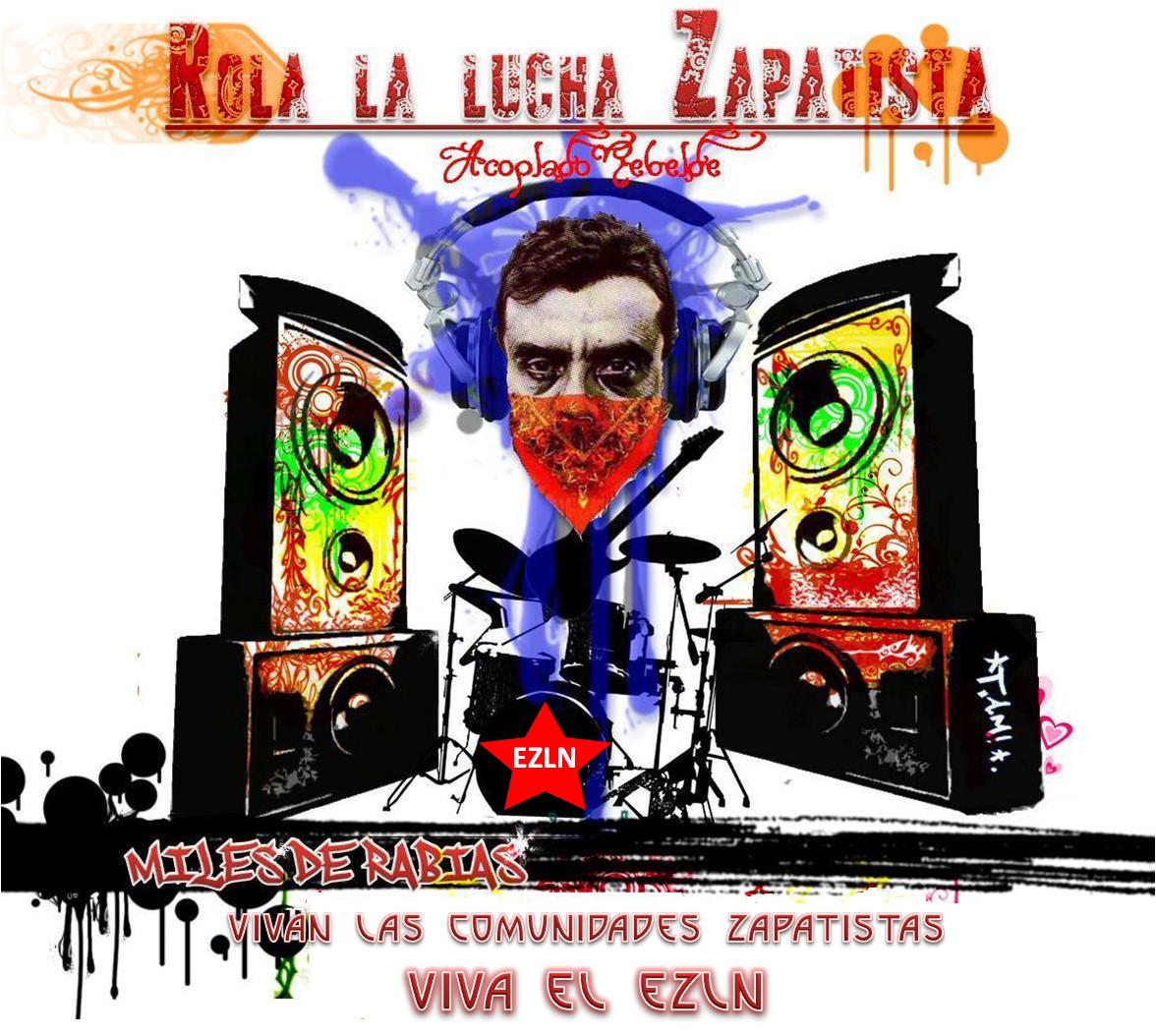
(Escucha también el acoplado musical Rola la Lucha Zapatista,  con más de 70 obras de músicos de México y el mundo como parte de la campaña Miles de Rabias, un Corazón en honor a la lucha zapatista, así como nuestra colección musical Las voces rebeldes del Otro Lado, música zapatista del otro lado de la frontera.)

(Continuar leyendo…)

radio
Miles de Rabias, un corazón

Rola la Lucha Zapatista

Rola la Lucha Zapatista

En el marco de la campaña nacional e internacional “Miles de Rabias, un corazón: VIVAN LAS COMUNIDADES ZAPATISTAS“, músicos de México y del mundo contribuyeron para crear esta colección musical… un canto múltiple y colorido a nuestros sueños que cobran vida en los Municipios Autónomos Rebeldes Zapatistas, y un grito al poder que nuestr@s herman@s zapatistas ¡NO están sol@s! porque desde muchos rincones y de muchas maneras los acompañamos, luchando a su lado.

(Para esta campaña, Radio Zapatista contribuyó con la colección musical Las voces rebeldes del Otro Lado y con el documental Ritmos de Zapata, sobre el movimiento musical chicano-zapatista, desde las entrañas del imperio.)

Rola la Lucha Zapatista

01 Basta – Primera Declaración de la Selva Lacandona – Aníbal Méndez
(Descarga aquí)  
001 Cumbia Zapatista – Sonido psicotropical
(Descarga aquí)  
002 Seguimos en la lucha – Instituto del Habla & Ajixar a.k.a. Masta Mind
(Descarga aquí)  
003 Más o menos – Juan Sebastián Larobina
(Descarga aquí)  
004 Esta es mi palabra – R.O.J.O.
(Descarga aquí)  
005 Sos político – Cienpiés
(Descarga aquí)  
006 Takikum – Nicolás Falcoff y la inurgencia del caracol
(Descarga aquí)  
007 Chacana y Kultrun (Versión Comunidad Mapuche) – Voces Clandestinas
(Descarga aquí)  
008 Muerte al poder – Daddy Longleg
(Descarga aquí)  
009 El silencio de los muertos
(Descarga aquí)  
010 Injusticia – Ideología Vigente
(Descarga aquí)  
011 A quién le tenemos que pedir perdón – Sicario sound machine
(Descarga aquí)  
012 Un cafecito mami – El V and the Garden
(Descarga aquí)  
013 Zapatistas – Brigada Roja
(Descarga aquí)  
014 Hambre – El otro sound system
(Descarga aquí)  
015 El serrucho – David Soraiz
(Descarga aquí)  
016 En la mira – Sangre maíz
(Descarga aquí)  
0016 No nos rendimos – Segunda Declaración de la Selva Lacandona – Aníbal Méndez
(Descarga aquí)  
017 En esta tierra que me vio nacer – Mc Lokoter
(Descarga aquí)  
018 Dos Iguales – Joselito Mayorga
(Descarga aquí)  
019 La Corrupción – Tony Romo y Tijuana Blues Band
(Descarga aquí)  
020 Campesinos Dub – Axiónmente
(Descarga aquí)  
021 El fuego y la palabra – Comando cucaracha
(Descarga aquí)  
022 En pie de lucha – Olmeca
(Descarga aquí)  
023 Flores como armas – Leiden Gomis Fernández
(Descarga aquí)  
024 Corazón de la tierra – Mayito
(Descarga aquí)  
025 De qué país me hablas – The Páramos
(Descarga aquí)  
026 Barricadas de Cherán
(Descarga aquí)  
027 Tierra y libertad – Fuga
(Descarga aquí)  
028 Nadie mira – Rabia
(Descarga aquí)  
029 Nosotros – Golpe The Ronin
(Descarga aquí)  
0030 La patria vive – Tercera Declaración de la Selva Lacandona – Aníbal Méndez
(Descarga aquí)  
030 Fiesta y lucha – Los vicios de papa
(Descarga aquí)  
031 La lloroncita – Los Tlaxiqueros
(Descarga aquí)  
032 Indígena – Sangre poeta
(Descarga aquí)  
033 Guerra olvidada – Acteal
(Descarga aquí)  
034 La piedrita en el zapato – Manolo Cocho & Ricardo Lassala
(Descarga aquí)  
035 Explotados – I-Jerome
(Descarga aquí)  
036 Ramona – Conciencia total
(Descarga aquí)  
037 El insurgente – Zapateros sin zapatos
(Descarga aquí)  
038 Somos – Lengua alerta
(Descarga aquí)  
039 Paraguas – B-side Players
(Descarga aquí)  
040 Homenaje a Atenco – Adelit@s
(Descarga aquí)  
041 No más sangre – Colectivo ADN2H
(Descarga aquí)  
042 Tierra y libertad – Ramon Marino
(Descarga aquí)  
043 La suca – Quinoa Groove
(Descarga aquí)  
044 Vamos – Cihuatl-Ce
(Descarga aquí)  
0045 Aquí estamos – Cuarta Declaración de la Selva Lacandona – Aníbal Méndez
(Descarga aquí)  
045 Me levanto – Bacwe
(Descarga aquí)  
046 Pan y circo – Mexikan Sound Sistem
(Descarga aquí)  
047 Exhumando al maestro – Luis Rodriguez Cruz n Pinkle
(Descarga aquí)  
048 La vela – Los Nadie
(Descarga aquí)  
049 Los de abajo2 – Punker Teokalli
(Descarga aquí)  
050 Vientre – Los Grammarian Monkeys
(Descarga aquí)  
051 Ya no te escucho – Toxic
(Descarga aquí)  
052 Viaje al sur – Llibellula
(Descarga aquí)  
053 Eres bella – Krudas Cubensi
(Descarga aquí)  
054 Mexika Tiahui – Para la Gente
(Descarga aquí)  
055 Liliana – Salvador y Raquel
(Descarga aquí)  
056 Semillita – Semilla
(Descarga aquí)  
057 Sangre iluminada – Mayazteca
(Descarga aquí)  
058 Mosaico zapatista – Free Radicals
(Descarga aquí)  
059 La 4a Guerra – Rivolta
(Descarga aquí)  
060 What’s good – Brown Buffalo
(Descarga aquí)  
061 Niños de la calle – Mayito
(Descarga aquí)  
062 Mate con Tequila – Juan Sebastián Larobina
(Descarga aquí)  
0062 Resistimos – Quinta Declaración de la Selva Lacandona – Aníbal Méndez
(Descarga aquí)  
063 Atenco ardió – The Páramos
(Descarga aquí)  
064 Dónde están – Bandera negra
(Descarga aquí)  
065 Poder Caracol – Lengua Alerta
(Descarga aquí)  
066 A la cadencia del corazón – Olmeca
(Descarga aquí)  
067 Fue una masacre – The Páramos
(Descarga aquí)  
068 Voces Clandestinas(Versión Rap anarquista) – Chacana y kultrun
(Descarga aquí)  
069 La morenita – Sangre maíz raíz profunda
(Descarga aquí)  
070 Norte-Sur avec Les Voix Ferrées – Juan Sebastián Larobina
(Descarga aquí)  
071 Algo tenemos que hacer – La Otra kultura inlakech
(Descarga aquí)  
072 Libertad – Rekon
(Descarga aquí)  
073 Café como el color de la tierra – Bacwe / To cuic libre – Coordinadora Valle de Chalco
(Descarga aquí)  

radio
Radio Zapatista

La Onda Bajita: Programa de abril

radio
Regeneración Radio

Invitación a programa sobre Mumia Abu-Jamal

En Regeneración Radio, conjuntamente con Amigxs de Mumia México, estamos preparando un programa especial para festejar al compañero Mumia Abu Jamal en el contexto de su 58 aniversario y sumándonos a las actividades internacionales por su libertad.

Lo podrán escuchar este próximo 10 de abril de 12 de medio día a 2 pm a través del 105.3 de FM. En el Norte de la Ciudad de México o por internet agregando el siguiente URL a tu reproductor de audio: http://www.orelha.radiolivre.org:8000/regeneracionradio.m3u o directamente desde nuestra página: www.regeneracionradio.org

Nos estará acompañando compas de Amigxs de Mumia México y vamos hablar sobre:

–          Los inicios de la lucha de Mumia.

–          Su caso y la situación actual.

–          Reseñas sobre sus mas recientes libros (El Nuevo Jim Crow y The Classroom and the Cell).

–          Y sobre el sistema carcelario en nuestro país.

Regeneración Radio

Comunicación contra el poder

radio
Red contra la Represión y por la Solidaridad

Tercer Informe de San Patricio – Brigadas de Observación RvsR Chiapas

LA RESITENCIA ZAPATISTA CIVIL Y PACIFICA DE SAN PATRICIO FRENTE AL GRUPO PARAMILITAR UCIAF

En Chiapas el Ejercito Zapatista de Liberación Nacional y sus comunidades autónomas tienen ya 18 años resistiendo una guerra de desgaste integral1 generada por el estado mexicano. Esta guerra se ejerce a través de varias estrategias de contrainsurgencia. La contrainsurgencia se entiende como una serie de acciones militares, paramilitares, políticas, económicas, psicológicas y civiles realizadas por el gobierno para derrotar la insurgencia2. En Chiapas estas acciones van desde la formación de grupos paramilitares, la ocupación militar en territorio indígena chiapaneco, la inyección de dinero a través de programas sociales, la persecución política, fabricación de delitos y encarcelamiento de bases de apoyo zapatistas inocentes.

Hoy en Chiapas los municipios autónomos rebeldes zapatistas están resistiendo una embestida paramilitar, obviamente respaldada y programada desde los tres niveles de gobierno. La comunidad zapatista de San Patricio, fundada en tierras recuperadas del 94, ha resistido varios intentos de despojo por el grupo paramilitar UCIAF (Unión Campesina Indígena Agrícola y Forestal), la cual es una escisión del grupo paramilitar Paz y Justicia.

Los grupos paramilitares constituyen una evolución del sicariato y del fenómeno de las guardias blancas en el campo mexicano. Se distinguen porque cuentan con una estructura militarizada, visten y operan como militares y emplean armas de uso exclusivo de las fuerzas armadas. En la teoría militar, los paramilitares son aquellos grupos que son distintos a las fuerzas armadas regulares de cualquier país o estado pero que observan la misma organización, equipo, entrenamiento o misión que las primeras3. Otro término militar utilizado para nombrar a los paramilitares es el de “personal civil militarizado”, el cual tiene como objetivo, localizar, hostigar y destruir a las fuerzas insurgentes.

Los grupos paramilitares en Chiapas se manifestaron principalmente en la región norte de la selva y Los Altos, uno de los más importantes en esta primera fase de formación de grupos paramilitares fue Paz y Justicia, “el cual nace el 5 de agosto de 1995 como un frente de ejidatarios , campesinos y autoridades de los municipios de Salto de Agua, Tila, Túmbala Ya jalón, Sabanilla, Chilón, El Limonar y Nuevo Limonar de carácter priista”4. A 17 años de sembrar el Estado la semilla paramilitar en estos municipios, la violencia hacia las bases de apoyo zapatistas nunca ha desaparecido, los años del 95 al 98 fueron los “años del terror”, después vino una supuesta calma, donde ya no hubo masacres, pero la guerra sucia contra los zapatistas continua hoy en día. Hace varios años existen documentos públicos de ataques de la UCIAF hacia San Patricio. Desde esos años los paramilitares han intentado invadir las tierras recuperadas, sin tener éxito gracias a la resistencia de los zapatistas, y el apoyo de la solidaridad nacional e internacional.

En septiembre del 2011 el predio La Lámpara, tierra recuperada de San Patricio, vuelve a ser invadida por los paramilitares de la UCIAF de Ostelucum y Union Hidalgo. En octubre de ese año el gobernador Sabines ofrece nuevas tierras y dinero a los paramilitares a cambio de que salieran de las tierras zapatistas. Los paramilitares aceptan y se van. La prensa de Chiapas no tardó en relucir la nueva noticia de que el gobierno de Sabines supuestamente había traído “la paz” a San Patricio, ¿pero empoderar a un grupo paramilitar es Paz? Este arreglo entre el gobierno chiapaneco y los paramilitares, solo alimenta la violencia y ambición de otros grupos paramilitares vecinos como los de Lázaro Cárdenas , los Moyos y El Porvenir.

La Brigada de Apoyo y Solidaridad numero 9 de San Patricio reportó que el dirigente paramilitar Pedro Ramírez Guzmán de Unión Hidalgo, hijo de un ex militar llamado Hipólito Ramírez, está preparando un nuevo ataque junto con otros paramilitares de Sabanilla: Jacinto Gómez Sánchez, Rodrigo Guzmán Gómez, Rolando Gómez Guzmán y Amador Ramírez Guzmán.

Otros hostigamientos reportados son las amenazas hacia al representante zapatista y el rumor de otra invasión preparada para el 16 y 17 de enero, la cual no se realizó. Lo importante de estas amenazas cotidianas es su función: generar miedo, desgaste y tensión en la comunidad, sin necesidad de un enfrentamiento directo.

Por otro lado la brigada 10 reportó que el 16 de enero del 2012 por la mañana alrededor de las 11:43 am., llegó una camioneta de policías municipales con 6 elementos y 2 civiles. Estuvo en la comunidad durante 15 minutos y de ahí se fue, casualmente ese mismo día por la noche a las 9:42 pm se escucharon 6 disparos a las faldas del cerro y a las 11:05 pm se vieron luces en el cerro que bajaban de Ostelucum.

El 25 de enero fue la entrega del apoyo de gobierno a los partidistas de la región, generando un gran tráfico de furgonetas llenas de mujeres, hombres y niños, los cuales cuando pasan por San Patricio gritaban no tenemos miedo a los zapatistas.

Las brigadas de Observación y Solidaridad en San Patricio serán permanentes hasta que cese el hostigamiento del grupo paramilitar UCIAF de Ostelucum, Unión Hidalgo y El Porvenir que junto con el gobierno intentan despojar las tierras recuperadas ganadas a sangre y fuego en el 94.

ANTE LA REPRESION LA SOLIDARIDAD

RED CONTRA LA REPRESION Y POR LA SOLIDARIDAD EN CHAIPAS.

1 . [La] guerra de desgaste es un tipo de guerra -ubicado en manuales contrainsurgentes estadounidenses- que se concibe como la sucesión de pequeños operativos que van asfixiando al enemigo en los terrenos político, económico y militar, evitando en lo posible acciones espectaculares que motiven la atención de la prensa y la opinión pública internacionales. Definición tomada del artículo de Gilberto López y Rivas de “Contrainsurgencia y paramilitarismo en el gobierno de Vicente Fox” donde cita a Pau Pérez Sales, Cecilia Santiago Vera y Rafael Álvarez Díaz, Ahora apuestan al cansancio. Chiapas: fundamentos psicológicos de una guerra contemporánea, Grupo de Acción Comunitaria-Centro de Derechos Humanos Miguel Agustín Pro Juárez, A. C., México, 2002.

2 The U.S.Army Marine Corps Counterinsurgency Field Manual. No 3-24.pag 383

3 El Enemigo Interno, Contrainsurgencia y fuerzas armadas de México, Jorge Luis Sierra Guzmán pág. 171, editorial Académica, 2003. Definición tomada de John Quick, Diccionary of Weapons and military Terms, McGrawHill Estados Unidos, 1973, citado en: Erubiel Tirado, La seguridad nacional en Mexico, tesis profesional de licenciatura, UNAM, 1997.

4 El Enemigo Interno, Contrainsurgencia y fuerzas armadas de México, Jorge Luis Sierra Guzmán pág. 173, editorial Académica, 2003

radio
Radio Zapatista

Las voces rebeldes del Otro Lado

Como parte de la campaña Miles de Rabias, un corazón: Vivan las comunidades zapatistas y de la convocatoria Rola la lucha zapatista, Radio Zapatista presenta la colección musical Las voces rebeldes del Otro Lado.

Las palabras de los Zapatistas han sido un grito de esperanza y motivación para continuar con nuestras propias luchas en el otro lado de la frontera. Es por eso que dedicamos esta colección musical a las comunidades Zapatistas, dejándoles saber que han sido nuestra inspiración para luchar y vivir con dignidad.

  1. Acteal – Guerra olvidada (4:11) (Descarga aquí)  
  2. Fuga – Tierra y libertad (4:30)(Descarga aquí)  
  3. Free Radicals with special guests Andrew Seifert, Michelle Yom, and Pelayo Parlade – Mosaico Zapatista (4:45)(Descarga aquí)  
  4. Cihuatl-Ce – Vamos (3:36)(Descarga aquí)  
  5. Los vicios de papa – Fiesta y lucha (6:25)(Descarga aquí)  
  6. Mayazteca – Sangre iluminada 4:01(Descarga aquí)  
  7. Quinoa Groove – La suca (4:43)(Descarga aquí)  
  8. B-Side Players – Paraguas (4:56)(Descarga aquí)  
  9. Ramón Marino – Tierra y Libertad (4:44)(Descarga aquí)  
  10. Para la Gente – Mexika Tiauhi (4:09)(Descarga aquí)  
  11. Brown Buffalo – What’s Good (3:02)(Descarga aquí)  
  12. Krudas Cubensi – Eres bella (4:02)(Descarga aquí)  
  13. Conciencia Total – Ramona (3:45)(Descarga aquí)  
  14. Los Nadie – La vela (5:43)(Descarga aquí)  
  15. Olmeca – A la cadencia del corazón (4:15)(Descarga aquí)  
  16. Los Grammarian Monkeys – Vientre (4:34)(Descarga aquí)  
  17. Luis Rodríguez Cruz & Pinkle – Exhumando al Maestro (3:16)(Descarga aquí)  
  18. Adelit@s – Homenaje al pueblo de San Salvador Atenco (3:36)(Descarga aquí)  
  19. Semilla – Semillita (1:37)(Descarga aquí)  
radio
Red contra la Represión y por la Solidaridad

¡HASTA SIEMPRE, MARTHA DE LOS RÍOS!

Con la gran pena que nos embarga queremos informar de la irreparable pérdida de nuestra querida compañera DOÑA MARTHA DE LOS RÍOS MERINO (1945-2012), fundadora e impulsora del Comité de Madres de Desaparecidos Políticos de Chihuahua desde 1978 para luchar por la presentación de los compañeros y compañeras desaparecidos por el régimen político mexicano, en particular por su hermana Alicia.

Martha se integró en 2005 al llamado del Ejército Zapatista de Liberación Nacional (EZLN) para adherir a la Sexta Declaración de la Selva Lacandona, participando activamente en el recorrido de la Otra Campaña por el país realizado en los años 2006 y 2007.

Junto con las compañeras y compañeros de la Unión de Familiares con Hijos Desaparecidos de Sinaloa, el Comité de Chihuahua, y con muchos más participó en el Foro Nacional Contra la Represión como ponente y en la mesa de la reunión junto con el compañero SCI Marcos. Fundando así la Red Contra la Represión y por la Solidaridad (RvsR) de la cual fue impulsora central en su estado natal Chihuahua y en particular en Ciudad Juárez, de donde tuvo que salir varios meses por las amenazas y agresiones que desde el gobierno se dirigían en su contra.

Desgraciadamente no pudo vencer a la enfermedad que le aquejaba desde hace tiempo. Le sobreviven su hijo Gilberto Sandino Aquino, su nuera Leonor Cortés, su nieto Ismael, su sobrina Licha, sus hermanas Irene, Irma y Gilberto y Alicia, a quienes les mandamos un fuerte abrazo.

El día de hoy se incineró el cuerpo de Martha y se llevarán sus cenizas de vuelta a su lugar de origen, San José de Bachíniva, en donde nació el 21 de enero de 1945.

Martha se mantiene en nuestra memoria y en nuestra lucha por la presentación de nuestros compañeros y compañeras desaparecidos políticos, por la libertad de las presas y presos políticos y sobre todo en la lucha por un México de Justicia, Paz y Libertad.

¡Hasta siempre querida Compañera!

Fraternalmente,

¡Contra el despojo y la represión: la Solidaridad!

radio
Abejas de Acteal

Coro de Acteal en la ENAH – 23 de marzo

Sociedad Civil “Las Abejas”
Presentación del
Coro de Acteal

Viernes 23 de marzo, 17 horas (5 p.m.)
ENAH,
Auditorio Román Piña Chan

y del video documental

ACTEAL 10 AÑOS DE IMPUNIDAD Y ¿CUÁNTOS MÁS?
Dedicado a la memoria de las 45 víctimas de Acteal asesinadas por un grupo paramilitar de los Altos de Chiapas el 22 de diciembre de 1997. Su intención es dar a conocer las causas que ocasionaron la masacre: qué papeles jugaron las autoridades estatales y federales mexicanas, los políticos, la Iglesia, las organizaciones sociales, etc. Y que con esa información podamos reflexionar y sacar conclusiones en torno a este episodio de lahistoria reciente de México. Que se haga justicia, que nunca más vuelva a ocurrir algo semejante.
radio
Rights Action

Sangre por Plata, Sangre por Oro – El asesinato de Bernardo Vázquez en la mina de Fortuna Silver en Oaxaca

Disculpas, este artículo está sólo en inglés

(Article and photos by Jonathan Treat, March 18, 2012)

“One thing is clear: this was a political hit. Bernardo was murdered because he dared to speak out.” (Dawn Paley)

(At the gravesite of Bernardo Vasquez, “Stop the Assassinations”)

In the dry and dusty town of San José del Pacifico, south of Oaxaca, Mexico, a funeral was held on March 17 for Bernardo Vasquez, a slain community leader who actively opposed a Canadian silver and gold mining project in his community.  During the somber event, attended by roughly 300 members of this Zapotec community, the collective grief, solidarity and resistance was palpable.  Fear also hung in the air; some people held placards proclaiming their resistance in front of their faces to avoid being photographed.

(Bernardo’s mother and family grieving their loss)

The fear is understandable – Bernardo Vásquez was the second anti-mining activist to be shot dead in the past two months.  Three others at the scene of the assassination of Vasquez were also shot and remain in serious condition.

WHY THE VIOLENCE?

Why all the bloodshed in this small Zapotec community?  The common thread connecting the victims of the recent violence is that – together with a coalition of people from other nearby communities – they were all actively opposing the presence of the Canadian company, Fortuna Silver Inc.’s “Trinidad/Cuzcatlán” silver and gold mine in their community in the Ocotlán valley, about 45 minutes outside of Oaxaca City.

(“Berna, We Will Always Rembember You.  You Fought for Us”)

Bernardo Vásquez was killed on March 16 when he and two passengers were ambushed at an intersection near his community.   His brother Andrés and friend Rosalinda Canseco remain hospitalized in serious condition. In an interview at the hospital, Rosalinda’s father said doctors are concerned they may have to amputate her leg.

PREVIOUS KILLING OF BERNARDO MENDEZ

Two months ago, the now dead Bernardo Vásquez was denouncing the murder of Bernardo Mendez, a friend and colleague also opposed to the Trinidad/Cuzcatán mine.  During a press conference on January 23, as spokesperson for a local coalition of people opposed to Fortuna Silver’s mine, Vásquez denounced the shooting death of Méndez that had occurred several days earlier.  That murder happened when a group of people confronted a work crew constructing a water pipeline in San José.  The people suspected the project would divert the arid community’s scarce water resources to the mine.  An argument ensued and municipal police arrived on the scene and opened fire into the crowd.  Bernardo Méndez later died of 7 gunshot wounds.  Abigail Vásquez, sister of Bernardo Vázquez (killed March 16), was seriously wounded in the January killing.

During the press conference, Vázquez and the Coalition of People United in the Ocotlán Valley (COPOVU) held the Vancouver-based Fortuna Silver and it’s local Trinidad/Cuzcatlán mining activities directly responsible for the murder and other related violence, and called for the suspension and removal of all the mining company’s activities in San José.  The anti-mining group also called for the cancellation and removal of the mining project.

FORTUNA SILVER DENIES ANY LINKS TO ITS ACTIVITIES AND THE VIOLENCE

Mining officials dismissed allegations that the mine was diverting water from the community, and denied any links between the recent violence and their mining operation in San José del Progreso.  In response to COPOVU’s accusations that the mine is responsible for the violence in San José, CEO Jorge Ganoza called the allegations “misinformation”.

“We, as a company, and our team in Oaxaca, are saddened by these senseless and continued acts of violence in the town of San José, related to a long-standing political struggle for local power”, he said in statement published by Canadian media.  “It is in no way related to our activities or involves company personnel…”.  Several Oaxaca state government officials in press releases repeat this version of events, but critics point out to a long history of violence in local communities since Fortuna Silver first arrived on the scene in 2006.

HISTORY OF MINE-RELATED VIOLENCE

In 2009, roughly three hundred opponents to Fortuna Silver’s mining operation participated in a blockade of the entrance to the Trinidad/Cuzcatlán.  After 40 days, the blockade was brutally broken when some 700 police stormed into the community in full anti-riot gear, with automatic weapons, tear gas, attack dogs and a helicopter.  People were beaten and more than 23 people were arrested; some were detained for three months.

In 2010, the mayor of San José, along with another municipal official, was killed in a confrontation between residents supporting and those opposing the mine.  A local priest supporting anti-mining activists was brutally beaten and detained.

The ongoing violence has divided and created a tense, fearful atmosphere in the once peaceful community.  One local activist who has been involved in resistance to the mine from the beginning estimated that the vast majority of residents were opposed to the mine when it started originally arrived to break ground in the community.  The ongoing repression and intimidation – coupled with bribes to prominent members of the community – has reduced the number of residents who actively resist the mine.  Nonetheless, he estimated that roughly half of the community is opposed to the mine, and many others are against the mine but fearful of openly resisting the mining project.

WHY THE OPPOSITION TO THE MINE?

In the arid Ocotlán valley of Oaxaca, as in many parts of the state, water is a scarce and precious commodity.  Residents opposed to the mine argue that processing silver and gold is water-intensive puts their local aquifers at risk.

Their argument has strong precedent.  Another Oaxacan community with years of painful experience with mining operations, Calpulálpam, had its water supply devastated by the Canadian “Continuum” mine there.  Aquifers were disrupted and local resident report that 13 local streams completely dried up due to mining in their community.  Local springs were also so polluted by chemicals used to process ore that livestock were dying from the contamination. The devastation was so flagrant that the Mexican Federal Environmental Protection Agency eventually ordered the mine to suspend all activities.

Thus the violent confrontation in January between the group of local residents and workers installing a water pipeline is understandable. The actual motives behind the project remain unclear; transparency about public works in San José is sorely lacking.  While Fortuna Silver continues to flatly deny any link between purported municipal potable water project and mining activities, many local residentS remain unconvinced.  And Mexico’s three leading national newspapers, including the respected daily La Jornada, all reported that the disputed water pipeline was indeed related to the mining operation and all linked the violence to tensions in the community around the mine’s activities there.

HUMAN RIGHTS AND CIVIL SOCIETY ORGANIZATIONS SPEAK OUT

In a recent statement by the Oaxacan Collective in Defense of Territories, an umbrella organization made up of prominent human rights and civil society organization, issued a statement on March 16, the day following the ambush of Vázquez and his two companions.  The declaration points out that Vázquez had repeatedly alerted state and federal authorities – since 2008 – of the risk of violent confrontations due to the initiation of mining operations by Fortuna Silver without the consent of the community, as legally required by international accords signed by Mexico. The statement says that the members of the anti-mining coalition COPUVO repeatedly complained that the mining company was financing armed groups in the community with the endorsement of the municipal president of San José del Progreso, Alberto Mauro Sánchez.  The collective’s statement says argues that the lack of justice and application of law by government officials has created a dangerous atmosphere of impunity in San José.  The statement closes with a demand for the immediate departure of the Trinidad/Cuzcatlán mine.

EULOGY FOR BERNARDO VÁSQUEZ

In a eulogy for Bernardo Vásquez, Dawn Paley, an independent Canadian journalist, wrote:

“Bernardo Vasquez was a clear spoken Zapotec activist, a brother, son, and cousin, who dared to stand up against a mining project in the territory of his people. He was well aware that a paramilitary group was operating in San José Progreso, Oaxaca, and that it was organized to snuff out opposition to a gold mine , owned by Vancouver based Fortuna Silver.  …  One thing is clear: this was a political hit. Bernardo was murdered because he dared to speak out, ignoring the climate of fear imposed upon his people.” (http://vancouver.mediacoop.ca/story/another-activist-murdered-organizing-against-canadian-mine/10243)

THE STAKES ARE HIGH, BUT THE STRUGGLE CONTINUES

Fortuna Silver’s $55 million Trinidad/Cuzcatlán mine began its production in September last year and projected to produce 1.7 million ounces of silver and 15,000 ounce of gold in 2012.  Future conflicts are likely as the mine expands its operations in its 58,000 hectares holdings just south of Oaxaca City in coming years, particularly in light of the ongoing impunity enjoyed by local officials and hired guns in San José.

During the funeral, many residents expressed their concerns that the lack of justice for those responsible for the recent shootings has created an atmosphere of impunity that is likely to foster more bloodshed.

(The Funeral Procession)

But in spite of the fear and intimidation, the March 17 funeral clearly illustrated that anti-mining activists from San José together with other surrounding communities affected by the mine, will continue on in their resistance. Indignation and defiance hung in the air.  Just before Vasquez’s coffin was lowered into the ground, a friend said: “They can cut a flower, but they cannot stop the Spring.”

(Jonathan Treat is a journalist, professor, activist and founding member of the non-profit organization SURCO (University Services and Knowledge Networks of Oaxaca), www.surcooaxaca.org.  He works with SURCO as Academic Director and Coordinator of Delegations looking at issues related to the defense of indigenous territories in Oaxaca and Chiapas. Jonathan: jonathantreat2002@yahoo.com)

******************

WHAT TO DO – WRITE & KEEP ON WRITING

Please keep on keeping on sending copies of this information, and your own letters, to Canadian and American politicians and government officials, and to your local media.  North American resource extraction companies are operating around the world with the full support of North American governments.  Please send copies to pension funds across North America – like the Canada Pension Plan – that are invested in most North American resource extraction companies around the world, with no concern for environmental, health or human rights concerns.

FORTUNA SILVER

Suite 650, 200 Burrard Street

Vancouver, British Columbia, Canada V6C 3L6

T: 604.484.4085

TF: 866.719.8962

info@fortunasilver.com

http://www.fortunasilver.com/s/ContactUs.asp

*****************

radio
Radio Zapatista

Arte y Resistencia desde abajo – México / Brasil

ARTE Y RESISTENCIA DESDE ABAJO
Literatura, pintura, teatro y otras artes y oficios
en los barrios bravos de Brasil y México

Jueves, 15 de marzo de 2012 – Cideci/Unitierra Chiapas

Pedimos permiso…
(Descarga aquí)  
Presentación (Xóchitl Leyva – RETOS y RACCACH)
(Descarga aquí)  
Luis Arévalo – Centro Cultural Tepito (Tepito, México)
(Descarga aquí)  
Poema de José González, interpretado por Everardo Pillado
(Descarga aquí)  
Allan da Rosa – Edições Toró (São Paulo, Brasil)
(Descarga aquí)  
Martha Cilia Olmos – Centro de Derechos Humanos Yaxkin (DF, México)
(Descarga aquí)  
Everardo Pillado – El sótano de los olvidados (Tepito, México)
(Descarga aquí)  
Cuento “La última y ahí nos vemos” de Luis Puga, leído por Everardo Pillado
(Descarga aquí)  
Poema de Juan Felipe Herrera, leído por Alejandro Reyes
(Descarga aquí)  
Alejandro Reyes – Radio Zapatista (Chiapas, México)
(Descarga aquí)  
Palabras Xochitl Leyva
(Descarga aquí)  

(Continuar leyendo…)