
[:es]¡Comienza la “invasión zapatista”![:en]The “Zapatista invasion” has begun![:]
[:es]Se habia anunciado hace seis meses; pero, ahora, es el momento.
El viaje zapatista hacia Europa ha empezado.
La «conquista invertida» está por iniciar.
Cuando los zapatistas publicaron su comunicado “Una montaña en alta mar”, el 5 de octubre de 2020, hubo una gran sorpresa con la noticia de que preparaban una gira del EZLN (Ejército Zapatista de Liberación Nacional) por los cinco continentes, para empezar en Europa. Es la primera vez (con una excepción) que abandonan las fronteras de su país.
Luego, el primero de enero, redactaron y firmaron con cientos de personas, colectivos y organizaciones, una Declaración por la vida [ver primer texto en esta misma pestaña] explicando los motivos de este viaje[1]: contribuir a la lucha contra el capitalismo – inseparable de la lucha por la vida – estar en plena conciencia de sus diferencias y alejarse de cualquier deseo de homogeneización o hegemonía. En los últimos seis meses se ha iniciado un amplio proceso de organización a escala europea, pero también en cada país o “geografía”, según la terminología zapatista. Ha surgido una coordinación francófona y, dentro de ella, ocho coordinaciones regionales, que engloban colectivos e iniciativas locales. Al mismo tiempo, el EZLN confirmó que preparaba una nutrida delegación compuesta por más de un centenar de integrantes, de los cuales tres cuartas partes eran mujeres. Esta delegación estará acompañada por diez miembros del Congreso Nacional Indígena – Consejo de Gobierno Indígena, que aglutina las luchas indígenas de México en su conjunto, así como una delegación del Frente de Ciudades en Defensa del Agua y la Tierra de Morelos, Puebla et Tlaxcala, constituida contra la implantación de una doble central termoeléctrica que amenaza con desviar los recursos hídricos indispensables para los campesinos de la región[2]
El 10 de abril, aniversario del asesinato de Emiliano Zapata, se anunció la salida de la primera delegación zapatista en hacer el viaje por mar. Se esperaba verla partir, ese día, del caracol [3] de Morelia, cuyos integrantes llevaban meses preparándose. Luego hubo un ritual en debida forma, con música tradicional, incienso y gestos de purificación (“limpia”), todo esto sobre la réplica de la proa de un barco; sin embargo, la montaña no se ha movido aún[4]. En efecto, se anunció que la delegación fue puesta en cuarentena durante quince días para asegurar que no portara un virus distinto al de la rebelión, opción que reitera la decisión del EZLN de tomar (por sí sola y lejos de cualquier estado). mandato judicial) todas las medidas preventivas de salud necesarias para prevenir la propagación del SARS-Cov-2. De hecho, desde el 15 de marzo de 2020, una alerta roja ha cerrado el acceso a todos los caracoles zapatistas.
También se conoció que esta delegación marítima había sido denominada “Escuadrón 421”, por estar integrada por cuatro mujeres, dos hombres y una persona transgénero (“unoa / otroa” en el léxico zapatista), presentando individualmente en un comunicado del Subcomandante Galeano [5]. Luego de otra fiesta de salida, el domingo 25, con la exhibición de numerosos cuadros y esculturas, palabras de aliento de la Junta de Buen Gobierno y baile popular [6], este lunes 26 de abril fue el día efectivo de la salida de Morelia. . De allí se dirigirán a un puerto mexicano donde les espera un barco llamado “La Montaña”, y el 3 de mayo soltarán las amarras para la travesía del Atlántico. El escuadrón 421 estará sujeto a circunstancias oceánicas imponderables, bajo la conducción competente de la tripulación del barco. Se espera que llegue a las costas europeas alrededor de la segunda quincena de junio (no se informará al país hasta más tarde).
Paralelamente, durante estos últimos días, se organizaron pequeñas fiestas al son de tambores y aliento de todo tipo para celebrar la partida de otros miembros de la delegación zapatista, pobladores de la Selva Lacandona, que de vez en vez bajaban por los ríos de esta región tropical, en la frontera con Guatemala, en piraguas [7]. Ellos y ellos formarán parte de los grupos de la delegación que, por esta ocasión, llegarán en avión al viejo continente a partir de principios de julio.
Comenzarán meses de intensas actividades, encuentros e intercambios en toda Europa, ya que los zapatistas anunciaron que habían recibido y aceptado invitaciones de muchas “geografías”: Alemania, Austria, Eslovenia, Cataluña, Sardenia, Chipre, Croacia, Dinamarca, Estado español, Finlandia, Francia, Grecia, Países Bajos, Hungría, Italia, Luxemburgo, Noruega, País Vasco, Polonia, Portugal, Reino Unido, Rumanía, Rusia, Serbia, Suecia, Suiza, Turquía, Ucrania.
Se han propuesto cientos de reuniones y actividades a los zapatistas y ahora están en preparación. Los colectivos y organizaciones interesados los darán a conocer cuando sea el momento adecuado. Es posible que existan grandes concentraciones, involucrando todas las luchas del período actual, desde los Chalecos amarillos en Francia hasta las Zonas a Defender (ZAD), además de diversas resistencias territoriales frente a grandes proyectos destructivos, colectivos feministas de apoyo a los migrantes, luchas contra la violencia policial, de quienes luchan contra la dominación colonial, redes de ayuda mutua nacidas en las metrópolis y destinadas a regiones rurales donde se perfilan otras formas de vida, sin olvidar la movilización prioritaria a la que estamos obligados, como subrayan los zapatistas, el trágico sollozo de nuestro planeta herido. La lista es larga (y aquí incompleta) en medio de la galaxia de rebeliones contra todos los aspectos de la barbarie y la resistencia capitalistas, que apuntan a dar paso a otros mundos más deseables.
Sobre todo, los zapatistas explicaron que viajarían para intercambiar – es decir, hablar, y más para escuchar – con todos los que los invitaran “a hablar de nuestras mutuas historias, nuestros dolores, nuestro enojo, nuestras conquistas y nuestras fallos ”[8]. Reuniones a pequeña escala, para darse tiempo para conocerse y empezar a aprender unos de otros, de los aquellos. Los zapatistas han insistido durante mucho tiempo en el hecho de que nuestras luchas no pueden permanecer aisladas unas de otras, subrayando la necesidad de construir redes planetarias de resistencia y rebelión. De nada sirve recordar aquí todos los encuentros internacionales organizados en Chiapas, desde los Encuentros Internacionales por la Humanidad y Contra el Neoliberalismo (denominados “Intergalácticos”), en 1996, hasta el seminario “Pensamiento crítico contra la hidra capitalista”, en 2015 [9]. . Pero se puede notar que en agosto de 2019, al momento de anunciar un nuevo avance en la autonomía, con la creación de cuatro nuevas comunas autónomas y 7 nuevos consejos de buen gobierno, necesitaban que ya no se propusieran organizar grandes reuniones, sino antes de hacer “Encuentros con grupos, colectivos y organizaciones que trabajan [luchan] en sus geografías” [10]. En ese momento no se hablaba de viajar por los cinco continentes, pero ahora, esta ocasión podría ser, además de otras razones para emprender tal viaje, una forma de desencadenar este proceso. Sin embargo, si tal perspectiva puede resonar con la necesidad que muchos sienten de tejer más lazos entre las luchas existentes, es claro que requiere de antemano no solo el intercambio, que permita identificar lo que se comparte, sin negar diferencias y divergencias, sino también y sobre todo, el encuentro que crea un mutuo conocimiento real.
El viaje por la vida será, por tanto, la oportunidad para que un mayor número de personas conozcan a los zapatistas y conozcan más sobre esta experiencia de autonomía y dignidad que ha soportado contra vientos y mareas durante un cuarto de siglo. Y, con suerte, también será una oportunidad para dejarse llevar por el contagio rebelde de que los zapatistas son los portadores potentes. Esperemos que todas y todos los que reconocen la Declaración por la Vida y para quienes la autonomía zapatista brilla en el cielo de nuestras aspiraciones (e inspiraciones) estén listas y listos para acoger y apoyar su iniciativa itinerante (por ejemplo, aportando y haciendo circular la plataforma del crowdfunding creado al efecto [11]), y participar, de la forma que mejor se adapte a todos y cada uno, en el VIAJE POR LA VIDA. (*)
***
Pero volvamos al Escuadrón 421. Desde el anuncio del viaje a Europa, los zapatistas plantean que se trata de rehacer el proceso de conquista. Disfrutan con la idea de una invasión inversa (y esta vez, de consentimiento). Es su estado de ánimo, por supuesto (pero ¿es solo humor?) [12]. En cualquier caso, anunciaron que el 13 de agosto de 2021 estarían en Madrid para celebrar a su manera los 500 años de la conquista de México-Tenochtitlan por parte del ejército de Hernán Cortés. Los indígenas de Chiapas, como los de todo el continente americano, llevan cinco siglos experimentando carne propia, lo que significa la colonización y todas las formas de colonialismo interno y racismo, que son su extensión. Pero los zapatistas dijeron claramente que no irían a Madrid a exigir que el estado español o la Iglesia católica pidieran perdón. Ambos rechazan la condena esencial de un «Occidente» demonizado y asimilado por completo a los colonizadores y la actitud que consiste en encerrar a los colonizados en la posición de víctimas. Al contrario, quieren hacer oír a los españoles «que no nos ganaron [y] que seguimos en resistencia y rebelión». Rehacer el viaje en sentido contrario es desmontar una historia que está lista, señalando lugares congelados y unívocos a los ganadores y perdedores. Se trata de abrir la posibilidad de otra historia.
Cuando la delegación marítima zapatista toque tierra en un punto aún desconocido del continente europeo, será Marijose, “un/a otroa” del Escuadrón 421 quien desembarcará primero. Y es así como el subcomandante Galeano describe de antemano la escena, en una inversión del gesto de Cristóbal Colón -quien sin embargo no desembarcó, el 12 de octubre de 1492, conquistando, ni siquiera descubriendo, ya que solo trató de encontrar las tierras ya conocidas por el Japón y China, y se apresuró a clavar su cruz e imponer el nombre de San Salvador en la isla de Guanahaní:
Así que la primera planta que se posará sobre suelo europeo (claro, si es que nos dejan desembarcar) no será de un hombre, tampoco de una mujer. Será de unoa otroa.
En lo que el finado SupMarcos hubiera calificado como “cachetada con media negra para toda la izquierda heteropatriarcal”, se ha decidido que quien primero desembarque sea Marijose.
En cuanto ponga sus dos pies sobre el territorio europeo y se recupere del mareo, Marijose gritará:
“¡Ríndanse cara pálidas hetero patriarcales que persiguen lo diferente!”
Nah, es broma. Pero, ¿a poco no estaría bien que dijera eso?
No, al pisar tierra, loa compa zapatista, Marijose, dirá, con voz solemne:
“A nombre de las mujeres, niños, hombres, ancianos y, claro, otroas zapatistas, declaro que el nombre de esta tierra, a la que sus naturales llaman ahora “Europa”, de aquí en adelante se llamará: SLUMIL K´AJXEMK´OP, que quiere decir “Tierra Insumisa”, o “Tierra que no se resigna, que no desmaya”. Y así será conocida por propios y extraños mientras haya aquí alguien que no se rinda, que no se venda y que no claudique”.*
***
Bienvenidos, compañeroas, compañeras y compañeros zapatistas, en las distintas geografías del continente pronto rebautizado como Slumil K’ajxemk’op.
El texto original en francés fue publicado en lundimatin Nro. 285, el 26 de abril de 2021.
Actualización: ver el nuevo comunicado «La ruta de Ixchel», publicado este 26 de abril, tras la publicación de este artículo.
Notas:
[1] Primera parte: Una declaración… Por la vida
[2] https://reporterre.net/Au-Mexique-les-zapatistes-du-Chiapas-s-opposent-aux-grands-projets-nuisibles.
[3] Nombre de los centros regionales que albergan los «Las Juntas de Buen Gobierno» de la autonomía zapatista y donde tienen lugar los encuentros nacionales e internacionales organizados por el EZLN.
[4] http://enlacezapatista.ezln.org.mx/2021/04/12/en-route-vers-leurope/.
[5] https://lavoiedujaguar.net/Escadron-421-La-delegation-maritime-zapatiste. Luego nos enteramos de que esta delegación marítima debía estar formada por 20 personas, pero que las demás no pudieron superar los obstáculos para obtener su pasaporte. NB: El Escuadrón 201 es una unidad aérea mexicana que participó en la Segunda Guerra Mundial.
[6] https://espoirchiapas.blogspot.com/2021/04/reveillez-vous.html et https://radiozapatista.org/?p=37273.
[7] http://enlacezapatista.ezln.org.mx/2021/04/24/y-mientras-tanto-en-la-selva-lacandona/.
[8] http://enlacezapatista.ezln.org.mx/2021/04/12/en-route-vers-leurope/.
[9] Véase https://fr.wikipedia.org/wiki/Zapatisme.
[10] http://enlacezapatista.ezln.org.mx/2019/08/28/communique-du-ccri-cg-de-lezln-et-nous-avons-brise-lencerclement/. Voir aussi: https://reporterre.net/Ici-le-peuple-dirige-le-gouvernement-obeit-au-Mexique-le-zapatisme-est-bien.
[11] https://www.helloasso.com/associations/une-montagne-en-haute-mer/collectes/la-route-pour-la-vie-2021.
[12] Durante la fiesta del 25 de abril, en Morelia, se exhibieron maquetas de bavios, con nombres referidos únicamente a las carabelas de Cristóbal Colón: «Santa María – La Revancha»; «No soy Niña»…
(*) Las coordinaciones regionales pueden contactarse en las siguientes direcciones:
Centre Val de Loire : zapatista-centrevaldeloire@siberry.fr
Coordination Nord : zalig@herbesfolles.org
Coordination Nord-est : zapat-est@riseup.net
Coordination Nord-Ouest : coordnordouest@lists.riseup.net
Coordination Île-de-France : comcomzap-idf@riseup.net
Coordination Auvergne-Rhône-Alpes : zap21_auv_rhon_alp@lists.riseup.net
Coordination PACA : pacaz@riseup.net
Coordination Sud-Ouest : contact-coordSudOuest@riseup.net
Coordination Belgique francophone : razb@collectifs.net
La coordination francophone à cette adresse: zap_2021_fr_contact@lists.riseup.net
En otros idiomas:
Français: https://lundi.am/L-invasion-zapatiste-commence
English: https://roarmag.org/essays/zapatista-mexico-europe-trip/
Português: https://www.n-1edicoes.org/a-invasao-zapatista-esta-comecando
ελληνικά: https://www.lifo.gr/blogs/almanac/i-zapatistiki-eisboli-xekinise
[:en]After months of preparations, a delegation of the Zapatistas has set sail from Mexico towards Europe. The “reversed conquest” has well and truly started.
It was a genuine surprise when the Zapatistas published their communiqué “A Mountain on the High Seas” on October 5, 2020, announcing a tour of the EZLN (Ejército Zapatista de Liberación Nacional) across five continents, starting with Europe. Even though the Zapatistas have not shied away from organizing initiatives in Chiapas and across Mexico — the March of the Color of the Earth just 20 years ago is a case in point — it is basically the first time since 1994 that they are leaving the borders of their homeland behind.
Then, on January 1 of this year, they published a Declaration for Life, co-signed with hundreds of individuals, collectives and organizations, outlining the objective of this voyage: making a contribution to the effort for anti-capitalist struggles — which are inseparable from the struggles for life — to converge in full consciousness of their differences and unhampered by homogenizing or hegemonizing forces.
In the past six months, extensive organizing has taken place at the European level, as well as in each individual country or “geography,” according to the Zapatista vocabulary. For instance, a francophone coordinating body has been established, which includes eight regional federations of collectives and local initiatives.
Meanwhile, the EZLN confirmed that a large delegation of more than a hundred members, three-quarters of which are women, was getting ready. The delegation is also said to be accompanied by members of the National Indigenous Congress–Indigenous Council of Government which unites Indigenous struggles across Mexico, as well as a contingent of the People’s Front in Defense of Land and Water of Puebla, Morelos and Tlaxcala which is fighting against the installation of a massive power plant that is threatening to divert water resources indispensable to the peasants in the region.
The Voyage for Life — Europe Chapter
On April 10, the anniversary of Emiliano Zapata’s assassination, they announced the departure of the first party of the Zapatista delegation, destined to make its voyage by sea. We had expected to see them leave the caracol of Morelia that day, where the members had been preparing themselves for months. A formal ritual was performed for the occasion, with traditional music, incense and purifying acts (“limpia”), upon a life-size model of a ship’s prow.
But the group did not set out on their journey right away: first they went into a 15-day quarantine to ensure that no one leaves the Zapatista territory carrying any other virus than that of rebellion. This decision is in line with the EZLN’s resolution to take all the required precautionary sanitary measures to avoid the spread of COVID-19 upon themselves and outside of state mandates. This had led them to issue a red alert and close off access to all Zapatista caracoles since March 15, 2020.
The maritime delegation was baptized “Escadron 421” because it is composed of four women, two men and one transgender person (“unoa otroa” in the Zapatista lexicon), who were individually introduced in a communique of Subcomandante Galeano.
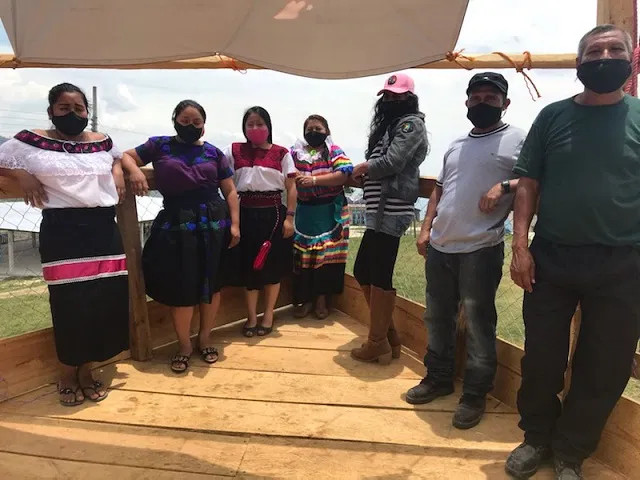
The Escadron 421
After another farewell party on Sunday, April 25, accompanied by the exhibition of numerous paintings and sculptures, encouraging speeches by the Council of Good Government and a communal ball, the delegation departed the next day from Morelia. From there they reached the Mexican harbor at Isla Mujeres where a ship named “La Montaña” was awaiting them and they set sail for the Atlantic crossing on May 2. The Escadron 421 is now at the mercy of the ocean’s wiles, under the capable seamanship of the ship’s crew. They should be within sight of the European coast at the port of Vigo in Spain in the second half of June.
Simultaneously smaller celebrations were organized by the sound of drums and all sorts of encouragements to accompany the departure of other members of the Zapatista delegation, leaving their villages in the Lacandon jungle, at times using canoes to descent the rivers of this tropical region close to the Guatemalan border. They are part of different groups of the Zapatista delegation, which will reach the old continent, by air travel this time, from the beginning of July onwards.
So will begin months of intensive activities, meetings and exchanges all over Europa for the Zapatistas. Thus far they have received and accepted invitations from a great number of “geographies”: Austria, Basque Country, Belgium, Bulgaria, Catalonia, Croatia, Cyprus, Denmark, Finland, France, Germany, Greece, Hungary, Italy, Luxembourg, Norway, Netherlands, Poland, Portugal, Romania, Russia, Sardinia, Serbia, Slovenia, Spain, Sweden, Switzerland, Turkey, UK and Ukraine.
Hundreds of meetings and activities have been proposed to the Zapatistas, which are currently being coordinated. These events will be made public by the organizing collectives when the time comes. This might also include larger gatherings/rallies, around all current struggles: from the Gilets Jaunes to ZAD’s, in the case of France, and other resistance groups fighting destructive mega projects; feminist collectives, migrant support initiatives, groups struggling against police violence, as well as movements aiming to undo colonial forms of domination; mutual aid networks based in cities and rural areas as well as those involved in building alternative ways of living; not forgetting the critical mobilizing efforts compelled by, as the Zapatistas emphasize, the bloody tragedies of our wounded planet. The list — incomplete here — is long in the vast constellation of rebellions against capitalist brutality and struggles for other, more desirable worlds.
Above all, the Zapatistas have explained that they are coming to exchange with — that is, to speak, and even more so, to listen to — all those that have invited them “to talk about our mutual histories, our sufferings, our rages, our successes and our failures.” Especially in grassroots meetings so there is enough time to get to know and learn from one another.
The Zapatistas have long since argued for our struggles not to remain isolated from each other, and have underlined the importance of constructing global networks of resistance and rebellion. There is no need to enumerate all the international events that they have organized in Chiapas from the First Intercontinental Encounter for Humanity and against Neoliberalism (also referred to as “Intergalactic”) in 1996 until the Critical Thought in the Face of the Capitalist Hydra seminar in 2015. But in August 2019, while announcing the recent advancement in local self-government with the establishment of four new autonomous communes and seven new Councils of Good Government, the Zapatistas had made it clear not to be organizing any large events anymore. Instead they were planning to take part in “meetings with groups, collectives, and organizations that work [struggle] within their geographies.”
There was no question back then of touring the five continents, but it could be — among many other reasons to set out on such a journey — a way to initiate this very process. If such an approach may indeed resonate with the widely felt need to weave stronger bonds between existing struggles, this requires not only an exchange to identify the commonalities and differences but especially a human-to-human encounter that can forge interconnection.
The Zapatistas are calling this journey the “Voyage for Life,” and it will present an opportunity for a vast number of people to meet the Zapatistas and learn more from their experiment in autonomy and dignity, persevered against overwhelming odds for over a quarter century. And, hopefully, many will allow themselves to be won over by the virus of rebellion of which the Zapatista are contagious carriers.
Let’s also hope that all those who identify with the Declaration for Life and for whom the autonomy of the Zapatista is a shining source of aspiration and inspiration will be ready to welcome them, support their itinerant initiative and participate in a manner best suited to each and every one on this Voyage for Life.
The continent renamed “Slumil K’ajxemk’op”
Returning to the Escadron 421. Since the first announcement, the Zapatistas have talked about their voyage towards Europe as a reversed process of conquest. The idea of the inversed invasion — this time with consent — amuses them. Obviously, it is said in jest — but are we entirely sure? When the delegation left, scale models ironically alluded to the caravels of Christopher Columbus: “No soy una Niña” and “Santa Maria La Revancha”; but it was also clarified that it is only if the members of Squadron 421 manage to land on European soil that it can be truly said that “the invasion has started.” If all goes well, they will be in Madrid on August 13, 2021, to celebrate in their own way the quincentenary of the conquest of Mexico-Tenochtitlan by the army of Hernan Cortés.
The Indigenous population of Chiapas, like all those on the American continent, have for five centuries suffered the implications of colonization, including all the forms of internal colonialism and racism that extend it. The Zapatistas have made it clear, however, that they are not coming to Madrid to get a formal apology from the Spanish state or the Catholic church. They reject the essentialist condemnation of the “West” as evil and fully assimilated to the colonizers, as well as the attitude that relegates the colonized to the role of victim. On the contrary, they are intending to tell the Spaniards “that they have not conquered us [and] that we are still resisting and in fact in open rebellion.”
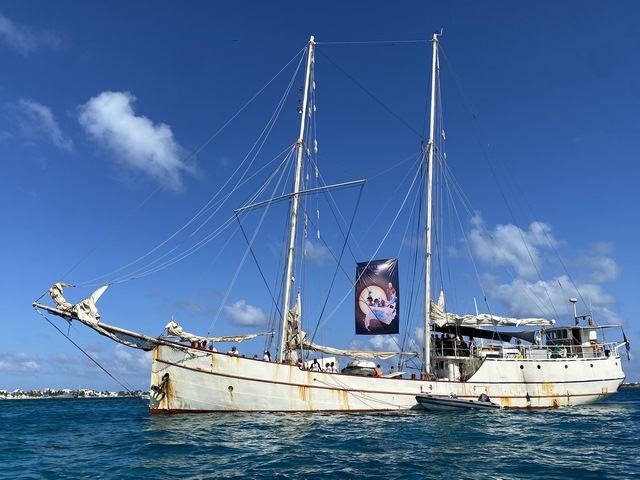
The ship named “La Montaña” that will bring the Zapatistas to Europe.
To make this voyage in reverse is to nuance a history that has assigned deeply entrenched and unambiguous positions to the vanquisher and the vanquished, and unlock the possibility for an alternative history.
When the maritime Zapatista delegation reaches Europe it is Marijose, “unoa otroa” of the Escadron 421 that will go ashore first. The following is how Subcomandante Galeano described the scene in advance; an inversion of the gesture by which Christopher Columbus — who disembarked on October 12, 1492, neither as a conqueror nor as a discoverer, since he was only seeking to find the already known lands of Japan and China — rushed to plant his cross and impose the name San Salvador on the island of Guanahaní:
Thus, the first foot that will set on European soil (that is, if they let us disembark) will not be that of man or a woman. It will be the foot of another.
With what the deceased SupMarcos would have described as “a slap with a black stocking in the face of all the heteropatriarchal left,” it has been decided that the first person to disembark will be Marijose.
As soon as they will have planted both feet firmly on European ground and recovered from seasickness, Marijose will shout out:
“Surrender, pale heteropatriarchal faces who persecute that which is different!”
Nah, I’m joking. But wouldn’t it be good if they did?
No, on stepping out on land the Zapatista compa Marijose will solemnly declare:
“In the name of women, of children, of men, of elders and, of course, of other Zapatistas, I declare that the name of this land, which its natives today call “Europe” will henceforth be known as: SLUMIL K’AJXEMK’OP, which means “Rebel Land,” or, “Land that doesn’t yield, that doesn’t fail.” And thus it will be known by its inhabitants as well as by strangers as long as there is someone who will not abandon, who will not sell out, and who will not capitulate.”
Welcome, compañeroas, compañeras and compañeros zapatistas, to the diverse geographies of the continent that will soon be renamed Slumil K’ajxemk’op.
Other languages:
Français: https://lundi.am/L-invasion-zapatiste-commence
Español: http://comunizar.com.ar/comienza-la-invasion-zapatista
https://rebelion.org/la-invasion-zapatista-comienza
Português: https://www.n-1edicoes.org/a-invasao-zapatista-esta-comecando
ελληνικά: https://www.lifo.gr/blogs/almanac/i-zapatistiki-eisboli-xekinise[:]


Vivo en Holanda.
Puedo hospedar con alimento a dos personas por una semana cuando vengan a éstas laderas.
Pueden compartir sus actividades? Y cómo uno puede participar?
Puedo ayudar a traducción de inglés y/u holandés a español.
Cuídense mucho del Covid que en Europa está aún fuertísimo.
Comentario by Xare — May-15-2021 @ 07:05