
http://www.jornada.unam.mx/2012/05/19/index.php?section=politica&article=018n1pol
* Demandan también la excarcelación de Francisco Santiz López, base de apoyo zapatista
* ¿No se dan cuenta que la protesta ya es mundial?, cuestionan; crecen acciones en otras partes
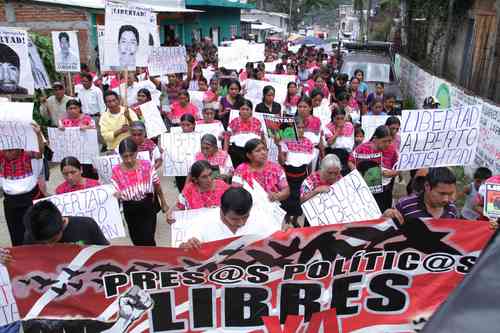
Unas mil personas, la mayoría indígenas tzotziles del municipio de El Bosque, en Chiapas, marcharon ayer para exigir la libertad del maestro Alberto Patishtán Gómez, preso desde el 19 de junio de 2000, y también por Francisco Santiz López, base de apoyo zapatista preso desde hace sesis meses. Foto Moysés Zúñiga Santiago
Hermann Bellinghausen
Enviado
Periódico La Jornada
Sábado 19 de mayo de 2012, p. 18
El Bosque, Chis. 18 de mayo. Todo sucede en tzotzil, aquí donde Alberto Patishtán Gómez se llama Beto. O compañero maestro. “Beto, aguanta, que el pueblo se levanta”, gritan sus paisanos pasado el mediodía, al iniciar una marcha alrededor de la cabecera municipal. Reunirán al menos un millar de indígenas, la mayoría de este municipio, pero también de San Andrés, Simojovel y Huitiupán, y hasta de lugares más distantes como Venustiano Carranza, demandando la liberación inmediata de su compañero, hermano, primo, maestro, vecino, encarcelado hace 12 años por un crimen que todos saben que no cometió.
La movilización exige también la liberación de su hermano zapatista
Francisco Santiz López, de Tenejapa, preso hace seis meses en San Cristóbal de Las Casas por ninguna razón
.
Las proclamas de la gente, una gran cantidad de mujeres de todas edades –ancianas muchas, y aún más las jóvenes estudiantes–, llevan una carga emotiva cercana al cariño. Las consignas rutinarias: Alberto, hermano, el pueblo te da la mano, Alberto, amigo, el pueblo está contigo
, adquieren una resonancia literal, como que les sale de dentro a los ancianos venerables en calzón de manta, a las maestras y maestros, a una vasta parentela de Patishtanes y Gómez y Ruiz que recorren el pueblo bajo un sol plomizo pero severo. La gente asoma a las puertas y las terrazas (abundan aquí, pues el paisaje es muy empinado) y mira pasar con simpatía o curiosidad ese río de gente y sombrillas hermosas de muchos colores gritando la palabra libertad
.
Las tal vez 300 personas que iniciaron la marcha en el auditorio municipal, cuando retornaron al recinto se habían convertido en mil. La caminata llevó al frente un carro con sonido y una gran manta con el rostro de Patishtán, y enseguida un grupo de familiares y amigos de los otros presos políticos en Chiapas, adherentes de la otra campaña. Portaban carteles con retratos amplificados, fijos en bastidores de cartón corrugado y con un palo para alzarlo, de Rosario Díaz Méndez, Pedro López Jiménez, Juan Collazo Jiménez, Alejandro Díaz Santiz, Rosa López Díaz y Enrique Gómez Hernández.
Tras llenar la multitud el auditorio en el centro del poblado, la gente se aplaude a sí misma, contenta de ser tanta. Presiden la asamblea-mitin familiares mayores del profesor encarcelado ahora en Guasave, Sinaloa, y hace 12 años privado de su libertad. Desde allá, él escribió para la ocasión: Los gobiernos mexicanos han querido y quieren callarme separándome de mis abogados, amigos y familia, del injusto traslado, mas en respuesta de esto quiero decir que mientras exista la injusticia ni muerto puedo callar, porque morir es vivir hacia los demás. Bien, compañeros, tengan mucho ánimo que no están solos, sigan adelante, el pueblo los necesita, yo aquí oraré por ustedes
.
Toman la palabra maestras, madres, antiguas autoridades ejidales, testificando por su compañero. Doña María Gómez Gómez proclama su inocencia y rompe en llanto. La congregación escucha una grabación en tzotzil de Alberto saludando a su pueblo. El maestro Martín Ramírez, vocero del Movimiento del Pueblo de El Bosque por la libertad del docente, recordará enseguida que desde el primer momento de su detención, en julio de 2000, el pueblo protestó, se movilizó, y tomó el palacio municipal. El gobernador Roberto Albores Guillén prometió liberarlo, y en vez de eso fue consignado.
Está claro que la gente se siente ofendida y traicionada, le levantaron falsas acusaciones cuando él estaba viendo las necesidades del pueblo
. Ramírez levanta un documento y señala: Este fue el delito del compañero, la causa de su encarcelamiento
. Y lee una carta fechada el 26 de mayo de 2000, tres semanas antes de la masacre de policías el 12 de junio por la que el profesor purga 60 años de cárcel. Dirigida al mandatario de entonces, decenas de autoridades ejidales y comunitarias le enumeran de manera contundente los delitos y malos manejos del gobierno municipal y piden su destitución. Hicieron una lista con esos nombres para detenerlos a todos, pero al final le tocó sólo al compañero. Nos amenazaban con usarla contra los demás si seguíamos protestando
.
No han dejado de exigir justicia, y eso ya demuestra mucho aguante; nadie en el gobierno les hace nunca caso. Ahora apelan al gobernador Juan Sabines Guerrero, al Presidente de la República, a los jueces: ¿Hasta cuándo nos van a escuchar? ¿No se dan cuenta que la protesta ya es a nivel mundial?
Se disponen a marchar a la ciudad de México en las próximas semanas para llevaral gobierno federal su demanda de salud, traslado y libertad
para Patishtán.
Dentro de la semana mundial por su libertad y la de Santiz López, este acto no es el único. Se han realizado, o lo serán este fin de semana, acciones y movilizaciones en Suiza, Italia, Alemania, Nueva Zelanda y Holanda. Colectivos de esas naciones se han sumado a los de Gran Bretaña, Estados Unidos, Francia, España, Canadá, Sudáfrica, Argentina, el Movimiento Sin Tierra (MST) de Brasil, y en las ciudades de México y Oaxaca.
** They also demand the release of Francisco Santiz López, Zapatista support base
** They ask: Don’t they realize that the protest is now worldwide? Actions grow in other places
Good Photo: Moysés Zúñiga Santiago
By: Hermann Bellinghausen, Envoy
El Bosque, Chiapas, May 18, 2012
It all happens in Tzotzil, here where Alberto Patishtán Gómez is called Beto, or Compañero Teacher. “Beto, endures, may the people rise up” his countrymen shout past noon, upon starting a march around the municipal headquarters. At least a thousand indigenous join together, the majority from this municipality, but also from San Andrés, Simojovel and Huitiupán, and even from more distant places like Venustiano Carranza, demanding immediate freedom for their compañero, brother, cousin, teacher, neighbor, incarcerated 12 year ago for a crime that everyone knows he did not commit.
The mobilization also demands the liberation of their “Zapatista brother” Francisco Santiz López, from Tenejapa, a prisoner since six months ago in San Cristóbal de Las Casas “for no reason.”
The announcements from the people, a large number of women of all ages –many older women, and even young students–, have an emotional charge close to affection. The routine chants: “Alberto, brother, the people shake your hand, Alberto, friend, the people are with you,” acquire a literal resonance, like what comes from inside the venerable elders in trousers (made) from a blanket, the teachers, a vast family of Patishtáns and Gómez and Ruiz that walk through the town under a grey but severe sun. The people begin to appear at doors and terraces (they abound here, because the landscape is very high) and look at that river of people passing with sympathy or curiosity and pretty umbrellas of many colors shouting the word “freedom.”
The perhaps 300 persons that started the march in the municipal auditorium, when they returned to the enclosure had been converted into a thousand. The march had a car in front with sound and a big banner with Patishtán’s face, and followed by a group of family and friends of the other political prisoners in Chiapas, adherents of the Other Campaign. They carry signs with enlarged portraits, set in corrugated cardboard frames and with a stick to raise it up, of Rosario Díaz Méndez, Pedro López Jiménez, Juan Collazo Jiménez, Alejandro Díaz Santiz, Rosa López Díaz and Enrique Gómez Hernández.
After the crowd fills the auditorium in the town’s center, the people applaud themselves, happy with being so many. Elderly relatives of the professor, now incarcerated in Guasave, Sinaloa, and deprived of his freedom for 12 years, preside over the assembly/meeting. From there (Sinaloa), he wrote for the occasion: “The Mexican governments have wanted and still want to shut me up by separating me from my lawyers, friends and family, with the unjust transfer, more in response to this I want to say that while injustice exists not even death can shut me up, because dying is living near the others. Good, compañeros, have much spirit that you are not alone, continue forward, the people need you, I will pray for you here.”
Teachers, mothers, old ejido authorities speak, testifying for their compañero. Doña María Gómez Gómez proclaims his innocence and breaks into tears. The congregation listens to a recording in Tzotzil of Alberto greeting his people. The teacher Martín Ramírez, spokesperson for the El Bosque People’s Movement (Movimiento del Pueblo de El Bosque) for the teacher’s freedom, would next remember that from the first moment of his detention, in July 2000, the people protested, mobilized, and took over the municipal palace. Governor Roberto Albores Guillén promised to free him, and instead of that he was sentenced.
It’s clear that the people feel offended and betrayed, “they made false accusations when he was seeing the people’s needs.” Ramírez holds up a document and points: “This was the compañero’s crime, the cause of his incarceration.” And he reads a letter dated May 26, 2000, three weeks before the police massacre on June 12 for which the professor is condemned to serve 60 years in prison. Directed to the then governor, dozens of ejido and community authorities enumerate resoundingly the crimes and bad management of the municipal government and ask for its removal. “They made a list of those names to detain everyone, but in the end it only touched the compañero. They threatened us with using it against the rest if we continued protesting.”
They have not stopped demanding justice, and that ya demonstrates a lot of endurance; no one in the government ever pays attention. Now they appeal to Governor Juan Sabines Guerrero, to the President of the Republic, to the judges: “When are you going to listen? Don’t you realize that the protest is now on a worldwide level?” They are willing to march to Mexico City within the coming weeks to take their demand for Pathishtán’s “health, move and freedom” to the federal government.
Within the worldwide week for his freedom and that of Santiz López, this act is not the only one. Actions and mobilizations have been or will be carried out this weekend in Switzerland, Italy, Germany, New Zealand and Holland. Collectives from those nations have been added to those of Great Britain, the United States, France, Spain, Canada, South Africa, Argentina, the Sin Tierra (Landless) Movement (MST) of Brazil, and in Mexico City and Oaxaca.
________________________________________________
Originally Published in Spanish by La Jornada
Saturday, May 19, 2012
English translation by the Chiapas Support Committee for the:
International Zapatista Translation Service, a collaboration of the:
Chiapas Support Committee, Oakland, California
Wellington Zapatista Support Group
UK Zapatista Solidarity Network