“Eco Mundial en Apoyo a l@s Zapatistas:
Justicia y Libertad para San Marcos Avilés y Francisco Sántiz López”
http://sanmarcosaviles.wordpress.com
“HORA DE RESISTENCIA Y SOLIDARIDAD”:
EN NUEVA CARTA GUSTAVO ESTEVA RESPALDA A SAN MARCOS AVILÉS Y FRANCISCO SÁNTIZ LÓPEZ
“Es urgente mostrarnos al lado de los compañeros de San Marcos Avilés. La amenaza es inmediata. Los Comités de la Palabra Verdadera debemos hacernos presentes, en cualquier forma a nuestro alcance, para que se vea la fuerza de nuestra solidaridad.”
– Gustavo Esteva
Compañeras y compañeros:
Desde Oaxaca, México, y en el marco de la primera etapa de la campaña “Eco Mundial en Apoyo a l@s Zapatistas: Justicia y Libertad para San Marcos Avilés y Francisco Sántiz López”, el intelectual y activista mexicano Gustavo Esteva nos manda una reflexión crítica y a la vez poética que desarrolla las razones por las que nos urge manifestar nuestro apoyo y solidaridad con la resistencia zapatista. En su explicación emocionante, titulada “HORA DE RESISTENCIA Y SOLIDARIDAD”, lo cual incluye palabras profundas de l@s zapatistas mism@s, el compa Gustavo le da lenguaje a lo que sabemos de corazonada. La resistencia digna de l@s Zapatistas no es cosa aislada o lejana, como explica Gustavo, sino un movimiento de pueblos dignos que nos une y corresponde a tod@s. Por ende, hay que defenderlo, hay que defendernos.
Acá con mucho orgullo compartimos esta hermosa carta en su totalidad.
HORA DE RESISTENCIA Y SOLIDARIDAD
por Gustavo Esteva
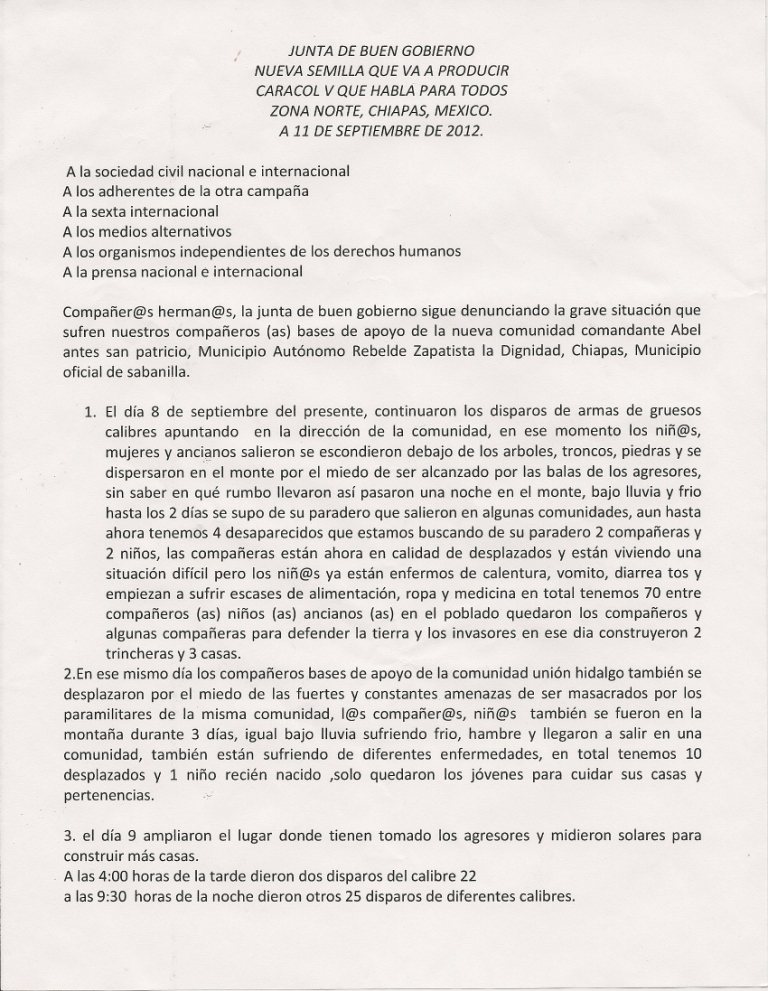
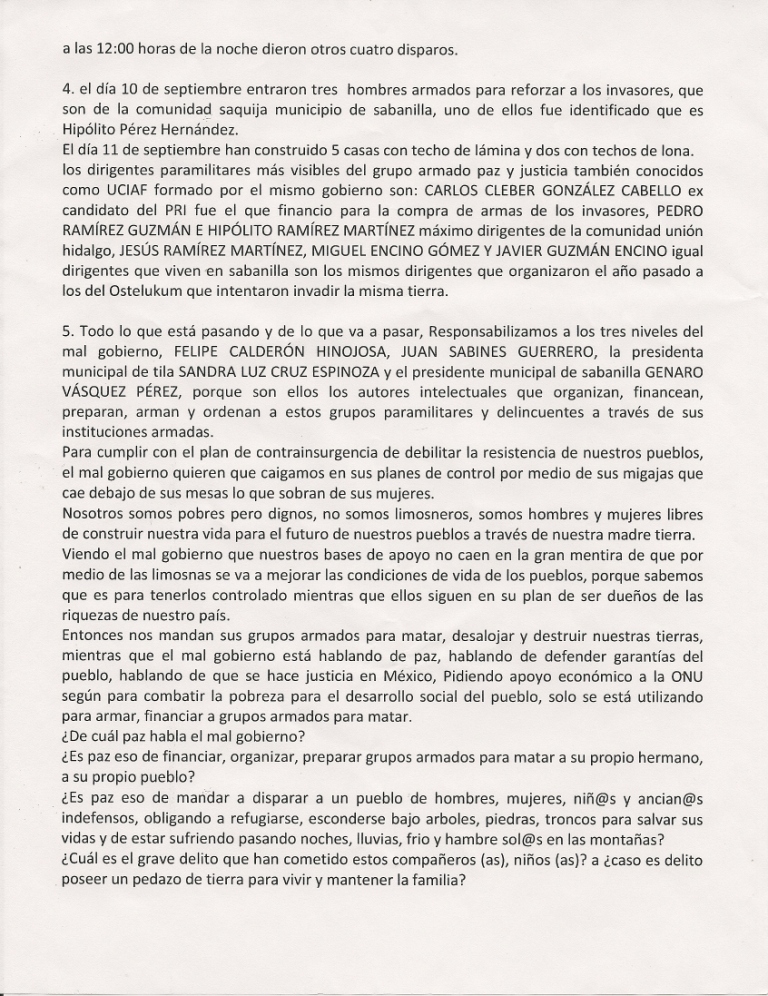
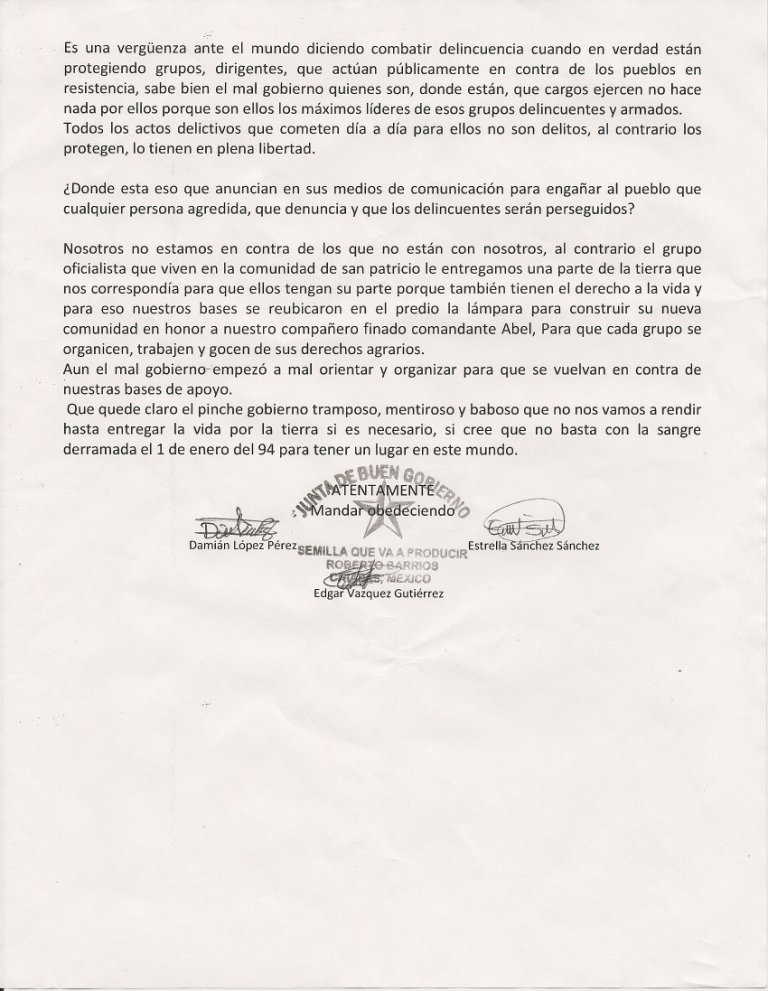
“Luchar juntos, no importa qué color traigamos, lo que importa es lo que está en nuestro corazón,” nos dijeron en la Junta de Buen Gobierno en algún lugar del sureste mexicano, en este mes de septiembre de 2012, cuando sigue caminando la palabra verdadera por el compañero Francisco Sántiz López y por los compañeros de San Marcos Avilés.
Luchar juntos, porque sólo así podemos hacer frente a quienes están haciendo todo lo que pueden para impedir nuestras iniciativas, nuestra subsistencia, nuestra organización, nuestra autonomía.
Hace más de diez años nos lo dijeron con claridad los compañeros zapatistas, pero parece que no estábamos en condiciones de oírlos. No se veía entonces, con la claridad de ahora, que estamos en la Cuarta Guerra Mundial. No es una guerra entre países. Es una guerra de los de arriba contra los de abajo. Porque los de abajo andamos levantados, porque hemos dicho ¡Basta! desde el primero de enero de 1994, cuando nos despertó la insurrección zapatista. Porque ya no estamos dispuestos a dejar que se siga destruyendo la Madre Tierra y que sigan asesinándonos y encarcelándonos. Porque nos hemos organizado y estamos construyendo alternativas. Por eso y por muchas otras cosas se ha desatado una guerra continua contra nosotros, hacia afuera y hacia adentro, y se hace cada vez más difícil vivir. Se quiere convertir el mundo entero en una prisión. El mercado se ha acostumbrado ya a la nueva situación. Opera ya dentro de un escenario de guerra y cotiza todo en la bolsa de valores, hasta la incertidumbre. Pero la gente no se acostumbra. Y resistimos.
“La resistencia no nada más es una palabra,” nos dijeron en la Junta. “Antes pensábamos que era fácil, pensábamos que era nomás aguantar. Ahora sabemos que es el único camino, un camino para demostrar que no sólo con dinero se hace la vida, es con la resistencia con la que trabajamos y vivimos. Ya no mucho le llamamos resistencia en nuestras comunidades, porque ya nos acostumbramos. Donde sí vemos la resistencia es donde el mal gobierno nos viene pegando, con los ataques de los paramilitares, ahí si vemos la resistencia porque tenemos que cuidar lo nuestro, porque si dejamos un poco la resistencia le damos espacio al mal gobierno para que nos quite lo que tenemos y nosotros no nos vamos a echar para atrás con lo que hemos construido. Sabemos que a algunos no les gusta que nos organicemos y por eso pasan muchas cosas, nos atacan, pero ni modos, cada uno de nosotros ahí seguimos, seguros y contentos, si nos pasa algo pues detrás de nosotros vienen otros compas. A pesar de esto, ahí lo vemos que estamos pasando la vida tranquilos con nuestros hermanos y ahí es donde vemos la resistencia. La resistencia es el lugar donde hacemos lo que queremos sin pedirle permiso a nadie, por eso decimos que hay muchas resistencias. Nosotros no tenemos un horario para la resistencia ni un tiempo definido. Nosotros no tenemos fin, estamos seguros que no lo vamos a dejar ni aunque nos maten porque nuestra palabra sigue.”
“Nos estamos dando cuenta que hay muchos como nosotros, nomás que nadie nos enseña qué cosa vamos a hacer, por eso lo más importante es la unidad, la mejor manera de lograr construir el mundo donde quepan muchos mundos es la unidad, ser y querer todos juntos, aunque seamos diferentes. A nosotros nos da mucho gusto cuando escuchamos de otros países y lugares sus luchas. Para ser luchadores tenemos que estar claros y dispuestos, no sólo de la cárcel sino también de la muerte pues. Pero si esto es lo que queremos pues sigamos. Sólo así podemos, otro camino no queda.”
Tanto Francisco Sántiz López como San Marcos Avilés son frentes de batalla de esa gran guerra que se intensifica todos los días en las comunidades zapatistas porque su resistencia camina, porque todos los días se afirman en su autonomía, consolidan sus logros y los llevan más lejos. El mal gobierno observa cómo se enriquece la resistencia zapatista, cómo se extienden sus formas propias de aprender y sus formas de justicia y sus formas de sanar y todas sus formas de vivir y cómo a pesar de todo lo que hacen contra ellos la nueva realidad social, la que funda una forma de existencia diferente, se contagia y se afirma. Los ataques no van dirigidos contra la debilidad, contra lo que está triste o muerto. Se ataca lo que florece, lo vigoroso, lo que es fuente de inspiración y sirve de ejemplo.
Puede pensarse que estos ataques son muy lejanos, están allá en un pequeño pueblo de los Altos de Chiapas, en donde se piensa que nadie verá el horror de este ataque anunciado contra quienes sólo quieren seguir viviendo a su manera, en su construcción autónoma, y extienden las actividades en que sus niños aprenden a participar en ella. Pero dice bien Sántiz, desde su cárcel: “Si estoy aquí, estoy allá; si estoy allá, estoy aquí.”
Los demonios están sueltos. La guerra anda por todas partes. Y por todas partes anda también la solidaridad, la decisión de estar juntos en esta lucha común que ya no respeta territorios. En cada lugar es diferente. Pero en cada lugar se reproduce el mismo fenómeno: la gente se afirma en su dignidad y dice ¡Basta! y toma su camino y de arriba viene la respuesta de intimidación, de agresión, de corrupción, de guerra continua…
Es urgente mostrarnos al lado de los compañeros de San Marcos Avilés. La amenaza es inmediata. Los Comités de la Palabra Verdadera debemos hacernos presentes, en cualquier forma a nuestro alcance, para que se vea la fuerza de nuestra solidaridad.
Es hora de resistencia. Y resistir es esta lucha en común, juntos, en el abrazo solidario.
San Pablo Etla, septiembre de 2012.
“Worldwide Echo in Support of the Zapatistas:
Freedom and Justice for
San Marcos Avilés and Francisco Sántiz López”
http://sanmarcosavilesen.wordpress.com/
“THE TIME FOR RESISTANCE AND SOLIDARITY”:
GUSTAVO ESTEVA SENDS NEW LETTER
SUPPORTING SAN MARCOS AVILÉS AND FRANCISCO SÁNTIZ LÓPEZ
“It is urgent to show ourselves at the side of our compañeros in San Marcos Avilés. The threat is immediate. The Committees of the True Word must make ourselves known in every way we can, to show clearly the strength of our solidarity.”
– Gustavo Esteva
Compañeras and compañeros:
From Oaxaca, Mexico, as part of the first phase of the “Worldwide Echo in Support of the Zapatistas: Freedom and Justice for San Marcos Avilés and Francisco Sántiz López” Campaign, the long-time Mexican intellectual and activist Gustavo Esteva sends us a critical and poetic reflection that lays bare the reasons we must support and stand in solidarity with the Zapatista resistance. In his moving piece, titled “The Time for Resistance and Solidarity,” which incorporates quotes from the Zapatistas themselves, our compa Gustavo gives language to what we know instinctively, as a feeling. The dignified resistance of the Zapatistas is not some isolated or distant thing, as Gustavo explains, but rather a movement of dignified people that unites us. It is directly relevant to all of us. Therefore, we must defend it; we must defend ourselves.
With great pride, we share here this beautiful letter in its entirety:
THE TIME FOR RESISTANCE AND SOLIDARITY
Gustavo Esteva
“Struggling together, the colour of our skin is not important, what matters is the content of our hearts,” they told us in the Good Government Council, somewhere in the Mexican southeast, in the month of September 2012, as the true word continues walking for our compañero Francisco Sántiz López and for the compañeros of San Marcos Avilés.
Struggling together, because that is the only way we are able to confront those who are doing everything in their power to disrupt our initiatives, our livelihoods, our organization, our autonomy.
It is more than ten years now since our Zapatista compañeros told us this clearly, but it seems that at that time we could not hear them. We did not see then with the clarity we have now that we are in World War IV. It is not a war between countries. It is a war of those from above against those from below. Because we, those from below, are now walking in rebellion; because we have been saying “enough!” ever since the first of January 1994, when the Zapatista uprising awoke us. Because we are no longer willing to let them continue to destroy our Mother Earth, and to continue to kill and imprison us. Because we have organized ourselves now, and we are building alternatives. For these and many other reasons they have unleashed a continuous war against us, from outside and inside, making it more and more difficult for us to live. They want to turn the whole world into a prison. The market has already got used to the new situation. It operates within a war scenario and trades everything on the stock market, leading to uncertainty. But the people do not get used to it. And we resist.
“Resistance is no longer just a word,” they said to us at the Junta. “Before, we thought it was easy, we thought it was no more than just enduring. Now we know that it is the only way, the way to show that life is not made with money, but with the resistance with which we live and work. Now we do not often speak of resistance in our communities, because we have become accustomed to it. But we see resistance where the bad government comes to beat us, with attacks by paramilitaries, here yes we see resistance because we have to care for what is ours, because if we give up the resistance even a little we will give a space to the bad government to take away what we have, and we are not going to go back on what we have built. We know that some people do not like us to organize, and for this reason many things happen, they attack us, but never mind, each of us is still here, safe and happy, if something happens to us there are other compas waiting behind us. Despite this, there we see that we are living a quiet life with our brothers and sisters, and that is where we see the resistance. Resistance is the place where we do what we want without asking permission from anyone, and so we say that there are many resistances. We do not have a timetable for the resistance or a set time. We will never come to an end, we know that we will not give up, even if they kill us, because our word will continue.”
“We are finding that there are many like us, for nobody teaches us what we are going to do, and so what matters most is unity, the best way to build the world where many worlds fit is through unity, to be and to want to be together, although we are different. It gives us great pleasure when we hear of the struggles of other countries and places. To be fighters we have to be ready and willing, not only for prison but also for death. But if this is what we want, then let us continue. This is the only way we can go, there is no other way.”
Both Francisco Sántiz López and San Marcos Avilés are frontlines in this great war that escalates daily in the Zapatista communities, because their resistance is walking onwards, because every day they affirm themselves in their autonomy, consolidate their achievements and take them even further. The bad government watches how the Zapatista resistance is enriched, how they extend their own ways of learning and justice and health and all their modes of living and how, despite everything that is done against them, the new social reality, which is the foundation for a different mode of existence, spreads and is strengthened. The attacks are not directed against weakness, or against something sad or dead. They attack all that flourishes, all that is robust, and all that serves as an example and is a source of inspiration.
You might think that these attacks are very distant, that they occur over there in some small community in the highlands of Chiapas, where they think no one will ever witness the horror of this attack unleashed against those who just want to continue to live in their own way, in the construction of their autonomy, and to extend the activities so that their children may learn to participate in this autonomy. But Sántiz speaks well from his prison: “If I’m here, I’m there; if I’m there, I’m here.”
The demons are on the loose. The war is everywhere. But so too is solidarity—that decision to be together in this common struggle that no longer respects territories. In each place it is different. But everywhere the same phenomenon is reproduced: the people affirm their dignity and say ‘enough!’, and they take their path, and the response from above is intimidation, aggression, corruption, continuous war…
It is urgent to show ourselves on the side of our compañeros in San Marcos Avilés. The threat is immediate. We, the Committees of the True Word, must make ourselves known in every way that we can, so that the strength of our solidarity may be seen.
It is the time for resistance. And to resist is to struggle in common, together, in the embrace of solidarity.
Gustavo Esteva
San Pablo Etla, September 2012