
SCI Marcos. TAL VEZ… (Carta Tercera a Don Luis Villoro en el intercambio sobre Ética y Política)Subcomandante Marcos: PERHAPS… (Third Letter to Don Luis Villoro in the interchange on Ethics and Politics)
TAL VEZ…
(Carta Tercera a Don Luis Villoro en el intercambio sobre Ética y Política)
EJÉRCITO ZAPATISTA DE LIBERACIÓN NACIONAL
MÉXICO.
Julio-Agosto del 2011.
Para: Don Luis Villoro.
De: SupMarcos
Don Luis:
Reciba los saludos de tod@s nosotr@s y un abrazo fuerte de mi parte. Esperamos que se encuentre mejor de salud y que la pausa en este intercambio haya servido para intentar nuevos planteamientos y reflexiones.
Aunque la realidad actual parece precipitarse en forma vertiginosa, una reflexión teórica seria debería ser capaz de “congelarla” un instante para así descubrir en ella las tendencias que nos permitan, revelando su gestación, ver hacia dónde va.
(Y hablando de la realidad, recuerdo que fue en La Realidad zapatista desde donde le propuse a Don Pablo González Casanova un intercambio: él debía hacerme llegar una paquete de galletas Pancrema, y yo debía enviarle un supuesto e improbable libro de teoría política (por llamarlo de alguna forma). Don Pablo cumplió, y el dilatado andar de nuestro calendario me ha impedido cumplir con mi parte del intercambio… todavía. Pero creo que en lluvias próximas habrá más palabras).
Como tal vez se ha ido insinuando en nuestra correspondencia (y en las letras de quienes, generosos, se han adherido a este debate), la teoría, la política y la ética se entrelazan de formas no muy evidentes.
Ciertamente no se trata de descubrir o crear VERDADES, ésas piedras de molino que abundan en la historia de la filosofía y de sus hijas bastardas: la religión, la teoría y la política.
Creo que estaríamos de acuerdo en que nuestro empeño apunta más hacia tratar de hacer “saltar” las líneas no evidentes, pero sustanciales, de esos quehaceres.
“Bajar” la teoría al análisis concreto es uno de los caminos. Otro es anclarla en la práctica. Pero en las epístolas no se hace esa práctica, si acaso se da cuenta de ella. Así que creo que debemos seguir insistiendo en “anclar” nuestras reflexiones teóricas en los análisis concretos o, con más modestia, tratando de acotar sus coordenadas geográficas y temporales. Es decir, insistir en que las palabras se dicen (se escriben, en este caso) desde un lugar y en un tiempo específico.
Desde un calendario y en una geografía.
I. El espejo local.
El año del 2011, Chiapas, México, el Mundo.
Y en estos calendario y geografía, acá seguimos atentos a lo que pasa, a lo que se dice y, sobre todo, a lo que se calla.
En nuestras tierras seguimos en resistencia. Siguen las agresiones en contra nuestra provenientes de todo el espectro político. Somos un ejemplo de que es posible que todos los partidos políticos tengan un mismo objetivo. Auspiciados por los gobiernos federal, estatal y municipales, todos los partidos políticos nos atacan.
Previa a cada agresión o después de ella, hay una reunión entre funcionarios gubernamentales y dirigencias “sociales” o partidarias. Se habla poco en ellas, sólo lo necesario para acordar el precio y la forma de pago.
Aquellos que critican nuestra posición zapatista de que “todos los políticos son iguales”, deberían darse una vuelta por Chiapas. Aunque es seguro que dirán que es algo estrictamente local, que eso no pasa a nivel nacional.
Pero en la clase política chiapaneca se repiten, con sus toques autóctonos, las mismas rutinas ridículas de los tiempos preelectorales.
Hay ajustes de cuentas internos (al igual que en las bandas criminales), que en la clase política se disfrazan de “justicia”. Pero en todas partes se trata de lo mismo: dejar libre el camino al elegido en turno. Todo lo que pasa abajo se tacha de ser un complot de uno o varios rivales. Todo lo que pasa arriba se deforma o se calla.
Con la política mediática de pago de elogios, cuando se trata de Chiapas no hay ninguna diferencia entre la prensa de la capital del país y la de la capital estatal.
¿Alguien puede hablar seriamente de justicia en Chiapas cuando sigue libre uno de los responsables de la matanza de Acteal, de nombre Julio César Ruiz Ferro? “Mi presidente no te preocupes, deja que se maten, yo voy a mandar la seguridad pública para que levanten a los muertos”, respondió el entonces gobernador de Chiapas, Julio César Ruiz Ferro, a Jacinto Arias Cruz, alcalde de Chenalhó, quien le advertía sobre un inminente enfrentamiento en Acteal el 19 de diciembre de 1997. (María de la Luz González, El Universal. 18 de diciembre del 2007).
¿Y qué decir de “El Croquetas” Roberto Albores Guillén, responsable de la matanza de El Bosque, además de haber erigido un imperio de crímenes y corruptelas que ahora le permiten jugarle a trasmano a Juan Sabines Guerrero y a su “gallo”, el coleto Manuel Velasco, para volver a la gubernatura de Chiapas? (hablando de “gallos”, ¿alguna vez el lopezobradorismo dará cuentas por haber ayudado a reciclar a lo peor de la política priísta chiapaneca?)
Ah, la vieja rivalidad entre las vetustas clases políticas de Comitán, San Cristóbal de Las Casas y Tuxtla Gutiérrez (por cierto, sus antecedentes se pueden encontrar en el libro de Antonio García de León, “Resistencia y utopía: memorial de agravios y crónicas de revueltas y profecías acaecidas en la Provincia de Chiapas durante los últimos quinientos años de su historia” en la editorial ERA de la entrañable Neus Espresate).
Mientras proliferan los barruntos de una tormenta en la política del Chiapas de arriba, Juan Sabines Guerrero parece seguir empeñado en la línea que tantos fracasos le dio antes al “Croquetas” Albores: alentar a grupos, paramilitares y no, para que agredan a las comunidades zapatistas; solapar el auge de mafias criminales con o sin coartada de partido político; mantener la impunidad para l@s cercan@s; la simulación como programa de gobierno.
Una prensa, local y nacional, bien “aceitada” con dinero, no alcanza a ocultar, con el disfraz de unanimidad, la guerra intestina en la política de arriba.
Sobre todo esto, baste con señalar lo siguiente: hace tiempo que las reglas internas de la clase política están rotas. Los encarceladores de ayer son los encarcelados hoy, y los perseguidores de hoy serán los perseguidos mañana.
No es que no se hagan “acuerdos”, sino que ya no tienen capacidad de cumplirlos.
Y una clase política que no cumple con sus acuerdos internos es un cadáver esperando sepultura.
No, la clase política de arriba no entiende nada. Pero sobre todo no entiende lo fundamental: su tiempo se ha terminado.
Gobernar dejó de ser un oficio político. Ahora el trabajo por excelencia de los gobernantes es la simulación. Más importantes que los asesores políticos y económicos, lo son los asesores de imagen, publicidad y mercadotecnia.
Así se hacen hoy en día los gobernantes en México, mientras las realidades locales, regionales y nacionales se hacen pedazos.
Ni los boletines gubernamentales disfrazados de “reportajes” y “notas periodísticas” logran cubrir la crisis económica: en las principales ciudades del Chiapas real empiezan a aparecer y a crecer la indigencia y los “trabajos” más marginales. La pobreza que parecía ser exclusiva de las comunidades rurales empieza a crecer en las zonas urbanas del sureste mexicano.
Justo como en el resto del territorio nacional.
¿Parece que estoy hablando de la política de arriba a nivel nacional y no local?
Ah, los fragmentos del espejo roto, irremediablemente roto…
II. ¿Un epitafio para una clase política o para una Nación?
Cuando Felipe Calderón Hinojosa (presidente gracias a la culpa ahora confesa de Elba Esther Gordillo), se disfraza de guía turístico para que a México no sólo lleguen policías y militares norteamericanos, se asoma al Sótano de Las Golondrinas, en Aqusimón, San Luis Potosí, y exclama un “¡Oh my god!” (http://mexico.cnn.com/nacional/2011/08/17/calderon-promueve-destinos-turisticos-en-el-programa-the-royal-tour), bien podría decir lo mismo si se asoma al pozo en el que el país se ha sumido durante su mandato.
Según las estadísticas reveladas por el Consejo Nacional de Evaluación de la Política de Desarrollo Social (CONEVAL) el número de pobres en México pasó de 48.8 millones a 53 millones. Casi la mitad de la población mexicana vive en condiciones de pobreza. Casi 12 millones de personas están en condiciones de pobreza extrema.
Y si uno revisa los mapas de la misma CONEVAL, podrá darse cuenta de que las manchas de pobreza, antes privativas de los estados del sur y sureste de México (Guerrero, Oaxaca, Chiapas) empiezan a extenderse a los estados de norte del país.
Los precios de los productos básicos se han duplicado y triplicado durante este sexenio.
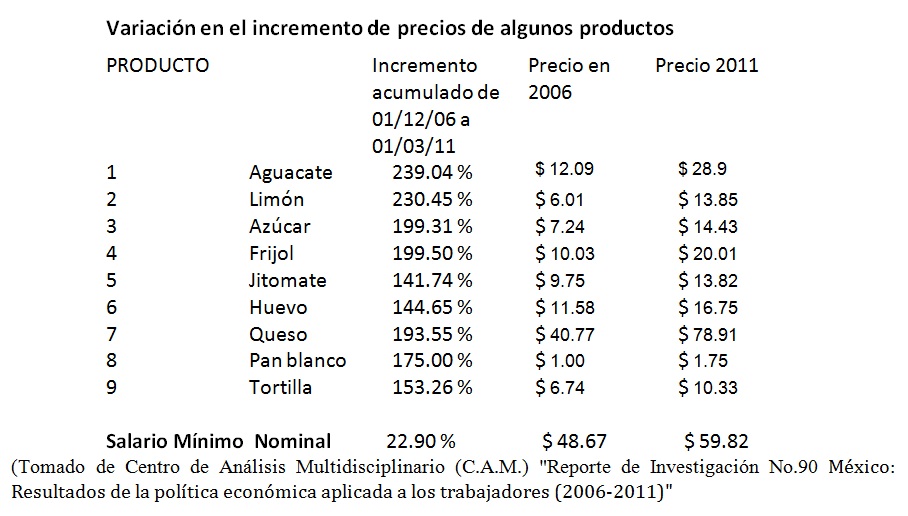
Según datos del Centro de Análisis Multidisciplinario, para tener el dinero suficiente para adquirir la canasta alimenticia recomendable, al inicio del sexenio de Felipe Calderón Hinojosa se necesitaban trabajar 13 horas y 19 minutos al día. 5 años después, en este 2011, se necesitarían trabajar 22 horas y 55 minutos.
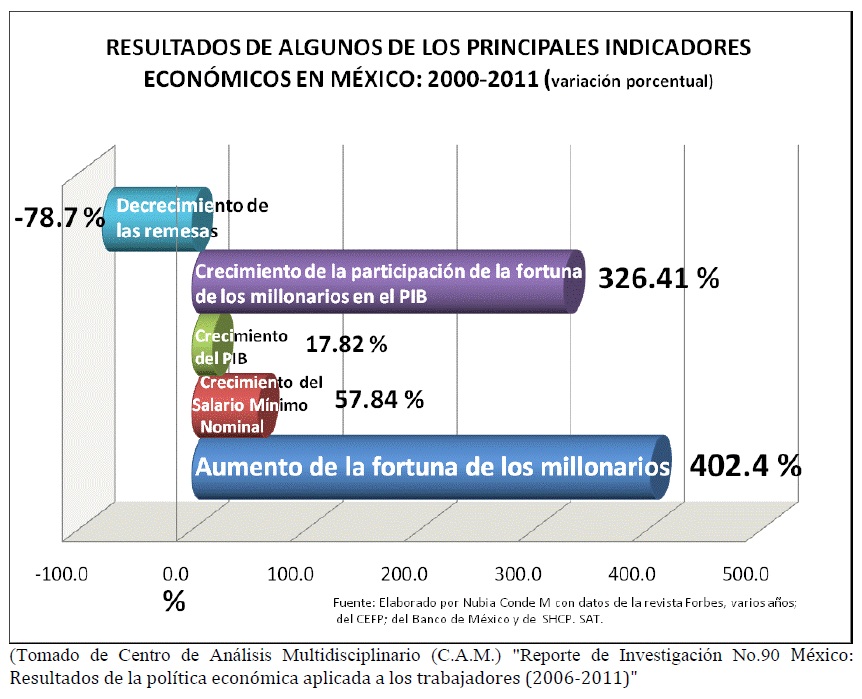
Mientras las ganancias de los millonarios se han cuadriplicado en los últimos 10 años.
A todo esto habría que sumarle las pérdidas de empleo por cierres de fuentes de trabajo. Entre ellos el golpe criminal al Sindicato Mexicano de Electricistas. El ataque fue encabezado por el facineroso secretario del trabajo, Javier Lozano Alarcón (que será recordado también por las extorsiones gansteriles -Zhenli Ye Gon y los 205 millones de dólares para el fraude electoral del 2006-), y “aclamado” por los grandes medios de comunicación masiva.
Por cierto, la gigantesca campaña propagandística en contra de los trabajadores del Sindicato Mexicano de Electricistas (que incluye la amenaza de acciones penales en contra de sus dirigentes), que lo mismo los acusa de indolentes que de terroristas, debiera contrastarse con la realidad: si esos trabajadores eran perezosos e inútiles, ¿cómo es que había luz eléctrica en la zona centro del país?, ¿cómo funcionaban las televisoras que ahora los atacan, los periódicos que los calumnian, las estaciones de radio que los difaman?; ¿y las deficiencias que, ahora con la Compañía Federal de Electricidad, se padecen en la mayoría de los hogares de esa parte de México?; ¿y los nuevos recibos que aparecen ahora con cantidades exorbitantes?
Pero la resistencia de estos trabajadores no pasa desapercibida. No para nosotros.
Y mientras en la economía nacional la crisis mundial apenas se asoma, la clase política sigue, esa sí, en su holgazanería.
El 2012 llegó al calendario de arriba desde el 1 de diciembre del 2006, y a lo largo de estos 5 años no ha hecho sino evidenciar que esos calendarios no sirven ni para decorar los muros derruidos de la casa grande que aún llamamos “México”.
En el PRI, un Beltrones y una Paredes hacen cálculos para desplazar a un Peña Nieto quien se ocupó más en hacer pasarela mediática (había dinero) y poco en hacer política (no había oficio).
En el PRD, la pareja dispareja de López Obrador y Marcelo Ebrard comienza a darse cuenta de que lo fundamental depende de las burocracias partidarias de la autodenominada “izquierda” institucional.
Y en el PAN de la pesadilla nacional, un hombrecito enloquecido con muerte y destrucción busca quien le cubra las espaldas cuando los guardias presidenciales y el palacio nacional ya no lo hagan.
Aunque el desprestigio y desgaste del partido en el gobierno es grande, Felipe Calderón Hinojosa le apuesta, y fuerte, al uso de todos los recursos a su alcance para imponer su propuesta. Si ya lo hizo en el 2006, bien podría repetirlo en 2012. Y lo necesitará, porque sus cartas están muy ajadas: Un Cordero que le promete a su pastor que seguirá siéndolo; un Lujambio esperando no recibir la estocada de la estela de luz; un Creel al que el gris le sienta bien (y lo define); y una Vázquez Mota cuyo único argumento es ser mujer.
(Recuerdo alguna discusión cuando Barack Obama y Hillary Rodham Clinton se disputaban la candidatura presidencial. Algunas feministas pedían el apoyo a Hillary por ser mujer, algunas afroamericanas demandaban respaldar a Obama por ser de color. El tiempo demostró que allá arriba no cuentan ni el color ni el género).
Mientras, como la matrona de un burdel, Elba Esther Gordillo deshoja la margarita… y no descarta el lanzarse ella misma, en vez de apoyar a alguien.
Con tan patético panorama es lógico, y hasta de esperar, que surjan precandidatos externos… y jilgueros que los acompañen.
En realidad, fuera de las camarillas partidarias, del poder económico y de alguna militancia, el relevo gubernamental no parece interesarle a nadie.
La apatía va siendo remplazada por el rencor, y no son pocos los sueños en los que se acaba por fin de sepultar al sistema político mexicano, y con manos plebeyas se labra sobre su tumba el epitafio: “Lo hizo de la manera difícil, pero el juego ha terminado al fin”
Mientras tanto la guerra sigue… y con ella las víctimas…
III. Culpar a la víctima.
Un psicólogo norteamericano, William Ryan, escribió en 1971 un libro llamado “Culpar a la víctima” (“Blaming the Victim”). Aunque su intención inicial era una crítica al llamado “Reporte Moynihan” que pretendía hacer responsable de la pobreza en la población negra en Estados Unidos a conductas y patrones culturales y no a la estructura social, esta idea se ha usado más para casos de sexismo y racismo (más frecuentemente en los casos de violación, donde se acusa a la mujer de haber “provocado” al violador por la ropa, la actitud, el lugar, etc.).
Aunque nombrándolo de otra forma, Theodor Adorno describió esto de “culpar a la víctima” como una de las características definitorias del fascismo.
En el México contemporáneo, han sido algunos miembros del alto clero, autoridades gubernamentales, artistas y “líderes de opinión” de los medios de comunicación, quienes han recurrido a esta patraña para condenar a víctimas inocentes (principalmente mujeres y menores de edad).
La guerra de Felipe Calderón Hinojosa ha convertido ese rasgo fascista en todo un programa de gobierno y de impartición de la justicia. Y no son pocos los medios de comunicación que lo han hecho suyo, permeando así el pensamiento de quienes todavía creen lo que se dice y se escribe en la prensa, la radio y la televisión.
Alguien, en algún lado, señaló que los crímenes contra inocentes encierran una triple injusticia: la de la muerte, la de la culpa y la del olvido.
Todo el sistema que padecemos cuida, guarda y cultiva el nombre y la historia del asesino, sea para su condena, sea para su glorificación.
Pero el nombre y la historia de las víctimas queda atrás.
Más allá de sus familiares y amistades, las víctimas son asesinadas de nuevo al ser condenadas a convertirse en un número, en una estadística. Muchas veces ni eso alcanzan.
En la guerra que Felipe Calderón Hinojosa ha impuesto a la sociedad entera de México, sin distingos de clase social, raza, credo, género o ideología política, se agrega un dolor más: el de etiquetar a esas víctimas inocentes de criminales.
Se disfraza así el imperio de impunidad bajo la consigna del “ajuste de cuentas entre narcotraficantes”.
Y esa pesada lápida cae también sobre familiares y amistades.
La injusticia reinante no sólo funciona para garantizar impunidad a funcionarios gubernamentales de todo tipo, federales, estatales y municipales. También agobia a las familias y amistades de las víctimas.
Sus muertos lo son también cuando socialmente se prescinde de su nombre y de su historia, y una vida recta se deforma con los calificativos prodigados por las autoridades y repetidos hasta la nausea por los medios de comunicación.
Las víctimas de la guerra se convierten entonces en culpables y el crimen que les corta miembros o los asesina no es sino una forma cuasi divina de justicia: “ell@s se lo buscaron”.
Felipe Calderón Hinojosa será recordado como un criminal de guerra, no importa que hoy, rodeado de abrazo y escapulario, se las dé de gran estadista o “salvador de la patria”.
Y su historia será recordada con rencor.
Ni siquiera alcanzará, a falta de justicia, la mofa y el escarnio populares que suelen acompañar la salida de los mandatarios.
Sus patéticos remedos de “guía turística”, la ilegalidad e ilegitimidad de su llegada a la presidencia, sus fracasos políticos, su responsabilidad en la crisis económica, el haberse hecho de un equipo formado por golpeadores y guaruras disfrazados de funcionarios, el nepotismo, el consolidar lo que ya se conoce como “el cártel de Los Pinos”; todos sus desfiguros quedarán en segundo plano.
Quedará su guerra, perdida, con su cauda de víctimas “colaterales”: la derrota, el desgaste y el desprestigio irremediables de las fuerzas armadas federales (poco o nada podrán hacer las series televisivas para contrarrestar eso); la entrega de la soberanía nacional al imperio de las barras y las turbias estrellas (ya lo dijimos antes: los Estados Unidos de América serán los únicos triunfadores en esa guerra); el aniquilamiento de economías locales y regionales; la destrucción irreparable del tejido social; y la sangre inocente, siempre la sangre inocente…
Puede ser que la muerte no tenga remedio.
Que nada pueda llenar el hueco de soledad y desesperanza que deja la muerte de un inocente.
Puede ser que nada de lo que se haga pueda volver a la vida a las decenas de miles de inocentes muertos en esta guerra.
Pero lo que sí se puede hacer es luchar contra esa tesis fascista de “culpar a la víctima” y nombrar a los muertos y con ello recuperar sus historias.
Liberarlos así de la culpa y del olvido.
Aliviar su ausencia.
IV. Nombrar a los muertos y su historia.
Mariano Anteros Cordero Gutiérrez, era su nombre. Estaba por cumplir 20 años cuando, el 25 de junio del 2009 en Chihuahua, Chihuahua, fue asesinado.
El padre de Mariano, el Lic. Mariano Cordero Burciaga, se entrevistó con el entonces gobernador del Estado de Chihuahua, José Reyes Baeza, éste le dijo que el asesinato había sido una confusión callejera. Unas semanas después de los acontecimientos, la representación del Colegio de la Barra de Abogados del Estado pidió una explicación de los hechos a las autoridades correspondientes. Éstas respondieron que había sido “un ajuste de cuentas entre narcotraficantes”. Culpar a la víctima.
Aquí unos jirones de su historia:
Mariano estudiaba en el Instituto Tecnológico de Parral (ITP) la carrera de ingeniería en gestión empresarial y había recibido la carta de aceptación para estudiar la carrera de derecho en la Universidad Autónoma España de Durango, Campus Parral.
Antes de estos estudios fue misionero voluntario, en el Internado Marista del poblado de Chinatú, Municipio de Guadalupe y Calvo, Chihuahua. Era responsable de 32 niños indígenas que estudiaban la primaria en dicho internado.
Mariano era un joven zapatista, de ésos que luchan sin pasamontañas. En marzo de 2001, junto con su padre, participó como cinturón de paz en la Marcha del Color de la Tierra. En 2002 marcha en las diferentes manifestaciones del altermundismo en Monterrey, Nuevo León, con motivo de una cumbre de jefes de Estado donde estuvo Bush pero también Fidel Castro. Al momento de morir, Mariano guardaba en un morral de uso cotidiano la Sexta Declaración de la Selva Lacandona, el Manifiesto del Partido Comunista y su último libro adquirido: “Noches de fuego y desvelo”.
Cuando hicimos nuestro recorrido de la Otra Campaña por el norte de México, a nuestro paso por el estado de Chihuahua, el joven Mariano asistió a una de las reuniones. Al terminar, pidió hablar conmigo a solas.
¿La fecha? Noviembre 2 del 2006. Unas semanas antes, el 17 de octubre de ese año, Mariano había cumplido 17 años.
Nos sentamos dentro del mismo cuarto donde había sido la reunión. Palabras más, palabras menos, Mariano me manifestó su deseo de venir a vivir a una comunidad zapatista. Quería aprender.
Me sorprendió su sencillez y humildad: no dijo que quería venir a ayudar, sino a aprender.
Le dije la verdad: que lo mejor era que estudiara una carrera universitaria y que la terminara, porque acá (y allá, y en todos lados) la gente de honor termina lo que comienza; que mientras no dejara de luchar ahí, en su tierra, con los suyos.
Que ya con sus estudios terminados, si seguía pensando igual, tendría un lugar con nosotros, pero a nuestro lado, no como maestro ni como alumno, sino como uno más de nosotros.
Cerramos el trato con un apretón de manos.
7 años antes, el 8 de mayo de 1999, cuando Mariano tenía 9 años, yo le había escrito un mensaje en una hoja de cuaderno:
“Mariano: Llegará el momento, (no todavía, pero llegará, es seguro) en que en tu camino encontrarás otros que cruzan y tendrás que escoger uno. Cuando llegue ese momento, mira hacia adentro y sabrás que no hay opciones, que es sólo una la respuesta: ser consecuente con lo que uno piensa y dice. Si esto está firme, no importa el camino ni la velocidad del paso. Lo que importa es la verdad que ese paso anda.”
Hoy nombramos a Mariano, a su historia, y desde esta geografía le mandamos a su familia un abrazo zapatista de herman@s que, aunque no cure, sí alivie…
V. ¿Juzgar o tratar de entender?
También desde nuestra geografía hemos tratado de seguir con atención el paso del Movimiento por la Paz con Justicia y Dignidad que encabeza Javier Sicilia.
Sé bien que juzgar y condenar o absolver es el camino preferido por los comisarios del pensamiento que aparecen a uno y otro lado del espectro intelectual, pero acá pensamos que hay que hacer un esfuerzo por tratar de entender varias cosas:
La primera es que se trata de una movilización nueva que, en su proyecto de constituirse en movimiento organizado, va construyendo sus propios caminos, con logros y caídas propios. Como todo lo nuevo, pensamos que merece respeto. Ellos pueden decir, con razón, que se pueden cuestionar las formas y los métodos, pero no las causas.
Y también merece atención para tratar de comprender, en lugar de hacer juicios sumarios, tan caros a quienes no toleran nada que no esté bajo su dirección.
Y para respetar y comprender hay que mirar hacia arriba, pero también hacia abajo.
Cierto que arriba llaman la atención e irritan los arrumacos que reciben los responsables directos de tantas muertes y destrucción.
Pero abajo vemos que, en familiares y amistades de las víctimas, despierta esperanza, consuelo, compañía.
Nosotros pensábamos que tal vez era posible que se levantara un movimiento que detuviera esta guerra absurda. No parece que así sea (o no todavía).
Pero lo que sí se puede apreciar, desde ya, es que hizo tangibles a las víctimas.
Las sacó de la nota roja, de las estadísticas, de los míticos “triunfos” del gobierno de Felipe Calderón Hinojosa, de la culpa, del olvido.
Gracias a esa movilización, las víctimas comienzan a tener nombre e historia. Y la patraña del “combate al crimen organizado” se desmorona.
Cierto que todavía no entendemos el por qué se dedican tanta energía y esfuerzos a la interlocución con una clase política que, desde hace tiempo, perdió toda voluntad de gobierno y no es más que una pandilla de facinerosos. Tal vez lo irán descubriendo por sí mismos.
Nosotros no juzgamos y, por lo tanto, ni condenamos ni absolvemos. Tratamos de entender sus pasos y el anhelo que los anima.
En suma, el digno dolor que los acuerpa y mueve, merece y tiene nuestro respeto y admiración.
Pensamos que es lógico que se dialogue con los responsables de los problemas. En esta guerra, es razonable dirigirse a quien la desató y la escala. Quienes critican que se dialogue con Felipe Calderón Hinojosa olvidan esto tan elemental.
Sobre las formas que ha tomado ese diálogo, han llovido críticas de todo tipo.
No creo que a Javier Sicilia le desvelen las críticas ruines de, por ejemplo, el Paty Chapoy de La Jornada, Jaime Avilés (igual de frívolo e histérico), o las vilezas del Doctor ORA (de quien en ningún lugar se dice que sea de izquierda ni que sea congruente) a quien sólo le falta decir que Sicilia mandó matar a su hijo para “impulsar” la imagen de Felipe Calderón Hinojosa; o los señalamientos que le reprochan no ser radical, hechos precisamente por quienes enarbolan como un logro el “no haber roto ni un vidrio”.
En su correspondencia (y me parece que en algunos actos públicos), Javier Sicilia gusta de recordar un poema de Kavafis, en especial el verso que dice: “No has de temer ni a los lestrigones ni a los cíclopes, ni la cólera del airado Poseidón”. Y esos críticos histéricos no llegan ni de lejos a eso, así que los patéticos rencores de esos hombrecitos no llegan más allá de sus pocos lectores.
Lo real es que ese movimiento está haciendo algo por las víctimas. Y eso es algo que ninguno de sus “jueces” puede alegar a favor propio.
Por lo demás, ni Javier Sicilia ni algunos de sus allegados desprecian las observaciones críticas que reciben desde la izquierda, que no son pocas y sí son serias y respetuosas.
Pero no hay que olvidar que son observaciones, no órdenes.
Transcribo el final de una de las cartas privadas que le hemos mandado:
“De manera personal, si me lo permite, le diría que siga con la poesía, y el arte en general, a su lado. En ella se encuentran asideros más firmes que los que parecen abundar en el sin ton ni son del palabrerío de “analistas” políticos.
Por eso termino estas líneas con estas palabras de John Berger:
“No puedo decirte lo que el arte hace y cómo lo hace, pero sé que el arte con frecuencia enjuicia a los jueces, clama venganza para el inocente y proyecta hacia el futuro lo que el pasado ha sufrido, de modo que no sea jamás olvidado.
Sé también que el poderoso teme al arte, en cualquiera de sus formas, cuando hace esto, y este arte a veces corre como un rumor y una leyenda entre la gente porque le da sentido a lo que la brutalidad de la vida no puede, un sentido que nos unifica, porque al final es inseparable de la justicia. El arte, cuando funciona así, se convierte en el lugar de encuentro de lo invisible, de lo irreductible, lo perdurable, el valor y el honor”
En fin, tal vez todo esto no venga al caso (o cosa, según)…
VI.- Una pequeña historia.
Y tal vez tampoco venga al caso (o cosa, según) esta pequeña historia que ahora le cuento Don Luis:
El día 7 de mayo del 2011, una columna de vehículos salió de madrugada de la zona zapatista Tzots Choj, transportando hombres y mujeres bases de apoyo del EZLN que participarían, junto con las otras zonas, en la movilización de apoyo al Movimiento por la Paz con Justicia y Dignidad que encabeza Javier Sicilia. Siendo las 0600, uno de los carros volcó y en el accidente perdió la vida el compañero Roberto Santis Aguilar. Siendo muy joven, Roberto se hizo zapatista y escogió “Dionisio” como nombre de lucha.
La historia del compañero Dionisio se antoja sencilla escuchándola contada por sus padres y su esposa. Dice su padre que, en su familia, fue Dionisio el que primero se entró en zapatista:
“Entonces ya que estamos trabajando aquí en la milpa tanteó la hora que vamos platicar allá en la milpa, el miró como que ya no hay gente, ahí dijo vamos a platicar un rato, hay una organización, lo oí que está muy bueno. Entonces ahí empezó a decir, pues empezó a platicar con nosotros, con sus hermanos, entonces ahí empezó a decir que está muy bueno ese organización, parece que hay ayuda para nosotros y así dijo. Entonces así entramos pero primero nosotros lo oímos esa palabra, entonces ya entramos ya nosotros, pues poco a poco fue arrimando todo, también la gente. Así es, entró a la organización ahí.
Entramos nosotros a la organización, es que en ese tiempo pues estamos muy jodido para vivir pues, y es que no hay terreno donde puedas trabajar más pues, no hay pues, estamos muy pobres de al tiro. Luego el mal gobierno hace así, fuéramos a hablar si hay modo de agarrar un pedazo pues así de tierra, ya ni caso hace el pinche gobierno pues, por eso este organización oímos que estaba en este camino y ahí entramos pues con esta organización nosotros, sí, año que entramos, año de 1990, sí.”
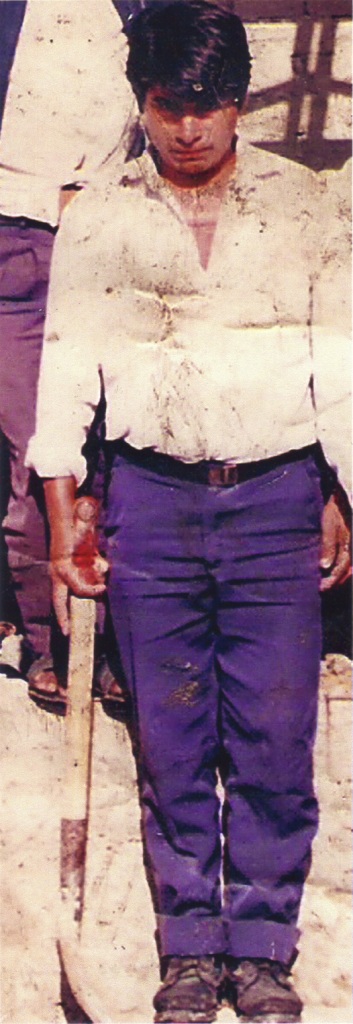
Cuatro años después, siendo ya miliciano zapatista, el compañero Dionisio forma filas en el regimiento que toma las cabeceras municipales de Altamirano, Chanal y Oxchuc, llevando una escopeta calibre 20. Las guarniciones gubernamentales fueron derrotadas en esas plazas, pero en el repliegue el compañero Dionisio y otros milicianos fueron tomados presos y torturados por priístas de Oxchuc.
Tal vez recuerde usted, Don Luis, las imágenes que repitieron hasta el cansancio los medios de comunicación nacionales e internacionales: los zapatistas golpeados severamente, amarrados en un quiosco en la cabecera de Oxchuc, la turba priísta gritando y amenazándolos con quemarlos vivos. Un helicóptero gubernamental los trasladó a la cárcel de Cerro Hueco, donde siguieron siendo interrogados con torturas. Lo tuvieron 15 días sin alimento, con apenas agua y lo sacan a las 4 de la mañana para bañarlo con agua fría. No dio información alguna. Fue liberado después, junto con otros presos zapatistas, a cambio del prisionero de guerra general Absalón Castellanos.
Después siguió el Diálogo de Catedral, el Diálogo de San Andrés, la firma de los acuerdos, el incumplimiento gubernamental, la resistencia zapatista.
Decenas de miles de hombres, mujeres, niños y ancianos se negaron a recibir la ayuda gubernamental e iniciaron el proceso de construcción de su autonomía con sus propias fuerzas y la ayuda de la sociedad civil nacional e internacional.
El compañero Dionisio fue elegido como autoridad de un Municipio Autónomo Rebelde Zapatista y fue presidente de la comisión de producción municipal. Cuando nacieron las Juntas de Buen Gobierno, fue miembro de una de ellas. Terminando su servicio comunitario como autoridad autónoma, quedó como promotor local en su comunidad.
De cómo cumplía sus trabajos nos cuenta su esposa:
El compañero antes de que hacía los trabajos decía que él no le importaba el tiempo que lo va a perder y también no es que traiga dinero suficiente, tan siquiera el pasaje que llega donde lo va a hacer trabajo y no le importa de que pierda su tiempo, tan siquiera pues con pozol pues eso es lo que decía antes el compañero cuando hacía el trabajo, que eso lo quiere nuestra lucha. Y él decía que de por sí él está bien convencido de la lucha, que no lo quiere dejar y ya sea cualquier sufrimiento que hay pero él está bien convencido de luchar. Al compañero le gustaría más el trabajo, no le importaría si es que no tiene dinero pero lo que gustaría más es el trabajo, y siempre cuando sale en su comisión o a hacer trabajo como consejo mucha gente ahí en ese ejido está en contra del compañero porque sale haciendo trabajo lo que es de la organización, pues como es ejidatario y siempre le piden la multa que no asiste en las reuniones, otros trabajos que se hacen en la comunidad.

Cuando el compañero Dionisio hacía su trabajo como consejo autónomo, su esposa quedaba trabajando en la milpa o cargando leña. Y comparten el trabajo: cuando el compañero regresa del trabajo en su oficina, llega en su casa y al otro día sale a las cuatro, a las cinco de la mañana para ver su trabajo, ya sea de la milpa o de otros trabajos, pero su esposa siempre lo acompaña para hacer los trabajos, así comparten entre ellos.
El día de la marcha, el 7 de mayo de este año: se levantan a las 2 de la mañana y empezaron a alistarse: moler la masa para las tortillas, preparar la comida para dejar a los hijos, y a preparar pozol para que llevaran a la marcha. Y dice su esposa que, siempre que el compañero Dionisio salía de comisión le decía que nunca se sabe si es que regresa. Esa madrugada salió bien contento. El cuerpo del compañero regresó acompañado de muchas bases de apoyo zapatistas.
Lo acompañaron hasta llegar a su casa.
Cuando hablamos con los familiares del finado compañero Dionisio, nos pidieron que pasáramos estos mensajes a quienes están luchando contra la guerra del mal gobierno:
El padre: este mensaje para el compañero Javier Sicilia y a otros compañeros que han muerto sus hijos a causa de buscar el bien, entonces le mando este mensaje que ánimo en su lucha, que pues para poder vencer al mal gobierno.
La esposa: El mensaje al compañero Javier Sicilia y a otros compañeros que han muerto sus hijos pues ánimo en su lucha, que no dejen de luchar, es el mensaje para luchar juntos.
La madre: que sigan luchando, ánimo con sus luchas y pues siempre a esta situación que si estamos dispuestos a luchar esto va a pasar, y que ellos sigan luchado, y no están solos.

Cierto, no están solos.
La historia del compañero Dionisio es sencilla y, como la de tod@s l@s zapatistas, se puede resumir así: ni se rindió, ni se vendió, ni claudicó.
-*-
Mmh… pues salió larga esta carta. Imagine usted lo que será la dirigida a Don Pablo González Casanova a quien le debo no una misiva sino un libro.
Y ahora que la releo antes de enviarla, se me ocurre que todo lo que en ella se dice tal vez no venga al caso en lo que estamos reflexionando sobre ética y política.
¿O tal vez sí?
Vale. Salud y ojalá haya más empeño en entender y menos en juzgar.
Desde las montañas del Sureste Mexicano.
Subcomandante Insurgente Marcos.
México, Julio-Agosto del 2011.
PERHAPS…
(Third Letter to Don Luis Villoro in the Exchange on Ethics and Politics)
ZAPATISTA NATIONAL LIBERATION ARMY
MEXICO.
July-August 2011.
To: Don Luis Villoro.
From: SupMarcos
Don Luis:
Receive greetings from all of us and a big hug from me. We hope you are in better health and that the pause in this exchange has been useful for attempting new proposals and reflections.
Although current reality seems to rush headlong at a dizzying rate, a serious theoretical reflection should be capable of “freezing” it for a moment in order to discover tendencies within it that permit us, revealing its gestation, to see where it is going.
(And speaking of reality, I remember that it was in the Zapatista La Realidad where I suggested to Don Pablo Gonzalez Casanova an exchange: he should send me a packet of Pancrema biscuits, and I would send him an alleged and improbable book of political theory (to call it something). Don Pablo complied, and the delayed walk of our calendar has prevented me from fulfilling my part of the exchange … yet. But I think that in the coming rains there will be more words.)
As perhaps has been insinuated in our correspondence (and in the letters of those who, generously, have joined the debate), theory, politics, and ethics are intertwined in ways not too obvious.
We are certainly not discussing discovering or creating TRUTHS, those millstones that abound in the history of philosophy and its bastard children: religion, theory, and politics.
I think we would agree that our efforts are aimed more towards trying to make the not-so evident but substantial lines stand out from those tasks.
“Downloading” theory into concrete analysis is one of the paths. Another is to anchor it in practice. But that practice is not being done in these epistles, as may be realized. So I think we should continue to insist on “anchoring” our theoretical reflections in concrete analysis or, more modestly, trying to limit their geographical and temporal coordinates. In other words, insisting that the words are spoken (written, in this case) from a specific place and time.
From one calendar and in one geography.
I. The Local Mirror.
The year 2011, Chiapas, Mexico, the World.
And in this calendar and this geography, we continue attentive around here to what happens, what is said and, above all, to what is silenced.
We continue in resistance in our lands. The attacks against us continue from across the political spectrum. We are an example that it is possible for all the political parties to have a common goal. Sponsored by federal, state and municipal governments, all political parties attack us.
Prior to each attack or after it, there is a meeting between government officials and “social” or party leaders. Little is said, just enough to agree on a price and the method of payment.
Those who criticize our Zapatista position that “all politicians are alike” should take a trip around Chiapas. Although it is certain that they will say this is something strictly local, that this does not happen at the national level.
But the political class in Chiapas repeats, with local variations, the same ridiculous routines of pre-election times.
There is an internal settling of scores (just like among the criminal gangs), which in the political class they disguise as “justice”. But everywhere it’s the same: to clear the path for the one who is elected this time. Everything that happens below is suspected of being a plot by one or more rivals. Everything that happens above is deformed or silenced.
With media policy to pay compliments, when it comes to Chiapas there is no difference between the press in the nation’s capital and in the state capital.
Can anyone seriously talk about justice in Chiapas when one of those responsible for the Acteal Massacre, namely Julio Cesar Ruiz Ferro, remains free? “Don’t worry, my president, let them kill each other, I’m going to send the public security services to pick up the dead”, the then governor of Chiapas, Julio Cesar Ruiz Ferro, replied to Jacinto Arias Cruz, mayor of Chenalho, who warned of an imminent confrontation in Acteal on December 19, 1997. (See: Maria de la Luz Gonzalez, El Universal, December 18, 2007.)
And what about “croquettes”[1] Roberto Albores Guillen, – the one responsible for the El Bosque killings, in addition to having built an empire of crime and corruption that now permits him to play second to Juan Sabines Guerrero and his “cock,” the coleto[2] Manuel Velasco, – returning to the governorship of Chiapas? (Speaking of “cocks,” Will López Obrador ever account for having helped to recycle the worst of Chiapas PRI politics?)
Ah, the old rivalry between the ancient political classes of Comitan, San Cristobal de las Casas and Tuxtla Gutiérrez (indeed, its history can be found in the book by Antonio García de León, “Resistance and Utopia: memory of grievances and chronicle of revolts and prophecies which occurred in the province of Chiapas during the last five hundred years of its history” in the ERA editorial of the endearing Neus Espresate).
While inklings of a storm proliferate in the politics of the Chiapas of above, Juan Sabines Guerrero seems to continue to be committed to the line that gave so many failures before to “croquettes” Albores: to encourage groups, paramilitary and non-paramilitary, to assault the Zapatista communities, cloaking the power of criminal mafias with or without the alibi of a political party; maintaining impunity for close [friends]; simulation as a government programme.
A local and national press, well “oiled” with money, does not succeed in hiding, under the guise of unanimity, the internal war in the politics of above.
About all this, suffice it to point out the following: that the internal rules of the political class were broken a while ago. The jailers of yesterday are those jailed today, and the pursuers of today will be pursued tomorrow.
It’s not that they don’t cut “deals,” but they no longer have the ability to fulfill them.
And a political class that does not comply with its internal agreements is a corpse awaiting burial.
No, the political class of above understands nothing. But above all it does not understand the basics: your time is up.
Ruling stopped being a political function. Now the work par excellence of the rulers is simulation. More important than political and economic advisers are image, advertising and marketing advisors.
So behave the leaders in Mexico nowadays, while the local, regional and national realities go to pieces.
Neither can the government bulletins disguised as “reporting” and “journalistic notes” manage to cover up the economic crisis: in the principal cities of real Chiapas begin to appear and grow destitution and more marginal “jobs.” Poverty that seemed to be unique to rural communities begins to increase in urban areas of the Mexican Southeast.
Just like in the rest of national territory.
Does it seem like I’m talking about the politics of above on the national level and not the local level?
Ah, the fragments of the broken mirror, irremediably broken …
II. An epitaph for a political class or for a Nation?
When Felipe Calderón Hinojosa, (who became president through the – now confessed – crime of Elba Esther Gordillo), disguised as a tourist guide so that people other than the military and the police would come to Mexico, looked out at the Cave of the Swallows in Aqusimón, San Luis Potosí, and shouted out “Oh my God!” (http://mexico.cnn.com/nacional/2011/08/17/calderon-promueve-destinos-turisticos-en-el-programa-the-royal-tour), he could very well say the same thing if he looked out at the hole the country has fallen into during his administration.
According to statistics revealed by the National Council for the Evaluation of Social Development Policy (CONEVAL), the number of poor people in Mexico has increased from 48.8 to 53 million. Almost half the Mexican population lives in poverty. Almost 12 million people live in extreme poverty.
And if you study the maps of CONEVAL itself, you could realize that the marks of poverty, which used to be confined mainly to the South and South-Eastern states of Mexico (Guerrero, Oaxaca, Chiapas), are now spreading to the Northern states as well.
The prices for basic items have doubled and trebled during the last 6 years.
| Variation in the increase in prices of some products | ||||
| PRODUCT | Increase from 1/12/06 to 01/3/11 | Price in 2006 | Price in 2011 | |
| 1 | Avocado | 239.04% | $12.09 | $28.90 |
| 2 | Lemon | 230.45% | $6.01 | $13.85 |
| 3 | Sugar | 199.31% | $7.24 | $14.43 |
| 4 | Beans | 199.50% | $10.03 | $20.01 |
| 5 | Tomato | 141.74% | $9.75 | $13.82 |
| 6 | Eggs | 144.65% | $11.58 | $16.75 |
| 7 | Cheese | 193.55% | $40.77 | $78.91 |
| 8 | White bread | 175.00% | $1.00 | $1.75 |
| 9 | Tortilla | 153.26% | $6.74 | $10.33 |
| Minimum wage | 22.90% | $48.67 | $59.82 | |
| Taken from Centre for Multidisciplinary Analysis (CAM) “Report of Investigation No 90 Mexico: Results of economic policy applied to the workers (2006-2011)” | ||||
According to data from the The Centre for Multidisciplinary Analysis, in order to have enough money to buy the recommended basic food basket during the first year of Felipe Calderón Hinojosa’s administration, it was necessary to work for 13 hours and 19 minutes per day. Five years later, in 2011, it would be necessary to work for 22 hours and 55 minutes per day.
Meanwhile, millionaires’ earnings have quadrupled during the last 10 years.

| Source: Prepared by Nubia Conde M with data from Forbes Magazine, several years of CEFP, the Bank of Mexico and SHCP, SAT. |
On top of this, add up the job losses due to the closure of job sources. Among them, the criminal blow to the Mexican Electricians Union. The attack was led by the villainous secretary of work Javier Lozano Alarcón (who will also be remembered for his gangster-like extortions – Zhenli Ye Gon and the 205 million dollars that paid for the 2006 election fraud -), and was “applauded” by the mass media.
Certainly, the huge campaign against the workers of the Mexican Electricians Union (including the threat of penal actions against its leaders), which accuses them not only of being lazy, but at the same time of being terrorists, should compare itself with reality: if these workers were actually lazy and useless, how come the central zone of the country had electricity? How could the TV companies, radio stations and newspapers that now attack them and defame them operate? What about the deficiencies that, with the Federal Electricity Company, most of the homes in that part of Mexico are now facing? What about the ridiculously high new bills they are now getting?
Nonetheless, the resistance of these workers is not ignored. Not by us.
And while the world crisis is barely affecting the national economy, the political class continues in its idleness.
The year 2012 reached the calendar of those of above on December 1st 2006, and throughout all these 5 years it has only been proof that those past calendars are not even good for decorating the destroyed walls of this big house we still call “Mexico.”
In the PRI, a Beltrones and a Paredes are figuring out how to displace a Peña Nieto, who spends more time performing for the media (there is money involved) than in politics (he has no function).
In the PRD, the odd couple of López Obrador and Marcelo Ebrard are starting to realize that everything depends on the party bureaucracies of the self-styled institutional “left.”
Finally, in the PAN of the national nightmare, a little man, surrounded by death and destruction, is looking for someone to back him up now the presidential guards and the national palace will no longer do so.
Although the discredit and waste of the party in government is huge, Felipe Calderón Hinojosa is gambling, and gambling high, to use all the resources he can get hold of to impose his proposal. If he did it already in 2006, he could do it again in 2012. And he will need to, because his playing cards are worn out: a Cordero (lamb) promising his shepherd he’ll keep being a lamb; a Lujambio waiting to avoid the thrust of the stream of light; a Creel who looks good in grey (a colour that defines him); and a Vázquez Mota whose only argument is the fact that she is a woman.
(I recall an argument when Barack Obama and Hillary Rodham Clinton were running for the presidential candidacy. Some feminists were looking for support for Hillary because she was a woman; some Afro-Americans were supporting Obama because he was black. Time proved that above neither gender nor colour are important).
Meanwhile, like a brothel madam would do, Elba Esther Gordillo picks the leaves off the daisy…and she is still considering joining the race, instead of supporting someone else.
With such a pathetic panorama, it is only logical, and even expected, that other pre-candidates will show up…and with their own supporters.
In reality, the replacement government seems to interest no one, other than the party cliques, the economic power and an occasional militant.
Bitterness is replacing apathy, and not a few dreams finally bury the Mexican political system, and worker’s hands are engraving on its tomb the epitaph: “they did it the hard way, but the game is finally over.”
In the meantime the war continues…and with it, its victims…
III. Blaming the victim
In 1971, the north American psychologist William Ryan, wrote a book called “Blaming the Victim”. Although his initial intention was a criticism of the so-called “Moynihan Report”, which suggested that the black population of the USA were responsible for their own poverty due to their cultural patterns, rather than the social structure being to blame, this idea has been used more often to excuse acts of sexism and racism (even more so in rape cases, where the female is accused of provoking the rapist by her clothing, attitude, place, etc.)
Similarly, but using a different name, Theodor Adorno describes “Blaming the victim” as one of the defining characteristics of fascism.
In contemporary Mexico, the church, government, artists and people from the mainstream media, have used the same nonsense to condemn innocent victims (mainly women and young people).
Felipe Calderόn Hinojosa’s war has converted this characteristic of fascism into a whole programme of government and the dispensing of justice. Moreover, most of the media coverage holds to the same strategy, permeating through the minds of those who still believe what the newspapers, radio and television report.
Someone somewhere said that crimes against innocent people commit a triple injustice: death, guilt, and oblivion.
The whole system that we currently endure cares, keeps, and cultivates the killers and their names, whether it is to condemn or to glorify them.
However, the victim’s name and story are left behind.
Far beyond the victim’s relatives and friends, the victims are killed once again when they are reduced to a number, a statistic. Some others don’t even reach that.
In the war that Calderόn has imposed on the whole of Mexican society, across race, belief, social class, gender, political ideology, another grief is added: innocent victims are labeled as criminals.
The empire of impunity is disguised under the name of “settling of scores amongst narcos”.
And this heavy weight falls onto the relatives and friends too.
The reigning injustice not only guarantees impunity for all those working in the federal, state and municipal governments. It also overburdens the families and friends of the victims.
Other deaths are also their deaths, when society omits their names and stories. An honest life is distorted when [criminal] adjectives are lavished on those lives by the authorities and repeated ad nauseam by the media.
Then the victims of the war become the culprits and the crime of chopping their limbs off or killing them becomes a quasi-divine justice: “they asked for it”.
Felipe Calderόn Hinojosa will be remembered as a war criminal, even though today he is surrounded by embraces and congratulations, he thinks he is a great statesman, or the country’s saviour.
He will be remembered with bitterness.
It will even surpass the lack of justice, the derision and the usual scorn that follows the governor’s departure.
His pathetic imitation of a “tourist guide”, the illegality and illegitimacy of becoming president, his failed policies, his responsibility for the economic crisis, his surrounding of himself with a team of hitmen and security guards dressed in politician’s clothing; the nepotism that consolidates what is already known as the “los Piňos Cartel”[3], all these misrepresentations will be left in the background.
What will remain will be his war, lost, with its trail of collateral victims: the defeat, wearing down and discredit of the federal armed forces (which TV series could do very little to counter); the handing over of national sovereignty to the empire of stripes and blurred stars (we have said this before: the USA will be the sole winners of this war); the wiping out of local and regional economies; the breakdown of the social fabric; and innocent blood, always innocent blood…
It may be that death has no cure.
That nothing can fill the void of loneliness and despair that is left by the death of an innocent.
It may be that nothing can be done to bring back to life the tens of thousands of innocents killed in this war.
But one thing that can be done is to fight against this fascist idea of “blame the victim”, to name the dead and thus to recover their stories.
To free them from guilt and from oblivion.
To provide comfort for their absence.
IV. Naming the dead and their history
Mariano Anteros Cordero Gutierrez was his name. He was about 20 years old when, on June 25, 2009, he was murdered in Chihuahua.
When Mariano’s father, Mariano Cordero Burciaga, met with the then governor of Chihuahua, José Reyes Baeza, the latter said that the murder had been the result of a street fight. A few weeks after the events, a representative of the College of State Lawyers of the Bar asked the appropriate authorities for an explanation of the facts. They said they had been “a settling of accounts between drug traffickers”. Blame the victim.
Here are a few fragments of his story:
Mariano was studying at the Institute of Technology in Parral (ITP) for an engineering degree in business management and had received a letter of acceptance to study for a law degree at the Autonomous University of Durango in Spain, Parral Campus.
Prior to these studies he was a missionary volunteer at the Marist boarding school in the town of Chinatú, in the municipality of Guadalupe y Calvo, Chihuahua. He was responsible for 32 indigenous children in the primary section of this boarding school.
Mariano was a young Zapatista, one of those who struggle without masks. In March 2001, along with his father, he participated as a member of the ‘belt of peace’ during the March of the Colour of the Earth. In 2002, he took part in the various anti-globalization (altermundismo) demonstrations in Monterrey, Nuevo León, during a summit of heads of state attended by Bush but also by Fidel Castro. At the time of his death, Mariano kept in a bag for daily use a copy of the Sixth Declaration of the Lacandon Jungle, the Communist Party Manifesto and his most recently-acquired book, “Nights of Fire and Sleeplessness”[4]
When we did our Other Campaign tour of northern Mexico, we passed through the state of Chihuahua, and the young Mariano attended a meeting. At the end of the meeting, he asked to speak with me alone.
What was the date? November 2, 2006. A few weeks earlier, on October 17 of that year, Mariano had reached the age of seventeen.
We sat in the same room where the meeting had been. More or less, what Mariano told me was that he wanted to come to live in a Zapatista community. He wanted to learn. I was surprised by his simplicity and humility, he did not say he wanted to come to help, but to learn.
I told the truth: that it was best to study for a college degree and to finish it, because here (and there and everywhere), people of honour finish what they have started; meanwhile they do not stop fighting, there in their land with their people.
That once he had finished his studies, if he still felt the same, he would have a place with us, but by our side, not as teacher or as a student, but as one of us.
We closed the deal with a handshake.
Seven years earlier, on May 8, 1999, when Mariano was 9, I had written him a message on a sheet of paper from a notebook:
“Mariano:The time will come, (not yet, but it will come, that is certain), when your path crosses others, and you have to choose one. When that time comes, look inside you and know that there are no options, there is only one answer: to be true to what you believe and say. If this is true, then the path and the speed of walking do not matter. What matters is the truth of the path walked”.
Today we name Mariano, and his story, and from this geography we send his family a hug from his Zapatista brothers and sisters, which, although it will not cure it, will relieve the pain…
V. Judging or trying to understand?
From our geography we have also tried to follow closely the course of the Movement for Peace with Justice and Dignity that Javier Sicilia heads.
I know that judging and condemning or absolving is the way preferred by the commissioners of thought that appear on either side of the intellectual spectrum, but around here we think that one must make an effort to try to understand several things:
The first is that we’re dealing with a new movement that, in its project of becoming an organized movement, is constructing its own paths, with its own achievements and failures. Like anything new, we think it deserves respect. They can say, rightly, that the ways and means can be challenged, but not the causes.
And it deserves attention to try to comprehend, instead of making the summary judgments so dear to those who do not tolerate anything that is not under their direction.
And to respect and understand you have to look up, but also down below.
It’s true that above the shows of affection received by those directly responsible for so much death and destruction call attention and irritate.
But below we see that, in the family members and friends of the victims, awakens hope, comfort and companionship.
We thought maybe it was possible for a movement to rise up that would stop this absurd war. It doesn’t seem to be so (or not yet).
But what can be seen, of course, is that made tangible to the victims.
It lifted them out of the page of police reports, out of the statistics of the mythical “triumphs” of the government of Felipe Calderon Hinojosa, out of the blame, the forgetting.
Thanks to that mobilization, the victims begin to have a name and a history. And the hoax of the “fight against organized crime” falls apart.
For sure we still don’t understand the reason they spend so much energy and effort in dialogue with a political class that have long lost the will to govern and are nothing but a gang of outlaws. Perhaps they will discover this for themselves.
We do not judge and, therefore, neither do we condemn or absolve. We try to understand their steps and the longing that animates them.
In short, the dignified pain that embodies and moves them deserves and has our respect and admiration.
We think it is logical to dialogue with those responsible for the problems. In this war, it is reasonable to address those who unleashed it and escalated it. Critics of that dialogue with Felipe Calderón Hinojosa forget this fundamental.
Criticism of all kinds has rained on the forms that dialogue has taken.
I do not think that Javier Sicilia loses any sleep over the vile criticism of, for example, the Paty Chapoy of La Jornada, Jaime Avilés (just as frivolous and hysterical), or the vileness of Dr. ORA (who nowhere says that he is on the left or that he is congruent), who only lacks saying that Sicilia ordered the killing of his son to “push” the image of Felipe Calderon Hinojosa; or the signals that reproach him for not being radical, made precisely by those who hoist as an achievement “not having broken one pane of glass.”
In his correspondence (and it seems to me in some public events), Javier Sicilia likes to recall a poem by Cavafy, especially the verse that says: “Thou shalt not fear either Laestrygonians or Cyclops, or the wrath of angry Poseidon.” And these hysterical critics get nowhere near this, so that the bitterness of these pathetic little men does not reach beyond their few readers.
The reality is that this movement is doing something for the victims. And that is something that none of the “judges” can claim to do.
As for the rest, neither Javier Sicilia nor any of those close to him disdain the critical observations that they receive from the left, which are not few but are serious and respectful.
But one must not forget that they are observations, not orders.
I transcribe the end of one of the private letters that we have sent to him:
“Personally, if I may, I would tell him to continue with poetry, and art in general, at his side. In it are found stronger handles than those that seem to abound without rhyme or reason from the palaver of political “analysts”.
So I finish these lines with the words of John Berger:
‘I cannot tell you what art does and how it does it, but I know that art often prosecutes judges, cries out for vengeance for the innocent and projects into the future what the past has suffered, in a way that is never ever forgotten.
I also know that the powerful fear art, in any of its forms, when it does this, and that art sometimes runs like a rumour and a legend among the people because it gives meaning to what the brutality of life cannot, a meaning that unifies us, because in the end it is inseparable from justice. Art, when it functions like that, becomes the meeting place of the invisible, the irreducible, the enduring, the courage and the honour’ ”
In the end, maybe all this will not come to be the case (or the thing, depending)[5] …..
VI. A little story.
And perhaps this little story I am now going to tell you, Don Luis, will not come to be the case (or thing, depending,) either:
In the early morning of May 7, 2011, a column of vehicles left the zapatista Tzots Choj zone, ferrying men and women of the EZLN support bases to participate, along with people from other areas, in a demonstration in support of the Movement for Peace with Justice and Dignity headed by Javier Sicilia. At 6 o’clock, our compañero Roberto Santis Aguilar lost his life when one of the cars overturned in an accident. When he was very young, Robert became a Zapatista and chose “Dionisio” as his struggle name.
The story seems simple, when listening to it being told by his parents and his wife. His father says that Dionisio was the first member of his family to join the Zapatistas.
“So, since we were working here in the cornfield, the time came when we were chatting here in the cornfield, he looked to see that there was no one around and said, we’ll talk a while, there is an organization, I heard it is very good. Then he started to say, he began to talk with us, with his brothers, then he began to say that there is this organization which is very good, it seems that there is help for us and this is what he said. So this is how we joined, but first we heard the word, and then we joined ourselves, it was gradually coming closer to all of the people. So, we joined the organization then.
We joined the organization at that time because we were very fucked up for living then, and there was no more land for us to work, we were very poor then. Then the bad government did this, we were talking about if there was a way to grab a piece of land, since there was no way the bloody government would give us one, so this organization heard we were on this path and then we joined this organization yes, we joined in the year, the year 1990, yes”.
Four years later, now as a member of the Zapatista militia, compañero Dionisio, carrying a 20-gauge shotgun, was part of the regiment which took the municipalities of Altamirano, Chanal and Oxchuc. The government garrisons were defeated in those places, but afterwards Dionisio and other milicianos were taken prisoner and tortured by the PRI in Oxchuc.
You may remember, Don Luis, the images repeated ad nauseam by the national media and international organizations: the Zapatistas severely beaten, tied up in a building at the headquarters of Oxchuc, the PRI mob shouting and threatening to burn them alive. A government helicopter flew them to the Cerro Hueco prison, where they continued to be interrogated under torture. They had 15 days without food, with hardly any water, and being taken out at 4 in the morning to wash in cold water. He did not give them any information. He was released later, along with other Zapatista prisoners, in exchange for the Prisoner of War General Absalόn Castellanos.
There followed the Dialogue in the Cathedral, the Dialogue of San Andres, the signing of the accords, the government’s failure to ratify them, and the Zapatista resistance.
Tens of thousands of men, women, children and old people refused to receive government aid and began the process of building their autonomy through their own efforts and with the support of national and international civil society.
Compañero Dionisio was elected an authority of the Rebel Zapatista Autonomous Municipality and chairman of the commission of municipal production. When the Good Government Juntas were born, he was a member of one of them. Completing his community service as an autonomous authority, he remained a local promoter in his community.
His wife tells us how he fulfilled his duties:
“Before starting work the compañero said that it did not matter to him how much time he lost or if he would not earn enough money, not even the time when he was going to do the work and he did not mind that he would lose his time, even with pozol, because that’s what he said before doing the work, that that is what our struggle needs. And he said that he was in himself quite convinced of the struggle, he did not want to give up, or mind whether there was any suffering, but he was quite convinced to fight. The compañero would like more work, would not mind if he had no money, but what he liked most is the work, and always when he goes out in the commission or in the council to work, many people there in the ejido were against the compañero, because work is what is making the organization, because, as an ejidatario he was always asked for a fine because he did not attend the meetings, doing other jobs in the community”.
When compañero Dionisio was doing his job as an autonomous authority, his wife stayed behind working in the cornfield or carrying firewood. And they shared the job: when the compañero returned from work in his office, he came home and the next day left at four or five in the morning to go to his work, either in the cornfield or other jobs, but always accompanied to work by his wife, and so they shared the work between them.
The day of the march, on May 7 this year, they got up at 2am and began to get ready: to grind the [flour for] dough for the tortillas, to prepare food to leave for the children, and to prepare pozol to take on the march. His wife says that whenever he went out to do work for the commission, Dionisio said he never knew whether he would return. That morning he left happily. The body of the compañero came back along with many Zapatista support bases.
They accompanied him back home.
When we spoke to the family of the late Dionisio, they asked us to pass these messages on to those who are struggling against the bad government’s war:
The father: this message is for compañero Javier Sicilia and other compañeros whose children have died as a result of looking for the good, then I send this message to encourage them in their struggle, so perhaps they can defeat the bad government.
The wife: this message to the compañero Javier Sicilia and other compañeros whose children have died, to encourage them in their struggle, not to stop fighting, the message is to fight together.
The mother: to keep struggling, their struggles and courage, as always with this situation if we are willing to fight it is going to happen, to continue to struggle, and they are not alone.
Truly, they are not alone.
The story of Dionisio is a simple one and, like that of all the Zapatistas can be summarized as follows: they neither surrendered nor sold out nor gave up.
-*Hmm … it came out as a long letter. Imagine what will be sent to Don Pablo Gonzalez Casanova, to whom I owe not a letter but a book.
And now that I re-read it before sending, it occurs to me that all it says may not come to be the case as we reflect on ethics and politics.
Or perhaps it will?
Vale. Good health to you and hopefully there will be more effort put into understanding and less into judging.
From the mountains of the Mexican Southeast
Subcomandante Marcos
Mexico, July – August 2011
[1] Nickname referring to the individual’s shape
[2] Coleto – a term used to describe those in San Cristóbal, Chiapas, who think of themselves as descendants of the Spanish invaders.
[3] The president’s residence’s drug cartel
[4] Title of a book by Marcos
[5] caso (o cosa, segun)…. this is a phrase often used by Marcos, which is a play on letters almost impossible to translate

