300.
Part II:
A Continent as a Backyard, a Country as a Cemetery, Pensamiento Únicoi as a Government Program, and a Small, Very Small, Ever So Small Rebellion.
From our analysis of the world we move to the level of the continent.
If we look above…
We see the examples of Ecuador, Brazil and Argentina, where supposedly progressive governments have not only been removed from power but prosecuted, and the governments that have taken their place are ones that have been trained as good overseers—obedient to capital, that is—ready to take on a realignment of the world plantation (though, to be fair, even in their cynicism they’re still pretty clumsy). Take Temer in Brazil, Macri in Argentina, and that guy in Ecuador who was supposed to be good because he was chosen by the now-persecuted Correa (a man of the “citizen’s revolution”, “a leftist” according to the progressive intelligentsia who backed him) but who, it turns out, is actually on the right: Lenin Moreno (yeah, paradoxically his name is Lenin).
Under the watchful eye of the State that has become the policeman of the region—Colombia—threats are issued, destabilization efforts are undertaken and plans are made for provocations that would justify “peace force” invasions. In all of South America, we see a return to the brutal times of the Colonies, now characterized by a “new” extractivism—really just the same ancestral plunder of natural resources, categorized as “raw materials”—but endorsed and promoted among the progressive governments of the region as “Left extractivism”. This is supposed to be something like a Leftist capitalism or a capitalist Left, or who knows what it’s supposed to be because it destroys and dispossesses just the same, only it’s for a “good cause” (??). Any criticism or movement that opposes the destruction of the originary peoples’ territories is written off as having been “promoted by Empire” or “backed by the right-wing”, among other equivalents to being “a conspiracy by the mafia of Power.” In sum, the “backyard” of Capital extends across the continent all the way to Cape Horn.
But if we look below…
We see resistances and rebellions, first and foremost among the originary peoples. It would be unfair to try to name them all since there’s always a risk of leaving some out, but their identities are clear in their struggles. There where the machine encounters resistance to its predatory advance, rebellion dresses in colors so old they’re new again and speaks “strange” languages. Displacement, also disguised as the leasing of lands, tries to impose its commodity logic on those who refer to the Earth as “Mother.” These resistances are accompanied by groups, collectives, and organizations which, while perhaps not themselves composed of originary peoples, share the same effort and the same destiny, that is to say, the same heart. That is why they suffer insults, persecution, imprisonment and, not infrequently, death.
Words of the EZLN’s Sixth Commission at the Gathering of Support Networks for the Indigenous Governing Council (CIG) and its spokeswoman
(Expanded version)
Given time restrictions, we were unable to present these thoughts in full during the gathering. We promised you the full version, and we include the full transcription here, including the parts that were not read at the gathering. You’re welcome. Don’t mention it.
300 Part I: A Plantation, a World, a War, Slim Chances.
August, 2018.
Subcomandante Insurgente Galeano:
Good morning, thank you for coming, for accepting our invitation and for sharing your words with us.
We are going to begin by explaining our way of doing analysis and evaluation.
We start by analyzing what is happening in the world, then move to what is happening at the continental level, then to what is happening in this country, then to a regional and finally to a local level. From there, we develop an initiative and begin to move back up from a local level to a regional level, then to the national, the continental, and finally the global level.
We think that capitalism is the dominant system at the global level. In order to explain this system both to ourselves and to others, we use the image of a plantation. I’m going to ask Subcomandante Insurgente Moisés to explain this part.
-*-
Subcomandante Insurgente Moisés:
Compañeros and compañeras: we interviewed our own compañeros and compañeras who are our great-grandfathers and great-grandmothers, some of whom are still alive. The following is what they told us and what they helped us understand: how the rich, the capitalists, want to turn the whole world into their plantation.
Sorry, this entry is only available in Español. For the sake of viewer convenience, the content is shown below in the alternative language. You may click the link to switch the active language.
Palabras de la Comandancia General del EZLN en voz del Subcomandante Insurgente Moisés y del Subcomandante Insurgente Galeano, durante la plenaria del Encuentro de Redes de Apoyo al Concejo Indígena de Gobierno, el 5 de agosto de 2018 en el Caracol de Morelia, Chiapas.
Sorry, this entry is only available in Español. For the sake of viewer convenience, the content is shown below in the alternative language. You may click the link to switch the active language.
(Debido a fallas en nuestro audio, no hemos podido subir el mensaje que enviaron las compañeras zapatistas el Encuentro de Mujeres el pasado 29 de julio. A partir de audios que subieron páginas amigas, transcribimos el mensaje zapatista. Colectivo RZ).
Mensaje de las mujeres bases de apoyo zapatistas el Encuentro de Mujeres que se realizó en la comunidad indígena Hñähñu de San Lorenzo Nenamicoyan, Estado de México, los días 28 y 29 de julio de 2018
A las Mujeres del Congreso Nacional Indígena
Del Concejo Indígena de Gobierno
A Mujeres del Encuentro de Mujeres
Reciban un saludo revolucionario a nombre de las compañeras bases de apoyo zapatistas. Nos da mucho gusto escuchar que ustedes organizaron un Encuentro de Mujeres, que no dependieron de los hombres. Es así que debemos conquistar nuestro derecho como mujeres, donde tengamos espacio para luchar contra el capitalismo patriarcal, escuchar diferentes formas organizándonos en las reuniones, asambleas, con conciencia y valor. Que nosotras, las mujeres, sí podemos hacer los trabajos de diferentes formas, como en la salud, educación, producción, tercias, medias, justicia, radios comunitarias, en las artes y también como gobernamos en las juntas de buen gobierno, en los MAREZ y autoridades locales de los tres niveles autónomos.
Todo eso no ha sido tan fácil porque no tenemos manual, sino en las prácticas ahí fuimos aprendiendo como en los trabajos que se necesitan. Aunque con errores, ahí fuimos corrigiéndonos. No por eso dejamos de luchar. También estamos vigilándonos en todas las áreas del trabajo que ejercemos en la autonomía y educamos a nuestros jóvenas y jóvenes a que tengan una vida mejor, su libertad para luchar contra el pinche sistema capitalista patriarcal.
Nosotras, como mujeres, no somos objetos para ellos. Tampoco mercancías ni limosneras. No pensemos que alguien nos viene a dar el cambio, sino que nosotras tenemos que hacer el cambio, organizándonos desde abajo con los millones de mexicanas y mexicanos que ¿a poco se conforman con la situación en que están? (…) La esperanza, compañeras, que sigamos luchando y organizándonos. Que no sea la primera ni la última vez que organizan este encuentro porque es necesario compartir sus experiencias de lucha. Así como nosotras llevamos 24 años de lucha y nos falta mucho para hacer y aprender organizándonos, como ya dijimos que no tenemos libros o manual para diario, sino conforme a los pasos, vamos tejiendo nuestras experiencias y rescatando nuestra sabiduría como pueblos originarios.
Ánimo, pues, compañeras. No dejemos de luchar. Ganaremos en conquistar nuestros derechos como mujeres, la igualdad y la libertad junto con nuestros compañeros. Vamos adelante.
29 de julio del 2018
¡Vivan las mujeres del Congreso Nacional Indígena!
¡Vivan las mujeres del Concejo Indígena de Gobierno!
¡Vivan las mujeres que participan en el Encuentro Nacional de Mujeres!
To the People of Mexico:
To the People and Governments of the World:
To the Free, Alternative, Autonomous, or whatever they’re called Media:
To the National and International Sixth:
To the National Indigenous Congress and the Indigenous Governing Council:
To the National and International Press:
July 17th, 2018.
Since yesterday and during today, media has been running a story backed by declarations of Mister Alejandro Solalinde (who presents himself as a presbyter, priest, clergyman or however its said, christian, catholic, Roman Apostolic), of a supposed approach between EZLN and Mister Andrés Manuel López Obrador and that “the EZLN already agreed to have a first dialogue” (textual words by Mister Solalinde).
About this lie EZLN declares:
First: The CCRI-CG of EZLN, the political, organizational and military directorate of EZLN, hasn’t agreed to a first dialogue with anyone. As its well know by whoever has the minimum knowledge of EZLN and its ways, a matter like this would have been made public well in advance.
Second: EZLN hasn’t received from Mister Solalinde anything but lies, insults, libel and racist and sexist comments, by assuming just like it was done during the days of Salinismo and Zedillismo, that we are poor ignorant indigenous manipulated by the -quoting his own words- “Caxlanes who administer Zapatismo” that don’t allow us to look down and kneel to the mister whose Solalinde considers the new savior.
Third: We understand Solalinde’s need to be on the spotlight and his demand for our submissiveness, but he is wrong about EZLN’s Zapatismo. Not only he is wrong about that. We don’t know much about it, but it seems like one of the church commandments to whom Mister Solalinde supposedly serves, which goes: “Thou shalt not bear false witness against thy neighbour, and you won’t lie”.
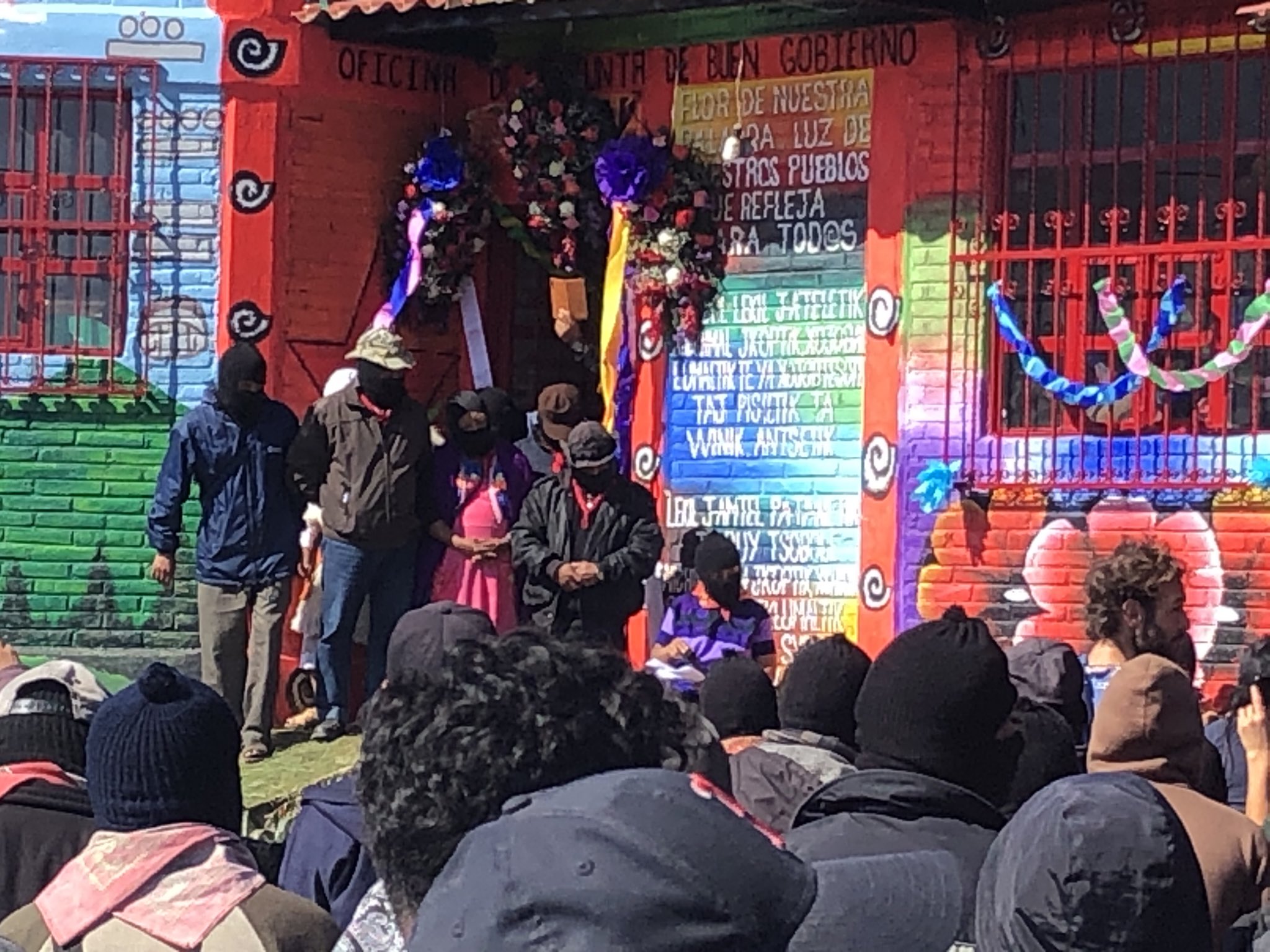
Convocation to a Gathering of Support Networks for the Indigenous Governing Council; to CompARTE[i] 2018, “For Life and Freedom”; and to the Fifteenth Anniversary Event of the Zapatista Caracoles entitled, “Píntale Caracolitos a los malos gobiernos pasados, presentes y futuros” [ii]
July, 2018.
To the individuals, groups, collectives and organizations of the Support Networks for the Indigenous Governing Council:
To the National and International Sixth:
First and last point:
The Grand Finale.
You arrive at the grand stadium. “Monumental,” “colossal,” “an architectonic marvel,” “the concrete giant”—these and similar descriptors roll off the lips of TV broadcasters who, despite the different realities that they describe, all highlight the enormously proud structure.
To get to the magnificent building, you’ve had to wade through rubble, cadavers, and filth. Older folks say that it wasn’t always like this, that it used to be that homes, neighborhoods, businesses, and buildings were erected around the great sporting hub. Rivers of people would rush all the way up to the gigantic entrance, which only opened once in a while and on whose threshold was inscribed, “Welcome [Bienvenido] to the Supreme Game.” Yes, “bienvenido” in the masculine, as if what occurred inside was exclusively a men’s affair, as used to be the case with public bathrooms, bars, the machinery and tools sections of hardware stores…and, of course, soccer.
Sorry, this entry is only available in Español. For the sake of viewer convenience, the content is shown below in the alternative language. You may click the link to switch the active language.
Jueves 21 de Junio
7 a 10 am: entrevistas con medios alternativos y comerciales de Mexicali.
11 a 13 horas: Encuentro con los pueblos indígenas de Baja California. Escuela Primaria del poblado El Mayor.
17 a 19 horas: Encuentro con la Red de Apoyo, Colectivos, Organizaciones e Individuos (as-oas) que se adscribieron y decidieron apoyar la propuesta del CIG y su Vocera. Salón Social de los Jubilados Burócratas, calle H # 444, casi esquina con Av. Zaragoza, Colonia Nueva.
Viernes 22 de junio.
15 a 20 horas: Festival Cultural y Encuentro con la Red de Apoyo, Colectivos, Organizaciones e Individuos (as-oas) que se adscribieron y decidieron apoyar la propuesta del CIG y su Vocera. Lugar por confirmar.
Sorry, this entry is only available in Español. For the sake of viewer convenience, the content is shown below in the alternative language. You may click the link to switch the active language.
El pasado 28 de Abril en la CDMX se realizó un concierto solidario en apoyo al Concejo Indígena de Gobierno (CIG) . Aquí el registro visual del evento en donde musiqueros solidarios, colectivos, organizaciones y redes de apoyo al CIG, acompañados por los miles de asistentes al evento; cantaron, escucharon la palabra del CNI , y bailaron hasta hacer retemblar en su centro la tierra.
Mexico City, 2 May 2018.- Today at noon a press conference was held by the National Indigenous Congress, the Indigenous Governing Council (CIG), and the Sixth Commission of the Zapatista Army of National Liberation, where they announced the aggreements of the CIG’s second work session (held on April 28 and 29 in Mexico City).
Evaluation by council members regarding the achievements and difficulties of the CIG’s tour in Mexico (4’33 min.)
Communiqué by the CNI-CIG-Sixth Commission of the EZLN:
(Source: Enlace Zapatista)
WHAT’S MISSING IS YET TO COME
April 2018.
To the CIG and Marichuy Support Networks:
To those who participated in the Civil Association entitled, “The Hour for Our Peoples to Flourish Has Come”:
To the National and International Sixth:
To the Mexican people:
To the free, autonomous, alternative and independent media:
To the national and international press:
Faced with the intensification of war, dispossession, and repression in our communities, and as the electoral process advances, we, in accordance with the path walked by our spokeswoman Marichuy together with the councilmembers of the CIG [Indigenous Governing Council], respectfully address the Mexican people to say:
We hear the pain of all the colors we are, all of the colors which make up Mexico from below.
Under the pretext of collecting signatures, we traveled throughout the indigenous territories of our country where together we grew our political proposal from below, and through this process made visible the struggles, problems, and proposals of many originary peoples.
Through our participation in this electoral process, we reiterated to the indigenous and non-indigenous peoples of Mexico that we will not be silent while those above steal and destroy our land, which we inherited from our grandparents and which we owe to our grandchildren. We will not remain silent while they poison rivers and blow holes in mountains to extract minerals; we will not sit idly by as they turn the peace and life that we have been building every day into war and death via the armed groups that protect their interests. Have no doubt: our response will be organized resistance and rebellion to heal the country.
With the massive mobilization of thousands and thousands of compañeras and compañeros from the support networks around the country, we realized, and it became shamelessly clear, that to get on the ballot we would have had to prove ourselves as bad as or worse than those above. If we collect signatures, they must be fraudulent or else they won’t count; if we spend money it should come from a shady source; if we say anything it has to be a lie; if we come to any serious agreements, they must be with corrupt politicians, extractivist corporations, bankers, or drug cartels, but never, ever, with the Mexican people.
Getting on the ballot is only for those who seek to administer power from above to oppress those below, because the power they seek is rotten to the core.
It’s a competition that can be won with deceit, money, and power, as the political class’ elections are merely a commodity. There is not nor will there ever be room there for the word of those below—those who, whether they are indigenous or not, despise power and build democracy by making collective decisions which then become a form of government in the street, barrio, town, ejido, collective, city, or state.
The electoral process is one big pigsty where the competition is between those who can falsify thousands of signatures and those who have billions of pesos to coerce and buy votes. Meanwhile, the majority of the Mexican people are caught between poverty and misery.
That’s why our proposal isn’t like theirs. That’s why we’re not campaigning, falsifying signatures, or collecting and spending the monies that the people of Mexico need to meet their basic needs. That’s why we don’t need to win any election or get involved with the political class. Rather, we’re in search of power from below, born of the pain of the peoples. That’s why we’re seeking out the suffering of all the colors that make up the Mexican people: that’s where hope lies, in a good government that rules by obeying and which will only be able to emerge from organized dignity.
The racism inherent in the political structure is not the only thing that kept our proposal off the ballot. Well, even if those who oppose the destruction wrought by the capitalist system on the world had different eyes, whether they were blue or red, public policy and this supposed democracy would still be meant to exclude them.
The originary peoples and those of us who walk below and to the left don’t fit in their game. This is not because of our color, race, class, age, culture, gender, thought, or heart, but rather because we are one and the same with the Mother Earth and our struggle is to stop everything from being turned into a commodity, as this will mean the destruction of everything, starting with our destruction as peoples.
This is why we struggle and organize ourselves. This is why not only do we not fit into the structure of the capitalist state, but we also feel more disgust each day for the power above which makes its profound contempt for all Mexicans more obvious by the hour. Our peoples are facing a very serious situation, a situation which has only gotten worse in recent weeks as repression and displacements have increased, and this has been met with complicit silence by every candidate.
As a consequence, and as agreed upon during the second working session of the Indigenous Governing Council which took place April 28-29 in Mexico City, neither the CIG nor our spokeswoman will seek or accept any alliance with any political party or candidate, nor will they call for people to vote nor for people to abstain from voting. Rather, we will continue to seek out those below to dismantle the rancid power above. Whether you vote or not, organize yourselves. We will walk forward by building the keys to heal the world.
Among the originary peoples of this country—where the formation of the Indigenous Governing Council was decided, and where our spokeswoman walked, weaving bridges as she was mandated to do by the general assembly of the CNI—we find the resistances and rebellions that give shape to our proposal for the whole nation. For this reason, we traveled together with the councilmen and councilwomen from every state and region through their geographies, where every day people face war and the invasion of the capitalist monster; where people are expelled from their land so that it can be taken out of collective hands and transferred into the hands of the rich, so their territories can be occupied and destroyed by mining companies, so the aquifers can be devastated by fossil fuel extraction, so the rivers can be poisoned and the water privatized in dams and aqueducts, so the sea and air can be privatized by wind farms and aviation, so native seeds can be contaminated by genetically modified seed and toxic chemicals, so cultures can be turned into folklore, so territories can be configured for the ideal functioning of international drug trafficking, and so that organization from below can be suppressed by the terrorist violence of narcoparamilitaries at the service of the bad governments.
We saw ourselves reflected on paths illuminated by the worlds that have preserved their cultures, where the words and plans of all the indigenous peoples are being drawn, and where from each struggle and each language arise the fundamental reasons for the existence of the Indigenous Governing Council.
That’s where we see the glimmer of hope we set out to find. We also see it in the parts of civil society organized as the Sixth and in the CIG Support Networks and groups that stepped forward not only to show their solidarity and create an agenda for the whole country, but also to build, from below and out of these capitalist ruins, a better country and a better world. We have deep admiration and respect for all of them.
We call on all the women and men of the Mexican people, all the compas from the CIG Support Networks in all the states of the country, and all the compañeras and compañeros who made up the “The Hour for Our Peoples to Flourish Has Come” Civil Association to continue their process of discussing and evaluating our work, making assessments, and finding and walking the paths we decide upon, always organizing ourselves, regardless of whether we vote or abstain from voting for any candidate. Your words, feelings, and proposals are important to us.
We will continue to extend respectful bridges toward those who live and struggle in order to together grow the collective word that helps us resist injustice, destruction, death and dispossession, and to reweave the fabric of the country with the consciousness of those below who dream and rebel with their own geographies, cultures, and customs.
The collective proposal of the peoples contains our word that we share with the world. We will continue walking further below, towards the indigenous peoples, nations and tribes we are. For this reason we call for a General Assembly of the National Indigenous Congress in October 2018 in order to announce the results of the evaluations by the originary peoples who make up the CNI, and to advance on the next step.
Sisters and brothers of the Mexican people and the world, let us continue together, as what’s missing is yet to come.
For the Integral Reconstitution of Our Peoples
Never again a Mexico Without Us
National Indigenous Congress
Indigenous Governing Council
Sixth Commission of the EZLN
Sorry, this entry is only available in Español. For the sake of viewer convenience, the content is shown below in the alternative language. You may click the link to switch the active language.
No matarán la flor de la palabra. No aquí ni ahora, no con tanta lucha por delante. No con tanta muerte acechando. Tras once días de conversar con música, baile, foto, cine, cartel, silencio atento y palabras, anoche concluyó en el CIDECI-Unitierra un encuentro que resignifica y redefine mucho. Una Comisión Sexta que celebra a su nuevo integrante (el Comandante Pablo), ha planteado una vez más la importancia de la organización mientras propone cuidar la “pedagogía” del mensaje a transmitir. No hay “propiedad privada de la lucha”, dice el Sup Galeano, hay “una nueva semilla que es de todos, todoas, todas y no es de nadie”.
Al presentar a detalle sus vivencias de los meses recientes, cuando se lanzaron a la búsqueda de apoyos para Marichuy y el CIG, integrantes de su Red de Apoyo se hacen voz colectiva que describe el proceso de aprendizaje-trabajo-información vivido por muchos rincones de México. Aunque escuchamos solamente a colectivos de Chiapas y de la Ciudad de México y zonas cercanas, lo que narran podría narrarlo cualquiera de ellxs. Son “colectivo de colectivos”, esfuerzo conjunto aunque disperso. Son fractales de resistencia. Sus voces coinciden cuando nos transmiten la emoción, el frío, la confianza, el agotamiento, el ánimo, el ansia y, sobre todo, la convicción. Recuerdan a Marco Antonio Jiménez, “activo auxiliar de Marichuy”, maestro de la Sexta que “ya no se encuentra aquí entre nosotros”. Recuerdan también a Eloísa Vega Castro, de la Red Sudcaliforniana de apoyo al CIG. Pero en realidad recuerdan todas las muertes y las desapariciones, todos los encarcelamientos y los abusos, todos los feminicidios, todo el despojo y el racismo, pues durante meses se dedicaron a recordárselos a cada persona que se acercó a sus mesas de recolección de apoyos. “También vivimos la tormenta”, nos dicen. “Cada firma era un diálogo que permitía visibilizar la lucha de los pueblos indígenas”, pero para visibilizarla tenían que verla ellxs mismxs. Con gran elocuencia, Raúl Romero presenta sus tres miradas de ese proceso: lo que llamó a juntar firmas (el diagnóstico), lo que pasó juntando firmas (las experiencias) y lo que es este semillero (la esperanza).
En sus intervenciones durante la clausura, tanto el Comandante Pablo como los Subcomandantes Moisés y Galeano replicaron el “efecto Marichuy” y los pueblos originarios al insistir en que nuestra lucha es por la vida. Según lo narraron a lo largo de estos días, cada participante de este Conversatorio-Semillero recibió una invitación del EZLN que les preguntaba “¿cómo está tu corazón?”. Cada quién dio su respuesta. Pero por lo que nos enseñaron y por la fuerza organizada de quienes convocaron, todo indica que el corazón está listo.
Escucha/descarga los audios (para descargar, haz clic con el botón derecho del ratón sobre la pista deseada):