
Ostula
La recuperación comunitaria de Xayakalan en la costa michoacana es también la de sus tierras, guardias y autonomíaThe community recuperation of Xayakalan on the Michoacán Coast is about their lands, guards and autonomy
Fuente: Ojarasca – La Jornada
|
Adazahira Chávez
La organización de la comunidad nahua de Santa María Ostula, Michoacán, en su lucha por la tierra, reanudó la marcha en febrero de este año. Después de que en junio de 2009 los comuneros activaron su Policía Comunitaria y retomaron el lugar conocido como La Canaguancera (renombrado Xayakalan), enfrentaron una ola de asesinatos y desapariciones —sobre todo contra miembros de la guardia tradicional o de los bienes comunales— que estableció un clima de terror y obligó al desplazamiento de familias enteras.
Pero ya están de regreso y afirman, como lo declararon en 2009, que no abandonarán sus tierras. En fechas recientes, acompañados por grupos de autodefensa de Tierra Caliente, los guardias comunitarios reingresaron a su territorio —muchos de ellos, como su comandante Semeí Verdía, estuvieron exiliados— y los comuneros desplazados también volvieron a Xayakalan, que sigue en disputa legal con los pequeños propietarios de La Placita, quienes lo invadieron hace ya cuatro décadas. La tarea urgente, señalan, es levantar de nueva cuenta las asambleas y trabajar las tierras que les dieron sustento y que tuvieron que abandonar.
La tarea no se mira fácil, y los nahuas lo saben. Relatan que en su territorio se cruzan intereses de todo tipo: los gobiernos buscan implementar proyectos carreteros que faciliten el trasiego de mercancías y estimulen el turismo de playa; las mineras quieren explotar la veta que nace desde San Miguel Aquila; los pequeños propietarios quieren sembrar sus tierras o fraccionarlas y venderlas, y los narcotraficantes tienen aquí un importante punto de circulación de sus mercancía. En este estado —de acuerdo con las denuncias que los comuneros han hecho desde hace años— muchas veces estos actores son los mismos sujetos. Y de este territorio ambicionado son dueños los comuneros de Ostula.
Tierra rica, tierra despojada
La cabecera comunal de Ostula y sus 22 encargaturas abarcan más de 28 mil hectáreas del municipio de Aquila, uno de los de mayor marginación en Michoacán. Los nahuas han poblado poco a poco la porción de su territorio que se extiende hacia la costa michoacana.
Las tierras correspondientes a la encargatura de Xayakalan, informan los comuneros, se localizan dentro de sus títulos primordiales del siglo xviii y dentro de la Resolución Presidencial que reconoció parte de su territorio en 1964. A pesar de ello, enfrentan un litigio agrario por unas 700 hectáreas que seis pequeños propietarios de La Placita invadieron “no sólo para la siembra de papaya, mango y tamarindo, sino para venderla al mejor postor” a pesar de las medidas cautelares a favor de los indígenas. La Comisión por la Defensa de los Bienes Comunales de Ostula señala que algunos de esos invasores son cabezas del crimen organizado en la región.
 Cruce El Naranjo-Tenosique, Tabasco. Foto: Prometeo Lucero |
La tierra de Aquila tiene abundancia de minerales (plata, zinc, oro y cobre), además de yacimientos de hierro, que en la actualidad explotan las empresas Ternium, Sicartsa y Metal Steel, y aporta una cuarta parte de la producción nacional. La veta que atraviesa San Miguel Aquila —comunidad de la que también tuvieron que salir los integrantes de la guardia tradicional y los comuneros por conflictos con la mina y el crimen organizado— llega hasta tierras de Ostula, y la empresa argentina Ternium tiene en la mira su explotación futura. Ternium es dueña de la mitad de Peña Colorada, mina de Ayotitlán, Jalisco, que ha provocado también persecuciones contra los líderes comuneros nahuas como Gaudencio Mancilla.
Dentro de este territorio invadido no sólo pasan las riquísimas vetas minerales, sino que hay playas con especies animales en peligro de extinción. Allí se contempló la ampliación de la carretera Coahuayana-Lázaro Cárdenas, e incluso la construcción de un puerto para transportar materiales que Ternium extrae de San Miguel Aquila.
Los días 13 y 14 de junio de 2009, el Congreso Nacional Indígena publicó el Manifiesto de Ostula, que reivindica el derecho a la autodefensa. Después de varios intentos infructuosos de negociación y al sentirse burlados por el gobierno, los comuneros retomaron las tierras de Xayakalan en 2009, establecieron su guardia comunitaria “para cuidar el territorio que nos pertenece” y se asentaron cerca de 250 personas, pertenecientes a 40 familias.
Los comuneros decidieron no participar en las elecciones oficiales en 2011, al igual que sus hermanos p’uhrépechas de Cherán, Pómaro y Coíre, en rechazo a la poca eficacia de las autoridades y el divisionismo que, denunciaron, promueven los partidos políticos.
La respuesta a su reto fue atronadora. En los últimos tres años, 32 pobladores de Ostula fueron asesinados brutalmente o desaparecidos. Destacan las ejecuciones en 2011 de los líderes Trinidad de la Cruz Crisóstomo, conocido como don Trino o el Trompas, encargado de la guardia comunitaria, y de Pedro Leyva. Las bases de la Armada —que se establecieron después de 2009— no ayudaron a detener la ola de violencia. Las autoridades judiciales no resolvieron ni uno sólo de los crímenes. Las balas de los “cuerno de chivo” poblaron las escenas de los crímenes, y las familias amenazadas huyeron.
Pocos habitantes quedaron en Xayakalan, pero los desplazados se ocuparon de planear el retorno y la reconstitución de su organización autónoma, que se pudo concretar este 2014. El 8 de febrero, “un grupo de comuneros de Santa María Ostula, coordinado con los grupos de autodefensa de los municipios de Coalcomán, Chinicuila y de la cabecera de Aquila, tomó el control de la tenencia de Ostula”, informaron en un documento público.
Coincidentemente, desde ese día “grupos de policías federales ministeriales e integrantes del ministerio público, de manera totalmente ilegal han ido a amenazar a los comuneros que viven en Xayakalan con desalojarlos”. Para los indígenas es “la continuación de las graves condiciones de guerra no declarada que vive Ostula desde que precisamente resolvió hacer el resguardo de las tierras de Xayakalan, el 29 de junio de 2009”.
Este 10 de febrero, un pelotón del Ejército federal intentó desarmar a la guardia comunitaria y a los grupos de autodefensa que la respaldaban, pero la población hizo que los soldados devolvieran las armas. El 13 de febrero, más de mil 200 comuneros en asamblea decidieron reorganizar formalmente la Policía Comunitaria. Ahora sus esfuerzos se centran en fortalecer los mecanismos comunitarios de decisión, reconstruir la base material para su organización y supervivencia —la comida y los recursos escasean— y mantener la seguridad en su territorio. A pesar de los años de terror, indican a Ojarasca desde Ostula, “la gente responde a su ancestral organización”Source in English: Chiapas Support Committee Blog
All kinds of interests cross each other within their territory: the governments seek to implement highway projects that facilitate the shipment of merchandise and stimulate tourism at the beaches; the mining companies want to exploit the vein that originates in San Miguel de Aquila; the small property owners want to plant their lands or subdivide and sell them; and, the drug traffickers have and important point for circulation of their merchandise here.
 Self-defense forces (autodefensas) enter Xayakalan, Michoacán
By: Adazahira Chávez
Organization of the Nahua community of Santa María Ostula, Michoacán, in its struggle for land, was renewed in February of this year. Later, in June 2009, the comuneros activated their Policía Community Police and took back the place known as La Canaguancera (renamed Xayakalan). They confronted a wave of murders and disappearances —especially against members of the traditional guard of of the communal wealth (commission)— that established a climate of terror and obliged the displacement of entire families.
But they are returning now and, as they declared in 2009, assert that they will not abandon their lands. Recently, accompanied by self-defense groups from Tierra Caliente, the community guards re-entered their territory —many of them, like their commander Semeí Verdía, were exiled— and the displaced comuneros also returned to Xayakalan, which continues in a legal dispute with the small property owners of La Placita, who invaded it four decades ago. The urgent task, they point out, is to construct anew the assemblies and to work the lands that gave them sustenance and that they had to abandon.
The task does not look easy, and the Nahuas know it. They tell that all kinds of interests cross each other within their territory: the governments seek to implement highway projects that will facilitate the shipment of merchandise and stimulate beach tourism; the mining companies want to exploit the vein that is born from San Miguel Aquila; the small property owners want to plant their lands or subdivide and sell them; and the drug traffickers have an important circulation point here for their merchandise. In this state —according to the denunciations that the comuneros have made for years— many times these actors are the same subjects. And the comuneros of Ostula are the owners of this coveted land.
Rich land, dispossessed [stolen] land
The communal capital de Ostula and its 22 administrative districts encompass more than 28,000 hectares (approximately 69,000 acres) of Aquila Municipality, one of those of greatest marginalization in Michoacán. The Nahuas have populated the portion of their territory that extends to the Michoacán Coast little by little.

Municipality of Aquila, Michoacán, which lies along the Pacific Coast, is in red.
The lands corresponding to the district of Xayakalan, the comuneros report, are located inside of their land titles that in the 18th Century were the very first and also inside of the Presidential Resolution that recognized part of its territory in 1964. Despite that, they confront agrarian litigation over some 700 hectares that six small property owners of La Placita invaded “not only for the planting of papaya, mango and tamarind, but also to sell it to the highest bidder” in spite of precautionary measures in favor of the indigenous. The Commission for the Defense of the Communal Wealth of Ostula points out that some of those invaders are heads of organized crime in the region.
Aquila’s land has an abundance of minerals (silver, zinc, gold and copper), besides iron deposits, which the Ternium, Sicartsa and Metal Steel companies currently exploit, and it contributes one fourth of the national production. The vein that runs through San Miguel Aquila —a community from which members of the traditional guard and the comuneros also had to leave due to conflicts with the mine and with organized crime— arrives in the lands of Ostula, and the Argentine company Ternium has in sight its future exploitation. Ternium is the owner of half of Peña Colorada, the mine in Ayotitlán, Jalisco, which has also provoked persecutions against leaders of the Nahua comuneros like Gaudencio Mancilla.
Inside of this invaded territory pass not only the rich mineral veins, but there are also beaches with animal species in danger of extinction. There, they contemplate the expansion of the Coahuayana-Lázaro Cárdenas Highway, and even the construction of a port for transporting the materials that Ternium extracts from San Miguel Aquila.
 Pristine beach in Aquila Municipality, Michoacán.
On June 13 and 14, 2009, the National Indigenous Congress published the Ostula Manifesto, which vindicated the right to self-defense. After several fruitless attempts at negotiation and upon feeling mocked by the government, the comuneros took back the lands of Xayakalan in 2009, established their community guard “to care for the territory that belongs to us” and around 250 people, belonging to 40 families, settled here.
Los comuneros decided not to participate in the 2011 official (national) elections, just like their Purépecha brothers of Cherán, Pómaro and Coíre, in rejection of the authorities’ lack of efficiency and the divisionism that, they denounced, the political parties promote.
The response to their challenge was deafening. In the last three years, 32 residents of Ostula were brutally murdered or disappeared. The executions in 2011 of the leaders Trinidad de la Cruz Crisóstomo, known as don Trino or el Trompas, in charge of the community guard, and of Pedro Leyva stand out. The Navy bases —that were established after 2009— did not help to stop the wave of violence. Judicial authorities did not resolve even one single crime. Bullets from the “goat horns” (AK- 47s) populated the crime scenes, and the threatened families fled.
Few residents stayed in Xayakalan, but those displaced occupied themselves with planning their return and the reconstitution of their autonomous organization, which was concretized this 2014. On February 8, “a group of comuneros of Santa María Ostula, in coordination with self-defense groups from the municipalities of Coalcomán, Chinicuila and from the capital of Aquila, took control of the tenancy of Ostula,” they reported in a public document.
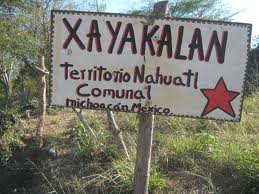
 Xayakalan
Coincidentally, since that day “groups of federal ministerial police and members from the public ministry, in a totally illegal way, have been threatening the comuneros that live in Xayakalan with evicting them.” For the indigenous it is “the continuation of the grave conditions of an undeclared war that Ostula has lived through precisely since it resolved to guard the lands of Xayakalan, on June 29, 2009.”
This February 10, a federal Army platoon attempted to disarm the community guard and the self-defense groups that were supporting them, but residents made the soldiers return the weapons. On February 13, more than 1200 comuneros in an assembly decided to formally reorganize the Community Police. Now, efforts are centered on strengthening community decision mechanisms, reconstructing the material base for their organization and survival —food and scarce resources— and on maintaining security within their territory. Despite the years of terror, they indicate to Ojarasca from Ostula, “the people respond to their ancestral organization.”
——————————————————–
Originally Published in Spanish by Ojarasca #203
La Jornada Supplement, March 2014
Translation: Chiapas Support Committee
En español: http://www.jornada.unam.mx/2014/03/08/oja-costa.html
Pronunciamiento de la RvsR por el asesinato de don Trinidad de la Cruz y contra la Guerra a Ostula
La noticia del asesinato de don Trinidad de la Cruz nos ha provocado indignación. Este asesinato se suma a la de otros compañeros de Santa María Ostula:
- Diego Ramírez Domínguez
- Simón Pineda Verdía
- Simón Pineda, hijo
- Quintín Regis Valdez
- Erick Nemesio Domínguez
- Froylán Medina Álvarez
- Demetrio Olivero Álvarez
- Humberto Santos Valladares
- Venancio Ramírez Cirino
- Manuel Flores Álvarez
- Miguel Ángel Flores Álvarez
- José Martínez Ramos
- Horacio Martínez Ramos
- Ernesto Nicolás López
- Pedro Nazario Domínguez
- Pedro Guzmán
- Isidro Mora Domínguez
- Feliciano Cirino Domínguez
- Fortino Verdía Gómez (quemado y después asesinado)
- Jonathan Verdía Gómez (quemado y después asesinado)
- Francisco Verdía Macías
- Ambrosio Verdía Macías
- Nicolás de la Cruz
- Nicolás de la Cruz, hijo
- Juan Faustino Nemesio
- Pedro Leyva
Además de las desapariciones de Gerardo Vera Orcino, Javier Martínez Robles, Francisco de Asís Manuel, Máximo Magno Valladares y Enrique Domínguez Macías, de 17 años de edad.
Tantos asesinatos, en apariencia, parecen no importar a las autoridades estatales de Michoacán o a las federales; pero es una falsa impresión ya que los promueven, los provocan y los mantienen impunes., y, por lo tanto, hay un sincero interés en continuar perpetrando crímenes contra este pueblo nahua.
Las razones son claras: detener los procesos de autonomía de la región, sin las plagas electoreras promovidas por el IFE, sin los intereses de ningún partido político (opuestos a los de cualquier ciudadano de este país), sin la rapiña gubernamental y sin la explotación del crimen organizado. Ahí está la feliz comunión entre las organizaciones criminales y los gobiernos locales y las instancias federales, enemigos del trabajo honesto, de la madurez política de los ciudadanos y de la libertad, y tan amigos de la ambición, la corrupción y el poder paternalista que somete.
El asesinato de don Trinidad ha demostrado esta complicidad ya conocida. Horas después de su desaparición forzada, se difundió la denuncia firmada por la Campaña: Alto a la Guerra contra Ostula, y por organizaciones e individuos solidarios con Santa María Ostula. Esta denuncia nos narra cómo, sospechosamente, el vehículo de la Policía Federal Preventiva, que escoltaba a los integrantes de las Brigada de Observación a Ostula, se separó momentos antes de las agresiones contra los brigadistas y de la desaparición de don Trinidad. En la denuncia se identifica a tres de los agresores: Prisciliano Corona Sánchez, El Chalano, Iturbide Alejo, El Turbinas, y Margarita Pérez, La Usurpadora. Estos tres criminales, el 14 de noviembre de 2011, fueron los mismos que golpearon y amenazaron de muerte públicamente a don Trinidad. Las autoridades, con esta información, no hicieron nada. Con el asesinato de don Trinidad, la PGJE inició la averiguación previa 215/2011-U, en el que no se tiene el nombre de ningún sospechoso. La impunidad está presente. Autoridades y criminales son aliados.
Llamamos a manifestarnos contra este brutal asesinato, contra la Guerra que el gobierno federal, estatal de Michoacán y el crimen organizado ejecuta contra el pueblo de Santa María de Ostula; llamamos a presionar por la justicia, incluso, a que nosotros mismos investiguemos todos estos hechos que la mismas autoridades no les conviene realizar, ya que ellas mismas son cómplices, ydenunciémoslas públicamente; organicémonos contra la represión.
ALTO A LA GUERRA CONTRA OSTULA
Contra el despojo y la represión…
la solidaridad.
Red Contra la Represión y por la Solidaridad
RvsR

