News:

comunidades zapatistas

image/svg+xml image/svg+xml
radio
Red de Resistencia y Rebeldía Ajmaq

¡Manuel Gómez Vázquez Libre!

Sorry, this entry is only available in Español. For the sake of viewer convenience, the content is shown below in the alternative language. You may click the link to switch the active language.

radio
Tercios Compas

EZLN | Eleventh Part: In the meanwhile, in the mountains of the Mexican Southeast…

Produced by Los Tercios Compas. Mountains of the Mexican Southeast. Copyleft November 2023.
With a Little Help from My Friends, Lennon y McCartney. Version by Joe Cocker.

radio
FrayBa

(Español) Celebramos la libertad del compañero Manuel Gómez Vázquez, Base de Apoyo del EZLN

Sorry, this entry is only available in Español. For the sake of viewer convenience, the content is shown below in the alternative language. You may click the link to switch the active language.


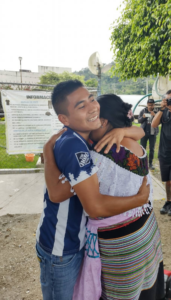
Manuel Gómez Vázquez es liberado después de 2 años, 11 meses y 7 días injustamente privado de su libertad.

El día de hoy se emitió sentencia absolutoria que ordenó la inmediata libertad para Manuel Gómez Vázquez, Base de Apoyo del #EZLN, al no comprobarse ninguna responsabilidad en la comisión del delito.

Agradecemos infinitamente la solidaridad de todas las personas, colectivos, organizaciones de derechos humanos que hicieron posible la libertad del compañero.

radio
FrayBa

(Español) Jornada de Acción. Agujas e hilos por la libertad

Sorry, this entry is only available in Español. For the sake of viewer convenience, the content is shown below in the alternative language. You may click the link to switch the active language.

Agujas e hilos por la libertad

Jornada de bordado en solidaridad con los presos políticos de Chiapas, víctimas de la fabricación de culpables y rehenes del Estado mexicano.

Convocamos a bordadorxs solidarios para exigir la libertad inmediata y sin condiciones de nuestros compañeros presos políticos.

Está actividad se realizará el domingo 19 de noviembre en la Plaza de la Resistencia, también conocida como la Plaza de la Cruz, de 12 pm a 3 pm. Les invitamos asistir para mandar mensajes de solidaridad y de exigencia con los presos por luchar. Es una actividad para todas las edades,  trae agujas e hilos para bordar, si no tienes aquí tendremos material.

Les recordamos que también ese día estaremos recaudando ropa de abrigo para nuestros compañeros presos políticos y sus hijxs. Ropa de abrigo de colores claros (no negro, ni azul marino, ni verde militar, pues son colores prohibidos en la cárcel), cobijas, además de cobijas; y ropa para infancias y adolescencias, de 3 a 15 años. Todo en buen estado y limpio.

¡Libertad inmediata para los 5 de San Juan Cancuc, Manuel Santiz Cruz, Agustín Pérez Domínguez, Juan Velasco Aguilar, Martín Pérez Domínguez y Agustín Pérez Velasco!

¡Libertad inmediata para Manuel Gómez Vázquez y José Díaz compañeros base de apoyo zapatista rehenes del Estado mexicano!

radio
EZLN

EZLN | Tenth Part: Regarding pyramids and their uses and customary regimes.

Tenth Part: Regarding pyramids and their uses and customary regimes.
Conclusions from the critical analysis of MAREZ and JBG.
(Fragment of the interview with Subcomandante Insurgente Moisés
during the months of August-September 2023,
in the mountains of Southeast Mexico)

November 2023.

Introduction. –

Who built Thebes of the 7 gates? In the books you will read
the names of kings. Did the kings haul up the lumps of rock?
And Babylon, many times demolished, who raised it up so many times?
In what houses of gold glittering Lima did its builders live? Where,
the evening that the Great Wall of China was finished, did the masons go? Great Rome
is full of triumphal arches. Who erected them?

Bertold Brecht.

Known is the obsession that dominant systems have, throughout their history, in rescuing the image of the defeated dominant classes or castes. As if in the winner inhabited the worry of neutralizing the image of the defeated: avoiding his fall. In the study of the remains of the defeated civilization or culture, emphasis is usually placed on the great palaces of the rulers, the religious buildings of the high hierarchy, and the statues or monuments that the dominant people of that time made of themselves.

Not always with genuine anthropological or archaeological interest (it is not the same thing), for example, are the pyramids studied. Its architectural-religious sense –sometimes also scientific–, and what tourist brochures (and political programs across the spectrum) call “the splendor of the past.”

It is natural that the different governments take notice and, not without longing sighs, concentrate on kings and queens. The great palaces and pyramids can be pointed out as references of the scientific advance of those times, of the social organization and of the causes «of its development and decline», but no ruler likes to see his future reflected in the past. That is why they twist past history and it is possible to reschedule foundations of cities, empires and “transformations». So, without realizing it, every selfie taken at archaeological sites hides more than what it shows. Up there, the winner of today will be the defeated of tomorrow.

But, if there are no mentions about these constructions having someone who designed them –their architects, engineers and artists–, there will be even lesser references to «the labor force», that is, to the men and women on whose backs (in more than a sense) were built the wonders that amaze tourists from all over the world, while they make time to go to the club, the mall and the beach.

From that point to ignoring that the descendants of that “labor force” remain alive and active, with language and culture, there is only one step. The natives who built, for example, the pyramids of Teotihuacán and the Mayan area in the Mexican southeast, exist (that is, resist) and, sometimes, they add to their resistance that subversive component that is rebellion.

In the case of Mexico, the different governments prefer the natives as living crafts and, sometimes, as choreography ad hoc. The current government does not represent any change in this (well, not only in that, but that is not the point). Native peoples continue to be objects of alms (that aspirin for scoundrels), electoral hauling, artisanal curiosity and a vanishing point for those who administer the ongoing destruction: “I am going to destroy your life, that is, your territory; but don’t worry, I’m going to preserve the pyramids of those who exploited your ancestors and those funny things you say, and dress and do.»

Having said this, this “image” of the pyramid –the narrow upper tip and the wide lower base–, is now used by Subcomandante Insurgente Moisés to explain to us something of what was the analysis (ferocious and implacable, in my opinion) of the work of the MAREZ and Good Government Juntas.

The Captain

Some history, not much, just 30 years

The MAREZ and Good Government Juntas were not all bad. We must remember how we got to them. For the Zapatista towns they were like a school of political literacy. A self-literacy.

Most of us did not know how to read, write, or speak Spanish. Furthermore, we spoke different languages. That was good, because then our idea and our practice did not come from outside, but rather we had to search in our heads, in our history as indigenous people, in our own way.

We had never had the opportunity to govern ourselves. We were always governed. Even before the Spanish, the Aztec empire, which the current government loves very much –I think because they like bossy people— oppressed many languages ​​and cultures. Not only in what is now Mexico, also in what is now Central America.

The situation we were in was one of death and despair. They closed everything to us. There were no doors, no windows, no cracks. As if they wanted us to drown. So, as they say, we had to open a crack in that wall that enclosed us and condemned us. As if everything were darkness and with our blood we lit a little light. That was the Zapatista uprising, a little light in the darkest night.

Then it came that many people asked for a ceasefire, that we had to talk. The citizens already know about that. The same thing had happened to many of them as to us, that bad governments never fulfilled their word. And they do not comply because governments are the main oppressors. So we had to choose if we hope and wait that one day they comply, or if we look for a solution on our own. And we chose to find our way.

And well, you had to organize for that. We had organized and prepared for 10 years to take up arms, to die and kill. And then it turns out that we had to organize ourselves to live. And living is freedom. And justice. And to be able to govern ourselves as people, not as little children which is the way governments see us.

That’s where it got into our heads that we have to make a government that obeys. In other words, that it did not do as it pleased, but rather, did what the people say. In other words, “command by obeying”, which are the words that today’s scoundrels plagiarize (in other words, they do not only plagiarize theses. Editorial note).

So with the autonomous municipalities we learned that we can govern ourselves. And that was possible because many people supported us, without any interests, to find the path of life. In other words, those people did not come to see what they could get –like those that I imagine you are going to tell outsiders when you talk about 30 years—, but rather they really committed themselves to a life project. And there were those who wanted to tell us how we should do it. But we did not take up arms to change the boss. There is no good boss. But there were other people who did respect our thoughts, our way.

The value of the word.

When we obtain that support, it is like a commitment that we make. If we say that we need support to create schools and clinics, to prepare health and education promoters, to give an example, then we have to comply. In other words, we cannot say that it is for one thing and use it for another. We had then and have now to be honest, because these people do not come to exploit us, but to encourage us. That’s how we saw it.

So we have to put up with the attacks and the bullshit from the bad governments, from the landowners, from the big companies, who are trying hard to test us to see if we can endure it or it is easy for us to fall into a provocation so they are able to accuse us of telling lies, that we also want power and pay. And the thing about power is that it is like a disease that kills good ideas and corrupts, that is, it makes people sick. And there you have a person who seems like a good person, well, with power, he goes crazy. Or maybe he was already crazy and power sort of stripped naked his heart.

So we think that we need to organize, for example, our health. Because of course we saw and see that what the government does is a big lie that is only to steal and does not care that people die, especially if they are indigenous.

And it happened that, when we make that crack in the system and look out, we see many things. But also many people see us. And among those people, there are those who looked at us and took the risk of helping and supporting us. Because what if we are liars and don’t do what we say? But hey, they took a risk and they committed us.

Look, out there, in the cities, giving your word is no good. They can say one thing in one moment, and a minute later they say the opposite and is as if nothing had happened, all is calm. There is, for example, what they call “mañanera”, that one day they say one thing and another day the opposite. But, as it pays, they applaud him and are happy because he gives them alms that do not even come from his work, but from what working people give to governments with taxes, which are like the “cobro de piso” of disorganized crime.

So those people support us and we start little by little with preventive medicine. Since we had already recovered the lands, we improved our diet, but more was needed. So, health. We must recover herbal knowledge, but it is not enough, science is also needed. And thanks to doctors, that we call “fraternities” because they are like our brothers, who got on board and guided us. So the first Health trainers were born or formed, that is, those who prepare the promoters.

And also education, especially Castilian. Because for us Spanish is very important because it is like the bridge through which we can communicate and understand each other between different languages. For example, if you speak Tzeltal, you are going to struggle to communicate with the Cho’ol language, or Tzotzil, or Tojolabal, or Zoque, or Mame, or Quiché. So, you have to learn Spanish. And autonomous schools are very important for that. For example, our generation speaks combined tongue and Spanish, that is, not all well, that is, we speak crooked. But there are already generations of young people, who learned in autonomous schools, who know Castilian better than some citizens. The late SupMarcos said that these young people could correct the writings of university students. And you know that, before, to make a complaint, you had to go to the Command to write it. But then not anymore. In each autonomous authority there was one writer, and well, it worked.

Then it is like one advancement kind of pushes another. And soon after, these young people want more, to learn more. So we organize our health in each town, each region and zone. We are advancing in each area of ​​health, midwives, medicinal plants, bones, laboratories, dentists, ultrasound, among other areas, there are clinics. And the same in school, that is, education. We say school, because we adults also lack education, it is very broad for us, education, and not just children and adolescents.

Furthermore, we organized productive work because we already had land, which was previously in the hands of landowners. And so we work as a family and as a collective in the cornfield, the bean fields, the coffee fields, vegetables, and farms. And some livestock, which is used more for economic emergencies and for holidays. The collective work allowed the economic independence of women comrades and that brought many more things. But they have already talked about that.

A school.

In other words, we learned to govern ourselves and thus we were able to put aside bad governments and organizations that say they are leftist, progressive and I don’t know what else. 30 years learning what it means to be autonomous, that is, we direct ourselves, we govern ourselves. And it has not been easy, because all the governments that have passed from PRI, PAN, PRD, PT, VERDE and MORENA, their desire to destroy us does not end. For this reason, just as in past governments, in this one they say that we have already disappeared, or that we have already fled, or that we are already very defeated, or that there is no longer any Zapatista, that we went to the United States or Guatemala. But you see, well here we are. In resistance and rebellion.

And the most important thing we learned in the MAREZ is that autonomy is not about theory, about writing books and making speeches. It is something that needs to be done. And we have to do it as towns, and not wait for someone to come and do it for us.

All of this is, let’s say, the good thing about MAREZ: a school of practical autonomy.

And the Good Government Juntas were also very important because with them we learned to exchange ideas about struggles with other brothers from Mexico and the world, where we saw it right we took it and where we saw it was not, we discarded it. Some tell us that we have to obey just as they say. Where is that going to happen? If we put our lives at stake. In other words, that is what we are worth: our blood and that of generations that came before and those to come. We are not here for anyone to come and tell us what we are going to do, even if they say that they are very knowledgeable. With the JBG we learned to meet and organize, to think, to give an opinion, to propose, to discuss, to study, to analyze and to decide for ourselves.

So, as a summary, I tell you that the MAREZ and JBG helped us learn that theory without practice is pure words. And practice without theory, well it is as if you walked like a blind man. And since there is no theory of what we started to do, that is, there is no manual or book, then we have also had to make our own theory. We stumbled through theory and practice. I think that’s why the theorists and the revolutionary vanguards don’t like us very much, because we didn’t just take away their jobs. We also showed them that talking is one thing and reality is another. And here we are, the ignorant and backwards, as they call us, the ones who cannot find the way because we are peasants. But here we are and even if they deny us, we exist. Too bad.

The Pyramid.

Well, now it’s time for the bad things. Or rather not bad, but it proved that it will no longer be useful for what is to come. In addition to the inherent flaws. As you tell me, we will talk later about how all of this started, about how it got into our heads, we’ll see it later.

The main problem is the damn pyramid. The pyramid separated the authorities from the towns, they distanced themselves between towns and authorities. The proposals from authorities did not go down as they were to the people, nor do the opinions of the people reach the authorities.

Because of the pyramid, a lot of information is cut, the guidelines, suggestions, support of ideas that the CCRI comrades explain. The Good Government Junta does not fully transmit and the same thing happens when things are explained to the Authorities of the Zapatista Rebel Autonomous Municipalities, the same again is repeated when the MAREZ inform the assemblies of authorities of towns, and finally this is what happens with the authorities of the towns when they explain to each town. Many cuts of information or interpretations, or additions that were not there originally.

And many efforts were also made in the training of authorities and every 3 years new ones leave and enter. And the main base of village authorities is not being prepared. In other words, no relays were formed. “Government collective” we said and it was not fully fulfilled, the work was rarely done this way and the greater part what not fulfilled, both in MAREZ and in the JBG.

It was already falling into wanting to decide themselves, the authorities, the tasks and the decisions, as in MAREZ and JBG. They wanted to leave aside the 7 principles of commanding by obeying.

There were also NGOs, who forcefully want the projects that they had in the JBG and the MAREZ to be accepted and they are not what the people needed. And people who visited remain friends of a family or a town and they only sent some help to them. And some visitors outright wanted to direct us and treat us like their waiters. And so with great kindness we had to remind them that we are Zapatistas.

And there was also, in some MAREZ and JBG, poor administration of people’s resources, and, of course, they were sanctioned.

In other words, in summary, it was seen that the structure of how we were governed, as a pyramid, was not the way. It’s not from below, it’s from above.

If Zapatismo were only the EZLN, it is easy to give orders. But the government must be civil, not military. Then the people have to find their way, their way and their time. Where and when to do what. The military should be only for defense. Pyramid may be useful for military purposes, but not for civilian purposes. That’s what we see.

On another occasion we will tell what the situation is here in Chiapas. But now we just say that it is like anywhere else. It is worse than last years. Now they kill them in their homes, in their streets, in their towns. And there is no government that sees and listens to the demands of the people. And they don’t do anything because they themselves are the criminals.

Not only that. We have already said that we see many misfortunes that are going to arrive or that are already here. If you see that it is going to rain or that the first drops are already falling and the sky is black as a politician’s soul, then you take out your nylon and look for where you are going to go. The problem is that there is nowhere to protect yourself. You have to build your own shelter.

The thing is that we saw that with MAREZ and JBG we will not be able to face the storm. We need the Deni to grow and live and for all the other seven generations to be born and live.

-For all this and the rest, we entered into a great series of reflections and came to the conclusion that we only have left a great discussion of all the towns and analysis, of how to face the new and bad situation and at the same time how we are going to continue to govern us. Meetings and assemblies were held, area by area, until an agreement was reached that there would no longer be Good Government Juntas or Zapatista Rebel Autonomous Municipalities. And that we need a new structure, that is, to accommodate ourselves in another way.

Of course, this proposal is not just about reorganizing. It is also a new initiative. A new challenge. But I think that’s what we’ll say later.

So in general, without much fuss, then, the MAREZ and JBG were very useful at that stage. But another step follows and those clothes are already too short for us, and they break and even though you mend them, it’s for nothing. Because there will come a time when you’re left with pure rags.

So what we did is cut the pyramid. So we cut it from the tip. Or rather, we turned it upside down.

Do we celebrate the past or the future?

We have to keep walking and in the middle of the storm. But we as towns are already used to walking with everything against us.

This coming December and January, we do not celebrate the 30 years of the uprising. For us every day is a celebration, because we are alive and fighting.

We will celebrate that we began a path that will take us at least 120 years, maybe more. We’ve been rolling for more than 500 years, so it won’t be long, just over a century. And that is no longer so far away. It is, as José Alfredo Jiménez says, “just there behind the mound.”

From the mountains of the Mexican Southeast.
Subcommander Insurgent Moisés.

(Fragment of the interview conducted by Captain Marcos, for the Tercios Compas. Copyleft Mexico, November 2023. Authorization of the JBG… ah wow, if there are no more Juntas… well, of the MAREZ… well, neither… Well, the thing is that it is authorized. The interview was conducted the old-fashioned way, that is, like reporters used to do, with a notebook and pen. Now they don’t even go to the place to look for the note, they take it from social networks. Yes, a shame, my man).

I attest.

The Captain, practicing the cumbia “Sopa de caracol”. Dance! No matter there’s mud!


radio
Subcomandante Insurgente Moisés

EZLN | Ninth Part: The new structure of Zapastista Autonomy

Ninth Part: The new structure of Zapastista Autonomy

November 2023

Brothers, sisters, comrades:

I am going to try to explain to you how we reorganized the autonomy, that is, the new structure of the Zapatista autonomy. I will explain more to you later in more detail. Or maybe I won’t explain more, because practice is what matters. Of course you can also come to the anniversary and watch the plays, songs, poems and the art and culture of this new stage of our struggle. If not, Tercios Compas will send you photos and videos. At another time I will tell you what we saw good and bad in the critical evaluation of MAREZ and JBG. Now I’ll just tell you how it looks. Here it goes:

First: The main base, which is not only where autonomy is sustained, also without which the other structures cannot function, is the Local Autonomous Government, LAG [GAL for its acronym in Spanish]. There is a GAL in each community where Zapatista support bases live. The Zapatista GALs are the core of all autonomy. They are coordinated by autonomous agents and commissioners and are subject to the assembly of the town, ranchería, community, area, neighborhood, ejido, colony, or however each population calls itself. Each GAL controls its autonomous organizational resources (such as schools and clinics) and the relationship with neighboring non-Zapatista brother towns. And controls the proper use of the pay. It also detects and reports mismanagement, corruption and errors that may exist. And is attentive to those who want to pass themselves off as Zapatista authorities to ask for support or aid that they use for their own benefit.

So, if before there were a few dozen MAREZ, that is, Zapatista Rebel Autonomous Municipalities, now there are thousands of Zapatista GALs.

Second. – According to their needs, problems and advances, various GALs are convened into Collectives of Zapatista Autonomous Government, ZAG [CGAZ for its acronym in Spanish], and here discussions are held and agreements are made on matters that interest the convening GALs. When they so determine, the Collective of Autonomous Governments calls an assembly of the authorities of each community. Here the plans and needs of Health, Education, Agroecology, Justice, Commerce, and those that are needed are proposed, discussed and approved or rejected. The coordinators of each area are at the CGAZ level. They are not authorities. Their job is to ensure that the work requested by the GAL or that are deemed necessary for community life. Such as, for example: preventive medicine and vaccination campaigns, campaigns for endemic diseases, courses and specialized training (such as laboratory technicians, x rays, ultrasound, mammograms and those that we learn on the way), literacy and higher levels, sporting and cultural events, traditional festivities, etc. Each region or CGAZ has its directors, who are the ones who summon assemblies if there is an urgent problem or one that affects several communities.

That is to say, where before there were 12 Good Government ‘Juntas’, now there will be hundreds.

Third. – Next, the Assemblies of Collectives of ZAPATISTA Autonomous Governments, ACZAG [ACGAZ for its acronym in Spanish]. Which are what were previously known as zones. But they have no authority, and depend on the CGAZ. And the CGAZ depend on the GAL. The ACGAZ convenes and presides over zone assemblies, when necessary according to the requests of GAL and CGAZ. They are based in the caracoles, but move between regions. In other words, they are mobile, according to the towns demands for attention.

Fourth. – As will be seen in practice, the Command and Coordination of Autonomy has been transferred from the JBG and MAREZ to the towns and communities, to the GAL. The zones (ACGAZ) and the regions (CGAZ) are governed by the towns, they must be accountable to the towns and must find a way to meet their needs in Health, Education, Justice, Food and those that arise due to emergencies caused by natural disasters, pandemics, crimes, invasions, wars, and the other misfortunes that the capitalist system brings.

Fifth. – The structure and disposition of the EZLN has been reorganized in order to increase the defense and security of towns and mother earth in the event of aggressions, attacks, epidemics, invasion of companies that prey on nature, partial or total military occupations, natural catastrophes and nuclear wars. We have prepared so that our towns survive, even isolated from each other.

Sixth. – We understand that you may have problems assimilating this. And that, for a while, you will struggle to understand it. It took us 10 years to think about it, and of those 10 years, 3 to prepare it for its practice.

We also understand that it seems to you that your thinking is scrambled. That is why it is necessary to change your channel of understanding. Only by looking far away, backwards and forwards, can the present step be understood.

We hope you understand that it is a new structure of autonomy, that we are just learning and that it will take a while to get going well.

In reality, this statement has only the intention of telling you that Zapatista autonomy continues and advances, that we think it will be better for the towns, communities, places, neighborhoods, colonies, ejidos and rancherías where they live, that is, the bases of Zapatista support. And that it has been their decision, taking into account their ideas and proposals, their criticisms and self-criticisms.

Also, as will be seen, this new stage of autonomy is made to confront the worst of the Hydra, its most infamous bestiality and its destructive madness. Their wars and business and military invasions.

For us, there are no borders or distant geographies. Everything that happens in any corner of the planet affects us and concerns us, worries us and hurts us. To the extent of our very small strength, we will support human beings in distress regardless of their color, race, nationality, belief, ideology and language. Although we do not know many languages ​​or understand many cultures and ways, we know how to understand the suffering, pain, sorrow, and proud rage that the system provokes.

We know how to read and listen to brother hearts. We will continue trying to learn from them, their stories and their struggles. Not only because we have suffered from this for centuries and we know what it is like. Also, and above all because, as for 30 years, our fight is for life.

Surely we have made many mistakes in all these years. We will surely do more in the next 120 years. But we will NOT give up, we will NOT change path, we will NOT sell out. We will always be reviewing our struggle, its times and ways with a critical eye.

Our eyes, our ears, our heads and our hearts will always be ready to learn from others who, although different in many things, have our same concerns and similar desires for democracy, freedom and justice.

And we will always seek the best for our people and for our sister communities.

We are, therefore, Zapatistas.

As long as there is at least one man, one woman, one ‘otroa’ Zapatista in any corner of the planet, we will resist in rebellion, that is, we will fight.

See it for yourselves, friends and enemies. And those who are neither one thing nor another.

That is it, for now.

From the mountains of the mexican southeast.

Insurgent Subcommander Moisés.

Mexico, November 2023.

More than 500, 40, 30, 20, 10 years later.

P.S.- Here I leave you a drawing to see if you understand it a little.


radio
Subcomandante Insurgente Moisés

EZLN | Fourth Part and First Approach Alert. Several Necessary Deaths.

Fourth Part and First Approach Alert.
Several Necessary Deaths.
November 2023

To the people who subscribe the Declaration for Life:

We inform you of the following:

FIRST. – A few months ago, after a long and profound critical and self-critical analysis, and after consulting all the Zapatista towns, it was decided to disappear the Zapatista Rebel Autonomous Municipalities (MAREZ) and the Good Government Juntas.

SECOND. – All seals, letterheads, positions, representations and agreements with the name of any MAREZ or any of the Good Government Juntas are invalid from this moment on. No person can present themselves as a member, authority or representative of any MAREZ or Good Government Junta. The agreements held before this date, with Non-Governmental Organizations, social organizations, collectives, solidarity groups and instances in Mexico and the world are maintained until their expiration, but new agreements cannot be made with these bodies of Zapatista autonomy, for the simple reason that they no longer exist.

THIRD. – The Caracoles remain, but they will remain closed to the outside world until further notice.

FOURTH. – We will tell you the reasons and process by which this decision was made little by little in the following texts. I can only tell you that this evaluation, in its final phase, began about 3 years ago. We will also explain to you what the new structure of Zapatista autonomy is like and how it has been developing.

All that, and more things, will appear at the right time.

FIFTH. – We inform you that we will hold a celebration to mark the 30th anniversary of the beginning of the war against oblivion. This, in the months of December 2023 and January 2024. All people who signed the “Declaration for Life” are invited.

However, it is our duty, while inviting you, to discourage you. Contrary to what the official press, self-proclaimed cool-progre-chill, reports and misinforms, the main cities of the southeastern Mexican state of Chiapas are in complete chaos. The municipal presidencies are occupied by what we call “legal hitmen” or “Disorganized Crime.” There are blockades, assaults, kidnappings, “cobro de piso”, forced recruitment, shootings. This is the effect of the protection of the state government and the dispute over the political charges that is in process. What is being confronted are not political proposals, but rather criminal societies.

So, of course we tell you that, unlike other years, it is not safe.

San Cristóbal de las Casas, Comitán, Las Margaritas and Palenque, to mention some municipal seats, are in the hands of one of the disorganized crime cartels and in dispute with another. This is confirmed by the so-called hotel, tourism, restaurant and service industries. Those who work in these places know this and have not reported it because they are threatened and, furthermore, because they know that any request is useless, because the state and municipal authorities are the ones who commit crimes and know no limit in the robbery they are doing.

In rural communities the problem is even more serious. This is what is being shouted by those who live in all the regions of Chiapas, particularly in the entire border strip with Guatemala.

What is read, heard and seen in the majority of local and national media is just a bad and shameless echo of the state government’s social networks. The truth is that the official authorities are the problem. Yes, like in the rest of the country.

Federal, state and local military and police forces are not in Chiapas to protect the civilian population. They have the sole purpose of stopping migration. That is the order that came from the North American government. As is their way, they have turned migration into a business. Human trafficking is a business of the authorities who, through extortion, kidnapping and buying and selling of migrants, shamelessly enrich themselves.

So, we do not advise you to come. Unless, of course, you organize yourselves very well to do so.

So, although we are not waiting for you, we are inviting you. The tentative dates of the commemorations are between December 23, 2023 and January 7, 2024, the central celebration being December 30-31 and January 1-2. We will tell you the place afterwards. That is to say, we do want you to come, although we don’t recommend it.

Even if you don’t arrive, don’t worry. We will still send you photos and videos.

Well, that is if there still is a world in those dates, anyway.

See it for yourselves.

From the Mountains of the Mexican Southeast
Subcomandante Insurgente Moisés
Mexico, November 2023.

radio
Capitán Insurgente Marcos

EZLN – Second Part: Do the Dead Sneeze?

Second Part: Do dead people sneeze?

October 2023

SupGaleano died. He died just as he lived: unhappily.

Of course, he took care, before passing away, of returning the name to the one who is flesh and blood inherited from Master Galeano. He recommended keeping him alive, that is to say, fighting. So Galeano will continue walking in these mountains.

In all other regards, it was something simple. He started humming something like “I know I’m piantao, piantao, piantao”, and, just before he expired, he said, or rather asked: “Do dead people sneeze?”, and that’s it. Those were his last words. No sentence for history, nor for a tombstone, nor for an anecdote told in front of a fire. Only that absurd, anachronistic, extemporaneous question: “Do the dead sneeze?”

He then remained still, his tired breathing suspended, his eyes closed, his lips finally silenced, his hands clenched.

We left. Almost as we left the ‘champa’, already at the doorway, we heard a sneeze. SubMoy turned to look at me and I at him, with a barely hinted “bless you.” None of us had sneezed. We turned back to see where the deceased’s body lay and nothing. SubMoy just said “good question.” I didn’t say a word, but I thought «he must surely be hanging with the moon walking down Callao.»

Then of course, we spared the funeral. Although we lost the opportunity for coffee and tamales.

-*-

I know that no one is interested in another death, and least of all that of the now deceased SupGaleano. In truth, I tell you this because he left that poem by Rubén Darío with which he began this series of texts. If we ignore the obvious hint to the Nicaragua that resists and persists – it could even be seen as a reference to the current war of the State of Israel against the people of Palestine, but, at the time of his death, the terror that overwhelms the world today had not restarted-, he left that poetry as a reference. More as a response to someone who asked how to explain what is happening now in Chiapas, Mexico and the world.

And, of course, as a discreet tribute to maestro Galeano –from whom he inherited the name-, he left what he called a “reading report”:

Who started it? Who is to blame? Who is innocent? Who is the god guy and who is the bad guy? In what position is Francis of Assisi? Who failed: him, the wolf, the shepherds or all of them? Why does the man from Assisi can only conceive making an agreement based on the wolf giving up being what he is?

Even though this happened months ago, the text sparked allegations and discussions that continue to this day. So, I will describe one of them:

It is a kind of meeting or assembly or some sort of roundtable. The best of each house is there: learned specialists in everything, militants and internationalists of all causes except of those in their own geography, spontaneous people with a PhD in social networks (the majority), and one or two who, upon seeing the noise, approached to see whether they were giving away buckets, caps or t-shirts with the name of whatever political party it was. There were quite a few who came near to find out what all the fuss was about.

“You are nothing more than an agent of expansionist and imperial Zionism!,” shouted one.

“And you are just a propagandist of fundamentalist Arab Muslim terrorism!,” responded another, furiously.

There had already been several outbreaks of quarrel, but it had not yet gone beyond a “meet you outside” kind of pushing and shoving.

That point was reached because they were analyzing Rubén Darío’s poem “Los Motivos del Lobo”.

Not everything had been an exchange of adjectives, jabs and bad faces. It started like everything else in those parts: with good manners, forceful phrases, “brief interventions” – which usually lasted half an hour or more –, and a great deal of quotes and footnotes.

Purely male, of course, because the debate was organized by the so-called “Toby’s Hipertextual Club”

“The Wolf is the good guy,” someone said, “because he only killed out of hunger, out of necessity.”

“No,” argued another, “he is evil because he killed sheep, which were the shepherds’ sustenance. And he himself admitted that “sometimes he ate lamb and shepherd.”

And another: “the bad guys are the people from the village, because they didn’t fulfill the agreement.”

One sitting over there: «it’s Assisi’s fault, who gets the agreement by asking the wolf to stop being a wolf, which is questionable, and then doesn’t stay to hold the pact.»

And one sitting over here: “But Assisi points out that human beings are bad by nature.”

They reaffirm themselves on both sides. But it turns out that, if a poll were taken right now, the wolf would have a comfortable double-digit lead over the shepherd village. But a clever maneuver on social networks managed to get the hashtag “killer wolf” to be TT far above #deathtotheshpherds. So, the triumph of the pro-shepherd influencers over the pro-wolf influencers was clear, although only on social networks.

There were some who argued in favor of two States coexisting in the same territory: the Wolf State and the Shepherd State.

And some others for a Plurinational State, with wolves and shepherds, living under the same oppressor, sorry, I meant under the same State. Another responded that this was impossible, given the background of each party.

A man in a suit and tie stands up and asks to speak: “If Ruben (he said this, ignoring the Darío bit), followed the legend of Gubbio, then we can do the same. Let’s continue the poem:

The shepherds, using their legitimate right to defend themselves, attack the wolf. First by destroying his burrow with bombings, and then by entering with tanks and infantry. It seems to me, colleagues, that the end is set: the terrorist and animal violence of the wolf is annihilated and the shepherds can continue their bucolic life, shearing sheep for a powerful transnational corporation that makes clothing for another equally powerful multinational corporation that, in turn , owes an even more powerful international financial institution; which will lead the shepherds to become efficient workers on their own lands – yes, with all the legal labor benefits -, and will elevate that village to first world levels, with modern highways, tall buildings and even a tourist train where Visitors from all over the world will be able to appreciate the ruins of what once were meadows, forests and springs. The annihilation of the wolf will bring peace and prosperity to the region. Sure, some animals will die, no matter the number nor the species, but they are just perfectly forgettable collateral damages. After all, bombs cannot be asked to distinguish between a wolf and a sheep, nor to limit their blast wave so as not to damage birds and trees. Peace will be achieved and no one will miss the wolf.”

Someone else stands up and points out: “But the wolf has international support and inhabited that place in advance. The system cut down trees for pasture fields, and that altered the ecological balance, reducing the number and species of animals that the wolf consumed to live. And it is to be expected that the descendants of the wolf will take fair revenge.”

“Ah, so the wolf also killed other beings. “He’s just like the shepherds,” someone replies.

Thus, they continued, giving as good arguments as those indicated here, full of wit, a wealth of erudition and many bibliographical references.

But the restraint did not last long: it went from wolf and shepherds to the Netanyahu – Hamas war and the discussion escalated until it reached what heads this anecdote, postmortem courtesy of the now deceased SupGaleano.

But at that moment, at the back of the room, a small hand was raised asking to speak. The moderator couldn’t see whose hand it was, so he gave the floor «to the person who is raising his hand back there.»

Everyone turned to look and was about to shout out in scandal and disapproval. It was a girl who was carrying a teddy bear, almost equal to her in size, and she was wearing a white blouse with embroidery and pants with a kitten near her right ankle. Anyways, the classic “outfit” for a birthday party or something like that.

The surprise was such that everyone remained silent and kept their eyes on the girl.

She stood up on the chair, thinking that this way they would hear her better and asked:

“What about the kids?”

The surprise then turned into a condemning murmur: “Which kids? What is this girl talking about? Who the hell let a woman enter this sacred precinct? And worse, she is a girl-woman!”

The girl got down from the chair and, always carrying her teddy bear with clear signs of obesity – the bear, of course -, headed to the exit door saying:

«The kids. That is, the pups of the wolf and the pups of the shepherds. Their little babies, ‘pues’. Who thinks about the kids? Who am I going to talk to? And where are we going to play?”

From the mountains of the Mexican southeast.

Captain Insurgent Marcos.

Mexico, October, 2023.

P.S.- Unconditional freedom for Manuel Gómez Vázquez (taken hostage since 2020 by the state government of Chiapas) and José Díaz Gómez (hostage since last year), indigenous Zapatista bases imprisoned for that reason, for being Zapatistas. Afterwards, don’t ask who sowed what you reap.

P.S.- OTIS Hurricane: Collection center for indigenous peoples in the state of Guerrero: at the address of the “Casa de los pueblos ‘Samir Flores Soberanes’”, located at Av. México-Coyoacán 343, colonia Xoco, Alcaldía Benito Juárez, Ciudad de México, C.P. 03330. Deposits and bank transfers in support of these towns and communities in the account number 0113643034, CLABE 012540001136430347, SWIFT code BCMRMXMMPYM, BBVA bank in Mexico, branch 1769. In the name of: “Ciencia Social al Servicio de los Pueblos Originarios”. Phone number: 5526907936.


radio
Red de Resistencias y Rebeldias AJMAQ

(Español) Exigimos la libertad inmediata de Manuel Gómez Vázquez

Sorry, this entry is only available in Español. For the sake of viewer convenience, the content is shown below in the alternative language. You may click the link to switch the active language.

Al Congreso Nacional Indígena
A la Sexta nacional e internacional
A las Redes de Resistencias y Rebeldías
A las personas que siembran Dignidad y Organización

Compañerxs, como sabrán estos últimos años la guerra contra los pueblos del EZLN se ha profundizado. La represión por parte del mal gobierno y sus instituciones criminales tiene preso injustamente desde hace 2 años y 10 meses a nuestro compañero Base de Apoyo Zapatista Manuel Gómez Vázquez en la cárcel número 16 de Ocosingo, Chiapas.

Nuestro compañero es un joven maya tseltal de 23 años, quien fue detenido el 04 de diciembre del 2020 por autoridades oficiales y falsamente acusado de un delito que no cometió, fue torturado por estas y después procesado penalmente bajo la intervención y complicidad de la Fiscalía de Justicia Indígena quien participó en la prolongación de su detención, desaparición forzada y fabricación de pruebas en su contra[1].

Cabe subrayar que en tres ocasiones se ha suspendido la audiencia de juicio oral que daría pie a que su proceso penal se diera en forma, sin embargo, no ha sucedido, dilatando el proceso 1 año y 2 meses (septiembre 2022- noviembre 2023) y violando el derecho humano a la libertad. El próximo 14 de noviembre está fechada por cuarta ocasión lo que sería su primera audiencia.

Las abajo firmantes hemos decidido hacer una campaña de 21 días para exigir al mal gobierno la libertad de nuestro compañero Manuel. Esta campaña estará integrada por varias iniciativas para que cada una de ustedes, ya sea de manera colectiva o individual, se involucren desde sus geografías.

Compas esto aún no ha acabado, terminará hasta que veamos a nuestro compañero Manuel en libertad y con su familia. Desde esta semana hasta el día 14 de noviembre, día de la audiencia, daremos difusión masiva de su caso y un llamado a actividades para exigir su libertad.

En ese sentido hacemos un llamado para que nos sumemos organizadamente a la visibilización y denuncia para exigirle al mal gobierno su libertad.

Manuel, su familia y los pueblos zapatistas  no están solxs.

¡Libertad para Manuel Gómez Vázquez!

¡Justicia y Libertad!

¡Libertad a los presos políticos zapatistas!

Adhieren:
Red de Resistencias y Rebeldias AJMAQ
Raíces en Resistenccia -Cd de México y San Diego California
Red en Rsistencia Tlalpan
Subaltern Voices, Org.
Colectivx Zapatista “La Oveja Roja” Michoacán
Red Morelense de Apoyo al CNI-CIG/Nuestra Alegre Rebeldía
IUS Cohen Fundation
Colectivo de artistas TITERENETAS
Colectivo Resistrenzas, Puebla
Vendaval, cooperativa panadera y algo más
Red de Apoyo Iztapalapa Sexta (RAIS)
Colectivo de Trabajo los Cafetos
Colectivo de profesores de la sexta
Comunidad Tlanezicalli
Comunidad de Xochitlanezi
Coelctivo Gavilanas
Colectivo Cuaderno Común
Brújula Roja
Colectivo la Otra Justicia
Grupo de Trabajo No Estamos Todxs
Espacio de Lucha contra el olvido y la Represión (Elcor/Chiapas)

Adhesiones individuales

Raúl Zibechi (Uruguay)
Vilma Almendra (Colombia)
Manuel Rozental (Colombia )
Diego Osorno (México)
John Gilber (México/EEUU)
Diana Itzu Luna (México)
Margara Millán (México)
Carlos Sosa (México)
María Secco (México)
Carolina Coppel (México)
Tania Regalado (México)
Julio González (México)

[1] Libertad para Manuel Gómez Vázquez, Base de Apoyo Zapatista https://frayba.org.mx/libertad-para-manuel-gomez-vazquez-base-de-apoyo-zapatista

Para adherir más firmas: ajmaq_chiapas@riseup.net
Materiales de la campaña: https://redajmaq.org/manuelgomez

radio
Espacio de Coordinación Nacional ¡Alto a la Guerra contra los pueblos zapatistas!

(Español) Pronunciamiento del Espacio de Coordinación Nacional ¡Alto a la Guerra contra los pueblos zapatistas!

Sorry, this entry is only available in Español. For the sake of viewer convenience, the content is shown below in the alternative language. You may click the link to switch the active language.

Al Ejército Zapatista de Liberación Nacional y al Congreso Nacional Indígena
A los pueblos de México y el mundo,
A las personas, colectividades y pueblos que defienden la Vida

El 12 de octubre de 1492 una nueva historia comenzó a escribirse: la Historia de la Dignidad Indígena. La fuerza y determinación de los pueblos originarios, aquella cultivada por más de 531 años, adquiere hoy nuevos sentidos: la resistencia anticolonial de los más primeros, la defensa de sus territorios y modos de habitar el mundo, son fuente de conocimiento e inspiración en la lucha contra el capitalismo depredador y ecocida.

En toda América, la historia de las luchas por la libertad y la justicia están marcadas por las resistencias de los pueblos indígenas. En México, resistieron a la guerra de conquista, fortalecieron a los ejércitos populares en la guerra de Independencia, lucharon contra el imperialismo norteamericano y sus intentos expansionistas, fueron parte de la resistencia contra el imperio francés, contra la dictadura porfirista y tuvieron un papel fundamental en la guerra de Revolución en los ejércitos encabezados por Villa y Zapata. Durante el régimen priísta, los pueblos originarios nutrieron a los ejércitos populares y de liberación nacional. Con el alzamiento del Ejército Zapatista de Liberación Nacional, el 1 de enero de 1994, y la formación del Congreso Nacional Indígena, el 12 de octubre de 1996, los pueblos indígenas pasaron a la ofensiva contra la integración neoliberal y su acelerado despojo. Y como en el pasado, los pueblos indígenas resisten hoy al neodesarrollismo que intenta disfrazar el despojo de bienestar.

En los espejos de la realidad de la guerra que enfrentan quienes ancestralmente cuidan y defienden la madre tierra frente al despojo y la explotación capitalista y patriarcal; en los espejos del desprecio por sostener la dignidad de existir siendo quiénes son contra los intentos coloniales de exterminio; en los espejos de la persecución política, la desaparición, la cárcel y el asesinato por luchar, organizarse, resistir y cuidar la Vida. En esos espejos se refleja la guerra capitalista contra la naturaleza y la Vida, una guerra que hoy llena de sangre todo el territorio nacional y mundial.

La dimensión histórica del desafío de los pueblos zapatistas y del Congreso Nacional Indígena puede apreciarse en el sentido mismo de la Acción Global que estos días se realiza en más de 50 lugares del mundo: hacer frente a la guerra contra los pueblos de México y del Mundo. Exigir alto a la guerra contra las comunidades zapatistas y los pueblos del CNI. Luchar y organizarnos contra el avance de la militarización en México. Organizarnos para detener el avance y apertura de megaproyectos como el mal llamado Tren Maya, el Proyecto Integral Morelos, o el Corredor Transístmico. Defender el agua, la diversidad, la comunidad, la tierra, la vida digna.

A unos meses de que un sexenio más de mal gobierno termine, ante las múltiples evidencias de que mientras la hidra capitalista sea quien gobierne detrás de cualquier color, cualquier partido, el llamado de los pueblos marca un rumbo y un destino de dignidad. La guerra en México es una guerra contra la vida. Sus actores son los grupos del crimen organizado, los cuerpos represivos del Estado, formales e informales, la clase política en su conjunto, el Estado y sus instituciones que viven de la corrupción. Un Narco Estado Capitalista, como dicen CNI.

Y es que, aunque arriba pretenden ocultarla, abajo los pueblos vivimos cotidianamente esa guerra. Y para muestra de la brutalidad contra los pueblos originarios, un dato que apenas dimensiona el horror: en lo que va del actual sexenio, de este que prometió transformación, 50 compañeros y compañeras pertenecientes a organizaciones y pueblos vinculados al Congreso Nacional Indígena han sido asesinados y otras 6 personas se encuentran desaparecidas. Esto en los casos que tenemos denuncias y se han confirmado. A estos dolores, hay que sumar la prisión política, tortura, secuestros, desplazamientos forzados, amenazas, difamaciones mediáticas contra personas defensoras del territorio.

(Continuar leyendo…)