

News:

Trump

image/svg+xml image/svg+xml
radio
Democracy Now!

Donald Trump’s Ajit (Pai)-prop

By Amy Goodman & Denis Moynihan

“You’re fired!” When Donald Trump ousted FBI Director James Comey Tuesday night, it was more than just another of Trump’s shocking executive actions. Comparisons to Watergate are chillingly relevant; Comey was investigating potential collusion between the Russian government and Trump’s presidential campaign. Just days earlier, Comey asked the Justice Department, run by Trump crony Attorney General Jeff Sessions, for more resources for the investigation. Trump’s termination of Comey echoed President Richard Nixon’s firing of the special prosecutor investigating Watergate, Archibald Cox, in what was called “The Saturday Night Massacre.”

Amidst the daily deluge of scandal, one detail remains crystal clear: Donald Trump understands the power of the media, and he wields that power relentlessly. From the announcement of his Supreme Court nominee in a suspenseful event that could have been drawn from reality TV, to his incessant and inflammatory tweeting, Trump manipulates the media and, more often than not, controls the news cycle. His unpredictable pronouncements have captured the attention of the corporate media, almost to the point where very little else is covered.

Behind the headline-grabbing chaos, though, decades of progressive policy achievements are being quietly undone by the army of loyalists that Trump is assembling around him. Over at the Federal Communications Commission, for example, newly installed Chairman Ajit Pai is doing everything he can to eliminate rules protecting net neutrality on the internet, while allowing big, pro-Trump broadcasters to further consolidate. This will lead to increasingly restricted democratic dialogue in our society, further strengthening Trump’s grip on power.

Net neutrality is described by the media advocacy organization Free Press as “the First Amendment of the internet.” It describes a fundamental feature of the internet, allowing information to flow freely and equally over the web, regardless of its content. For example, whether you want to view web content from the National Rifle Association or the Brady Campaign to Prevent Gun Violence, the site you are seeking will load equally quickly. The ISPs are not allowed to favor one site over another.

Take another example: Many people watch video on the internet using Netflix. But imagine an ISP with ownership interest in another, competing service deciding to slow down Netflix in order to frustrate those users and drive them to its service. With strictly enforced net neutrality rules, this type of conduct would be illegal. In the internet that Ajit Pai, a former Verizon lawyer, is trying to construct, with net neutrality rules scrapped, it would likely become the norm. Extremely well-funded, incumbent sites would dominate, while smaller, startup web ventures would find it impossible to compete. The internet’s dynamism would disappear.

To take the hypotheticals one step further, imagine an activist website dedicated to organizing resistance to President Trump’s immigrant ban. Such a site, now, would be freely accessible. But without the protection of net neutrality, there would be nothing to stop an ISP from slowing down traffic to and from the site, rendering it useless.

Broadcast ownership rules, also under the FCC’s purview, are being targeted for elimination by Pai as well. On April 20, the FCC voted 3-2 along partisan lines to relax broadcast ownership rules, unleashing a wave of TV station ownership consolidation. The Sinclair Broadcast Group is reportedly attempting to purchase Tribune Media for $4 billion, giving it control of more than a third of the country’s local TV stations.

Sinclair is more than just a TV network, though: It has for many years exploited the public airwaves to promote a right-wing political agenda. “They’ve rolled out the red carpet for President Trump,” Craig Aaron, president and CEO of Free Press, said on the “Democracy Now!” news hour. “Right after the election, Jared Kushner, the president’s son-in-law and adviser, indicated that he had struck a deal with Sinclair for favorable coverage, where they would air Trump speaking at length without interruption. … They’ve hired multiple Trump spokespeople, mouthpieces from the administration, to come on the air, give the administration’s views.”

Broadcast networks are still the way that most people get their news, especially those who are less internet-connected, like older people and the poor. By supporting candidates like Donald Trump, Sinclair also ensures there will be no drastic changes to campaign finance law. Every election cycle, then, Sinclair and other broadcasters reap huge windfalls from the flood of dark money spent on broadcast airtime to disseminate misleading political ads. This creates a vicious cycle, allowing anti-democratic (small “d” democratic, that is) forces to tighten control of the broadcast networks and, increasingly, the internet.

President Trump knows how to use the mass media, and social media, to manipulate public opinion and sway voters. But Trump, and appointees like Ajit Pai, are learning that there is a force more powerful: organized people, taking to the streets. Trump can fire individuals who threaten his power, like James Comey. But he can’t fire a movement.
The original content of this program is licensed under a Creative Commons Attribution-Noncommercial-No Derivative Works 3.0 United States License. Please attribute legal copies of this work to democracynow.org. Some of the work(s) that this program incorporates, however, may be separately licensed. For further information or additional permissions, contact us.
radio
Democracy Now!

Trump’s Making Good on One of His Many Campaign Promises: Promoting Unfettered Police Power

ferguson

By Amy Goodman & Denis Moynihan

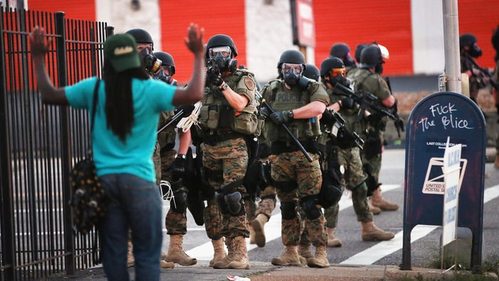
As the world focuses on state violence from Syria to Iraq to Yemen to North Korea, the groundwork is being laid in the United States for unchecked state violence here at home. Donald Trump is making good on at least one of his many campaign promises: promoting unfettered police power. His point person on these goals, Attorney General Jeff Sessions, is leading the Justice Department through a tectonic shift, abandoning Obama-era efforts to protect civil and voting rights, threatening more deportations and resuscitating the decades-old, failed “War on Drugs.”

This week, Sessions told the International Association of Chiefs of Police, “Unfortunately, in recent years … law enforcement as a whole has been unfairly maligned and blamed for the crimes and unacceptable deeds of a few bad actors.” Sherrilyn Ifill, president and director-counsel of the NAACP Legal Defense Fund, said on the “Democracy Now!” news hour, “What we see with Attorney General Jeff Sessions is an effort to basically take us back in time … this is a person who’s stuck in the ‘80s, and in some instances, stuck in the ‘50s.”

(Continuar leyendo…)

radio
Pueblo Sin Fronteras

Refugee Caravan 2017

On Sunday, April 9th, a caravan of Central American refugees will set foot from the Guatemala-Mexico border and make their way north to request asylum in the United States. Along the way, they will raise their voices to defend their right to seek refuge.

While European nations put up barbed wire to keep out Syrians fleeing civil war, the US Government refuses to recognize that there is a refugee crisis in Central America. All around the world, refugees’ rights are under attack. One of the Trump administration’s first actions was a refugee ban, alongside the promise of 3 million deportations in his first year in office. It solidifies a transnational deportation regime developed under Obama, and increasingly harmful for immigrant families seeking refuge.

In 2015 and 2016, Mexico deported twice as many Central Americans than did the United States for the first time in history. This shared system of border control has led to an extremely dangerous passage for refugees on the run.

More information (press release, map, calendar, reports, etc.): http://www.pueblosinfronteras.org/actions-.html


radio
La Jornada

(Español) Estados Unidos: ¿Normalización?

Sorry, this entry is only available in Español. For the sake of viewer convenience, the content is shown below in the alternative language. You may click the link to switch the active language.

Foto
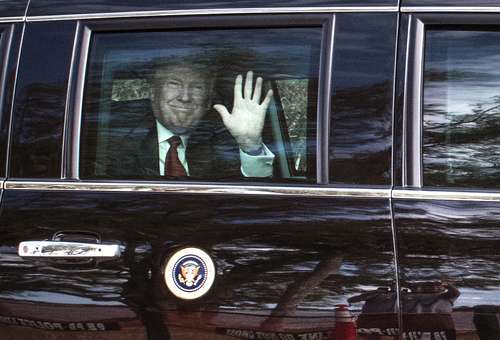
Donald Trump, presidente de Estados Unidos y comandante en jefe del ejército, quien había sido calificado de bufón populista, de repente ha sido aclamado como líder firme y decidido por haber lanzado una ofensiva militar contra una base aérea en Siria, en represalia por un ataque con armas químicas. En la imagen, el mandatario se despide de simpatizantes en Bingham Island, Florida, donde pasó el fin de semana. Foto Xinhua

Por David Brooks | La Jornada

El comandante en jefe ordenó el lanzamiento de 59 cohetes contra una base aérea en Siria y de repente todo pareció volver a lo normal. No había sucedido algo tan peligroso desde que Donald Trump fue electo.

Quien había sido calificado de aberración política, un bufón populista neofascista que amenazaba la democracia y los derechos humanos y civiles de todos, que repudiaba la ciencia y el derecho internacional, el que elevó la mentira y el engaño a niveles que asombraron hasta a los maestros de la farsa política en este y otros países, de repente ganó el elogio de la cúpula política de ambos partidos y de los medios tradicionales del país. Lo proclamaron normal.

Creo que Donald Trump se convirtió en presidente de Estados Unidos, declaró Fareed Zakaria, de CNN, quien había sido uno de los críticos de la política exterior de esta presidencia, al conocerse el ataque estadunidense contra Siria. Brian Williams, reconocido presentador liberal de MSNBC, fue más espeluznantemente lírico al reportar, viendo las imágenes proporcionadas por el Pentágono de los cohetes letales destruyendo objetivos, que había algo bello en estas imágenes y hasta citó un verso de la canción de Leonard Cohen, estoy guiado por la belleza de nuestras armas, sin reconocer que First we take Manhattan es todo menos un elogio a la guerra y la clase política.

(Continuar leyendo…)

radio
Red Voltaire

(Español) 12 de abril de 2017: el mundo está de nuevo al borde de la guerra

Sorry, this entry is only available in Español. For the sake of viewer convenience, the content is shown below in the alternative language. You may click the link to switch the active language.

por Thierry Meyssan

La Casa Blanca se alinea finalmente junto a la coalición de los neoconservadores alrededor del Reino Unido y de varias grandes transnacionales. Estados Unidos retoma la política imperialista que había adoptado en 1991 y reactiva la OTAN. La ruptura con Rusia y China se consumó el 12 de abril de 2017. El mundo se halla nuevamente al borde de la guerra nuclear.

Red Voltaire | Damasco (Siria) | 13 de abril de 2017
+
En dos semanas de intensa lucha en el seno de la administración Trump, Estados Unidos atacó ilegalmente la base aérea de Shayrat, en Siria, y multiplicó posteriormente las señales contradictorias antes de mostrar sus cartas. En definitiva, Washington vuelve a su política imperialista.

En menos de 2 semanas, la administración Trump defendió 7 posiciones diferentes sobre la República Árabe Siria [1].

Estados Unidos realizó otro importante cambio de posición el 12 de abril de 2017.

Al mismo tiempo, el secretario de Estado Rex Tillerson viajaba a Moscú para intentar un último acercamiento pacífico mientras que el Consejo de Seguridad de la ONU se reunía en Nueva York y tomaba nota del enfrentamiento y el presidente Trump volvía a lanzar la OTAN contra Rusia.

(Continuar leyendo…)