Archivo por fecha: 2013
ELLOS Y NOSOTROS VII.- L@s más pequeñ@s 2.-¿Cómo se hace?Them and Us. VII. – The Smallest of them All 2: How is it done?
ELLOS Y NOSOTROS.
VII.- L@s más pequeñ@s 2.
2.-¿Cómo se hace?
Febrero del 2013.
Nota: Compas, en otra oportunidad (si es que llega a haberla) les explicaremos cómo es que está organizado nuestro EZLN. Ahora no queremos distraerlos de la “Compartición“. Sólo les aclaramos que van a ver algo de una “Comisión de Información”. Esta Comisión está formada por compañeras y compañeros, comandantes y comandantas (El CCRI o Comité Clandestino Revolucionario Indígena), que están viendo los trabajos de la autonomía, apoyan a las Juntas de Buen Gobierno y mantienen informadas a las bases de apoyo zapatistas de cómo va todo.
Van, pues, más fragmentos de la “compartición” zapatista:
-*-
(…)
De esta manera hacemos el trabajo. Como aquí en el último dice: ¿cómo se resuelven los problemas? Sí ha habido problemas en el municipio. Problemas de tierra, problemas de amenaza, problemas de luz, sí lo existe y creo que en todos los pueblos existen esos problemas, porque no vivimos solamente los que somos base de apoyo, más cuando vivimos en los pueblos oficiales donde están los enemigos, donde están los que gobiernan, donde están los paramilitares, por eso existen esos problemas. Pero tenemos que ver la forma en que tenemos que gobernar, aunque realmente para aprender sí cuesta porque, como decían algunos compañeros, no hay un instructivo. No hay una forma dónde guiarse, no hay un escrito donde nos tenemos que guiar, sino tenemos que recordar cómo sirvieron nuestros antepasados cuando ellos no eran nombrados por los oficiales sino que es por el pueblo y ellos servían al pueblo, no había sueldo. Ya empezó la corrupción, empezó el mal servicio y es cuando entró el sueldo.
Por eso de esta manera, lo poco que yo he estado en mi pueblo, en mi municipio, es lo que he podido servir aunque todavía, como he dicho, seguimos aprendiendo, no porque ya tenemos edad. Seguimos aprendiendo con todos y todas. Creo que ésta es la función de los distintos niveles, así como los comisariados, los agentes, también tienen su función pero también les falta cómo resolver un problema. Sí hace falta porque no estamos preparados, porque nosotros como campesinos más nos enfocamos en el campo, nuestra ley es el machete y la lima, y el pozol que llevamos. Pues no sé si estoy mal, compañeros, pero eso es lo que alcanzo a compartir con ustedes.
(…)
-*-
(…)
Hicimos muchas reuniones y tomamos muchos acuerdos, no sólo una vez se tomó el acuerdo, vimos que es un trabajo pesado, no es fácil para hacerlo. ¿Por qué? Porque así como ya dije hace ratito, no tenemos una guía, no tenemos un libro dónde ver, dónde seguir; fuimos trabajando con nuestro pueblo.
-*-
(…)
Compañeros, esto es lo que estamos platicando, y ya no es mucho lo que voy a completar. Así como decíamos sobre la forma de cómo queremos llevar el trabajo. Muchas veces no lo puede hacer sólo la Junta, aunque nos pasa en la mente, aunque nos llega el pensamiento, tiene que ser a base de coordinación con los consejos, comités [CCRI], para que se pueda hacer esa idea de lo que pensamos, porque así vimos en algunos casos.
Por ejemplo, hablamos de los cargos, las responsabilidades, ahí vemos las dificultades que hay muchos trabajos que hacer. El tiempo cuando yo estuve en el cargo vimos que a veces fallan los elementos de la Junta y el trabajo existe; por ejemplo, en ese tiempo no habían choferes de la clínica, la Junta tiene que ser chofer, tiene que ser cocinero, tiene que ir a buscar leña, había muchos trabajos y el trabajo también dentro de la oficina también tiene que hacer, tenemos que estudiar los pendientes, los trabajos que quedan pendientes o algunos trabajos del municipio que no se han podido resolver, como que no nos alcanza el tiempo. Ahorita veo, y eso nos pasó en la mente, que sí necesitábamos de un apoyo, con otro chofer aparte, porque a veces nos toca a media noche ir a traer un enfermo urgente, tiene que ir a traer la Junta, llega a las tres de la mañana, a las cuatro de la mañana. Eso nos pasó en la mente pero no pudimos solucionar, se presenta pero no se puede.
Un ejemplo en mi turno, de diagnosticar los municipios, qué enfermedad más frecuente en los municipios y no se pudo definir en la Junta, ni con la información. Tuve que pedir apoyo si se puede hacer o no, y con el apoyo del mando, qué es lo que se quiere; se pidió al municipio y algunos municipios no actuó otra vez, algunos municipios dieron esa respuesta, consultaron al pueblo qué enfermedad más frecuente, porque había brote de tifoidea pero no hicieron los consejos. Entonces todo el trabajo se hace cuando funciona bien, es como una máquina. Cuando una máquina no funciona un pistón o un cilindro en el carro no sube las subidas, no tiene fuerza. Eso es lo que nos pasa en nuestra autoridad, aunque la Junta piensa o quiere poner su propuesta para aprobar con la asamblea a veces, muchas veces no se puede y ahí queda así.
Pero sí es una necesidad. Yo vi en ese tiempo había mucho trabajo en ese año porque no había chofer. Ahorita veo que ya están turnando choferes para las clínicas, aparte su trabajo, ése no trabaja en la Junta, está aparte lavando su carro, checando su llanta, llenando su gasolina.
Se está mejorando un poco más en ese paso y creo así poco a poco se va a ir mejorando, siempre y cuando vamos pensando y viendo cuál es las necesidades que se van presentando, porque el trabajo de la zona o del municipio poco a poco se va incrementando. Poco a poco se va ir participando más compañeras porque se está naciendo el trabajo. Eso es lo que vemos que es muy importante la coordinación entre todos y tomarnos en cuenta entre todos para poder sacar las propuestas y las ideas nuevas de cómo poder trabajar.
La importancia es de no perder el contacto con los pueblos porque en estos tiempos de trabajo, yo escucho que hay cosas que se hicieron con análisis del pueblo y ahora se pueden hacer sin consultar al pueblo, pueden cambiar unas letras sin que el pueblo lo sepa, entonces eso es un problema también que podemos descontrolar el pueblo, porque cuando el pueblo le enseñamos, le explicamos y cuando de repente dejamos a un lado el pueblo, hablan, discuten.
Eso puede traer inconformidades o hablan mal de las autoridades, y muchas veces se necesita explicarle al pueblo, como decíamos hoy, la Junta tiene que estar claro con los siete principios. [Se refiere a los 7 principios del “mandar obedeciendo”, guía de las Juntas de Buen Gobierno, que son: Servir y no Servirse; Representar y no Suplantar; Construir y no Destruir; Obedecer y no Mandar; Proponer y no Imponer; Convencer y no Vencer; Bajar y no Subir].
Es convencer al pueblo y no vencer a la fuerza como quiera una autoridad, tiene que explicarle la razón de modificar algunos reglamentos o algunos acuerdos, se tiene que explicarle al pueblo; porque si soy autoridad y ya no le explico porque como que no, ¿pero llegó hasta el pueblo ese punto? Puede traer una inconformidad aunque el pueblo lo entienda, pero con explicaciones es tratar de convencer y no vencer a la fuerza, para que el pueblo no se desanime, no se descontrola. Eso es lo que puedo explicar un poco más, porque de ahí nacen las inconformidades y ahí el pueblo anda desmoralizado, por eso lo digo, porque así vi el problema.
Siempre con el pueblo hay que estar pegaditos para que no.
Hay pueblos también que quieren hacer una cosa sin la mayoría, entonces también ese pueblo hay que explicarle que no se puede, porque nos pasó unos casos de esa forma. Hay pueblos que llegan en la oficina y hasta elevan su voz en contra de las autoridades pero no podemos aceptarlo porque depende de la mayoría. En eso hay que estar claro, pero es explicar al pueblo y tratar de convencerlo, darle a entender la razón de por qué se hacen estas cosas. Eso es lo que yo opino, compañeros, y eso es lo que trato de explicar de los siete principios, es lo que entendí, lo que aprendí un poco. No aprendí mucho porque sólo trabajé tres años y poco a poco me fui dando cuenta, a la mera hora no se puede hacer el trabajo fácil porque nosotros entramos como nuevos sin apoyo, pero ahora no, hay compañeros que quedaron todavía un año acompañando a los nuevos autoridades, como que sí más o menos se apoya uno.
Pero cuando comenzamos no, así nada más con el apoyo de los comités [CCRI] porque ellos sí estuvieron, con eso nos apoyamos y poco a poco nos fuimos dando cuenta. Entendí un poco, es lo poco que pude explicar, compañeros.
(…)
¿Cómo fueron nombrados?
Fueron nombrados a través de la asamblea, es un ejemplo como estamos ahora. En cada municipio convocó una asamblea toda la base, entonces de manera directa escogieron a ese grupo de compañeros para hacer el trabajo de la autonomía.
¿Qué trabajo tenían?, ¿qué trabajo van a hacer esos compañeros?, porque prácticamente no teníamos el conocimiento, tal vez algunos sí tenían, pero una mayoría no tiene conocimiento, ¿qué vamos a hacer? Vamos a trabajar en la autonomía, vamos a autogobernarnos, el cómo es la pregunta que surgió, ¿qué es lo que vamos a hacer? Pues como que nadie, como que no da, no sabía la respuesta, pero conforme pasaba el tiempo, cuando ya estaban esas autoridades, entonces salían los problemas. Realmente había problemas en cada uno de nuestros pueblos, en nuestros municipios.
¿Cuáles son los problemas que en aquel tiempo enfrentaron los que fueron autoridad?
En aquel tiempo el principal problema que se enfrentaba es el alcoholismo, problema familiar, problemas entre vecinos y algunos problemas agrarios.
¿Entonces qué hacían ese grupo de compañeros cuando ya se presenta un problema?
Lo que ellos hacían es que discutían; primero viene el quejoso y luego se escucha cuál es el problema que tiene, se escucha, cuando ya escucharon citan la otra parte, se escuchan las dos partes. Entonces lo que hacía ese grupo de compañeros es escuchar, lo que hacía es que esos hermanos que tienen problema se escuchaba primero qué es el problema que tienen y a la vez se escuchaba quién tiene la razón. En cuanto ya se vio que el quejoso tiene la razón entonces se tiene que hablar con el otro hermano con el que tiene problema.
Lo que hacían las autoridades en aquel tiempo es que daban ideas, o sea convencían a que las dos partes lleguen a una solución pacífica sin tanto rollo.
Eso es lo que hacían las autoridades igual en otros tipos de problemas, en cuestión de agraria así hacían, convencían también a los hermanos a que no se pelean, a que no se pelean por un pedazo de tierra; si realmente al hermano le están quitando su tierra pues también hay que darle la razón al otro que está quitando terreno que no debe ser así, lo que es, es.
(…)
-*-
(…)
Sí, eso sí, pero entonces mi pregunta es que se necesita hacer un reglamento, ¿entonces quién propone la idea?, ¿dónde nace la idea de cómo debería ser un reglamento?, ¿quién es el que dice ‘propongo esto’?, ¿dónde nace la idea? y luego entonces. cómo le hacen para que se junte la voz del pueblo, porque si ya es propiamente de la Junta, ¿asume eso o tiene que ser apoyado todavía por los compañeros de la Comisión de Información?, ¿o quién es el que dice que hay que hacer un reglamento aquí?
Respuesta de otro compañero: Así de que haya una iniciativa meramente de compañeras autoridades, de que salga la iniciativa como para hacer un reglamento, ya así de meras compañeras que están en función de un cargo de autoridad, todavía no existe eso. Se da entre compañeras y compañeros.
No, compa, mi pregunta es Junta de Buen Gobierno, no como compañeras. Como Junta de Buen Gobierno y es un ejemplo que estoy dando, no es especialmente de reglamento o de ley. Cuando ven que hay una necesidad o hay un problema, por eso doy el ejemplo de un reglamento, porque eso exige la relación, porque no va a imponer una ley la Junta de Buen Gobierno, entonces quisiéramos que nos platiquen cómo es que hacen eso. Porque aquí entra el juego de democracia, entonces lo que queremos entender, pues que no todo el tiempo, como nos dijeron ustedes, no va a estar todo el tiempo los mandos insurgentes y tampoco, entendemos que un día tampoco va a estar todo el tiempo la Comisión de Información, o sea el CCRI [Comité Clandestino Revolucionario Indígena]. Entonces cómo ustedes, como Junta de Buen Gobierno, hacen que se eche a andar una cosa que se necesita, ya sea ley, ya sea problema, de algún asunto que es necesario sacar adelante, un proyecto o lo que sea. ¿Cómo es que relacionan Junta de Buen Gobierno, MAREZ [Municipios Autónomos Rebeldes Zapatistas], autoridades y luego pueblos?
O sea, cómo se hace la democracia.
(…)
-*-
(Continuará…)
Doy fe.
Desde las montañas del Sureste Mexicano.
Subcomandante Insurgente Marcos.
México, Febrero del 2013.
:::::::::::::::::::::::::::::::::::::::::::::::::::::::::::::::::::::::::::::
Escucha y ve los videos que acompañan este texto:
Alfredo Zitarrosa, maestro tal vez involuntario de una generación, oriental que lucha aún con coplas, vidalitas y milongas. Aquí cantando “Adagio en mi país” y por país, es claro, se refiere a cada rincón en los que muchos mundos abundan y redundan.
——————————————————————–
Arturo Meza con la rola “La Rebeldía de la Luz”. En una parte de la canción, el maestro Meza menciona a cada uno de los pueblos originarios que, en México, resisten y luchan.
——————————————————————–
Daniel Viglietti, nuestro hermano y compa, lee un cuento llamado “La Historia del Ruido y del Silencio” que trata, en vano, de explicar los silencios y las miradas zapatistas.
Them and Us.
VII. – The Smallest of them All 2:
How is it done?
February 2013
Note: Compas, at another time (that is, if there is one) I will explain to you how our EZLN is organized. For now, we don’t want to distract you from the “Sharing.” We only want to clarify that you will see something about an “Information Commission.” This commission is made up of compañeras andcompañeros, comandantes and comandantas, (the CCRI, or Indigenous Revolutionary Clandestine Committee), who are watching over the work of autonomy, supporting the Juntas de Buen Gobierno (Good Government Councils), and who keep the Zapatista bases of support informed as to how everything is going.
For now, then, more fragments from the Zapatista “sharing”:
-*-
(…)
This is how we work, then. The last question here asks: How do you resolve problems? Yes there have been problems in the municipality. Land problems, threats, problems with electricity, yes they exist, and I think that these problems exist in all of the communities because it isn’t just bases of support who live together, we have even more problems where we live in the official [ruling party] pueblos where our enemies are, where those who govern are, where there are paramilitaries, that’s where we have these problems. But we have to figure out how to govern ourselves, even though it is difficult to learn this because, as other compañeros have said, there is no instruction manual. There is no a guide for this, there isn’t anything written down anywhere that tells us what to do; rather, we have to remember that this is how our ancestors served when they weren’t named by officials but rather by the people, and they served the people, and they didn’t get a salary. Corruption and bad service began when salaries entered into the equation.
It is in this way, in the little that I have done in my pueblo and in my municipality, that I have been able to serve, although as I said, we continue to learn, we do not just know how to do things because we are older. We continue learning with everyone [male and female]. I think this is the purpose of the distinct levels [of government], and the commissioners and agents, they each have a function but they lack a way to resolve problems. In our case, we have to learn how to govern because we are not trained in this, because we as campesinos are more focused on the countryside, our law is the machete, the file, and the pozol[i] that we carry with us. So, I don’t know if I’m wrong compañeros, but this is what I have to share with you.
(…)
-*-
We have had a lot of meetings and made many agreements, more than just once we had to arrive at an agreement. We learned that this is difficult work; it isn’t easy to do. Why? Because as I said a little while ago, we don’t have a guide, there is no manual that we can look at to see what to do, a guide we can follow; we learned through our work with our people.
-*-
(…)
Compañeros, this is what we have been talking about and I won’t add much more about the way we want to work. Many times the Junta cannot do the work alone, even though that idea crosses our minds; rather, the work must be based on coordination with the councils, and the committees [CCRI], so that we can carry out this idea of how we think things should work, this is what we have seen in some cases.
For example, with respect to the cargos,[ii] the responsibilities, we see the difficulty of having lots of work to do. When I had my cargo, we saw that sometimes there was work that the Junta didn’t have the capacity to cover. For example, at that time there weren’t drivers for the clinic, the Junta had to be the driver, it had to be the cook, it had to fetch firewood; there were a lot of tasks and on top of that we had all of the office work to do, like studying the pending issues, pending tasks or municipal issues that hadn’t been resolved, and there just wasn’t time for everything. Now I see, and this crossed our minds then, that we needed support, another driver in that case, because sometimes in the middle of the night we would have to go and get someone who was seriously ill, and it was the Junta that had to go, and would get back at three or four in the morning. This problem crossed our minds but we couldn’t find a solution, the situation presented itself, but we couldn’t resolve it.
One example during my turn as Junta was that we wanted to diagnose which illnesses were the most frequent in the municipalities. We couldn’t define this in the Junta, not even with the information we had. I had to ask the mando [local Zapatista authority], as is required, as to whether or not I could go to the municipalities for this information. So I asked the municipalities and some of the municipalities again did not act, some gave this response – they had consulted the people regarding which illness was most frequent and it was typhoid, there had been a typhoid breakout, but they hadn’t formed the councils [we asked for]. So work gets done when the process functions well, like a machine. When a machine doesn’t function, or a piston or a cylinder doesn’t work, the car can’t go up the hill; it doesn’t have the force. This is what happened with our authority, although the Junta thinks or wants to make a proposal for approval in the assembly, sometimes, many times, it doesn’t get approval and doesn’t go anywhere.
But yes, this is a necessity. I saw at that time that there was a lot of work that year because we didn’t have a driver. Now I see that they are rotating drivers to tend to the clinics, and to do the related work of washing the car, checking the tires, getting gasoline, the Junta isn’t responsible for that now.
With this step, things are getting better, and I think that like this, bit by bit, it will continue to get better, as long as we are thinking and studying the necessities that arise, because the work in the zone or the municipality is also growing little by little. Little by little, more compañeras will participate because the work is growing. So we see here that what is really important is coordination among everyone, taking everything into account, in order to develop proposals and new ideas for how we can work.
It is important not to lose contact with the people. These days I hear sometimes that things for which the people were consulted at one point can now be done without consultation, that they can change a few words without the people knowing. This is a problem and can cause things to run amok, because if we teach the people and explain to them, and then all of the sudden leave them aside, they start to talk, to argue.
This can create disagreements, or cause them to speak badly of the authorities, and many times we need to go back and explain to the people. As we said earlier today, the Junta has to be very clear on the seven principles. [This refers to the 7 principles of “lead by obeying” that guide the Juntas de Buen Gobierno: Serve, not Serve yourself/ Represent, not Supplant/ Construct, not Destroy/ Obey, not Command/ Propose, not Impose/ Convince, not Defeat/ Go Below, not Climb Above.]
The point is to convince the people, not to overcome them with the force of authority, you have to explain to them the reason for modifying certain rules or accords, you have to explain this to them; because if I am an authority and I don’t explain to them why we do or don’t do something, the question arises – was this point consulted with the people? This could create a grievance even if the people understand the decision, so explanations are meant to convince them and not to overcome them by force, so that people do not get discouraged or confused. This is what I wanted to explain a little more, because that’s where dissent begins and how people get demoralized, this is how I see the problem.
You must always be close to the people so that this does not happen.
There are also people who might want to do something without majority agreement, so you have to explain to them that it can’t be done, we have had a few cases like this. There are people who come to the office and even raise their voice to the authorities, but we can’t accept their proposal because it depends on having majority approval. In these cases one has to be clear, one has to explain to the people and try to convince them, try to help them understand why we do things this way. This is what I think, compañeros, and this is what I try to explain about the seven principles, it is what I have understood, what I have learned a little about. I have not learned much because I only worked in that role for three years and little by little I realized how things needed to be. At that moment we couldn’t do the work easily because we entered as new [authorities] without support, but now there arecompañeros who have stayed on for one more year to accompany the new authorities, so they have some support.
But when we began it wasn’t like that, we had only the support of the committees [CCRI], they were there, and with that support, gradually we were able to understand things. I understood a little, and that is what I could explain to you compañeros.
(…)
How were they chosen?
They were chosen by the assembly; something like where we find ourselves now. In each municipality we convoked an assembly of the entire base and directly chose the group of compañeros to do that would do the work of autonomy.
What is their work? What work were these compañeros going to do? Because we had practically no knowledge about this, maybe a few people had some, but the majority had no knowledge about this task, what would we do? We would work on autonomy, we would govern ourselves, but “how” is the question that arose, what is it exactly that we’re going to do? Well, no one knew the answer, but with the passage of time, with these authorities in place, problems arose that they would have to handle. There really were problems in each of our pueblos, in each of our municipalities.
What were the problems that the authorities faced at that time?
At that time, the principal problems we faced were alcoholism, domestic problems, problems between neighbors, and some agrarian problems.
So what did this group of compañeros do when a problem presented itself?
What they did was discuss it: first the person with the complaint would come and they listened to that person’s problem. When they had listened, they would call in the other party, they listened to both sides. So this group of compañeros listened, first they listened to what the problem was and who was right. When they could see that the person with the complaint was right, then they had to talk with the other compañero with whom the first had the problem.
At that time, the authorities would try to give them ideas, that is, convince both sides to arrive at a peaceful solution without so much drama.
This is what the authorities did with other types of problems as well, in agrarian issues for instance, they would convince the compañeros not to fight, not to fight over a piece of land. If one compañero’s land was being taken by somebody else, then they had to explain to the compañero who was taking the land why this shouldn’t be, what is right, is right.
(…)
-*-
(…)
Yes, that is true, but my question then is if you need to make a rule, who proposes the idea? Where does the idea come from regarding what the rule should be? Who is it that says, ‘I propose this’? Where does the idea come from? And so on. What do you do to unite the voice of the people, if it is originally the Junta’s idea? Does the Junta take this on or do they still need the support of the compañeros of the Information Commission? Or who is it that says that we need to create a rule here?
Another compañero’s response: What you have described, where an initiative comes directly from the compañeros who are authorities, an initiative for a rule comes directly from the compañeras who are in authority, that hasn’t happened yet. It is between compañeras and compañeros.
No, compa, my question is as Junta de Buen Gobierno, not as compañeras. As Junta de Buen Gobierno, and this is just an example that I am giving, it doesn’t have to be specifically about a rule or law. When you see that there is a need or there is a problem – I use the example of a rule because it requires a relation – the Junta de Buen Gobierno isn’t going to impose a law, and so we want to discuss how it is that you handle this. Because it is here that democracy enters into play, and this is what we want to understand. Because as you told us, there won’t always be insurgent leaders present, and, as we understand, the Information Commission, or the CCRI [Indigenous Revolutionary Clandestine Committee] won’t always be there either. So you as the Juntas de Buen Gobierno, how do you approach something that needs to be handled, a law or a problem, some issue that needs to move forward, a project or whatever it may be. How do the Juntas de Buen Gobierno, the MAREZ [Zapatista Autonomous Municipalities in Rebellion],the authorities and the people relate?
That is, how is democracy made?
(…)
-*-
To be continued…
I testify.
From the mountains of the Mexican Southeast.
Subcomandante Insurgente Marcos.
Mexico, February 2013
:::::::::::::::::::::::::::::::::::::::::::::::::::::::::::::::::::::::::::::
Listen to and watch the videos that accompany this text.
Alfredo Zitarrosa, perhaps involuntary teacher of a generation, oriental who still fights with the coplas, vidalitas, and milongas. Here he is singing “Adagio en mi pais,” and by country, of course, he refers to every corner of the many worlds that abound and redound.
Arturo Meza with the song “La Rebeldía de la Luz.” In one part of the song, master Meza mentions each one of the original peoples who, in Mexico, resist and struggle.
Daniel Viglietti, our brother and compa, reads a story called “La Historia del Ruido y del Silencio,” which tries, in vain, to explain the Zapatista silences and the Zapatista gaze.
[i] Pozol is a highly nutritious drink made of the dough from ground corn mixed with water. It is commonly consumed in the Mexican countryside as a midday meal.
[ii] Cargo is like a combination of duty and task, or charge; it also refers to a position of responsibility.
****************************
Traducción del Kilombo Intergaláctico.
****************************
ELLOS Y NOSOTROS. VII.- L@s más pequeñ@s 1. Aprendiendo a gobernar y gobernarnos, es decir, a respetar y respetarnos.Them and Us. VII.- The Smallest of them All 1.- Learning to govern and govern ourselves, that is, to respect and respect ourselves.
ELLOS Y NOSOTROS.
VII.- L@s más pequeñ@s 1.
1.- Aprendiendo a gobernar y gobernarnos, es decir, a respetar y respetarnos.
Febrero del 2013.
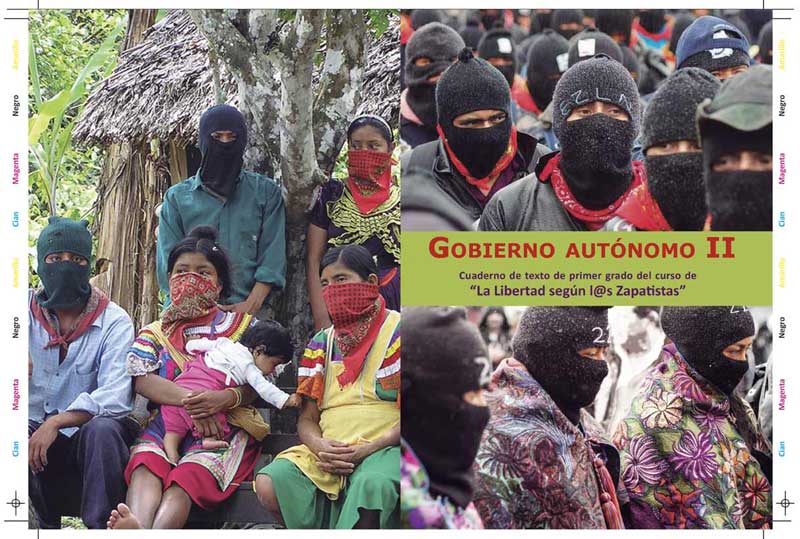
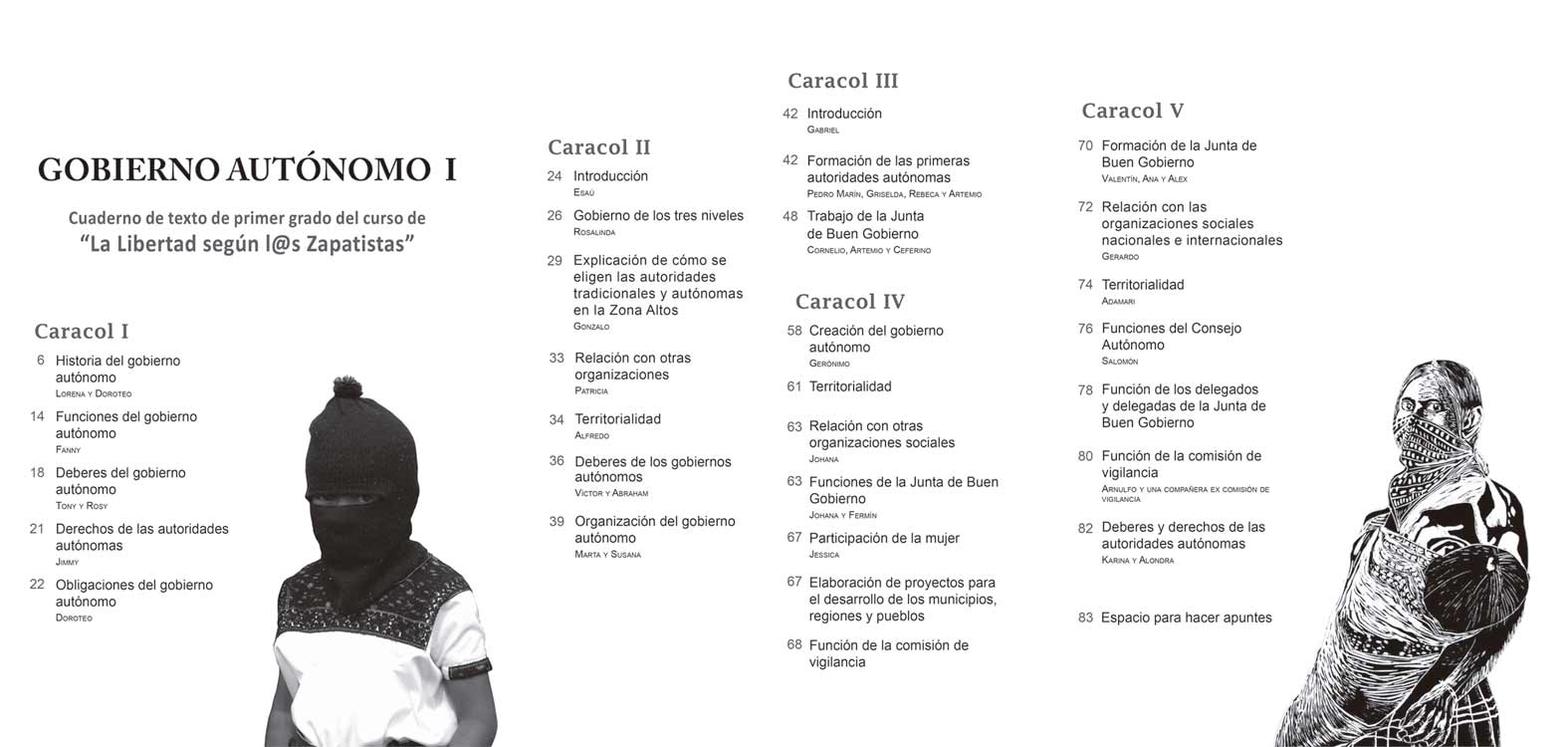
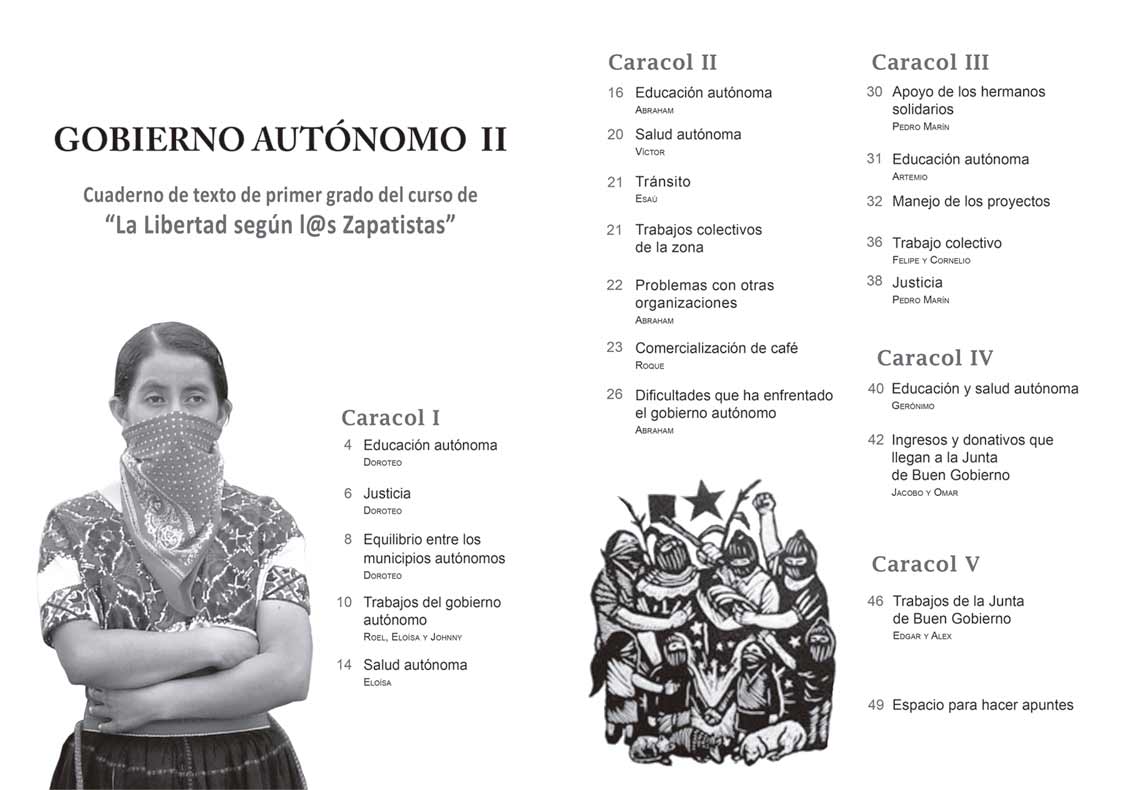
Nota: los cuadernos de texto, que son parte del material de apoyo para el curso “La Libertad según l@s zapatistas”, son producto de las reuniones que las bases de apoyo zapatistas de todas las zonas realizaron para evaluar los trabajos de la organización. Compañeras y compañeros tzotziles, choles, tzeltales, tojolabales, mames, zoques y mestizos, procedentes de las comunidades en resistencia de los 5 caracoles, se preguntaron y se respondieron entre sí, intercambiaron sus experiencias (que son diferentes según cada zona), criticaron, se autocriticaron, y evaluaron lo que llevan avanzado y lo que falta por hacer. Esas reuniones fueron coordinadas por nuestro compañero Subcomandante Insurgente Moisés y fueron grabadas, transcritas y trabajadas para la elaboración de los cuadernos de texto.
Como en estas reuniones l@s compas compartieron entre ell@s sus pensamientos, sus historias, sus problemas y posibles soluciones, ell@s mismos le pusieron nombre a este proceso: “la compartición“.
Éstos son algunos fragmentos sueltos de la compartición zapatista:
-*-
(…)
Aquí estamos para compartir la experiencia y uno de esos, nuestra palabra como zapatistas es que gobernamos juntos, gobernamos colectivo. ¿Qué compartición nos pueden dar de la forma de cómo hacen eso de que gobiernan juntos, colectivos?
La forma que estamos trabajando es no separase del pueblo. Así como siempre hacemos en cuestiones de hablando de reglamentos o de planes de actividades, de trabajos, tiene que llegar la información al pueblo, tiene que estar presente las autoridades en los planes, en hacer las propuestas.
(…)
Allá nosotros estamos trabajando algunas cosas y consideramos como parte de las obligaciones del gobierno autónomo, una es que es su obligación del gobierno autónomo atender a cualquier persona que acuda a la oficina por diferentes asuntos, se le dé o no se le dé solución a su asunto pero tiene que ser escuchado. Quien sea, zapatista o no zapatista, así estamos trabajando allá, siempre y cuando no sea gente del gobierno o enviado de gobierno, si así es pues esos sí no son atendidos, allá no se atiende. Pero si no, sea de cualquier organización social, es atendido. También estamos allá trabajando y siempre pendientes de que estemos cumpliendo con los siete principios del “mandar obedeciendo” y eso lo pensamos que tenemos que hacerlo así, es como una obligación, para no cometer los mismos errores que cometen las instancias del mal gobierno y no llevar los mismos modos de ellos, entonces el que nos va a regir son los siete principios.
-*-
El primer Aguascalientes que se construyó en Guadalupe Tepeyac, ahí empezó el primer paso de nuestra organización y de nuestra forma para hacer valer nuestro derecho. Este Aguascalientes dijimos que es un centro cultural, político, social, económico, ideológico, pero con el traición de Ernesto Zedillo, él pensó con este desmantelamiento, esa ofensiva que él hizo, pensó que con eso nos iba a terminar la política de nuestra organización. Pero fue al revés su política porque de ahí mismo, en ese mismo año 94, se declaró que se hicieran cinco Aguascalientes más.
(…)
-*-
Estos municipios dijeron que es la sede que ahí va a ser, entonces empezaron a buscar nombres de los municipios, cómo se va a llamar, ya una vez que tienen la sede ahora empezaron a ver cómo se van a llamar los municipios. El primer municipio autónomo que es La Garrucha se dijo que se va a llamar Francisco Gómez; el otro municipio que es San Manuel ahora, que es Las Tazas, que dijimos, se llamó San Manuel; Taniperlas se llamó Ricardo Flores Magón; San Salvador, Francisco Villa. Todos estos fueron honor a los compañeros Francisco Gómez, que ya todos conocemos, pues es un compañero que dio la vida por la causa que estamos, la que ya platicó el compañero, murió en el combate en Ocosingo el primero de enero, así se llamó Francisco Gómez. Entonces San Manuel en honor del compañero Manuel, que es el fundador de nuestra organización. Ricardo Flores Magón, pues también ya sabemos que es un luchador social que ya está en la historia. Y Francisco Villa, pues igual es un revolucionario que todos conocemos. Entonces así fueron formando nuestros municipios, así decidimos hacer todo esto a nombre de todos nuestros municipios y los acuerdos fueron todos en una asamblea comunitaria, en la asamblea regional ahí se nombró todos estos nombres de nuestros municipios. Compañeros, es las pocas palabras que les voy a contar y van a pasar otros compañeros o compañeras para explicar lo siguiente.
(…)
-*-
Los problemas principales que se presentaron desde el inicio de [inaudible], el problema del alcoholismo, ¿cómo está ese problema ahorita ahí en su zona?
Mira compañero, en aquellos tiempos, en el inicio de 1994, despuesito de la guerra pues, algunos entraron con miedo. Inició la guerra, todos nos amontonamos, así como ya nos dijeron, nos metimos y pa qué nos metimos, puede ser que así pasó, se amontonaron la gente. Algunos que sí conscientemente lo hicieron pero otros por miedo, entonces quienes de por sí lo hicieron con miedo, de por sí no están a gusto haciendo el trabajo, ¿qué es lo que hacían? Aunque teníamos la orden de que no debemos de tomar trago, pero qué es lo que pasa, tomaban a escondidas. ¿Qué es lo que hacíamos? Nosotros no lo castigábamos, lo que hacíamos, por eso tenemos la comisión de ancianos, ésos son los encargados de decirle por qué está haciendo eso, se le explicaba qué es el daño que se está provocando en sí mismo. Entonces quienes obedecen pues prácticamente van a seguir y quienes no pues se pelan. Esa es la respuesta.
(…)
-*-
-*-
Compañeros y compañeras, buenas tardes a todos. Yo vengo de un poblado que se llama ____, que pertenece al municipio Francisco Villa. Vengo a representar a la Junta de Buen Gobierno, mi cargo fue Consejo, en el año 2006 a 2009. Les voy a explicar cómo fue la causa de nuestra carga que tenemos todos, no me toca explicar todavía donde empezamos en el año de 1994, voy a contar un poco cómo empezamos después de 1994. Antes, 91, 92, ¿por qué fue la causa del levantamiento armado? Es por la causa de la dominación, la marginación y la humillación, de las injusticias y de las normas o leyes de los malos gobiernos y de los explotadores terratenientes. Y así antes, nuestros padres y abuelos, ellos no les tomaban en cuenta, sufrían y así no teníamos tierra dónde trabajar para el mantenimiento de nuestros hijos. Así los pueblos zapatistas se empezaron a organizar donde dijeron “ya basta de tanta humillación”. Entonces se levantaron en armas, no les importó caminar por la noche, ni el hambre.
Así fuimos formando y vimos que organizados, unidos, sí pudimos y vamos a poder más. Después pasando ese levantamiento que hicimos, vimos cómo vamos a avanzar a formar nuestras autoridades autónomas en cada municipio. Por eso aquí estamos reunidos todos para platicar y compartir cómo fue que empezamos a funcionar nuestros gobiernos autónomos, ¿por qué les explico un poco de este tema? Es porque yo lo que pienso es que desde ahí fuimos empezando y avanzando hasta donde estamos ahorita. En el tema que vamos a comenzar a ver le toca la palabra al compañero ___, que él va a explicar hasta hoy cómo estamos trabajando en nuestros municipios y en la Junta de Buen Gobierno. Es todo mi palabra, compañeros.
Compañeros, así como platicó el otro compa, ahora nos va a tratar de explicar el compañero ____, porque fue el fundador de nuestro gobierno autónomo en nuestro Caracol III, allá en la Garrucha, ellos fueron los que fundaron las primeras autoridades. Ahora nos van a compartir cómo trabajaron, cómo estuvieron, cómo empezaron y cómo estamos hasta ahora.
-*-
(…)
Como que se me pasó algo comentarles, más o menos un mes después del inicio de nuestras funciones, allá con una organización que se llama la CIOAC [de filiación perredista], nos secuestran a un compañero junto con un camión, y nos vimos obligados a denunciarlo y no teníamos la idea de hacer una denuncia. Miembros de la Junta de Buen Gobierno y consejos municipales tuvimos que dar nuestra palabra, una o dos palabras, para hacer esa denuncia, en equipo, cada quién daba su palabra y así vamos formando, así formamos una denuncia, pero sí lo sacamos. Y por eso lo hacíamos de secretario, lo hacíamos de cocinero, lo hacíamos de barrendero, porque teníamos que hacer aseo en nuestra oficina y en toda nuestra área de trabajo, no teníamos especialmente quién haga esas tareas y así lo seguimos haciendo hasta la fecha.
(…)
-*-
-*-
(…)
Así fuimos trabajando y así llegamos hasta el 2003, con la formación de las Juntas de Buen Gobierno. Llegamos a las juntas de buen gobierno, pues en esa zona, por decir así, pues no sabíamos si esa directiva de la asociación de municipios algún día serían autoridades y serían gobierno. Pero en el 2003, cuando se dan las Juntas de Buen Gobierno, el pueblo y la asociación de municipios deciden que esos ocho compañeros, miembros de la Directiva de Asociación de Municipios, pasaran a ser autoridades de la Junta de Buen Gobierno. Y esos ocho compañeros pues son los que toman el cargo en la Junta de Buen Gobierno, en el primer periodo de la Junta de Buen Gobierno, que fue de 2003 a 2006.
Así se dieron entonces, igual bajo las mismas condiciones, la Junta de Buen Gobierno no tenía ya un local adecuado. Días antes de que se hicieran públicas las Juntas de Buen Gobierno pues los pueblos construyeron ahí, de manera urgente, un local para la Junta de Buen Gobierno, así como un local para cada uno de los municipios autónomos, en el centro del Caracol. Se construyeron con los materiales con que contaban los pueblos en esos momentos, maderas usadas, láminas usadas y así se empezó, se hicieron las construcciones, en menos de una semana quedaron construidas. Así se empieza, quedan listas sus oficinas, llega agosto de 2003 y se hacen públicas; después de la publicación los pueblos se reúnen, orgullosos de haber formado una instancia más de gobierno en la autonomía. Y en una fiesta, en una gran celebración instalan formalmente el nuevo gobierno autónomo, haciendo la entrega pues a su oficina, con los materiales con que se contaba.
Pues podemos decir que fue un chingo, pero el pueblo hizo entrega a la Junta de Buen Gobierno una mesa y dos sillas, ése fue su material, y un local pues un poco más pequeño que este espacio donde estamos ahora, así fueron las condiciones. Días después, alguien por allá donó una maquinita de las más antiguas y con ésa se empezó a trabajar. Recibimos el local vacío y así empezamos, se fueron dando iniciativas de trabajo y fuimos empezando, arreglando el espacio.
(…)
-*-
En el trabajo también, como ven ustedes en la zona donde trabajamos, existen diferentes formas de ser, diferentes formas de vestir, diferentes colores, diferentes creencias, diferentes formas de hablar, y en el trabajo también se le respeta al compañero y compañera, independientemente de cómo sea. Lo único que nos interesa es la voluntad del trabajo y su capacidad, entonces todo eso no nos importa de cómo sea.
(…)
-*-
(Continuará…)
Doy fe.
Desde las montañas del Sureste Mexicano.
Subcomandante Insurgente Marcos.
México, Febrero del 2013.
——————————————————————–
“Poder Caracol” de Lengualerta/Cuyo, música Taxi Gang. Video de Pazyarte, imágenes del Caracol zapatista de Oventik, Chiapas. En el minuto 2:42 le preguntan a 2 compas internacionales qué aprendieron. Ellos responden: “a compartir”
———————————————————————–
Zach de La Rocha, vocalista de Rage Against Machine, explica el interés del capital para aniquilar al zapatismo (con una pequeña intervención de Noam Chomsky). Zach ha estado en comunidades zapatistas, como uno más, sin alardear de ser quien ha sido y es. Supo mirarnos, nosotr@s aprendimos a mirarlo. Música de fondo: la rola “People of the Sun”.
————————————————————————–
La rola “Canto a la Rebelión”, del grupo SKA-P, con letra incluida. Esta rola forma parte de su nuevo disco “99%”, que saldrá el próximo mes de marzo de este 2013, cortesía de Marquitos Spoil. Oh, no hay por qué darlas. ¡Órales con el brincolín!
————————————————————–
Them and Us.
VII.- The Smallest of them All 1.
1.- Learning to govern and govern ourselves, that is, to respect and respect ourselves.
February 2013.
Note: the notebooks that make up the support material for the course “Freedom According to the Zapatistas,” are a product of meetings that the Zapatista bases of support in all zones have carried out to evaluate their work in the organization.
Compañeras and compañeros from the communities in resistance of the 5 caracoles,[i] tzotziles, choles, tzeltales, tojolabales, mames, zoques y mestizos, gathered to ask and answer questions among themselves, exchange experiences (which are different in each zone), and to criticize, self-criticize, and evaluate what they have done so far and what they still have to do. These meetings were coordinated by our compañero Subcomandante Insurgente Moisés, and were recorded, transcribed, and edited for the notebooks. Since during these meetings the compas shared among themselves their thoughts, histories, problems, and possible solutions, they themselves named the process: “the sharing.” These are a few loose fragments of the Zapatista sharing:
-*-
(…)
We are here to share our experiences, and one of these is, as we Zapatistas say, that we govern together, we govern as a collective. What can we share about the way in which you govern together, collectively?
The way we work is by not separating ourselves from the people. Always, with issues of regulations, plans, activities, and work, we have to get information from the people, and the [community] authorities have to be present in making the plans, making the proposals.
(…)
We are thinking and working through various things, and we think that part of the duty of autonomous government is to attend to whoever comes to our office with an issue. Whether or not that issue can be resolved, it must be heard. This is for whoever comes in, Zapatista or not, that is how we work. The exception to this is people from the government or people sent from the government, in which case they are not attended to. But as long as that is not the case, anyone from any social organization is heard. Also in our work we are always vigilant about honoring the seven principles of “rule by obeying.” We consider this to be necessary, to be our obligation, in order not to make the same mistakes and develop the same habits of the entities of bad government. So the seven principles are what govern us.
-*-
The first Aguascalientes, built in Guadalupe Tepeyac, was where we took our first step toward organization and toward our own way of exercising our rights. This Aguascalientes was a cultural, political, social, economic, and ideological center. When Ernesto Zedillo[ii] betrayed us in a [military] offensive that dismantled the Aguascalientes, he thought our organizational politics would come to an end. But the opposite happened, because that same year, 1994, it was declared that we would build five more Aguascalientes.
(…)
-*-
These municipalities decided where their municipal seat would be, and began to think about names for the municipalities, what they would be called when the Aguascalientees was ready. The first autonomous municipality, La Garrucha, was called Francisco Gómez; the municipality that is today San Manuel was before Las Tazas; Taniperlas was renamed Ricardo Flores Magón; San Salvador was named Francisco Villa. All of these names honored compañeros. Francisco Gómez, a name we all know now, was a compañero who gave his life to our cause, he died in combat in Ocosingo on January 1st. San Manuel honors the compañero Manuel, founder of our organization. Ricardo Flores Magón, we know was a warrior of social struggle in our history. And Francisco Villa was also a revolutionary that we all know. So our municipalities were formed as agreed in our community assemblies, and in the regional assembly we decided on their names. Compañeros, those are the few words that I have to say and now other compañeros or compañeras will explain what comes next.
(…)
-*-
The principal problems that we had since the beginning of [inaudible], the problem of alcoholism, how is this problem now in your zone?
So in those days, at the beginning of 1994, a little after the war, some joined [the organization] out of fear. The war started, we all got together, we joined up for various reasons, but we joined up. Some did so consciously, but others out of fear. So those that joined out of fear, well of course they weren’t happy doing the work of the organization, so what did they do? We had the order not to drink alcohol, but they drank anyway, while trying to hide it. So what did we do? We didn’t punish them, what we did—and this is why we have the commission of elders—was have this commission explain to them why we made this rule, and explain the damage they were doing to themselves. So those who want to obey keep going, and those who don’t leave. That is our answer.
(…)
-*-
-*-
Compañeros and compañeras, good afternoon to everyone. I come from a village called ____, which is part of the municipality Francisco Villa. I am here representing the Junta de Buen Gobierno [Good Government Council], my cargo[iii] was Consejo[“Council”], from 2006 to 2009. I am going to explain how the responsibilities we have today came about. It’s not my job yet to explain where we started in 1994, rather, I’m going to tell a little about where we started after 1994. Before, in 91, 92, what was the cause of the armed uprising? It was the domination, marginalization, humiliation, injustice, and the norms or laws of the bad governments and the landowning exploiters. In those days, our parents and grandparents were not taken into account, they suffered, and didn’t have land to work and maintain their children. So the Zapatista pueblos began to organize, we said “enough of so much humiliation.” So we rose up in arms, we weren’t bothered by having to walk at night, or by hunger.
So we trained and educated ourselves, and we saw that organized, united, we could do things, and that we would be able to do many more things. After the uprising, we began to look at how to advance the training of our autonomous authorities in each municipality. That’s why we are all gathered here, to talk and share how our autonomous governments began to function. Why do I want to explain a little about this? Because I think that from that point on we were advancing toward where we are now. On this subject the compañero ___ is going to explain how we are working in our municipalities and in the Junta de Buen Gobierno today. That’s all I have to say, compañeros.
Compañeros, as the other compa already told you, now our compañero ____ is going to try to explain a little because he was the founder of our autonomous government in Caracol III, in la Garrucha, they were the first authorities. So they are going to share how they worked, how they were, how they began, and how things have been until today.
-*-
(…)
Ah I forgot to mention something before, about a month after we began our work, an organization called CIOAC [of PRD affiliation], kidnapped one of our compañeros along with a truck, so we had to denounce this but we didn’t have any idea how to make a denunciation. Members of the Junta de Buen Gobierno and municipal councils had to go and speak, a few words each, to make this denunciation, as a team, and that’s how we went about making the denunciation, but we got it out. And that’s why we started designating a secretary, a cook, someone who sweeps up, because we had to clean up our own office and our work area, we didn’t have anyone especially for those tasks and that’s how we still do it today.
(…)
-*-
-*-
(…)
So we went on working like that and we reached 2003, when the Juntas de Buen Gobierno were formed. We didn’t know still, in our zone, if the leadership of the association of municipalities would one day be the authorities, the government. But in 2003, when the Juntas de Buen Gobierno were born, the people and the association of municipalities decided that those eight compañeros, members of the Leadership of the Association of Municipalities, would become the authorities of the Junta de Buen Gobierno. And those eight compañeros are those who take on the cargo of the Junta de Buen Gobierno for its first period, from 2003 to 2006.
So that’s how it happened, and under those conditions, the Junta de Buen Gobierno did not yet have an adequate space to work in. A few days before the existence of Juntas de Buen Gobierno was made public, the pueblos quickly and urgently constructed a space for the Junta de Buen Gobierno, as well as a place for each of the autonomous municipalities in the center of the Caracol. These were built with the materials that the pueblos had in that moment—used wood and used tin sheets—and that’s how we started, building those spaces, and in less than a week they were ready. So the offices were ready when we made the Juntas public in August of 2003. After they were made public the pueblos gathered together, proud of having created another entity of government as part of our autonomy. We held a party, a big celebration, to formally install the new autonomous government, and give it the office we had built and the materials with which we had supplied it.
We could say it was a bunch of stuff, but what the pueblo gave the Junta de Buen Gobierno was a table with two chairs, those were the supplies, and the space, a little smaller than this room we are in now. Those were the conditions at that time. A few days later, someone donated a very old machine [computer] and with that the work began. We received the space almost empty and that’s how we started, work initiatives arose and we got going, setting up the space.
(…)
-*-
In this work, as you can see, in the zone where we work, there are different forms of being, different forms of dressing, different colors, different beliefs, different ways of speaking, and so in that work we respect our compañeros and compañeras, regardless of how they are. The only thing that interests us is the will and capacity to work, so all of this about how someone is doesn’t concern us.
(…)
-*-
(To be continued…)
I testify to this.
From the mountains of the Mexican Southeast.
Subcomandante Insurgente Marcos.
Mexico, February 2013.
——————————————————————–
“Poder Caracol” by Lengualerta/Cuyo, music Taxi Gang. Video of Pazyarte, images of the Caracol Zapatista in Oventik, Chiapas. At the minute 2:42 they ask 2 international compas what they learned. They respond: “to share.”
Zach de La Rocha, vocalist of Rage Against Machine, explains capital’s interest in annihilating zapatismo (with a small intervention by Noam Chomsky). Zach has been in Zapatista communities, acting like just one more among many, without boasting about who he was and who is he. He knew how to see us; we learned from seeing him. Background music: the track “People of the Sun.”
The track “Canto a la Rebelión,” from the group SKA-P, lyrics included. This track is part of their new album “99%,” which will come out this coming March 2013, courtesy of Marquitos Spoil. Oh, no reason to be presumptuous. ¡Órales con el brincolín!
[i] The Caracoles, literally “shells” or “spirals” were announced in 2003 as the homes of the Juntas de Buen Gobierno, or Good Government Councils. They replaced the five Zapatista “Aguascalientes,” one in each zone of Zapatista territory. When the EZLN first announced their existence they were described, in addition to being the seats of the self-government system, as “doors to enter into the communities” and “windows to see in and out.”
[ii] Ex-president of Mexico, 1994-2000.
[iii] Cargo is like a combination of duty and task, or charge; it also refers to a position of responsibility.