Noticias
Pueblos indígenas de México denuncian despojo y represiónIndigenous Peoples of Mexico Denounce Dispossession and Repression
CNI y EZLN convocan a Festival Mundial de la Resistencia y las Rebeldías contra el capitalismo
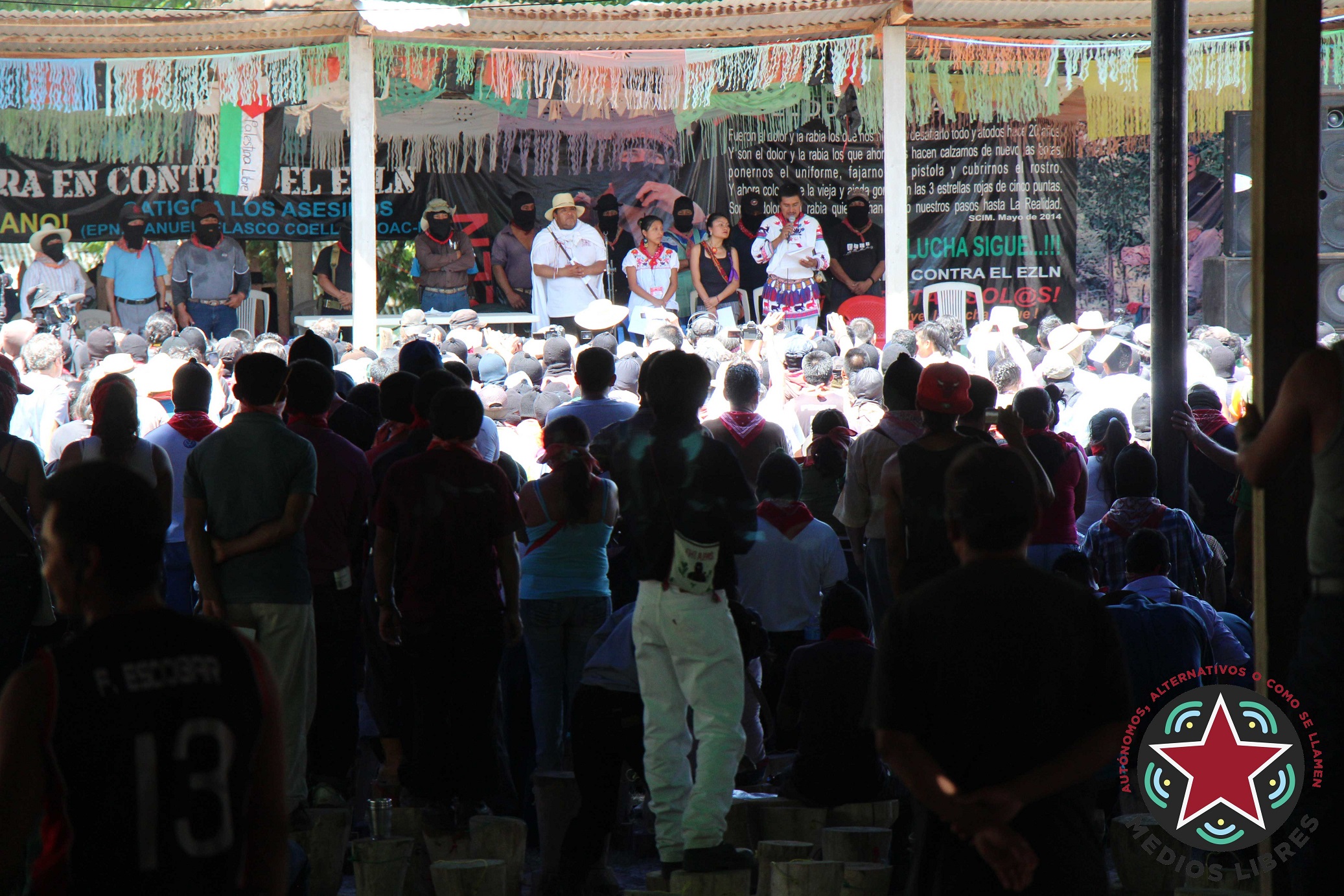
Después de una semana de compartir dolores pero también resistencias, los pueblos indígenas de México, integrantes del Congreso Nacional Indígena (CNI), que se reunieron con los pueblos zapatistas del 4 al 9 de agosto de 2014, en el Caracol de la Realidad, dieron a conocer tres declaratorias donde denuncian el despojo y la represión contra sus comunidades y hacen una invitación a intercambiar experiencias de lucha.
Segunda Declaración de la Compartición entre el CNI y el EZLN: sobre el Despojo contra Nuestros PueblosSecond Declaration of the CNI-EZLN Exchange: On the Dispossession of Our Peoples
“LOS ESPEJOS EN LA RESISTENCIA”
DECLARACIÓN DE LA COMPARTICIÓN CNI-EZLN
SOBRE EL DESPOJO CONTRA NUESTROS PUEBLOS
SOBRE EL DESPOJO CONTRA NUESTROS PUEBLOS
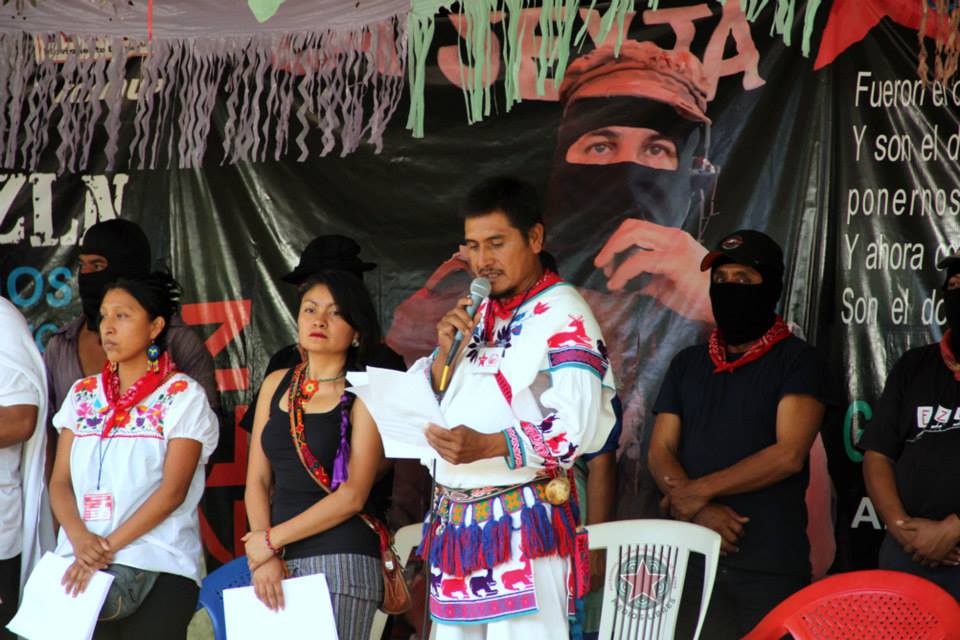
“La tierra que nos vio nacer, que nos da la vida y finalmente descansamos en ella eternamente. Por eso somos todos los colores que somos, todas las lenguas que hablan nuestros corazones, por eso somos pueblos, somos tribus y somos nación. Somos los y las guardianas y guardianes de estas tierras, de este país México, de este continente y del mundo”.
(EZLN, agosto del 2014)
ESCUCHA EN AUDIO AQUÍ: [podcast]https://radiozapatista.org/Audios/comparticion092014_2_despojo.MP3[/podcast]
A la Sexta Nacional e Internacional
A los pueblos del mundo que resisten floreciendo rebeldías
El despojo de lo que somos como pueblos originarios es el dolor que nos reúne en el espíritu de la lucha que hoy conmemoramos en nuestro compañero David Ruíz García, quien falleció compartiendo el dolor de los hermanos del Ejército Zapatista de Liberación Nacional por el asesinato del compañero Galeano y para hacernos uno en nuestra historia y en nuestra esperanza.
La muerte del compañero, que se renace hoy en colectivo de 28 pueblos, colores y lenguas reunidos en el Caracol Zapatista de La Realidad nos inspira en la compartición como pueblos originarios una alegría de encontrarnos, de sabernos vivos como vivos somos los pueblos, las lenguas, la historia colectiva que se hace memoria, resistencia y congruencia hacia nuestra madre que es la tierra que también está viva y a ella nos debemos.
La lucha que somos es diversa y al enemigo lo nombramos despojo porque es lo que vemos, morimos y vivimos todos los días, de manera colectiva como es el maíz, como es el compañero Galeano, como es el compañero David y como son nuestros hermanos y hermanas a los que ha sido arrebatada la vida en esta guerra de exterminio.
Es tan diverso ese despojo que tiene un solo nombre, y se llama capitalismo.
Desde un principio el capitalismo se ha crecido del DESPOJO y de la EXPLOTACIÓN. DESPOJO e INVASIÓN, son la palabra que mejor describe lo que llamaron conquista de América, despojo y robo de nuestras tierras, de nuestros territorios, de nuestros saberes, de nuestra cultura. DESPOJO, acompañado de guerras, de masacres, de cárcel, de muertes y más muertes, que se hacen vida colectiva porque aquí estamos los pueblos que somos, que seguimos siendo.
Después de la guerra de Independencia, el surgimiento de la nueva nación, la reforma liberal y la dictadura de Díaz, México se nació negando a nuestros pueblos, mediante constituciones y leyes que privatizaban nuestras tierras y pretendían legitimar el saqueo de nuestros territorios. Miles de nuestros hermanos, decenas de nuestros pueblos fueron exterminados a través de campañas militares y de su destierro masivo.
A pesar de un millón de indígenas y campesinos muertos durante la revolución, las leyes agrarias que surgieron después fueron inspiradas por Venustiano Carranza y Álvaro Obregón, los asesinos de Emiliano Zapata, con el fin de proteger los latifundios, impedir la restitución de las tierras, aguas, aire y montes comunales de los pueblos y convertir la propiedad comunal en ejidal. Es decir nos han querido matar una y otra vez, matar como pueblos y matar en lo individual. Y tras tanta muerte seguimos siendo los pueblos vivos y colectivos.
La respuesta al despojo y al exterminio fueron la rebeldía y la resistencia. Cientos de rebeliones en Baja California, Sonora, Chihuahua, Nayarit, Jalisco, Guanajuato, Michoacán, Querétaro, Veracruz, Estado de México, San Luis Potosí, Hidalgo, Morelos, Puebla, Guerrero, Oaxaca, Chiapas, Yucatán, Campeche, y Quintana Roo, y destacadamente la revolución zapatista; desafiaron a la sociedad colonialista, ocurridas todas después de la reforma liberal, estallando el movimiento armado de 1910 y defendiendo con las armas la posesión de la tierra comunal hasta los tiempos de la reforma agraria y la expropiación petrolera cardenista.
En la actualidad los capitalistas neoliberales, con el apoyo de todos los partidos políticos y los malos gobiernos encabezados por el criminal y jefe paramilitar Enrique Peña Nieto, están aplicando las mismas políticas de despojo a gran escala que aplicaron los liberales del siglo diecinueve, los carranzas o los obregones, apuntalándose en la militarización y paramilitarización, asesoradas por los cuerpos de inteligencia estadounidense, en aquellas regiones donde las resistencias se enfrentan al despojo.
Al igual que los gobiernos de aquellos tiempos, los actuales gobernantes están entregando nuestros territorios y los bienes que se nombran de la Nación a las grandes empresas nacionales y extranjeras, buscando la muerte de todos los pueblos de México y la de nuestra madre tierra, pero la muerte entre nuestros pueblos se renace en colectivo.
Reiteramos que nuestras raíces están en la tierra, y los despojos que retratamos en la Cátedra Tata Juan Chávez Alonso en agosto del año 2013, son nuestro dolor y nuestra rabia; de donde nacen nuestra determinación y nuestra rebeldía. Que son nuestra lucha irrenunciable y nuestra vida propia. Son despojos que siguen tan vivos como en ese entonces y que además se han multiplicado con nuevas formas y en nuevos rincones, que se hacen luchas y resistencias en las que vemos espejos que se reflejan en el espejo que somos:
Espejo 1: En la costa nahua del estado de Michoacán la ambición sobre las riquezas naturales ha sido motivo desde el año de 2009 de 31 asesinatos y 5 desapariciones a manos de los Caballeros Templarios que dependen de la corrupción en las estructuras del mal gobierno, que han protegido el despojo de tierras comunales por supuestos pequeños propietarios que son a su vez cabezas del crimen organizado en la región, el saqueo ilegal de minerales y maderas preciosas para después ser exportadas por empresas trasnacionales chinas desde los puertos de Manzanillo y Lázaro Cárdenas que administra el mal gobierno y su corrupción que ha dejado una ola de luto, de dolor, brutalidad ante la que la comunidad de Ostula se ha fortalecido con la creciente rebeldía que le permite mantener la seguridad y detener el saqueo de sus recursos. Todo esto mientras los malos gobiernos no dejan de amenazar con desarticular la autodefensa indígena como un derecho, con encarcelar o matar a los líderes comunitarios, lo que es un aviso de destrucción.
Espejo 2: El territorio nahua y totonaco del Totonacapan, Veracruz, se encuentra destruido por las lumbreras, la liberación de gas venteado, derrames tóxicos por ductos dañados que han devastado las fuentes de agua de la región. Todo esto como parte del Proyecto Paleocanal de Chicontepec, ahora nombrado Aceites Terciarios del Golfo donde se explotan 29 campos petroleros en una superficie de 3875 kilómetros cuadrados, donde se están explotando 1500 pozos petroleros en 14 municipios de la región, matando ríos y arroyos por cientos de derrames originados en 2220 reparaciones que se han realizado hasta el año 2010, existiendo la amenaza de 33 mil reparaciones de acuerdo con información de la Comisión Nacional de Hidrocarburos. Ahí se han realizado fracturas por la detonación de dinamita apuntalante y fracturamiento hidráulico (fracking) en 1737 pozos en toda la zona. En esa misma franja también se han otorgado numerosas concesiones mineras que ponen en riesgo la integridad del territorio.
Espejo 3: El Pueblo Wixárika pese a que se encuentra inmerso entre los límites de los estados de Jalisco, Nayarit y Durango, tiene un territorio continúo y su organización autónoma es fuerte y ancestral. Hoy enfrenta embestidas por varios frentes simultáneos, desde añejas invasiones agrarias en las que pese a haber sido ordenada la restitución a favor de la comunidad de San Sebastián Teponahuaxtlán, esta no se ha ejecutado por las indefiniciones limítrofes entre estados. Su territorio esta siendo atravesado por carreteras cuyo objetivo es el despojo de los recursos naturales de la región como es el caso de la comunidad de Santa Catarina Cuexcomatitlán que desde el año de 2008 detuvo mediante fuertes movilizaciones la imposición de la carretera Amatitán- Bolaños- Huejuquilla y actualmente el gobierno del estado de Jalisco se ha negado a reparar los daños causados a su bosque, a su camino comunal y a sus sitios sagrados a pesar de que la comunidad obtuvo resoluciones judiciales favorables.
En el estado de Durango, la Comunidad Wixárika Autónoma de Bancos de San Hipólito continúa en su larga lucha por el reconocimiento de su territorio ancestral, ejerciendo la autonomía como única vía de seguir existiendo como pueblo originario.
El territorio para nuestros pueblos no solo es agrario sino ceremonial y para el pueblo Wixárika el principal de sus sitios sagrados se encuentra en el desierto de Wirikuta, San Luis Potosí, que además de estar amenazado por 5 empresas mineras que tienen en su poder mas de 78 concesiones, en él se realiza el saqueo sin autorización alguna de antimonio, uranio, oro y plata en las zonas de San José de Coronados y la Presa Santa Gertrudis, en los municipios de Catorce y Charcas.
Espejo 4: En el municipio de Villa Guerrero, Jalisco, la comunidad Autónoma Wixarika- Tepehuana de San Lorenzo de Azqueltán que a pesar de tener un título virreinal desde el año de 1733, no ha sido reconocida en su territorio y por el contrario, se ha puesto a merced de caciques y gobiernos la superficie que siempre ha sido de ellos. El bosque es talado, invadido el territorio y destruidos sus sitios sagrados, como es el Cerro Colotlán, donde el mal gobierno ha dado su aval y dinero a los terratenientes para que usen cientos de piedras ceremoniales labradas como barreras de piedra para supuestas obras de protección de suelo. Lo que no solo es un despojo sino un genocidio.
Espejo 5: En el Istmo de Tehuantepec, donde habitan el pueblo Ikoots y Binniza de las comunidades de San Mateo del Mar y San Dionisio del Mar, así como el pueblo de Juchitán y la colonia Álvaro Obregón; las empresas Endesa, Iberdrola, Gamesa y Unión Fenosa Gas Natural Fenosa, Demex, filial de Renovalia Energy, Electricte de France (EDF), Eolicas del Sur, Zapotecas de Energía, Grupo Mar, Preneal, Ener green Power, estan despojando tierras comunales y destruyendo lugares sagrados en toda esta región, donde han sido ocupadas de manera ilegal mas de 32 mil hectareas donde han instalado 1600 aerogeneradores en Juchitan y Unión Hidalgo por los parques eólicos Biiyoxo y Piedra Larga I y II en tierras comunales desde el año 2001, en la actualidad la asamblea de comuneros de Unión Hidalgo, se oponen a la expansión de estos parques en los terrenos comunales del Palmar, El Llano, las áreas protegidas de manglar en el sur de las comunidades Binizaa. Territorio defendido por nuestros compañeros de la Asamblea Popular del Pueblo Juchiteco, Asamblea de Pueblos Indígenas del Istmo de Tehuantepéc en Defensa de la Tierra y el Territorio (APIITDTT).
En la misma zona del Istmo, la región de San Miguel Chimalapas y Santo Domingo Zanatepec, Oaxaca, fue invadida por 3 concesiones mineras otorgadas a favor de la Cooperativa la Cruz Azul en el lote minero al que llaman el Chincuyal, de la Minera Cascabel en el lote minero Mar de Cobre y de la Minera Zalamera en el lote minero Jackita, subsidiaria de la Mina Orum Gold Corporation, mismas que abarcan una superficie de 7310 hectáreas sobre terrenos de nuestros pueblos. Donde existe una invasión por parte del gobierno del estado de Chiapas, ricos ganaderos y por el Ejército Méxicano.
Al note del Istmo de Tehuantepec, al sur de Veracruz, el territorio Nahua Popoluca en la Sierra de Santa Martha, se encuentra amenazado por un proyecto minero que abarca tres concesiones llamadas La Morelense 1, La Morelense 2 y La Ampliación que pone en riesgo el medio ambiente y la integridad de esta zona indígena.
Espejo 6: En la comunidades ñatho de San Francisco Xochicuautla y Huitzizilpan, así como en una amplia franja del Alto Lerma, Estado de México, se pretende imponer el proyecto carretero privado Toluca- Naucalpan a cargo de la empresa Autovan, afectando un total de 23 kilómetros de bosque, además de la construcción de miles de casas habitación y clubs de golf como parte del proyecto denominado Gran Reserva Santa Fé. Este territorio es defendido por nuestros hermanos del Frente de Pueblos Indígenas en Defensa de la Madre Tierra.
Espejo 7: En la comunidad nahua de Tuxpan, Jalisco por presión de los malos gobiernos y los inversionistas nacionales y extranjeros, los indígenas han tenido que rentar las tierras ejidales a empresas aguacateras trasnacionales con sede en Michoacán, y son despojados por invernaderos extranjeros como Driscolt y Aguacates Los Tarascos, que hacen una modificación climática evitando que llueva.
Espejo 8: La comunidad coca de Mezcala, Jalisco, sigue sufriendo y defendiendo su territorio en contra del empresario Guillermo Moreno Ibarra que mantiene invadido un predio en la zona forestal de la comunidad y preservando su posesión y propiedad ancestral sobre la Isla sagrada que los malos gobiernos solo ven como un negocio millonario que puede poner en venta para las empresas turísticas extranjeras.
Espejo 9: En el territorio Chinanteco, en el estado de Oaxaca, se han impuesto reservas ecológicas que arrebatan el control territorial a los pueblos, mientras que al mismo tiempo el mal gobierno implementa proyectos de destrucción y muerte como la carretera Tuxtepec- Huatulco y el Corredor Turístico Chinanteco.
Espejo 10: En Huexca, Morelos, zona nahua del oriente del estado, fue impuesta una de las dos Termoeléctricas en zona de riesgo volcánico que forman parte del Proyecto Integral Morelos, promovidas por la empresa Abengoa y la Comisión Federal de Electricidad, con el apoyo de los tres niveles de gobierno, el Ejército Mexicano y la policía estatal. Asimismo como parte de dicho proyecto se busca construir un acueducto para la extracción del agua del río Cuautla, que afectará a 22 ejidos del municipio de Ayala.
Espejo 11: En Amilcingo y Jantetelco, en Morelos, zona nahua del oriente del estado y en la región nahua del Valle de Puebla, en las comunidades de San Geronimo Tecuanipan, San Lucas Atzala, San Andres Calpan, Santa María Zacatepec, San Lucas Tulcingo, Santa Isabel Cholula, San Felipe Xonacayucan, Santa Lucia Cosamaluapan, San Isidro Huilotepec, San Buenaventura Nealtican, San Juan Amecac y otras comunidades de Puebla y Tlaxcala se pretende imponer un gaseoducto de 160 kilometros en zona de riesgo volcánico, también como parte del Megaproyecto Integral Morelos, promovido por la CFE, las empresas españolas Elecnor, Enagas y la italiana Bonatti. En todas las comunidades los tres niveles de gobiernos de dichos estados han ejercido una represión brutal en los últimos dos años.
Espejo 12: En Tepoztlán, Morelos, perteneciente al pueblo nahua, se pretende despojar el territorio de la comunidad no solo de sus tierras sino de la biodiversidad de su territorio y cultura milenaria por la ampliación de la autopista La Pera-Cuautla, con la que se han derrumbado arboles ancestrales y sitios sagrados que permanecieron en el territorio durante muchas generaciones, pretendiendo con ello la llegada de empresas privadas e industrialización de las zonas más ricas en recursos naturales del estado de Morelos. La respuesta de los malos gobiernos fue una campaña de desprestigio en contra de los pueblos originarios para justificar el despojo.
Espejo 13: En el territorio nahua de la comunidad de Ayotitlan, en la Sierra de Manantlán en el estado de Jalisco, el saqueo de dos millones de toneladas de hierro y de maderas preciosas con el apoyo del crimen organizado se ha realizado con asesinatos y desapariciones de comuneros y ejidatarios.
Espejo 14: En la comunidad nahua de Zacualpan, en el estado de Colima, en meses pasados un empresario de apellido Verduzco, con la complicidad del gobierno del estado y la Procuraduría Agraria, intentó imponer una mina de hierro, oro, plata y manganezo en el Cerro Grande, en cuyos bosques se produce la totalidad de las aguas que abastecen a Colima y Villa de Alvarez; asimismo en el Cerro Grande el gobierno promueve programas de supuesta conservación ecológica, pretexto con el cual ha despojado a la comunidad de sus aguas comunales.
Espejo 15: La comunidad de Cherán, Michoacán en la meseta Purhépecha ha sufrido la devastación y robo de miles de hectáreas de bosques, a manos de talamontes ligados a la delincuencia organizada en complicidad con el mal gobierno, que han ejercido una violencia sin precedente en contra de los comuneros; mismos que ejerciendo su derecho ancestral de ejercer su autodefensa del territorio en un marco de autonomía y libre determinación, han constriudo su propio modo de gobierno atraves de los usos y costubres.
Espejo 16: En territorio maya de Campeche, el despojo se disfraza de rentas de tierras en las comunidades de la región de los Chenes por grupos denominados menonitas, donde el mal gobierno les entrega dinero para fortalecer el despojo de los territorios, además de imponer la siembra de cultivos transgénicos de soya.
Mientras tanto en las regiones indígenas de la llamada Riviera Maya se han dado acelerados procesos de privatización para proyectos turísticos nacionales y extranjeros, así como la destrucción de inumerables lugares sagrados.
El pueblo Maya de Bacalar, en el estado de Quintana Roo, viene sufriendo la imposición de cultivos de soya transgénica que ponen en riesgo sus semillas nativas, salud y alimentación como pueblo originario, por parte de las empresas Monsanto, Singenta y Pioneer con la complicidad de los malos gobiernos.
El Pueblo Maya de Yucatán es amenazado por diversos megaproyectos como el parque eólico en Dzilam de Bravo, la siembra del maíz transgénico, el proyecto del tren Transpeninsular, y el desarrollo inmobiliario que beneficia a unos cuantos empresarios y políticos corruptos.
Espejo 17: En el pueblo Tzeltal de Chilón, Chiapas, se ha pretendido la imposición de la construcción de la autopista San Cristóbal-Palenque en territorio de la comunidad.
Espejo 18: La comunidad nahua de San Pedro Tlanixco en el estado de México, ha sido despojada de sus manantiales y aguas del río Texcaltenco mediante concesiones en beneficio de ricos empresarios agroindustriales del municipio de Villa Guerrero, lo que ha costado la cárcel para sus líderes comunitarios.
Espejo 19: En el estado de Guerrero, en los municipios de Xochistlahuaca, Tlacoachistlahuaca, y Ometepec, cientos de comunidades amuzgas, mixtecas y afromestizas, se ven amenazadas por las obras de entubamiento del río San Pedro para llevarlo a la ciudad de Ometepec, atentando contra el derecho básico a la vida que tenemos como pueblos.
Espejo 20: La comunidad nahua de Xoxocotla, del Surponiente de Morelos, en zonas aledañas al sitio sagrado denominado Xochicalco es amenazada con la imposición de un proyecto minero que abarca 7 concesiones en 3 municipios que abarcan una superficie de 15 mil hectáreas en Xoxocotla, Temixco, Xochitepec y Miacatlán, en las comunidades Tetlama, Alpuyeca, Coatetelco, La Toma, Xochicalco.
Espejo 21: En el territorio Yaqui en el estado de Sonora, la ambición sobre el agua del Río Yaqui ha sido motivo de agresiones históricas en contra de la tribu y en la actualidad se pretende llevar el agua hacia la ciudad de Hermosillo mediante el acueducto Independencia, en perjuicio tanto de los Yaqui, así como de cientos de hectáreas de la tribu mayo yoreme y los agricultores del Valle del Yaqui.
Espejo 22: El pueblo Náyeri, en el estado de Nayarit ha sido guardián histórico del río San Pedro, donde se encuentra su sito sagrado denominado Muxa Tena, que hoy se encuentra amenazado por la construcción de la presa Las Cruces.
Espejo 23: En el estado de Sonora, con la construcción de la presa Los Pilares se destruirán sitios sagrados del pueblo Guarijío.
Espejo 24: Bachajón, Chiapas, pueblo Tzeltal, está siendo despojado en su tierra, agua y cultura, por la construcción de complejos turísticos en las cascadas de Agua Azul, además de carreteras y hoteles, mediante la represión de paramilitares.
Espejo 25: El pueblo Ch’ol de Xpujil, en el estado de Campeche fue desplazado de su territorio por la imposición del decreto de Reserva de la Biósfera de Calakmul que sobrepuso a la comunidad el área núcleo que restringe absolutamente su acceso al territorio.
Espejo 26: En territorio Nahua y Totonaco de la Sierra Norte de Puebla, en los municipios de Tlatlaqui, Zacapoxtla, Cuetzalan, Zoquiapan, Xochiapulco y Tetela, Zautla, Ixtacamaxtitlán, Olintla, Aguacatlán, Tepatlán, Xochitlán, Zapotitlán, Zoquiapan y Libres los proyectos capitalistas de muerte buscan adueñarse de cada rincón del territorio, a través de extracción de minerales a cielo abierto y presas hidroeléctricas. Hoy el 18% del territorio de la Sierra Norte de Puebla está concesionado a empresas mineras, ya que el gobierno ha otorgado 103 concesiones a las empresas mexicanas Grupo Ferrominero, Industrias Peñoles y Grupo Frisco, así como a la canadiense Almaden Minerals. Por otro lado existen seis proyectos hidroeléctricos que afectarían 12 ríos en una superficie de 123 mil hectáreas repartida en 18 municipios.
Espejo 27: El territorio del pueblo Kumiai ha sufrido de invasiones masivas derivadas de la falta de reconocimiento, de la imposición de ejidos y de las declaratorias de bienes nacionales en sus tierras. En los últimos años han sido impuestos proyectos eólicos en sus tierras y en el territorio del pueblo Kiliwa.
Espejo 28 La comunidad de Nurío Michoacán en la meceta Purépecha fue despojada de la mayor parte de su territorio por resoluciones que en su momento dictaron las autoridades agrarias del Estado Mexicano que provocaron numerosos muertos por enfrentamientos entre comunidades colindantes. }
Espejo 29: En las comunidades de Bochil, Jitotol y Pueblo Nuevo, pertenecientes al pueblo Tzotzil de los Altos, Chiapas, denuncian que existen proyectos de represas que amenazan este territorio.
Estos son los despojos que sufrimos, que nos hacen sabernos en una emergencia que atenta contra nuestra vida y hoy les decimos a los poderosos, a las empresas y a los malos gobiernos, encabezados por el criminal jefe supremo de los paramilitares Enrique Peña Nieto que no nos rendimos, que no nos vendemos y no claudicamos.
Nuestra memoria está viva porque ella somos y a ella nos debemos y señalamos que no hay mejor memoria que la de nuestros pueblos, que como hoy nos reunimos para vernos el uno en el otro y nuestra lucha no acabará, pues si no nos han matado en 520 años de resistencia y rebeldía no lo harán ahora ni nunca, pues los que somos pueblos de maíz que, sabemos que la milpa es colectiva y de colores diversos, tan diversos que también nos queremos nombrar en una sola palabra, rebelde y anticapitalista, con los que son hermanos de la Sexta Nacional e Internacional. Hoy como el maíz, nos renovaremos en nuestra decisión para construir desde abajo y a la izquierda un mundo donde quepan muchos mundos.
“EL CORAZÓN DE NUESTRA MADRE TIERRA VIVE EN EL ESPIRITU DE NUESTROS PUEBLOS”
ANDIÜMAATS NANGAJ IüT MEAWAN NÜTs KOS NEJ ÜÜCH IKOOTS MONAPAKÜY (LENGUA OMBEAYETS/IKOOT)
NA MA JOIIY RA PUIY Y RA VENI GUI JIINI (OTOMÍ)
LADXIDO GUIDXILAYU NABAANI LU XQUENDA CA GUIDXI XTINU (LENGUA DIIDXAZA/BINNIZA)
I PUJUK’AL LAK´ÑA LUM KUXUL TYI CHULRL LAK LUMALO’ (CHOL)
TE YO TALN TEJ NANATIL LUM CUXUL SOL XCHULEL TEJ LUMALTIC (TZELTAL)
LI YOON JMETIK BALUMILÉ KUXUL XCHULEL TAJ TEKLUMALTIK (TZOTZIL)
JAS J’UJOL JAJ NANTIK LU’UM ZAK’AN JAB’AYALTZIL JAJ CHONA B’LLTIK (TOJOLABAL)
IN YOLOTL TO TLALTICPAC NEMI IEKAUILKOPA TO ALTEPEUAN (NAHUA)
TA TEI YURIENAKA IYARIEYA TAKIEKARIPA YEYEIKA (WIXARIKA)
U KUXTAL K-LÚUMIL TÍAN TI U YÓOL LE KÁAJILO’OB. (MAYA PENINSULAR)
JUCHARI MINTSÏTA P’ARHAKPINIRHU IREKASÏNI TSÏPIKUANIRHU JUCHARI IRETA (LENGUA PURE/P’URHEPECHA)
TU TLAL UI NANA IYULO ISTOK I TUNAL PAN CHINANKOME (NAHUA)
XNAKU KIN TSEKAN TIYAT STAKGNAMA CHI KGALHI LISTAKGNI NAK KIN PULATAMANKAN (TOTONACO)
BI MAMA NAX BI TZOKOY JEJPA NETZANKUYJO BI KOXEN KUMKUYDE KAY JENAN (ZOQUE)
UU JIAPSI Y iiTOM AYEE VUIAPO ITOM JIPSICO JIAPSA ITOM PUEBLOMPO (MAYO YOREME)
NA’ T’SATS´OOM TYUAA MAYA NA’ M´AA NAQUII´ NTAAYA JA NA NNA NCUEE (ÑOMDAA/AMUZGO)
Desde La Realidad Zapatista, Agosto de 2014.
POR LA RECONSTITUCION INTEGRAL DE NUESTROS PUEBLOS
¡NUNCA MÁS UN MÉXICO SIN NOSOSTROS!
CONGRESO NACIONAL INDÍGENA
EJERCITO ZAPATISTA DE LIBERACION NACIONAL
“LOS ESPEJOS EN LA RESISTENCIA”
Second Declaration of the CNI-EZLN Exchange: On the Dispossession of Our Peoples
“The earth is that from which we were born, that gave us life, and in which we will rest eternally. That is why we are all the colors that we are, all of the languages that our hearts speak; that is why we are peoples, tribes, and nations. We are the guardians of these lands, of this country Mexico, of this continent and of the world.”
(EZLN, August 2014)
LISTEN TO THE AUDIO HERE: [podcast]https://radiozapatista.org/Audios/comparticion092014_2_despojo.MP3[/podcast]
To the National and International Sixth:
To the peoples of the world who resist, giving bloom to rebellions:
The dispossession that we have faced as indigenous people is the pain that unites us in the spirit of struggle that we commemorate today in honor of our compañero David Ruíz García, who passed away while sharing the pain of the brothers and sisters from the Zapatista Army for National Liberation after the murder of compañero Galeano. We become one in our history and in our hopes.
The death of the compañero, who is today collectively reborn among the 28 peoples, colors, and languages that are gathered in the Zapatista Caracol of La Realidad, inspires us as original peoples to share the happiness of encountering each other; of knowing each other to be as alive as are our peoples, our languages, our collective history that becomes our memory, our resistance, and our accountability to mother earth, who also lives and to whom we are indebted.
The struggle that we collectively represent is diverse, and we name our enemy dispossession because that is what we see, live, and die every day—an experience as collective as the corn, as our compañero Galeano, as our compañero David, and as our brothers and sisters whose lives have been taken in this war of extermination.
This dispossession is so diverse that it can only be called by one name: capitalism.
From the beginning, capitalism has grown through DISPOSSESSION and EXPLOITATION. PLUNDER and INVASION are the words that best describe the so-called conquest of America—plunder and theft of our territories, of our knowledges, of our culture. DISPOSSESSION, accompanied by wars, massacres, imprisonment, death upon death; these create a life in common because here we are as the peoples that we are, that we continue to be.
After the War of Independence, the emergence of the new nation, and the liberal reforms and dictatorship of Díaz, Mexico was born in denial of our peoples, through constitutions and laws that privatized our lands and sought to legitimize the looting of our territories. Thousands of our brothers and dozens of our peoples were exterminated and exiled en masse through military campaigns.
In spite of a million deaths of indigenous people and peasants during the revolution, the agrarian laws that appeared afterward were inspired by Venustiano Carranza and Álvaro Obregón—the ones who assassinated Emiliano Zapata—with the goal of protecting the large land owners, preventing the return of the people’s communal lands, water, and air, and converting communal property into ejidos. That is to say, they have wanted to kill us off time and time again as peoples and as individuals. Yet through all of this death, we continue on as living and collective peoples.
We have responded to our dispossession and extermination with rebellion and resistance. Hundreds of rebellions in Baja California, Sonora, Chihuahua, Nayarit, Jalisco, Guanajuato, Michoacán, Querétaro, Veracruz, the State of Mexico, San Luis Potosí, Hidalgo, Morelos, Puebla, Guerrero, Oaxaca, Chiapas, Yucatán, Campeche, and Quintana Roo, and notably, the Zapatista revolution, defied colonial society. All of these took place after the liberal reforms, giving rise to the armed movement of 1910 and the armed defense of communal lands up until the era of the agrarian reforms and Cardenista oil expropriation.
Currently, the neoliberal capitalists, with the assistance of all of the political parties and bad governments led by the criminal paramilitary boss Enrique Peña Nieto, are applying the same policies of large-scale dispossession applied by the nineteenth-century liberals—the Carranzas, the Obregones—propped up by militarization and paramilitarization and advised by U.S. intelligence in areas where there is resistance to the dispossession.
Just like the governments of that era, the current governments are giving our territories and the resources that belong to the Nation to large national and foreign corporations, seeking the death of all the peoples of Mexico and of our Mother Earth. But death among our people means collective rebirth.
We reiterate that our roots are in the land, and that the dispossession that we discussed in the Seminar Tata Juan Chávez Alonso in August 2013 is our pain and our rage; it is where our determination and rebellion are born. It is our unceasing and unfailing struggle and our very lives. These dispossessions continue in force today just as before, and have multiplied into new forms and onto new corners where new struggles and resistances are born that are reflected in the mirror that we are.
Mirror 1: On the Nahua coast in the state of Michoacán, the drive to extract natural riches has been the reason, since 2009, for the murder of 31 people and the disappearance of 5 at the hands of the Caballeros Templarios [Knights Templar, a drug cartel]. They rely on corruption within the structure of the bad government, which has provided cover for the plunder of the communal lands by small proprietors who are in turn the regional heads of organized crime, and for the illegal extraction of minerals and precious wood to be exported by Chinese transnational corporations from the Manzanillo and Lázaro Cárdenas ports, which are administered by the bad government. This corruption has left a wave of mourning, pain, and brutality for the community Ostula, which has strengthened itself with a growing rebellion that has allowed them to maintain security and detain the extraction of their resources. All of this while the bad governments threaten unceasingly to dismantle the indigenous people’s right to defend themselves by imprisoning or murdering their community leaders—a warning of more destruction to come.
Mirror 2: The Nahua and Totonaco territories in Totonacapan, Veracruz, have been destroyed by electric power plants, the release of flared gas, and toxic spills from damaged pipelines that have devastated the region’s water sources. All of this is part of the Proyecto Paleocanal de Chicontepec, now known as Tertiary Gulf Oil, where 29 oil fields are being exploited in an area of 3,875 square kilometers, with 1,500 oil wells across 14 municipalities in the region, destroying rivers and streams through hundreds of spills originating from 2,220 well overhauls that were made up until the year 2010. Currently there is a threat of 33,000 more well overhauls according to the National Commission of Hydrocarbons. Fracturing has been carried out through the detonation of dynamite, and hydraulic fracturing (fracking) in 1,737 wells in the entire zone. In that same area numerous mining concessions have been granted that put at risk the integrity of the territory.
Mirror 3: The Wixárika people, despite the fact that they encompass parts of the states of Jalisco, Nayarit, and Durango, have maintained their continuous territory and their autonomous organization is strong and ancestral. Today they face an onslaught on simultaneous fronts: past agrarian invasions which, despite restitution having been ordered in favor of the community San Sebastián Teponahuaxtlán, continue without enforcement of restitution due to blurry delimitations between states. Their territory has been subjected to the imposition of highways whose objective is the plunder of the region’s natural resources, as has been the case of the community of Santa Catarina Cuexcomatitlán, which since 2008 has mobilized large protests to halt the imposition of the Amatitán-Bolaños-Huejuquilla Highway. Currently the government of the state of Jalisco refuses to repair the damages caused to their forests, communal roads, and sacred sites, despite the fact that the community obtained legal rulings in its favor.
In the state of Durango, the Autonomous Wixárika Community of Bacos de San Hipólito continues their long struggle for recognition of their ancestral lands, exercising autonomy as their only option for their continuing existence as indigenous peoples.
For our peoples, territory is not only agricultural but also ceremonial. The principal sacred site of the Wixárika people is found in the Wirikuta desert in San Luis Potosí, which, in addition to being threatened by 5 mining corporations who have in their possession over 78 concessions, is currently undergoing the unauthorized extraction of antimony, uranium, gold, and silver in the zones of San José de Coronados and Presa Santa Gertrudis, in the Municipalities of Catorce and Charcas.
Mirror 4: In the Municipality of Villa Guerrero in Jalisco, the Autonomous Community Wixarika-Tepehuana de San Lorenzo de Azqultán, in spite of holding a viceregal title since the year 1773, have not received recognition for their own territory. On the contrary, the land that has always belonged to them has now been put at the mercy of the caciques [land bosses] and governments. The forest is being cut down, the territory invaded, and their sacred sites destroyed, such as in Cerro Colotlán where the bad government has given the landowners endorsement and money to carve up ceremonial stones for use as stone barriers supposedly to protect the soil. This is not only dispossession, but genocide.
Mirror 5: In the Isthmus of Tehuantepec, where the Ikoots and Binniza people of the communities of San Mateo del Mar and San Dionisio del Mar live, as well as the people of Juchitán and the inhabitants of the barrio Álvaro Obregón, the firms Endesa, Iberdrola, Gamesa y Unión Fenosa Gas Natural Fenosa, Demex (a subsidiary or Renovalia Energy), Eclectricte de France (EDF), Eolicas del Sur, Zapotecas de Energía, Grupo Mar, Preneal, and Ener green Power are plundering communal lands and destroying sacred sites throughout the region. They have illegally occupied more than 32,000 hectares and installed 1,600 wind turbines since 2001 on top of communal lands in Juchitan and Unión Hidalgo for the Biiyoxo and Piedra Larga II and II wind farms. Currently, the collective assembly of Unión Hidalgo is opposing the expansion of these parks to the communal lands of Palmar and El Llano, protected mangrove areas in the south of the Binizaa communities. This is territory defended by our compañeros from the Popular Assembly of the Juchiteco People and the Isthmus of Tehuantepéc Assembly of Indigenous Peoples in Defense of Land and Territory (APIITDTT).
In the same area of the Isthmus, Oaxaca’s region of San Miguel Chimalapas and Santo Domingo Zanatepec was invaded by three mining concessions granted to the Cruz Azul Cooperative for the mining lot they refer to as El Chincuyal, to Cascabel Mining for the mining lot called Mar de Cobre, and to Zalamera Mining for the mining lot called Jackita, a subsidiary of the Orum Gold Mining Corporation—whose reach stretches across 7,310 hectares of our peoples’ lands. The invasion is being carried out by the government of the state of Chiapas, rich cattle ranchers, and the Mexican Army.
To the north of the Isthmus of Tehuantepec, in the south of Veracruz, the Nahua Popoluca territory in the Sierra de Santa Martha is under threat from a mining project that stretches across three concessions called La Morelense 1, La Morelense 2, and La Ampliación. The project puts the environment and the integrity of this indigenous area at great risk.
Mirror 6: In the ñatho communities of San Francisco Xochicuautla and Huitzizilpan, as well as in a wide strip of land called Alto Lerma in the State of Mexico, a private road project called Toluca-Naucalpan is being imposed by the Autovan corporation. It will affect a total of 23 kilometers of forest, in addition to the construction of thousands of homes and golf courses as part of the project called Gran Reserva Santa Fe. This territory is defended by our brothers from the Indigenous Peoples Front in Defense of Mother Earth.
Mirror 7: In the Nahua community of Tuxpan, Jalisco, under pressure by the bad governments and national and international investors, the indigenous people have had to lease out ejidal lands to transnational avocado companies headquartered in Michoacán. These communities are being dispossessed by foreign greenhouses such as Driscolt and Aguacates Los Tarascos, who are engaging in weather modification schemes that prevent rain.
Mirror 8: The coca community of Mezcala, Jalisco, continues suffering and defending their territory against the businessman Guillermo Moreno Ibarra, who has invaded and kept a plot in the community’s forest region. The community is preserving its possession and ancestral property over the sacred island that the bad governments can only see as a million dollar business that they can put up for sale to foreign tourist companies.
Mirror 9: In the territory Chinanteco, in the state of Oaxaca, ecological reserves have been imposed that have snatched territorial control from the peoples while, at the same time, the bad government implements projects of destruction and death, such as the Tuxtepec-Huatulco highway and the Chinanteco touristic corridor.
Mirror 10: In Huexca, Morelos, in the Eastern Nahua region of the state, one of the two thermoelectric plants that make up part of the Morelos Integral Project was constructed in a volcanic activity risk zone. This project is promoted by the Abengoa company and the Federal Electric Commission (CFE) with the support of the three levels of government, the Mexican Army, and the state police. The same project seeks to construct an aqueduct for the extraction of water from the river Cuautla, which will affect 22 ejidos in the Municipality of Ayala.
Mirror 11: In Amilcingo and Jantetelco in Morelos, the eastern Nahua region of the state and in the Nahua region of Valle de Puebla, in the communities San Geronimo Tecuanipan, San Lucas Atzala, San Andres Calpan, Santa María Zacatepec, San Lucas Tulcingo, Santa Isabel Cholula, San Felipe Xonacayucan, Santa Lucia Cosamaluapan, San Isidro Huilotepec, San Buenaventura Nealtican, San Juan Amecac, and in other communal regions of Puebla and Tlaxcala, the Integral Morelos Megaproject intents to construct a 160 kilometer pipeline in an area of volcanic risk. This Project is promoted by the CFE, the Spanish corporations Elecnor and Enagas, and by the Italian corporation Bonatti. Over the last two years, the three levels of government in their respective states have exerted brutal repression on all of these communities.
Mirror 12: In Tepoztlán, Morelos, belonging to the Nahua people, the expansion of the La Pera-Cuautla highway will dispossess the community not only of their lands but of their territory’s biodiversity and ancient culture. Ancient trees and sacred sites that have sat on that land for generations have been destroyed to allow the arrival of private companies and the industrialization of the most resource-rich areas in the state of Morelos. The response of the bad governments was a campaign to discredit the indigenous peoples in order to justify the plunder.
Mirror 13: In the Nahua territory of the community of Ayotitlan, in the Sierra de Manantlán in the state of Jalisco, the extraction of two million tons of iron and precious wood has been carried out with the support of organized crime and via assassinations and disappearances of the community and ejidal members.
Mirror 14: In the Nahua community of Zacualpan, in the state of Colima, over the past few months a businessman by the name of Verduzco, with the complicity of the state government and the Attorney General’s Agrarian office, tried to impose a mine for iron, gold, silver, and manganese in the Cerro Grande, whose forests produce all of the waters that supply Colima and Villa de Alvarez. Also in Cerro Grande, the government is promoting programs supposedly for ecological conservation but which serve as a pretext for the dispossession of the community from its communal waters.
Mirror 15: The community of Cherán, Michoacán, on the Purépecha Plateau, has suffered the devastation and the theft of thousands of hectares of forest at the hands of loggers linked to organized crime and with the complicity of the bad government. Violence without precedent has been unleashed against the community members who have exercised their ancestral right to defend their territory within a framework of autonomy and self-determination, constructing their own mode of government through traditional “uses and customs”.
Mirror 16: In the Maya territory of Campeche, dispossession is disguised through the leasing of land in the communities of the Chenes region by groups called Mennonites, to whom the bad government gives money in order to strengthen the plunder of the territories and impose the planting of transgenic soybean crops.
Meanwhile, in the indigenous regions of the so-called Riviera Maya, privatization processes have accelerated on behalf of national and international tourism projects which have destroyed countless sacred sites.
The people of Maya de Bacalar, in the state of Quintana Roo, are suffering the imposition of transgenic soy cultivation which poses great risk to the native seeds, health, and food of the indigenous people. This is done by companies such as Monsanto, Singenta, and Pioneer with the complicity of the bad governments.
The Maya people of the Yucatan are threatened by various megaprojects, such as the Dzilam de Bravo wind farm, the planting of transgenic corn, the Transpeninsular train project, and real estate development which benefits a handful of businesses and corrupt politicians.
Mirror 17: In the Tzeltal village of Chilón, Chiapas, the construction of the San Cristóbal-Palenque highway is being imposed on the community’s territory.
Mirror 18: The Nahua community of San Pedro Tlanixco, in the State of Mexico, has been stripped of its springs and waters from the Texcaltenco River through concessions benefitting wealthy agro-industrial companies from the Municipality of Villa Guerrero, and has led to the imprisonment of the community leaders.
Mirror 19: In the State of Guerrero, in the Municipalities of Xochistlahuaca, Tlocoachistlahuaca, and Ometepec, hundreds of Amuzga, Mixteca, and Afromestiza communities are threatened by the pipe-laying projects that would send water from the San Pedro River to the City of Ometepec, violating the basic rights that we have as peoples.
Mirror 20: The surrounding areas of the sacred site of Xochicalco in the Nahua community of Xoxocotla in the southwest of Morelos, are threatened by the imposition of a mining project that holds 7 concessions in 3 municipalities that cover an area of 15,000 hectares in Xoxocotla, Temixco, Xochitepec, and Miacatlan in the communities of Tetlama, Alpuyeca, Coatetelco, La Toma, and Xochicalco.
Mirror 21: In the Yaqui territory in the state of Sonora, ambitions over the waters of the Yaqui River has historically motivated aggressions against the tribe. Currently the threat is for the waters to be diverted to the City of Hermosillo via the Independence aqueduct to the detriment of both the Yaqui and hundreds of hectares of the Mayo Yoreme tribe and the farmers of the Valle del Yaqui.
Mirror 22: The Náyari people, in the state of Nayarit, have historically been the guardians of the San Pedro River, home to their sacred site Muxa Tena. Today this site is threatened by the construction of the Las Cruces dam.
Mirror 23: In the state of Sonora, with the construction of the Los Pilares damn, the sacred sites of the Guarijío people will be destroyed.
Mirror 24: Bachajón, Chiapas, a Tzeltal community, is being stripped of its land, water, and culture through the construction of tourist resorts at the waterfalls of Agua Azul, in addition to highways and hotels. This is taking place through paramilitary repression.
Mirror 25: The Ch’ol people of Xpujil, in the state of Campeche, were displaced from their lands by decree for the Calakmul Biosphere Reserve. It was imposed on the community in such a way as to completely restrict their access to the territory.
Mirror 26: In the Nahua and Totonaco territory in the Sierra Norte of Puebla, in the Municipalities of Tlatlaqui, Zacapoxtla, Cuetzalan, Zoquiapan, Xochiapulco y Tetela, Zautla, Ixtacamaxtitlán, Olintla, Aguacatlán, Tepatlán, Xochitlán, Zapotitlán, Zoquiapan and Libres, the capitalist death projects seek to possess every corner of the territory through the extraction of minerals via open air mining and hydroelectric dams. Today, 18% of the territory in Puebla’s Sierra Norte has been conceded to mining companies, as the government has granted 103 concessions to the Mexican companies Gruop Ferrominero, Industrias Peñoles, and Grupo Frisco, as well as to the Canadian company Almaden Minerals. There also exist six hydroelectric projects that affect 12 rivers in an area of 123,000 hectares, distributed across 18 municipalities.
Mirror 27: The territory of the Kumiai people has suffered massive invasions stemming from the lack of recognition, the imposition of ejidos, and the declaration of their lands as national patrimony. Over the last few years, wind projects have been imposed on their lands as well as on the territory of the Kiliwa people.
Mirror 28: The community of Nurío Michoacán on the Purépecha Plateau was stripped of the majority of its territory through resolutions dictated by the Mexican agrarian authorities that provoked conflicts between neighboring communities resulting in numerous deaths.
Mirror 29: The Bochil, Jitotol, and Pueblo Nuevo communities, of the Tzotzil people of the Chiapas highlands, denounce planned dam projects that threaten this territory.
These are the dispossessions that we suffer, that we learn about during emergencies when attempts are made on our lives. And today we say to the powerful, to the corporations, to the bad governments led by the supreme criminal paramilitary boss, Enrique Peña Nieto, that we do not surrender, that we do not sell out, that we do not give up.
Our memory is alive because we ourselves are that memory to which we are indebted. We understand that there is no better memory than that of our peoples, and as we gather now in order to see each other we see that our struggle will not end; if they haven’t killed us off in these last 520 years of resistance and rebellion, they won’t be able to do it now, or ever. We are people of corn; we know that the milpa is collective and its colors are diverse—so diverse that we also want to give ourselves one name: rebellious and anti-capitalist, with the brothers and sisters of the National and International Sixth. Today, like the corn, we renew our decision to construct from below and to the left a world where many worlds fit.
“THE HEART OF OUR MOTHER EARTH LIVES IN THE SPIRIT OF OUR PEOPLES”
ANDIÜMAATS NANGAJ IüT MEAWAN NÜTs KOS NEJ ÜÜCH IKOOTS MONAPAKÜY (LENGUA OMBEAYETS/IKOOT)
NA MA JOIIY RA PUIY Y RA VENI GUI JIINI (OTOMÍ)
LADXIDO GUIDXILAYU NABAANI LU XQUENDA CA GUIDXI XTINU (LENGUA DIIDXAZA/BINNIZA)
I PUJUK’AL LAK´ÑA LUM KUXUL TYI CHULRL LAK LUMALO’ (CHOL)
TE YO TALN TEJ NANATIL LUM CUXUL SOL XCHULEL TEJ LUMALTIC (TZELTAL)
LI YOON JMETIK BALUMILÉ KUXUL XCHULEL TAJ TEKLUMALTIK (TZOTZIL)
JAS J’UJOL JAJ NANTIK LU’UM ZAK’AN JAB’AYALTZIL JAJ CHONA B’LLTIK (TOJOLABAL)
IN YOLOTL TO TLALTICPAC NEMI IEKAUILKOPA TO ALTEPEUAN (NAHUA)
TA TEI YURIENAKA IYARIEYA TAKIEKARIPA YEYEIKA (WIXARIKA)
U KUXTAL K-LÚUMIL TÍAN TI U YÓOL LE KÁAJILO’OB. (MAYA PENINSULAR)
JUCHARI MINTSÏTA P’ARHAKPINIRHU IREKASÏNI TSÏPIKUANIRHU JUCHARI IRETA (LENGUA PURE/P’URHEPECHA)
TU TLAL UI NANA IYULO ISTOK I TUNAL PAN CHINANKOME (NAHUA)
XNAKU KIN TSEKAN TIYAT STAKGNAMA CHI KGALHI LISTAKGNI NAK KIN PULATAMANKAN (TOTONACO)
BI MAMA NAX BI TZOKOY JEJPA NETZANKUYJO BI KOXEN KUMKUYDE KAY JENAN (ZOQUE)
UU JIAPSI Y iiTOM AYEE VUIAPO ITOM JIPSICO JIAPSA ITOM PUEBLOMPO (MAYO YOREME)
NA’ T’SATS´OOM TYUAA MAYA NA’ M´AA NAQUII´ NTAAYA JA NA NNA NCUEE (ÑOMDAA/AMUZGO)
From the Zapatista La Realidad, August 2014.
FOR THE INTEGRAL RECONSTITUTION OF OUR PEOPLES
NEVER AGAIN A MEXICO WITHOUT US!
NATIONAL INDIGENOUS CONGRESS
ZAPATISTA ARMY FOR NATIONAL LIBERATION

 Fotografía: Cristian Leyva
 Fotografía: Itzayana Tarelo