The Arts and the Sciences in the history of (neo) Zapatismo
Listen here: (Descarga aquí)
The Arts and the Sciences in the history of (neo) Zapatista
Words of Subcomandante Insurgente Galeano
December 28, 2016.
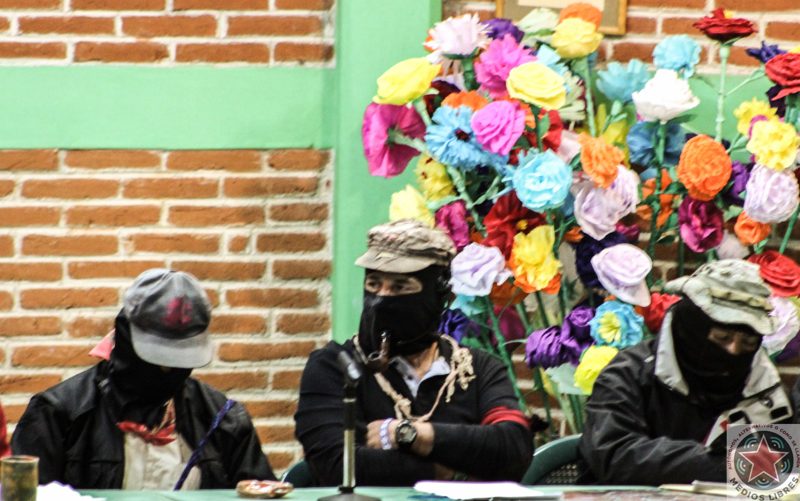
Last night I spoke to you about the interplanetary upheaval that had given rise to the question “Why is this flower this color? Why does it have this shape? Why does it have this scent?”
Ok, maybe I was exaggerating with the claim of “interplanetary.” I should have said the upheaval created by the question that young Rosita had put to Subcomandante Insurgente Moisés in the micro-cosmos of Zapatismo had provoked.
Although I believe it is obvious, it doesn’t hurt to mention that the response that SubMoy gave to the young Zapatista woman was the same one that, I’m not sure, but probably, I’m imagining, has fueled the advance of science since its very beginning: “I don’t know.”
Now I think that, certainly, the young woman knew what his response would be, but she also hoped that SubMoy would understand that, within the flower, there was a larger question.
We know now, because we are here in this meeting, that SubMoy knew that the response, “I don’t know” was not only insufficient, but also useless if it did not lead to other questions.
In a few minutes he is going to talk to you about what, as it were, is the context of the question…and about his response.
I am meant to speak to you briefly about the prehistory of this question and this response.
The arts and sciences prior to the uprising, within the eezeelen, had a very small universe and a brief history. Both the sciences and the arts had a purpose, a direction, and an imposed reason: war.
First in the guerilla encampments, then in the barracks, and later in the communities, the arts were limited to music, poetry, and a little bit of drawing and painting, all with exclusively revolutionary messages. Of course, it was not unusual that soon songs of love and broken hearts, corridos, rancheras and even the occasional Juan Gabriel ballad would appear, but that was only clandestinely within our clandestinity.
The Flower is to Blame
“The flower is to blame”
Listen here: (Descarga aquí)
December 27, 2016
“Earlier this year, on February 30, 2016, the Swedish electronic science magazine, River’s Scientist Research Institute, published a study that may revolutionize science and its social applications.
A group of scientists, led by Swedish doctors Stod Sverderg, Kurt Wallander, and Stellan Skarsgard, presented a complex, multidisciplinary analysis that arrived at the following provocative conclusion: There exists a direct correlation between the increase in quantity and quality of feminist movements, and the decrease in birth rates.
Combining statistical methods, embryology, molecular biology, genetics, and analytical behavior, the scientists concluded that the rise in the diversity of feminism’s belligerence provokes libido inhibitors in males, thus reduces the rate of frequency of sexual reproduction.
But there’s more. Laboratory analyses established that male spermatozoa exposed to feminist activism are weaker than unexposed spermatozoa. Known as astebizisoermia, or “lazy spermatozoa” syndrome, it is more prevalent in male populations where feminism occupies a protagonist role in social organization. According to the published article, Dr. Everet Bacstrom of the Rainn Wilson Institute, headquartered in London, tested the investigation’s theory with a sample of European, WASP, middle class males and reached the same conclusion.
In an interview with the publication, European feminist activists Chloë Sevigny and Sarah Linden said that the study was merely a dirty example of “patriarchal scientism.”