Produced by Los Tercios Compas. Mountains of the Mexican Southeast. Copyleft November 2023. With a Little Help from My Friends, Lennon y McCartney. Version by Joe Cocker.
Sorry, this entry is only available in Español. For the sake of viewer convenience, the content is shown below in the alternative language. You may click the link to switch the active language.
Hoy, 16 de noviembre de 2023, a las 12:00 horas, el Juzgado de Control y Tribunal de Enjuiciamiento Región III del Distrito Judicial de Ocosingo y Yajalón emitirá sentencia de Manuel Gómez Vázquez, base de apoyo zapatista, que desde hace dos años y 11 meses se encuentra detenido, acusado falsamente de homicidio.
El pasado martes, 14 de noviembre, inició la audiencia de juicio oral, que ya había sido diferida en tres ocasiones anteriores. Sobre la audiencia, dice la Red Ajmaq:
En medio de este teatro de injusticia nos quedamos con la imagen y sensación de que el compañero Manuel se mostró tal cual es: zapatista, digno, fuerte y rebelde, con la mirada al frente, los pies firmes y la sangre sabia. Su papá y mamá respaldando con amor y firmeza la vida. Estos tres compas eran una luz dentro de tanta obscuridad, falsedad, deshonestidad y mentira. Ell@s son un ejemplo de esperanza y dignidad de lo que afuera representa la organización del EZLN. Nos hubiera gustado mucho tomar una foto, para que tod@s ustedes fueran testig@s de todo lo que hemos presenciado, pero no permiten entrar con celular.
Durante el juicio, la Fiscalía Indígena sólo desahogó tres pruebas, ninguna de las cuales acredita la participación de Manuel en el delito del que se le acusa, y no presentó ningún testigo.
Junto con muchas otras organizaciones e individuos en México y el mundo, exigimos al Poder Judicial del estado de Chiapas la liberación inmediata y sin condiciones de Manuel.
Sorry, this entry is only available in Español. For the sake of viewer convenience, the content is shown below in the alternative language. You may click the link to switch the active language.
En el marco del 40 Aniversario de la fundación del Ejército Zapatista de Liberación Nacional y el 30 Aniversario del Levantamiento Zapatista, los invitamos a participar en el Foro: 40 y 30 años de Historia, Resistencia, Vigencia y Persistencia del EZLN.
Participa y hablemos de la “Nueva estructura de la Autonomía Zapatista”
La Cita es este 17 de nov. 16:00 Hrs. En la Casa de los Pueblos y Comunidades Indígenas “Samir Flores Soberanes”, ubicada en: Av. México-Coyoacán 343, Col. Xoco. Benito Juárez.
Al terminar compartiremos alimentos, pastel y un rico y aromático #CaféZapatista, y para cerrar, bailemos tod@s con alegre rebeldía. Te esperamos!!
#40y30AniversarioDelEZLN
#AltoALaGUERRAcontralosPublosZAPATISTAS]
Zapata Vive, la Lucha Siguen!
Viva el Ejército Zapatista de Liberación Nacional
Vivan las Comunidades Indígenas Zapatistas
Vivan los Pueblos Originarios!!
Atentamente
Comunidad Indígena Otomí residente en la CDMX
Coordinación Metropolitana Anticapitalista y Antipatriarcal con el CIG.
Sorry, this entry is only available in Español. For the sake of viewer convenience, the content is shown below in the alternative language. You may click the link to switch the active language.
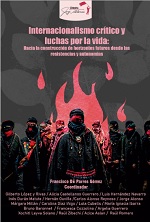
A unos días de cumplirse 40 años de la fundación del Ejército Zapatista de Liberación Nacional, estrenamos este trabajo colectivo que pretende reflexionar desde el caminar colectivo, algunos de los aprendizajes que nos han brindado los pueblos en su afán tenaz de transformar el mundo injusto en que vivimos. Desde las perspectivas internacionalistas que abarcan geografías amplias, se reflexiona sobre la Travesía por la Vida impulsada por las comunidades autónomas y al Congreso Nacional Indígena junto con muchas otras experiencias de lucha.
Francisco De Parres Gómez (Coordinador). Autores: Gilberto López y Rivas / Alicia Castellanos Guerrero / Luis Hernández Navarro / Inés Durán Matute / Hernán Ouviña / Carlos Alonso Reynoso / Jorge Alonso / Márgara Millán / Carolina Díaz Iñigo / Lola Cubells / María Ignacia Ibarra / Bruno Baronnet / Francesca Cozzolino / Argelia Guerrero / Xochitl Leyva Solano / Raúl Zibechi / Azize Aslan / Raúl Romero
Libro coeditado desde la Cátedra Jorge Alonso, el CIESAS Occidente, la Universidad de Guadalajara , el Cucsh Udg, Clacso – Consejo Latinoamericano de Ciencias Sociales , el Grupo de Trabajo: Cuerpos, Territorios, Resistencias, el Instituto de Investigaciones en Educación UV de la Universidad Veracruzana, Retos Nodo Chiapas Cooperativa Editorial Retos, la Cátedra Carlos Montemayor, la RERI. Red de Estudios sobre las Resistencias Indígenas y el Cotric – Colectivo Transdisciplinario de Investigaciones Críticas.
Ninth Part: The new structure of Zapastista Autonomy
November 2023
Brothers, sisters, comrades:
I am going to try to explain to you how we reorganized the autonomy, that is, the new structure of the Zapatista autonomy. I will explain more to you later in more detail. Or maybe I won’t explain more, because practice is what matters. Of course you can also come to the anniversary and watch the plays, songs, poems and the art and culture of this new stage of our struggle. If not, Tercios Compas will send you photos and videos. At another time I will tell you what we saw good and bad in the critical evaluation of MAREZ and JBG. Now I’ll just tell you how it looks. Here it goes:
First: The main base, which is not only where autonomy is sustained, also without which the other structures cannot function, is the Local Autonomous Government, LAG [GAL for its acronym in Spanish]. There is a GAL in each community where Zapatista support bases live. The Zapatista GALs are the core of all autonomy. They are coordinated by autonomous agents and commissioners and are subject to the assembly of the town, ranchería, community, area, neighborhood, ejido, colony, or however each population calls itself. Each GAL controls its autonomous organizational resources (such as schools and clinics) and the relationship with neighboring non-Zapatista brother towns. And controls the proper use of the pay. It also detects and reports mismanagement, corruption and errors that may exist. And is attentive to those who want to pass themselves off as Zapatista authorities to ask for support or aid that they use for their own benefit.
So, if before there were a few dozen MAREZ, that is, Zapatista Rebel Autonomous Municipalities, now there are thousands of Zapatista GALs.
Second. – According to their needs, problems and advances, various GALs are convened into Collectives of Zapatista Autonomous Government, ZAG [CGAZ for its acronym in Spanish], and here discussions are held and agreements are made on matters that interest the convening GALs. When they so determine, the Collective of Autonomous Governments calls an assembly of the authorities of each community. Here the plans and needs of Health, Education, Agroecology, Justice, Commerce, and those that are needed are proposed, discussed and approved or rejected. The coordinators of each area are at the CGAZ level. They are not authorities. Their job is to ensure that the work requested by the GAL or that are deemed necessary for community life. Such as, for example: preventive medicine and vaccination campaigns, campaigns for endemic diseases, courses and specialized training (such as laboratory technicians, x rays, ultrasound, mammograms and those that we learn on the way), literacy and higher levels, sporting and cultural events, traditional festivities, etc. Each region or CGAZ has its directors, who are the ones who summon assemblies if there is an urgent problem or one that affects several communities.
That is to say, where before there were 12 Good Government ‘Juntas’, now there will be hundreds.
Third. – Next, the Assemblies of Collectives of ZAPATISTA Autonomous Governments, ACZAG [ACGAZ for its acronym in Spanish]. Which are what were previously known as zones. But they have no authority, and depend on the CGAZ. And the CGAZ depend on the GAL. The ACGAZ convenes and presides over zone assemblies, when necessary according to the requests of GAL and CGAZ. They are based in the caracoles, but move between regions. In other words, they are mobile, according to the towns demands for attention.
Fourth. – As will be seen in practice, the Command and Coordination of Autonomy has been transferred from the JBG and MAREZ to the towns and communities, to the GAL. The zones (ACGAZ) and the regions (CGAZ) are governed by the towns, they must be accountable to the towns and must find a way to meet their needs in Health, Education, Justice, Food and those that arise due to emergencies caused by natural disasters, pandemics, crimes, invasions, wars, and the other misfortunes that the capitalist system brings.
Fifth. – The structure and disposition of the EZLN has been reorganized in order to increase the defense and security of towns and mother earth in the event of aggressions, attacks, epidemics, invasion of companies that prey on nature, partial or total military occupations, natural catastrophes and nuclear wars. We have prepared so that our towns survive, even isolated from each other.
Sixth. – We understand that you may have problems assimilating this. And that, for a while, you will struggle to understand it. It took us 10 years to think about it, and of those 10 years, 3 to prepare it for its practice.
We also understand that it seems to you that your thinking is scrambled. That is why it is necessary to change your channel of understanding. Only by looking far away, backwards and forwards, can the present step be understood.
We hope you understand that it is a new structure of autonomy, that we are just learning and that it will take a while to get going well.
In reality, this statement has only the intention of telling you that Zapatista autonomy continues and advances, that we think it will be better for the towns, communities, places, neighborhoods, colonies, ejidos and rancherías where they live, that is, the bases of Zapatista support. And that it has been their decision, taking into account their ideas and proposals, their criticisms and self-criticisms.
Also, as will be seen, this new stage of autonomy is made to confront the worst of the Hydra, its most infamous bestiality and its destructive madness. Their wars and business and military invasions.
For us, there are no borders or distant geographies. Everything that happens in any corner of the planet affects us and concerns us, worries us and hurts us. To the extent of our very small strength, we will support human beings in distress regardless of their color, race, nationality, belief, ideology and language. Although we do not know many languages or understand many cultures and ways, we know how to understand the suffering, pain, sorrow, and proud rage that the system provokes.
We know how to read and listen to brother hearts. We will continue trying to learn from them, their stories and their struggles. Not only because we have suffered from this for centuries and we know what it is like. Also, and above all because, as for 30 years, our fight is for life.
Surely we have made many mistakes in all these years. We will surely do more in the next 120 years. But we will NOT give up, we will NOT change path, we will NOT sell out. We will always be reviewing our struggle, its times and ways with a critical eye.
Our eyes, our ears, our heads and our hearts will always be ready to learn from others who, although different in many things, have our same concerns and similar desires for democracy, freedom and justice.
And we will always seek the best for our people and for our sister communities.
We are, therefore, Zapatistas.
As long as there is at least one man, one woman, one ‘otroa’ Zapatista in any corner of the planet, we will resist in rebellion, that is, we will fight.
See it for yourselves, friends and enemies. And those who are neither one thing nor another.
That is it, for now.
From the mountains of the mexican southeast.
Insurgent Subcommander Moisés.
Mexico, November 2023.
More than 500, 40, 30, 20, 10 years later.
P.S.- Here I leave you a drawing to see if you understand it a little.
Eighth Part: P.S. WHAT YOU HAVE TO READ TO KNOW WHAT IT’S ABOUT.
Legend has it that, in the times when time did not matter, rain and night covered the House of Beings. Then the power went out. Everything was darkness. Women, men and ‘otroas’ were stumbling and crashing with each other. For this reason, they argued and fought between brothers and neighbors. They didn’t even recognize each other, even though they were family members and acquaintances, because it was very dark. They scolded each other a lot.
The first gods, those who created the world, were lazy, lying in their hammocks, telling jokes and stories. But all the noise coming from the House of Beings reached them. “Whose noise is this?” asked one. “Who knows,” said another. Ixmucané, who was the mother goddess, said: “Let’s see what the noise is about,” but when she got out of the hammock, she fell and her face landed on the ground and it looked like it was dented, that is, like it had cracks. Ixmucané got up from the ground and did not swear because swear words had not yet been invented. She dusted herself off. She raised her skirt a little and ran towards the House of Beings.
The gods looked at each other and said nothing, but they thought, “Are we going to let a woman beat us?” and they got down from their hammocks, but carefully, and ran to catch up with Ixmucané. But it turns out that, since they had been lazy, they had not made or cleared path and there was a lot of bush. Pure ‘Acahual’, you see. There was an abundance of tzaw ch’ix (thorns), dry branches, sharp grass (which is also called gezau h’ak) and ch’oox tz’an, which is a vine with thorns. But there they went running and jumping as best they could and complaining on the way, those gods, because they were not going to allow a woman to beat them. They later arrived at the House of Beings, all scratched and dented on their faces and hands. But no one looked at them and noticed that they were all beaten up, because there was no light. That is why it is believed that the gods do not have wounds.
The gods didn’t look at anything either. Everything was dark. Just by the sound you knew there were more people. “And now?” the gods asked themselves. Ixmucané did not wonder anything, but remained thinking. The male gods were always very boastful and began to say that you have to go for ocote. Another said that they had to invent the the lamp. Another one said that had to gather a lot of fireflies. And so.
Ixmucané thought: “We have to replace the light. But to replace it, we have to find it. And to find it, we have to know where to look for it. And to know where to look for it, we just have to know what happened.”
Ixmucané gathered the men, women and ‘otroas’ of corn. At that time there were only men, women and ‘otroas’ made out of corn, they came in many colors and everyone had their own way. There were no religions, no nations, no States, no political parties, nor everything that was born later as seeds of war. So, when Ixmucané said “come, little brothers and sisters,” guided by her voice, all the men and women arrived, and ‘othroas’ too – because they did not feel excluded.
So they met in an assembly. They didn’t look at each other because there was no light, but they could talk and listen to each other.
Ixmucané asked them “What are we going to do?” The men, women and ‘otroas’ did not look at each other – because there was no light – but remained silent. Until a voice said “Well, you tell us what we are going to do.” The applause was not seen, but it was clearly heard. Ixmucané laughed heartily and said, “Do you think I know. We don’t know as it is, but maybe gathered together, in an assembly and talking, suddenly some ideas emerge about what we are going to do.» They were all silent, wondering what they were going to do.
The only noise that could be heard was the noise of the male gods who were fighting among themselves, saying where the hell was the ‘ocote’, and whether someone had remembered to create the fireflies, and whether it was not me, and whether that was up to I don’t know who but he always plays dumb or acts like a duck, and someone asked what is a “duck”, because the ducks were not made yet. And so.
In the assembly they were already talking and proposing how to do it. First just a few voices, then more. Then they had to make a list in order to speak in turns and have someone write if there is an agreement. Since there was no light to write or read, there was only the spoken word, so they named Ixmucané, for her to keep in her head everything that is said, and then talks about it.
Many ideas and words were said, and they no longer fit in his Ixmucané head. Then she began to keep them in her hair and her hair became long, that’s why women have long hair. But then it wasn’t enough either, although she adjusted her hair and that’s when the “hair press” was invented, which, as its name indicates, means “grab ideas.” Ixmucané’s hair was already reaching the ground and they continued speaking ideas and words. Then Ixmucané began to keep her ideas in the wounds she had gotten when she fell and with the thorns and vines. She had wounds everywhere: on her face, on her arms, on her hands, on her legs. Her entire body was full of wounds, so she was able to save everything. That’s why they say that old people, that is, sensible people, who have many wrinkles and scars, means that they have many ideas and stories. That is to say they know a lot.
In another turn I will tell you what they agreed on in that first assembly that took place in the House of Beings, but in this one I will tell you what Ixmucané said: “Well, we already have, as it were, a plan to face this problem that we have. Since the world is just being born and we are giving a name to each thing, so as not to confuse ourselves, we are going to call this thing we did «in common», because we all participated: some giving some ideas, others proposing other ideas, and there are those who speak and there are those who keep notes of what is said.”
There was silence first. Heavy, strong was the silence. Then you could hear someone start to applaud, then another, then everyone applauded and you could hear that they were very happy. And they didn’t dance because you could see nothing at all. But they laughed a lot because they had found a new word called “in common,” which means “to seek the path together.” And it was not that the first gods invented it, those who created the world, but it came to be that it was men, women, and ‘otroas’ made of corn, who, in common, found the word, that is, the way.
-*-
Ixmucané was the most knowledgeable of all the gods and, as she was the first to arrive at the House of Beings, she had more wounds, from the fall and from the race she did in the ‘Acahual’, and thus she was marked with those scars. “Wrinkles” and “scars,” they were called. Since then, wrinkles and scars represent wisdom. More wrinkles and scars, more knowledge. Of course, back then there were no social networks and no one was wearing makeup and modifying their photos with a well-known virtual application. And then it happens that you see the profile photo and then you see reality, and you want to run away. No, the wrinkles and scars were a source of pride and not something anybody could have. Even young men and women painted wrinkles and scars, or simply went into the mountains so that the thorns and vines scratched their faces. Because it didn’t matter who was prettier, but rather who was more knowledgeable. Instead of “followers” and “likes” they looked for who had the most wrinkles and scars.
And that’s it.
-*-
Yes, I would also like to know what happened to the lost light. Maybe later, in another postscript, we will know. For now, we have to learn to walk and live like this in the dark. There is no other way.
From the mountains of the Mexican southeast.
The Captain
November 2023. 40, 30, 20, 10 years after.
For over a month now, Israel has been bombing Gaza through air, sea, and land, in retaliation for the attack by Hamas on October 7, aimed at lifting the deadly blockade imposed on Gaza for 17 years, which has led to thousands of deaths, most of whom are children. Around 1,400 people died in that attack, although recent reports from Israel indicate that there is a strong possibility that many, if not most of the dead were killed by indiscriminate Israeli fire that day.
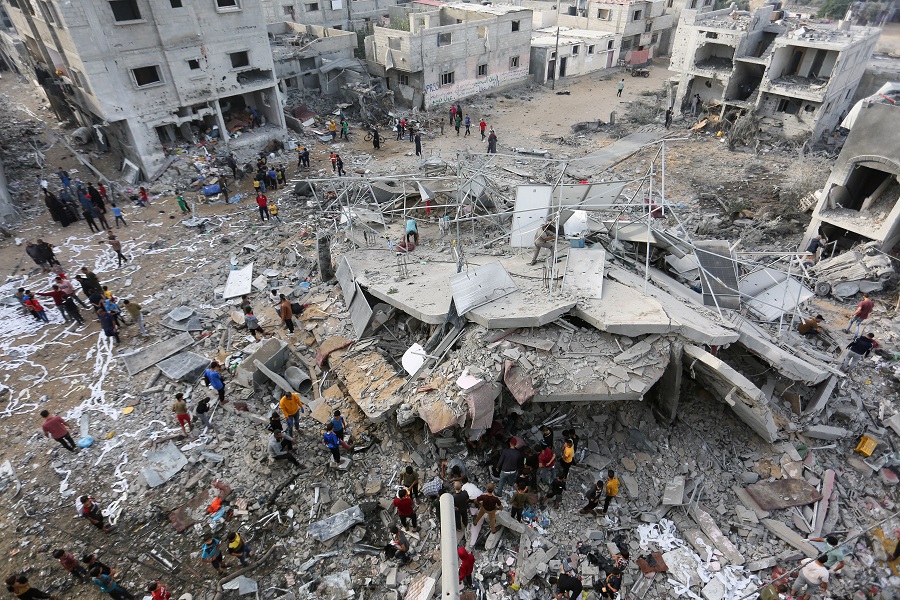
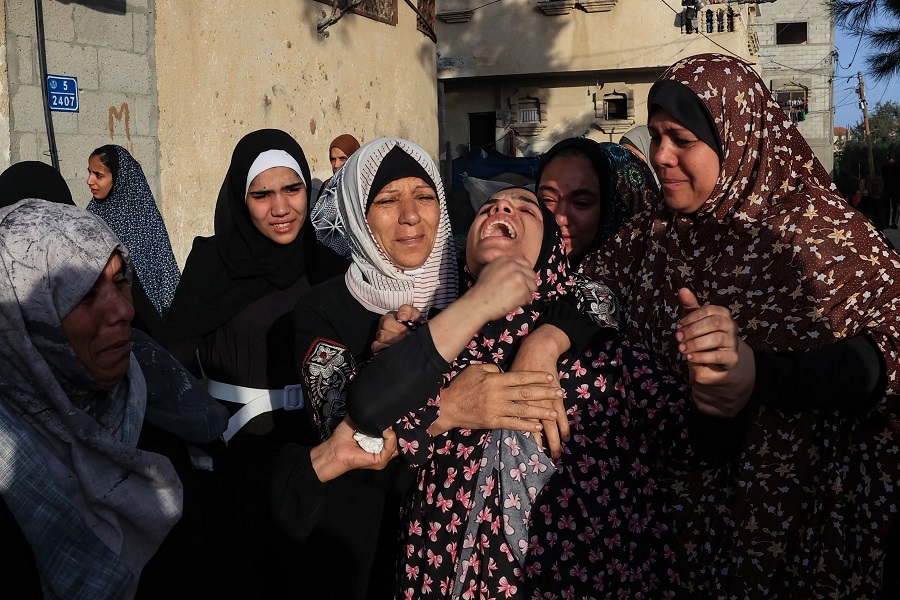
Israel’s offensive against Gaza has killed close to 11,000 people so far, at least 4,500 of whom are children. In violation of international law and all human rights conventions, Israel continues to massacre the civilian population indiscriminately, attacking hospitals, schools, ambulances, shelters, mosques, homes, buildings, and refugee camps, as well as infrastructure. Since October 7, Israel has hit at least 12,000 targets with 25,000 tons of explosives, according to Euro-Med Human Rights Monitor—the equivalent to two nuclear bombs. Massive demonstrations all around the world have condemned what is evidently Israel’s ethnic cleansing and genocidal project, not only committed through direct massacres, but also employing hunger and deprivation, cutting off access to food and clean water for a population of 2.5 million Palestinians.
From the West Bank, we spoke with Fuad Abu Saif, General Director of the Union of Agricultural Work Communities (UAWC), who explained the situation.
Foto: El Mundo
Thank you for being with us, Fuad. We would like to know what the situation is like in Gaza right now, but before we do that, we would like to know what life was like in Gaza for the last 16 or 17 years, since the borders were closed by Israel in 2006.
The story of Gaza, the West Bank and all of Palestine started not just on October 7 or even 16 or 17 years ago; it started 75 years ago when Israel occupied Palestine in 1948. In 2006, there was a national election in Palestine and Hamas won. Immediately, Israel imposed a siege in all of Gaza, which has made the life of people there very difficult. Gaza is a very small area: 665 km2 surrounded on all sides by Israel and the sea on the other side, and about 2.5 million people living there, all of them under siege. That means that there is no way to go in or out without passing through the Israeli border. They forbid about 100 different materials from entering Gaza, which means that all the fundamental and basic needs for life are prohibited from entering Gaza. And of course, there is no airport or other connection with the outside world, except through Egypt, which is also in agreement with Israel and also blocked that border.
We work closely with Gaza because our office is responsible for being in daily touch with people there. Thousands of people have died because there is not enough care in the hospitals, no materials, no fuel, no electricity. Even before October 7, electricity was only available for four hours a day. The water is contaminated, there is no clean water in Gaza, and no one can go in or out of Gaza for 16 or 17 years. So life was impossible…
Some people have described Gaza as the largest open-air prison in the world…
It’s not just an open-air prison. Israel waged five wars before this one during these 16 years, killed thousands of Palestinians and arrested many others. Thousands of Palestinians were killed because they entered their land in the area near the border between Israel and Gaza… everyone entering after 6 pm, they shoot them. Hundreds of farmers lost their life because they were late in their farm and the Israelis attacked them. Protesters who tried to protest and condemn this situation in the area were killed or injured because they organized a kind of march near the Israeli border—this has happened since 2014. The wars mean that military operations can happen at any moment, and it has happened five times without any reason to justify it. In the past 16 years, Israel initiated these military operations without having any attacks from Gaza.
What is it like now on the ground after October 7?
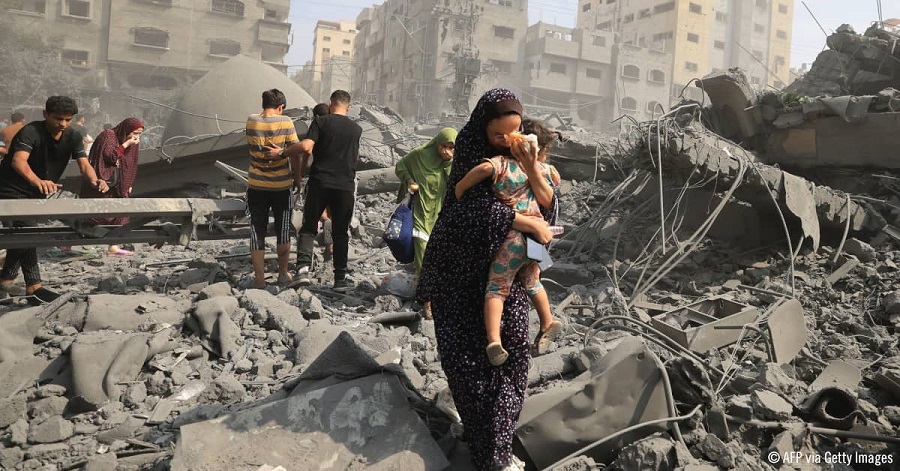
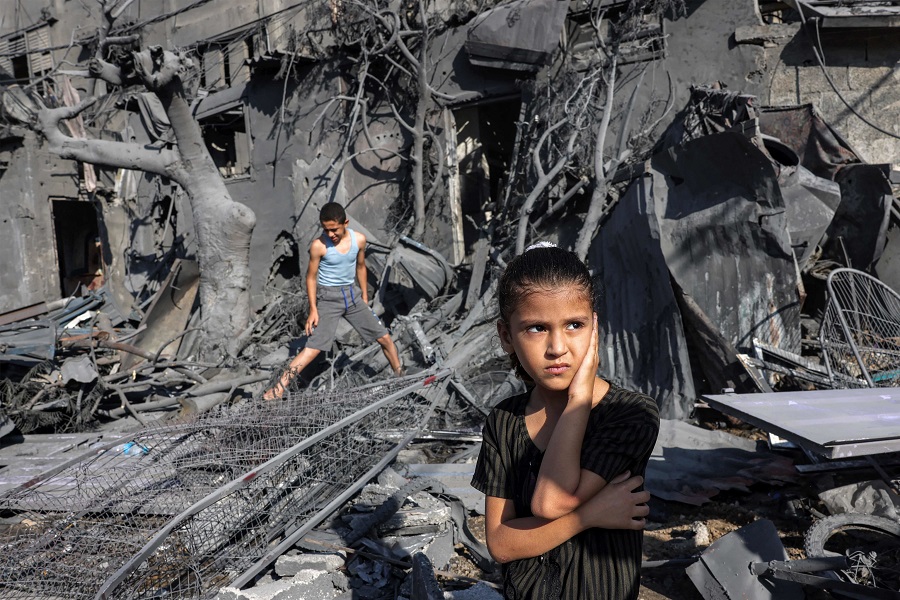
Since October 7, Israel started this genocide war in Gaza. The number of victims is increasing in a crazy way, until last night it was almost 11,000 Palestinians killed in one month, more than 55,000 injured by the Israeli air strikes against civilians, homes, and infrastructure in Gaza. The problem is that more than 69% are children and women. The way they are killing cannot be described. They bomb houses full of civilians and children. As you may know, the majority of people in Gaza are young and children, more than 60%. So all houses are full of children, and without alerting anyone, they bomb them, the houses, the buildings and everywhere in Gaza. Like I said, it is a very small area. Life cannot be described. There’s no safe place in all of Gaza, and in addition Israel, beside the siege imposed for 17 years, they imposed a different kind of siege—they totally cut off electricity on October 10. They cut off food and are using starvation in this war against civilian Palestinians. They cut roads, cut water, there is no food, no water, no safe place…
Foto: Mahmud Hams, AFP
How are people surviving with this lack of food, water, and mobility?
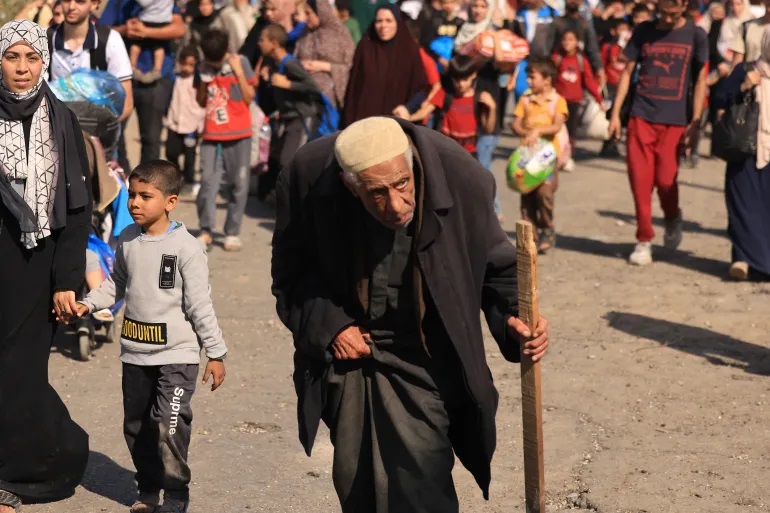
As a humanitarian organization, we launched from the beginning of this war a program to support people to have access to food. No food is available from the outside, we’re relying on the limited food inside Gaza. Gaza is an agricultural area. There are two different places: the buffer zone, which is a huge land area next to the Israeli border, where Israel isolated that area from the people and farmers, so no one can have access to that area. There is another small area, which is the land inside Gaza itself, where there is what we call the home gardens, where people plant around their homes. This is the only source of food they have. Plus there are some big suppliers in Gaza who had already stored food and materials before the war. We are in contact with them and they have almost run out in the last three or four days. They are managing with the very little food, and are scheduling between the families: this for tomorrow, this for after tomorrow. And as one of them told me: “Look, for us, we have no problem, but it’s difficult for me to describe that to my children, that we don’t have food and we have only one meal, which might sometimes be only bread or rice, and we explain this to the children and they start crying, they don’t understand what that means, but this is the only way that we are managing this starvation.” Water is the same… as an example, in Rafah, which is in the south of Gaza, where almost 900,000 Palestinians were forced to move from the north, plus the close to 1 million already living in that area. They have one well working manually because there is no electricity, and sometimes you have to wait four or five hours to fill your container with 30 to 40 liters, and if you are lucky you have water; if not, you come back the next day. They try not to use the bathroom, for example, this is an agreement, only one time per day. The stories coming from them are very hard, especially for children. Of course, there is no milk, and the bread sometimes is so dry that they have to mix it with water so children can eat it.
They allowed some trucks to enter Gaza, 150 trucks from the beginning. Some of the trucks were only filled to 30-40% of their capacity, and most of the materials and food were expired. Others bring things that the people don’t need, such as clothing.
Foto: Said Khatib, AFP
A few hours ago, the EZLN published a communiqué. Let me read you a part of it:
The murdered Palestinian children are not collateral victims, they are and always have been Netanhayu’s main objective. This war is not about eliminating Hamas. It is about killing the future. Hamas will only be the collateral victim. Israel’s government has lost the media battle because it turns out that genocide, even if disguised as revenge, does not have as many followers as it believed. It is now capable of the most unimaginable cruelty. The only ones who may perhaps end the massacre are… the people of Israel.
This brings me to a couple of questions. The first one has to do with the true motivations for this barbarism, which is backed by the United States, England, and other European countries. What are the economic and geopolitical interests at play here, and what are Israel’s and its allies’ true intentions?
There are some facts that have become clear for everyone. I don’t know how the world is accepting this, listening and not taking any real action in this genocide against civilians and in particular against children. Israel is not just Netanyahu. All Israeli leaders and even more the “civilians” declared from the beginning that no civilians are to survive in Gaza and that we have to kill them all. A few days ago, 100 doctors signed a petition demanding from the Israeli government to burn Gaza totally, including the children. I think that with this strong support from the United States and other Western governments, it is clear that they want to change the face of the whole region and restructure it so it is more beneficial for Israel. From the first moment, they moved rapidly to visit Israel and express their solidarity, and they agreed with the Israeli project to displace the Palestinians from Gaza and push them to Rafah as the first step, and the next step, from Rafah to Sinai. Until yesterday, Israelis have killed 175 Palestinians in the West Bank, where there is no Hamas, no military operations here. Which means that they are also preparing for another displacement to Jordan, and Israel is now putting that on the table and started speaking of this Israeli project, where Gaza will be pushed to the Sinai and the West Bank to Jordan. It is a horrifying project, ethnic cleansing in the West Bank and genocide in Gaza, with the full support of European governments and the US, and of course Palestinians will not allow this to happen. What is happening in Gaza and the way people are resisting is an example, but it’s risky for everyone. There is no room now for international law, and they encourage Israel to be above international law. They are attacking Syria again on a regular basis, Lebanon… they do whatever they want with the support of Europe and the US…
Foto: Mahmud Hams, AFP
And of course, this is happening in the context of a crisis of the United States as a world power, as Russia, China, and BRICS acquires more power and threatens Western hegemony.
The US is dealing with Israel as an important military base here. There is gas in Gaza, huge quantities discovered in 1996 but that became clearer in 2000. So they are not just using Israel as a military base. This explains why the next day Biden visited Israel, with a statement full of lies, and it’s clear that he’s lying, there is no evidence for his statements. They know that the Palestinians don’t have real power, we have no tanks, no weapons… we have natural resources. It is also about having access to the sea through Gaza, we’ve heard of this plan for decades, and the only way to do that is to displace the Gazan people.
In this context, what is the role of the other Arab countries?
Some of them are too weak, and others are supporting Israel. I mean the governments. Between Gaza and Egypt there are no Israelis, but the border is heavily closed. Since 2006, the Egyptian government closed the only gate for Gazans to have access to the world. So yes, they are contributing in a practical way. Egypt is the biggest Arab country and has the power to change everything. But they do the opposite exactly. The other Arab countries, the United States is scaring them, they are bringing all the US power and troops in the sea here, to alert them that if you move or support, there will be a mess in your country. They are very weak, fragmented, and the US has brought them to their side, and they sometimes even condemn Palestine and support Israel.
What do you see as possible outcomes? President Biden has said that there is no way this is going to stop, and Netanyahu denies all possibility of a ceasefire… where is this going?
It is difficult to talk about the future among those criminals and this kind of way of thinking from Biden and others. I am shocked that everyone is seeing people being killed in this way after almost 35, 40 days from the war, and they are justifying it saying that they keep attacking because they won’t give any chance to Hamas to rebuild; but that is not true at all. They don’t want a ceasefire because they want to keep the pressure on the people to keep pushing them to the south. They are surrounding Gaza City right now and they keep pushing and killing and attacking the people, and the people are starting to move to the south again. This is what they did in 1948, when Israel attacked more than 500 Palestinian villages and kept attacking them until they evacuated and displaced these villages to Jordan, Lebanon, Syria, etc., after which they became refugees. They are doing the same now again. It is a genocidal thinking clearly, everyone is watching as if it was a movie. This should be stopped; not just stopped, they should be held accountable for their crime. I’m a bit scared that, with this green light from the US, they will continue killing, and things will be increasingly difficult in Gaza… and everything is possible, frankly speaking. They don’t care about the number of victims. I’m not optimistic, I’m scared, we are all scared that this will continue and will become a normal part of the agenda, and after a few weeks no one will be talking about this.
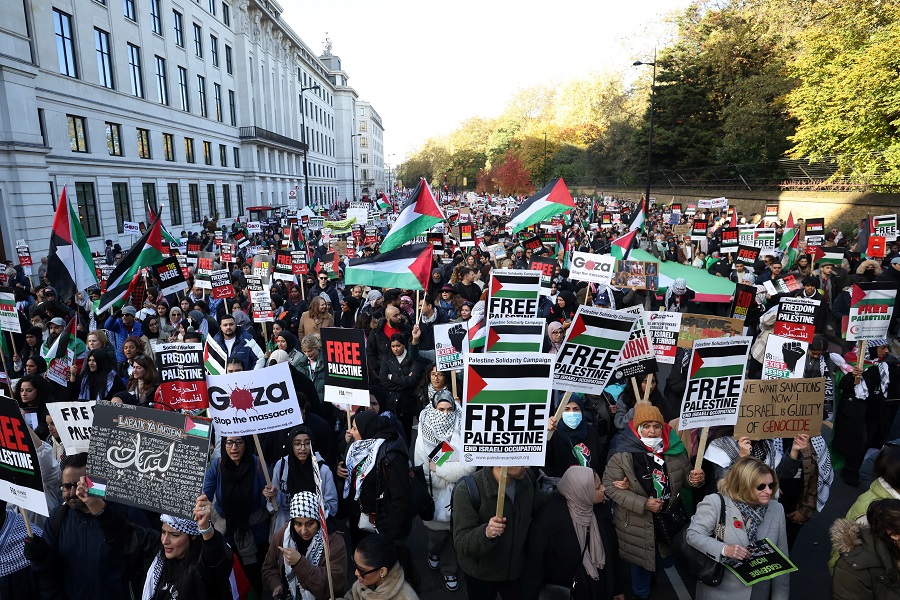
Yet there is an unprecedented outrage and support around the world, with very large demonstrations, including by Jewish communities in many countries who are saying no, not in our name, we will not accept this genocide. Do you see any hope in this world movement in defense of the Palestinian cause?
As Palestinians, we see two sources of hope among all this darkness. One of them is the steadfastness of the Palestinian people in the West Bank and Gaza. In the West Bank, it is also very hard, they imposed closure, siege, killing, shooting… The steadfastness of the Palestinian people is one hope and it’s a strong one.
The other hope is, yes, this kind of huge demonstrations all around the world. If it continues or grows, it might… for example, in France, and even in the US, we start hearing a very small change in words, not in a real change in their position, where they are talking about a ceasefire, because there was no talk of a ceasefire at all one or two weeks ago. In France, what Macron said in Jerusalem is that there should be an alliance against Hamas. And after these huge demonstrations, they started demanding a ceasefire in a very open and public way. That’s the only hope we have, no other hopes. There are no other options to see an end.
Foto: Hollie Adams, Reuters
Since you are in the West Bank, can you tell us what the situation is like there?
It is very difficult and risky. We cannot move from our cities or villages, they cut everything. They put gates in all the Palestinian cities and villages. You cannot go out or in without passing through the gates and checkpoints. If you get closer they might shoot you, and many Palestinians have been killed that way. According to the Oslo agreements, they divided the West Bank in three areas. Area C, is composed of 63% of the West Bank, the majority of land and resources are there. From October 7, they have displaced people from that area, which is huge and where there is hope to build the Palestinian state in the future. Settlers have raided Palestinian communities in Area C on a daily basis; they attack houses, burn houses, burn farms, steal Palestinian assets, uproot trees. We’re in the middle of the olive season, which is like carnival for the Palestinian people, and no one can harvest their olives because the settlers either steal the olives or uproot the trees or they shoot at Palestinian farmers who try to have access to their land. Last week for example, near Nablus, they killed some Palestinians picking their olives.
This month they killed 175 Palestinians; yesterday alone they killed 16 Palestinians in the Jenin camp. We have in 5,500 Palestinians in prison, arrested in the last 20 years; but in this month, 2,500 Palestinians have been arrested.
All checkpoints are closed. Even the food here, we have more spaces and food suppliers, but if it continues like this, there will be a shortage of food. They might turn off water and electricity at any moment if they decide so.
Is there anything else you would like to tell our audience?
I think the only message that all Palestinians have is that we need to get our freedom. We are tired of being under occupation for 75 years. We need our children to have hope and a future similar to all the children around the world. We need to be safe in our land, in our homes, in our camps. We don’t want to see more Palestinian refugee camps, we need Palestinian refugees to come back, we need to have an independent country and a future, we need sovereignty over our resources, similar to the Israelis, similar to everyone. We are no different from Israelis, we are as human as others. We don’t want to have people killed. We need to put an end to this situation, to this cycle of war, because this is the sixth time in the last 15 years in Gaza. So we need to stop this forever. We hate seeing Western countries’ hypocrisy and the US supporting and participating in killing Palestinians directly. This should end. We all have to respect human issues and international law, it cannot be applied to the Palestinians, the victims, while allowing Israel to do whatever they want. We are fighters for dignity, we are fighters for freedom. We are not fighting to kill or to hate. So this is what I would like the whole world to be aware of, and to stand with the Palestinians to achieve that. These are human values, not just for the Palestinians. Fighting occupation here or elsewhere is a fundamental human value all around the world. History is full of stories like this but they all finished, and we need it also to finish here and give Palestinians their freedom.
Sorry, this entry is only available in Español. For the sake of viewer convenience, the content is shown below in the alternative language. You may click the link to switch the active language.
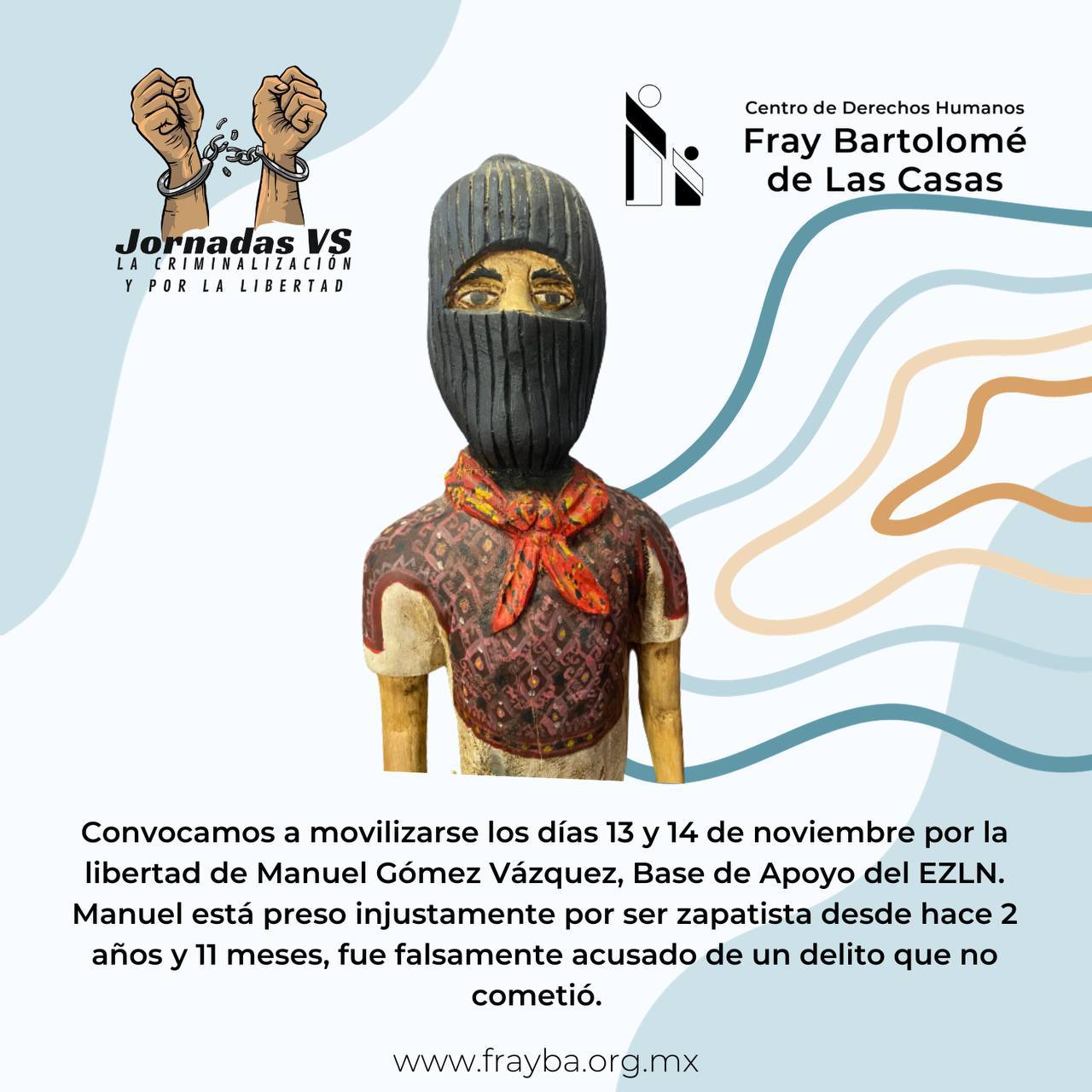
Convocamos a movilizarse el 13 y 14 de noviembre por la libertad de Manuel Gómez Vázquez, Base de Apoyo del EZLN privado arbitrariamente de su libertad desde hace 2 años y 11 meses por ser zapatista, acusado de un delito que no cometió a través de falsificación de pruebas.
El 14 de noviembre dará inicio la audiencia de juicio oral que derivará en próximas fechas en una sentencia, por lo que es un momento importante para hacer ver al Estado que Manuel no está sólo y seguir exigiendo su libertad.
Les invitamos a hacer visibles sus movilizaciones en redes sociales para mostrar nuestra indignación y a etiquetar las cuentas del #Frayba para poder replicar y concentrar sus acciones.
Sorry, this entry is only available in Español. For the sake of viewer convenience, the content is shown below in the alternative language. You may click the link to switch the active language.
Discover the Urgency of Food Sovereignty in our New Podcast!
Join Morgan Ody from France and Beatrice Katzigazi from Uganda as they explore the concept of Food Sovereignty from their unique perspective rooted in their daily lives as peasant farmers. This concept, introduced into international policy-making spaces by social movements like La Via Campesina in the late ’90s, has evolved into a critical response to the crises that impact our planet and humanity today.
At its core, Food Sovereignty defends the right to healthy and culturally appropriate food, produced sustainably and ecologically. It empowers people to define their own food and agriculture systems, ensuring small-scale food producers’ control over essential resources such as land, water, seeds and biodiversity.
Morgan and Beatrice discuss how Food Sovereignty offers a pathway to overcome the crises of climate change, biodiversity loss, and environmental threats. It’s not just about agriculture; it’s about shaping a society that addresses the major crises of our time. It opposes the “solutions” of the global elite, which place greater emphasis on food security and often lead to land grabbing, thus threatening small-scale farmers.
If you’re curious about how a return to localized food production, traditional knowledge, and community empowerment can help address the world’s most pressing issues, this podcast is a must-listen.