
ELLOS Y NOSOTROS.

VII.- L@s más pequeñ@s 1.

1.- Aprendiendo a gobernar y gobernarnos, es decir, a respetar y respetarnos.

Febrero del 2013.

Nota: los cuadernos de texto, que son parte del material de apoyo para el curso “La Libertad según l@s zapatistas”, son producto de las reuniones que las bases de apoyo zapatistas de todas las zonas realizaron para evaluar los trabajos de la organización.  Compañeras y compañeros tzotziles, choles, tzeltales, tojolabales, mames, zoques y mestizos, procedentes de las comunidades en resistencia de los 5 caracoles, se preguntaron y se respondieron entre sí, intercambiaron sus experiencias (que son diferentes según cada zona), criticaron, se autocriticaron, y evaluaron lo que llevan avanzado y lo que falta por hacer.  Esas reuniones fueron coordinadas por nuestro compañero Subcomandante Insurgente Moisés y fueron grabadas, transcritas y trabajadas para la elaboración de los cuadernos de texto.

Como en estas reuniones l@s compas compartieron entre ell@s sus pensamientos, sus historias, sus problemas y posibles soluciones, ell@s mismos le pusieron nombre a este proceso: “la compartición“.

Éstos son algunos fragmentos sueltos de la compartición zapatista:

-*-

(…)

Aquí estamos para compartir la experiencia y uno de esos, nuestra palabra como zapatistas es que gobernamos juntos, gobernamos colectivo.  ¿Qué compartición nos pueden dar de la forma de cómo hacen eso de que gobiernan juntos, colectivos?

La forma que estamos trabajando es no separase del pueblo.  Así como siempre hacemos en cuestiones de hablando de reglamentos o de planes de actividades, de trabajos, tiene que llegar la información al pueblo, tiene que estar presente las autoridades en los planes, en hacer las propuestas.

(…)

Allá nosotros estamos trabajando algunas cosas y consideramos como parte de las obligaciones del gobierno autónomo, una es que es su obligación del gobierno autónomo atender a cualquier persona que acuda a la oficina por diferentes asuntos, se le dé o no se le dé solución a su asunto pero tiene que ser escuchado.  Quien sea, zapatista o no zapatista, así estamos trabajando allá, siempre y cuando no sea gente del gobierno o enviado de gobierno, si así es pues esos sí no son atendidos, allá no se atiende. Pero si no, sea de cualquier organización social, es atendido.  También estamos allá trabajando y siempre pendientes de que estemos cumpliendo con los siete principios del “mandar obedeciendo” y eso lo pensamos que tenemos que hacerlo así, es como una obligación, para no cometer los mismos errores que cometen las instancias del mal gobierno y no llevar los mismos modos de ellos, entonces el que nos va a regir son los siete principios.

-*-

El primer Aguascalientes que se construyó en Guadalupe Tepeyac, ahí empezó el primer paso de nuestra organización y de nuestra forma para hacer valer nuestro derecho.  Este Aguascalientes dijimos que es un centro cultural, político, social, económico, ideológico, pero con el traición de Ernesto Zedillo, él pensó con este desmantelamiento, esa ofensiva que él hizo, pensó que con eso nos iba a terminar la política de nuestra organización.  Pero fue al revés su política porque de ahí mismo, en ese mismo año 94, se declaró que se hicieran cinco Aguascalientes más.

(…)

-*-

Estos municipios dijeron que es la sede que ahí va a ser, entonces empezaron a buscar nombres de los municipios, cómo se va a llamar, ya una vez que tienen la sede ahora empezaron a ver cómo se van a llamar los municipios. El primer municipio autónomo que es La Garrucha se dijo que se va a llamar Francisco Gómez; el otro municipio que es San Manuel ahora, que es Las Tazas, que dijimos, se llamó San Manuel; Taniperlas se llamó Ricardo Flores Magón; San Salvador, Francisco Villa.  Todos estos fueron honor a los compañeros Francisco Gómez, que ya todos conocemos, pues es un compañero que dio la vida por la causa que estamos, la que ya platicó el compañero, murió en el combate en Ocosingo el primero de enero, así se llamó Francisco Gómez.  Entonces San Manuel en honor del compañero Manuel, que es el fundador de nuestra organización.  Ricardo Flores Magón, pues también ya sabemos que es un luchador social que ya está en la historia.  Y Francisco Villa, pues igual es un revolucionario que todos conocemos.  Entonces así fueron formando nuestros municipios, así decidimos hacer todo esto a nombre de todos nuestros municipios y los acuerdos fueron todos en una asamblea comunitaria, en la asamblea regional ahí se nombró todos estos nombres de nuestros municipios.  Compañeros, es las pocas palabras que les voy a contar y van a pasar otros compañeros o compañeras para explicar lo siguiente.

(…)

-*-

Los problemas principales que se presentaron desde el inicio de [inaudible], el problema del alcoholismo, ¿cómo está ese problema ahorita ahí en su zona?

Mira compañero, en aquellos tiempos, en el inicio de 1994, despuesito de la guerra pues, algunos entraron con miedo. Inició la guerra, todos nos amontonamos, así como ya nos dijeron, nos metimos y pa qué nos metimos, puede ser que así pasó, se amontonaron la gente.  Algunos que sí conscientemente lo hicieron pero otros por miedo, entonces quienes de por sí lo hicieron con miedo, de por sí no están a gusto haciendo el trabajo, ¿qué es lo que hacían?  Aunque teníamos la orden de que no debemos de tomar trago, pero qué es lo que pasa, tomaban a escondidas.  ¿Qué es lo que hacíamos?  Nosotros no lo castigábamos, lo que hacíamos, por eso tenemos la comisión de ancianos, ésos son los encargados de decirle por qué está haciendo eso, se le explicaba qué es el daño que se está provocando en sí mismo.  Entonces quienes obedecen pues prácticamente van a seguir y quienes no pues se pelan.  Esa es la respuesta.

(…)

-*-

Gobierno Autónomo I

-*-

Compañeros y compañeras, buenas tardes a todos.  Yo vengo de un poblado que se llama ____, que pertenece al municipio Francisco Villa.  Vengo a representar a la Junta de Buen Gobierno, mi cargo fue Consejo, en el año 2006 a 2009.  Les voy a explicar cómo fue la causa de nuestra carga que tenemos todos, no me toca explicar todavía donde empezamos en el año de 1994, voy a contar un poco cómo empezamos después de 1994.  Antes, 91, 92, ¿por qué fue la causa del levantamiento armado?  Es por la causa de la dominación, la marginación y la humillación, de las injusticias y de las normas o leyes de los malos gobiernos y de los explotadores terratenientes.  Y así antes, nuestros padres y abuelos, ellos no les tomaban en cuenta, sufrían y así no teníamos tierra dónde trabajar para el mantenimiento de nuestros hijos.  Así los pueblos zapatistas se empezaron a organizar donde dijeron “ya basta de tanta humillación”.  Entonces se levantaron en armas, no les importó caminar por la noche, ni el hambre.

Así fuimos formando y vimos que organizados, unidos, sí pudimos y vamos a poder más. Después pasando ese levantamiento que hicimos, vimos cómo vamos a avanzar a formar nuestras autoridades autónomas en cada municipio.  Por eso aquí estamos reunidos todos para platicar y compartir cómo fue que empezamos a funcionar nuestros gobiernos autónomos, ¿por qué les explico un poco de este tema?  Es porque yo lo que pienso es que desde ahí fuimos empezando y avanzando hasta donde estamos ahorita. En el tema que vamos a comenzar a ver le toca la palabra al compañero ___, que él va a explicar hasta hoy cómo estamos trabajando en nuestros municipios y en la Junta de Buen Gobierno. Es todo mi palabra, compañeros.

Compañeros, así como platicó el otro compa, ahora nos va a tratar de explicar el compañero ____, porque fue el fundador de nuestro gobierno autónomo en nuestro Caracol III, allá en la Garrucha, ellos fueron los que fundaron las primeras autoridades. Ahora nos van a compartir cómo trabajaron, cómo estuvieron, cómo empezaron y cómo estamos hasta ahora.

-*-

(…)

Como que se me pasó algo comentarles, más o menos un mes después del inicio de nuestras funciones, allá con una organización que se llama la CIOAC [de filiación perredista], nos secuestran a un compañero junto con un camión, y nos vimos obligados a denunciarlo y no teníamos la idea de hacer una denuncia.  Miembros de la Junta de Buen Gobierno y consejos municipales tuvimos que dar nuestra palabra, una o dos palabras, para hacer esa denuncia, en equipo, cada quién daba su palabra y así vamos formando, así formamos una denuncia, pero sí lo sacamos. Y por eso lo hacíamos de secretario, lo hacíamos de cocinero, lo hacíamos de barrendero, porque teníamos que hacer aseo en nuestra oficina y en toda nuestra área de trabajo, no teníamos especialmente quién haga esas tareas y así lo seguimos haciendo hasta la fecha.

(…)

-*-

Gobierno Autónomo I

-*-

(…)

Así fuimos trabajando y así llegamos hasta el 2003, con la formación de las Juntas de Buen Gobierno.  Llegamos a las juntas de buen gobierno, pues en esa zona, por decir así, pues no sabíamos si esa directiva de la asociación de municipios algún día serían autoridades y serían gobierno.  Pero en el 2003, cuando se dan las Juntas de Buen Gobierno, el pueblo y la asociación de municipios deciden que esos ocho compañeros, miembros de la Directiva de Asociación de Municipios, pasaran a ser autoridades de la Junta de Buen Gobierno.  Y esos ocho compañeros pues son los que toman el cargo en la Junta de Buen Gobierno, en el primer periodo de la Junta de Buen Gobierno, que fue de 2003 a 2006.

Así se dieron entonces, igual bajo las mismas condiciones, la Junta de Buen Gobierno no tenía ya un local adecuado.  Días antes de que se hicieran públicas las Juntas de Buen Gobierno pues los pueblos construyeron ahí, de manera urgente, un local para la Junta de Buen Gobierno, así como un local para cada uno de los municipios autónomos, en el centro del Caracol.  Se construyeron con los materiales con que contaban los pueblos en esos momentos, maderas usadas, láminas usadas y así se empezó, se hicieron las construcciones, en menos de una semana quedaron construidas.  Así se empieza, quedan listas sus oficinas, llega agosto de 2003 y se hacen públicas; después de la publicación los pueblos se reúnen, orgullosos de haber formado una instancia más de gobierno en la autonomía.  Y en una fiesta, en una gran celebración instalan formalmente el nuevo gobierno autónomo, haciendo la entrega pues a su oficina, con los materiales con que se contaba.

Pues podemos decir que fue un chingo, pero el pueblo hizo entrega a la Junta de Buen Gobierno una mesa y dos sillas, ése fue su material, y un local pues un poco más pequeño que este espacio donde estamos ahora, así fueron las condiciones.  Días después, alguien por allá donó una maquinita de las más antiguas y con ésa se empezó a trabajar.  Recibimos el local vacío y así empezamos, se fueron dando iniciativas de trabajo y fuimos empezando, arreglando el espacio.

(…)

-*-

En el trabajo también, como ven ustedes en la zona donde trabajamos, existen diferentes formas de ser, diferentes formas de vestir, diferentes colores, diferentes creencias, diferentes formas de hablar, y en el trabajo también se le respeta al compañero y compañera, independientemente de cómo sea.  Lo único que nos interesa es la voluntad del trabajo y su capacidad, entonces todo eso no nos importa de cómo sea.

(…)

-*-

(Continuará…)

Doy fe.

Desde las montañas del Sureste Mexicano.

Subcomandante Insurgente Marcos.

México, Febrero del 2013.

——————————————————————–

“Poder Caracol” de Lengualerta/Cuyo, música Taxi Gang.  Video de Pazyarte, imágenes del Caracol zapatista de Oventik, Chiapas. En el minuto 2:42 le preguntan a 2 compas internacionales qué aprendieron.  Ellos responden: “a compartir”

———————————————————————–

Zach de La Rocha, vocalista de Rage Against Machine, explica el interés del capital para aniquilar al zapatismo (con una pequeña intervención de Noam Chomsky).  Zach ha estado en comunidades zapatistas, como uno más, sin alardear de ser quien ha sido y es.  Supo mirarnos, nosotr@s aprendimos a mirarlo. Música de fondo: la rola “People of the Sun”.

————————————————————————–

La rola “Canto a la Rebelión”, del grupo SKA-P, con letra incluida.  Esta rola forma parte de su nuevo disco “99%”, que saldrá el próximo mes de marzo de este 2013, cortesía de Marquitos Spoil.  Oh, no hay por qué darlas.  ¡Órales con el brincolín!

————————————————————–

Them and Us.

VII.- The Smallest of them All 1.

1.- Learning to govern and govern ourselves, that is, to respect and respect ourselves.

February 2013.

Note: the notebooks that make up the support material for the course “Freedom According to the Zapatistas,” are a product of meetings that the Zapatista bases of support in all zones have carried out to evaluate their work in the organization.

Compañeras and compañeros from the communities in resistance of the 5 caracoles,[i] tzotziles, choles, tzeltales, tojolabales, mames, zoques y mestizos, gathered to ask and answer questions among themselves, exchange experiences (which are different in each zone), and to criticize, self-criticize, and evaluate what they have done so far and what they still have to do. These meetings were coordinated by our compañero Subcomandante Insurgente Moisés, and were recorded, transcribed, and edited for the notebooks. Since during these meetings the compas shared among themselves their thoughts, histories, problems, and possible solutions, they themselves named the process: “the sharing.” These are a few loose fragments of the Zapatista sharing:

-*-

(…)

We are here to share our experiences, and one of these is, as we Zapatistas say, that we govern together, we govern as a collective. What can we share about the way in which you govern together, collectively?

The way we work is by not separating ourselves from the people. Always, with issues of regulations, plans, activities, and work, we have to get information from the people, and the [community] authorities have to be present in making the plans, making the proposals.

(…)

We are thinking and working through various things, and we think that part of the duty of autonomous government is to attend to whoever comes to our office with an issue. Whether or not that issue can be resolved, it must be heard. This is for whoever comes in, Zapatista or not, that is how we work. The exception to this is people from the government or people sent from the government, in which case they are not attended to. But as long as that is not the case, anyone from any social organization is heard. Also in our work we are always vigilant about honoring the seven principles of “rule by obeying.” We consider this to be necessary, to be our obligation, in order not to make the same mistakes and develop the same habits of the entities of bad government. So the seven principles are what govern us.

-*-

The first Aguascalientes, built in Guadalupe Tepeyac, was where we took our first step toward organization and toward our own way of exercising our rights. This Aguascalientes was a cultural, political, social, economic, and ideological center. When Ernesto Zedillo[ii] betrayed us in a [military] offensive that dismantled the Aguascalientes, he thought our organizational politics would come to an end. But the opposite happened, because that same year, 1994, it was declared that we would build five more Aguascalientes.

(…)

-*-

These municipalities decided where their municipal seat would be, and began to think about names for the municipalities, what they would be called when the Aguascalientees was ready. The first autonomous municipality, La Garrucha, was called Francisco Gómez; the municipality that is today San Manuel was before Las Tazas; Taniperlas was renamed Ricardo Flores Magón; San Salvador was named Francisco Villa.  All of these names honored compañeros. Francisco Gómez, a name we all know now, was a compañero who gave his life to our cause, he died in combat in Ocosingo on January 1st. San Manuel honors the compañero Manuel, founder of our organization. Ricardo Flores Magón, we know was a warrior of social struggle in our history. And Francisco Villa was also a revolutionary that we all know. So our municipalities were formed as agreed in our community assemblies, and in the regional assembly we decided on their names. Compañeros, those are the few words that I have to say and now other compañeros or compañeras will explain what comes next.

(…)

-*-

The principal problems that we had since the beginning of [inaudible], the problem of alcoholism, how is this problem now in your zone?

So in those days, at the beginning of 1994, a little after the war, some joined [the organization] out of fear. The war started, we all got together, we joined up for various reasons, but we joined up. Some did so consciously, but others out of fear. So those that joined out of fear, well of course they weren’t happy doing the work of the organization, so what did they do? We had the order not to drink alcohol, but they drank anyway, while trying to hide it. So what did we do? We didn’t punish them, what we did—and this is why we have the commission of elders—was have this commission explain to them why we made this rule, and explain the damage they were doing to themselves. So those who want to obey keep going, and those who don’t leave. That is our answer.

(…)

-*-
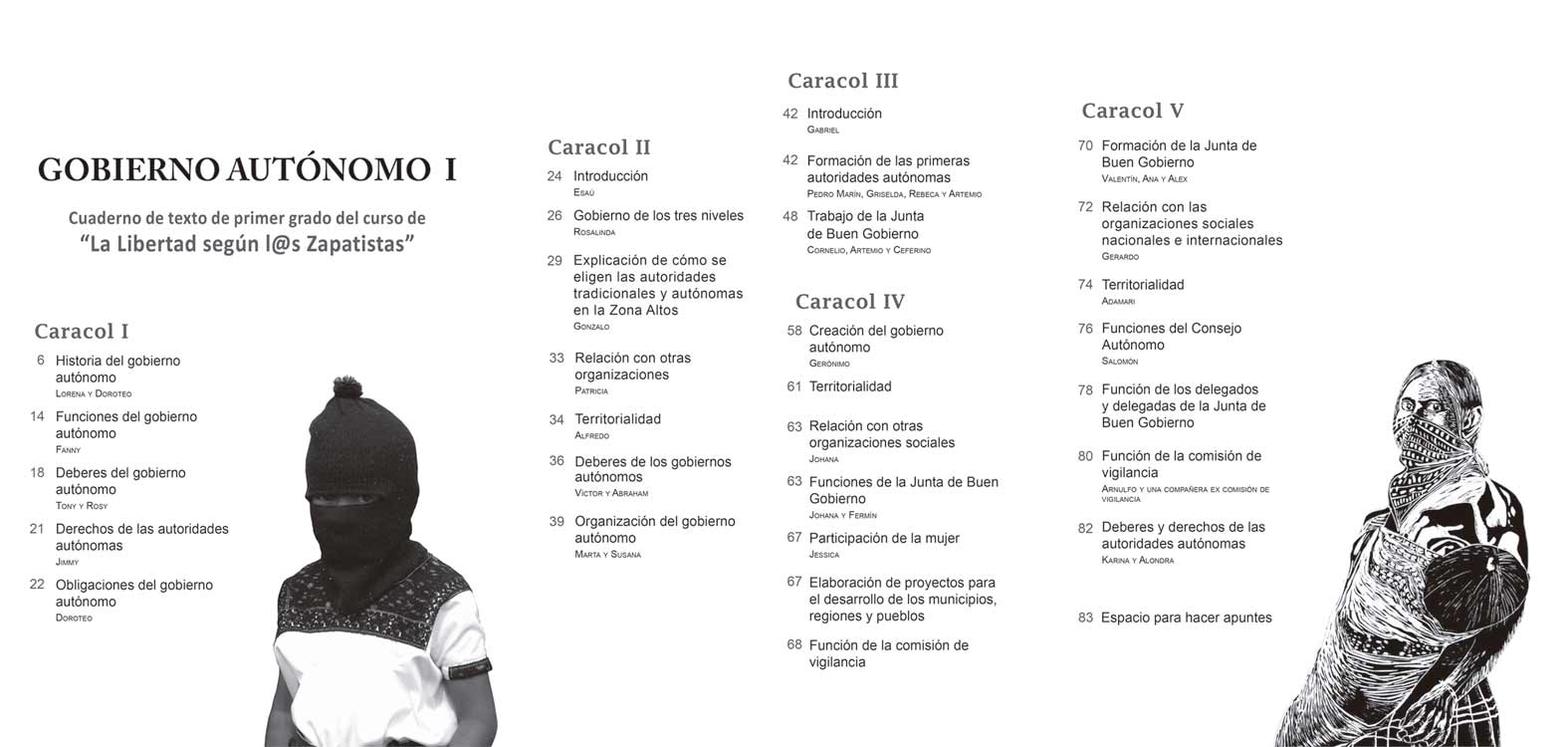
Gobierno Autónomo I

-*-

Compañeros and compañeras, good afternoon to everyone.  I come from a village called ____, which is part of the municipality Francisco Villa.  I am here representing the Junta de Buen Gobierno [Good Government Council], my cargo[iii] was Consejo[“Council”], from 2006 to 2009. I am going to explain how the responsibilities we have today came about. It’s not my job yet to explain where we started in 1994, rather, I’m going to tell a little about where we started after 1994. Before, in 91, 92, what was the cause of the armed uprising? It was the domination, marginalization, humiliation, injustice, and the norms or laws of the bad governments and the landowning exploiters. In those days, our parents and grandparents were not taken into account, they suffered, and didn’t have land to work and maintain their children. So the Zapatista pueblos began to organize, we said “enough of so much humiliation.” So we rose up in arms, we weren’t bothered by having to walk at night, or by hunger.

So we trained and educated ourselves, and we saw that organized, united, we could do things, and that we would be able to do many more things. After the uprising, we began to look at how to advance the training of our autonomous authorities in each municipality. That’s why we are all gathered here, to talk and share how our autonomous governments began to function. Why do I want to explain a little about this? Because I think that from that point on we were advancing toward where we are now. On this subject the compañero ___ is going to explain how we are working in our municipalities and in the Junta de Buen Gobierno today. That’s all I have to say, compañeros.

Compañeros, as the other compa already told you, now our compañero ____ is going to try to explain a little because he was the founder of our autonomous government in Caracol III, in la Garrucha, they were the first authorities. So they are going to share how they worked, how they were, how they began, and how things have been until today.

-*-

(…)

Ah I forgot to mention something before, about a month after we began our work, an organization called CIOAC [of PRD affiliation], kidnapped one of our compañeros along with a truck, so we had to denounce this but we didn’t have any idea how to make a denunciation. Members of the Junta de Buen Gobierno and municipal councils had to go and speak, a few words each, to make this denunciation, as a team, and that’s how we went about making the denunciation, but we got it out. And that’s why we started designating a secretary, a cook, someone who sweeps up, because we had to clean up our own office and our work area, we didn’t have anyone especially for those tasks and that’s how we still do it today.

(…)

-*-
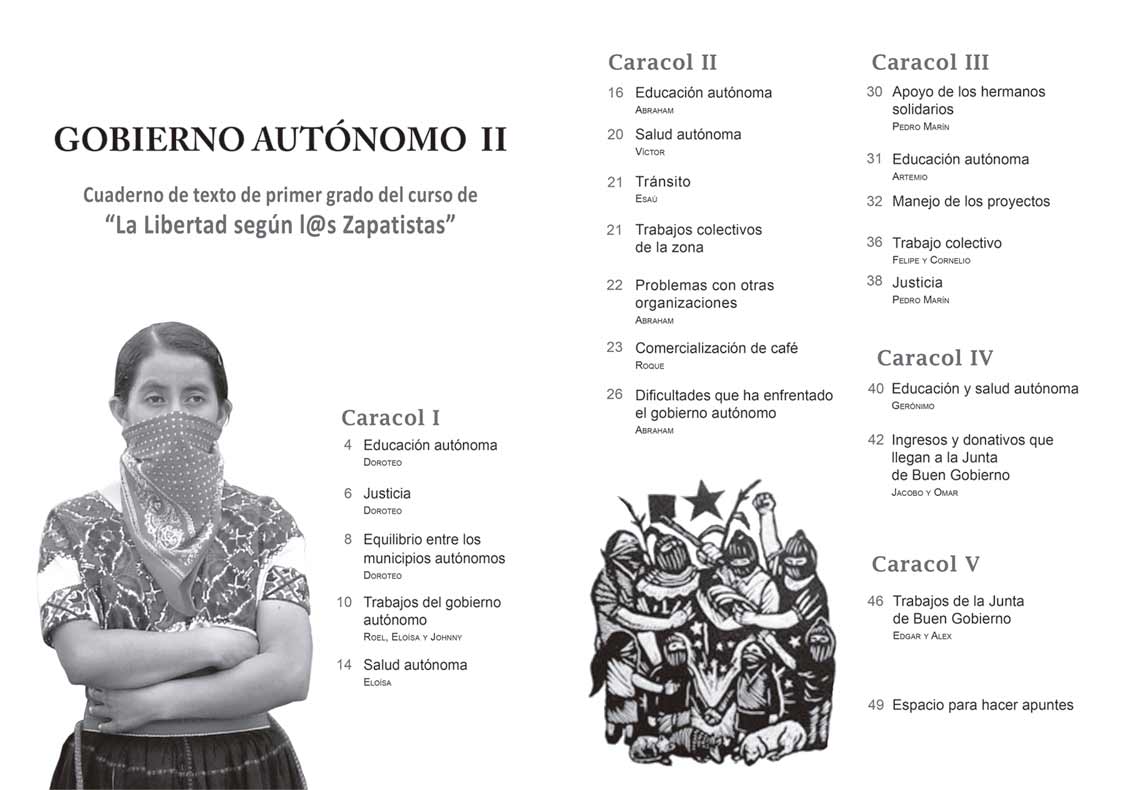
Gobierno Autónomo I

-*-

(…)

So we went on working like that and we reached 2003, when the Juntas de Buen Gobierno were formed. We didn’t know still, in our zone, if the leadership of the association of municipalities would one day be the authorities, the government. But in 2003, when the Juntas de Buen Gobierno were born, the people and the association of municipalities decided that those eight compañeros, members of the Leadership of the Association of Municipalities, would become the authorities of the Junta de Buen Gobierno. And those eight compañeros are those who take on the cargo of the Junta de Buen Gobierno for its first period, from 2003 to 2006.

So that’s how it happened, and under those conditions, the Junta de Buen Gobierno did not yet have an adequate space to work in. A few days before the existence of Juntas de Buen Gobierno was made public, the pueblos quickly and urgently constructed a space for the Junta de Buen Gobierno, as well as a place for each of the autonomous municipalities in the center of the Caracol. These were built with the materials that the pueblos had in that moment—used wood and used tin sheets—and that’s how we started, building those spaces, and in less than a week they were ready. So the offices were ready when we made the Juntas public in August of 2003. After they were made public the pueblos gathered together, proud of having created another entity of government as part of our autonomy. We held a party, a big celebration, to formally install the new autonomous government, and give it the office we had built and the materials with which we had supplied it.

We could say it was a bunch of stuff, but what the pueblo gave the Junta de Buen Gobierno was a table with two chairs, those were the supplies, and the space, a little smaller than this room we are in now. Those were the conditions at that time. A few days later, someone donated a very old machine [computer] and with that the work began. We received the space almost empty and that’s how we started, work initiatives arose and we got going, setting up the space.

(…)

-*-

In this work, as you can see, in the zone where we work, there are different forms of being, different forms of dressing, different colors, different beliefs, different ways of speaking, and so in that work we respect our compañeros and compañeras, regardless of how they are. The only thing that interests us is the will and capacity to work, so all of this about how someone is doesn’t concern us.

(…)

-*-

(To be continued…)

I testify to this.
From the mountains of the Mexican Southeast.
Subcomandante Insurgente Marcos.
Mexico, February 2013.

——————————————————————–

Poder Caracol” by Lengualerta/Cuyo, music Taxi Gang. Video of Pazyarte, images of the Caracol Zapatista in Oventik, Chiapas. At the minute 2:42 they ask 2 international compas what they learned. They respond: “to share.”

Zach de La Rocha, vocalist of Rage Against Machine, explains capital’s interest in annihilating zapatismo (with a small intervention by Noam Chomsky). Zach has been in Zapatista communities, acting like just one more among many, without boasting about who he was and who is he. He knew how to see us; we learned from seeing him. Background music: the track “People of the Sun.”

The track “Canto a la Rebelión,” from the group SKA-P, lyrics included. This track is part of their new album “99%,” which will come out this coming March 2013, courtesy of Marquitos Spoil.  Oh, no reason to be presumptuous.  ¡Órales con el brincolín!


[i] The Caracoles, literally “shells” or “spirals” were announced in 2003 as the homes of the Juntas de Buen Gobierno, or Good Government Councils. They replaced the five Zapatista “Aguascalientes,” one in each zone of Zapatista territory. When the EZLN first announced their existence they were described, in addition to being the seats of the self-government system, as “doors to enter into the communities” and “windows to see in and out.”

[ii] Ex-president of Mexico, 1994-2000.

[iii] Cargo is like a combination of duty and task, or charge; it also refers to a position of responsibility.