
Difusión Cencos México D.F., 29 de agosto de 2011
Carta al Subcomandante Marcos
Javier Sicilia / Movimiento por la Paz con Justicia y Dignidad
Querido Subcomandante Marcos:
Mil gracias por las líneas que le dedica al Movimiento por la Paz con Justicia y Dignidad en su tercera carta a Don Luis Villoro. Las hemos leído con el detenimiento de quienes están abiertos a la escucha. Desde ese detenimiento y esa escucha queremos darle las gracias por su profunda humildad y solidaridad con el Movimiento y decirles que a sus muertos, como Dionisio-Chiapas y Mariano, hacedores de paz, los llevamos con todos los dolores en nuestro corazón. Queremos decirles tambien que aunque no nos entiendan, aunque lo nuevo —esa capacidad para tratar de hacer la paz incluso con nuestros adversarios, porque creemos que los equívocos de un ser human no son el ser humano, sino una alienación de su conciencia que hay que transformar mediante la paciencia del amor— los desconcierte, compartimos los mismos anhelos y esperanzas, las de “un mundo en el que quepan muchos mundos”.
La paz, querido Subcomandante, es, como decía Gandhi, “el camino”, un camino que sólo se hace con todas y todos. Ustedes, hace 17 anos, al lado de la sociedad civil, nos lo enseñaron no sólo al visibilizar y dignificar el pasado negado y humillado de nuestra tradición indígena, sino también cuando, a partir de la escucha y del dialogo, abrieron el debate de lo que, en medio de la crisis de las instituciones, podría ser una nueva esperanza de reconstrucción de la nación: las autonomías.
Por desgracia, el poder, que es ciego; los intereses, que no escuchan los latidos del corazón de la historia, y el egoísmo, esa forma atroz del yo que rompe los vínculos con los otros, no los escucharon —cambiar el corazón del poder es siempre largo y doloroso—. La consecuencia es la espantosa emergencia nacional que vive actualmente el país, cuyo epicentro, como una ironía de la sordera, se encuentra en Juárez, en la frontera norte del país.
Hoy la guerra ha desgarrado los cuatro partes de México (el norte, el sur, el este y el oeste), pero también, en la visibilizacion de nuestros dolores —que son muchos y cada vez mas— de nuestros rostros, de nuestros nombres y de nuestras historias, nos ha unido para —en la paz del amor, que nos lleva a caminar, abrazando dolores, y a dialogar, buscando trastornar la conciencia de los poderosos— encontrar ese yo plural, ese nosotros, que nos han arrebatado. Ello sólo ha podido nacer del corazón, de la solidaridad y de la esperanza, es decir, de la gran reserva moral que hay todavía en la nación y de la cual ustedes forman una de sus más hermosas partes. Hoy, más que nunca, creemos que sólo en la unidad nacional de esa reserva —que no sólo está abajo, sino también arriba y a los lados, en todas partes— podemos detener la guerra y encontrar entre todos el camino de la refundación nacional.
México, querido Subcomandante, es un cuerpo desgarrado, un suelo fracturado, que hay que recomponer como un cuerpo y una tierra sanas en las que —como todo cuerpo y toda verdadera tierra— cada una de sus partes, cuando se armonizan y se cultivan en el bien, son tan necesarias como importantes.
Caminar, dialogar, abrazar y besar —esas cuatro maneras que encontramos en nuestra historia hecha del mundo indígena y del mundo occidental— son las formas que asumimos no solo para acompañar a otros y a otras, sino para encontrar el camino perdido y hacer la paz. Caminar, es ir al encuentro de los otros; dialogar es desnudar, estremecerse, iluminar la verdad —que al principio escuece, pero después consuela—; abrasarse y besarse es no sólo hacer la paz, sino también romper las diferencias que nos dividen y enfrentan.
Hace algunos años unos amigos fundamos una revista —espero tenga en sus manos algunos ejemplares—: *Conspiratio*. El nombre viene de la primera liturgia cristiana, donde había dos momentos altos: la *conspiratio* y la *comestio*. El primero se expresaba mediante un beso en la boca. Era una co-respiracion, un intercambio de alientos, un compartir el espíritu, que abolía las diferencia y creaba una atmosfera común, una verdadera atmósfera democrática —quizá de allí derivo el sentido que la palabra conspiración tiene en nuestra época; quizá el imperio romano, un imperio, como todo imperio, espantosamente estamentado, decía, “quienes son estos que conspiran y ponen en peligro el poder”—. Cuando besamos y abrazamos creamos esa atmosfera común, una atmosfera —es la realidad de cualquier atmosfera— inestable, que rápidamente puede desaparecer, pero no por ello falsa. Es un signo de lo que anhelamos y que repentinamente, en el amor, aparece lleno de gratuidad como la vida misma. Así, caminar, dialogar abrazar y besar es hacerlo, desde nuestro dolor, por y para nuestros muertos —a quienes olvidamos darles ese amor—, por y para nuestros jóvenes, nuestros niños y niñas, nuestros indígenas, nuestros migrantes, nuestros periodistas, nuestros defensores de derechos humanos, nuestros hombres y mujeres, es decir, por y para todos. Es, de alguna manera, evitar que la indolencia, la imbecilidad y la miseria del alma, nos condenen a todos a la muerte, a la corrupción y al olvido.
Como usted dijo bien al referirse al Movimiento por la Paz con Justicia y Dignidad —una frase que también empleo hace años en relación con el zapatismo—: “Podrán cuestionar los métodos, pero no las causas”. Es por ellas, por esas causas, que detener la guerra es tarea de todos y de todas.
Hagámonos cargo de lo que hoy es México, hagámonos cargo del dolor y del perdón, tomemos el camino de la paz y dejemos el juicio a la historia.
Nos vemos en el sur, querido Subcomandante. Mientras llegamos con la lentitud del andar y el dolor a cuestas, le mandamos a usted y a los compas un gran beso, ese beso con el que nuestro corazón no cesa de abrazarlos.
Desde el Arca, cerca de las montañas de Vercors
27 de agosto de 2011, 5 meses después de los asesinatos de Juanelo, Luis, Julio y Gabo.
Por el Movimiento por la Paz con Justicia y Dignidad
Paz, Fuerza y Gozo
Javier Sicilia
Información difundida por el Área de Comunicación y Visibilidad de Cencos
Translated by Kristin Bricker
Dear Subcomandante Marcos:
Many thanks for the lines you dedicate to the Movement for Peace with Justice and Dignity in your third letter to Don Luis Villoro. We have read them with the care of those who are open to listening. From that care and listening we want to thank you for your deep humility and solidarity with the Movement and to tell you that your dead, like Dionisio-Chiapas and Mariano, peacemaker, we carry with us with all of the pain in our hearts. We also want to tell you that even though you don’t understand us, even though that which is new–that ability to try to make peace even with our adversaries, because we believe that the mistakes of a human being are not the human being, but rather an alienation from his consciousness that must be transformed through the patience of love–puzzles you, we share the same yearning and hopes, those of “a world in which many wolds fit.”
Peace, dear Subcomandante, is, as Gandhi said, “the way,” a way that is only made with everyone. You, 17 years ago, alongside civil society, taught that to us not only when you visibilized and dignified our indigenous tradition’s negative and humiliating past, but also when, through listening and dialogue, you opened the debate to that which, in the midsts of an institutional crisis, could be a new hope of national reconstruction: autonomy.
Unfortunately, power, which is blind; interests, which do not hear history’s heartbeats, and selfishness, that ferocious form of “I” that breaks connections with others, did not listen to you–changing power’s heart is always long and painful. The consequence is the frightening national emergency that the country is currently experiencing, whose epicenter, like a irony of deafness, is in Juárez, on the country’s northern border.
Today the war has ripped apart the four parts of Mexico (north, south, east, and west), but also, in the visibilization of our pain–which are many and always increasing–of our faces, of our names and our histories, has united us–in the peace of love, which leads us to walk, embracing pain, and to dialogue, seeking to upset the consciousness of the powerful–to find that plural “I”, that “we,” that has captivated us. It alone has been able to be born from the heart, from solidarity and hope, that is, from the great moral reserve that still exists in the nation and from which you [the Zapatistas] form one of its most beautiful parts. Today, more than ever, we believe that only in the national unity of that reserve–which is not only below, but also above and to the sides, everywhere–we can stop the war and find in all of us the path to national refoundation.
Mexico, dear Subcomandante, is a body ripped to pieces, a broken ground, which must be put back together as a cured body and land in which–as with all bodies and all real land–each one of its parties, when they are harmonized and cultivated in good, are as necessary as they are important.
Walk, dialogue, embrace, and kiss–those four manners that we found in our history made from the indigenous world and the western world–are the forms that we assume not only to accompany one another, but also to find the lost path and make peace. Walk, is to go to meet others; dialogue is to undress, to tremble, to illuminate the truth–which stings at first, but then comforts–; to hug and kiss is not only to make peace, also to break with the differences that divide us and put us at odds.
A couple of years ago some friends and I founded a magazine–I hope that you have a couple of issues on hand–: “Conspiratio.” The name comes from the first Christian liturgy, where there were two high moments: the “conspiratio” and the “comestio.” The first is expressed through a kiss on the mouth. It was a co-breath, an exchange of breaths, a sharing of the spirit, which abolished differences and created a common atmosphere, a true democratic atmosphere–perhaps from there came the meaning that the word “conspiracy” has in our era; perhaps the Roman empire, an empire, as all empires are, frighteningly stratified, said, “Those who conspire and endanger power.” When we kiss and embrace we create a common atmosphere, an unstable atmosphere–it’s true about all atmospheres–that can quickly disappear, but that doesn’t make it false. It is a sign of that which we yearn for and which, suddenly, in love, appears full of gratuity and life. In that way, to walk, to dialogue, to embrace, and to kiss is to do it, from our pain, for our dead–to whom we forget to give that love–for our young people, our children, our indigenous, our migrants, our journalists, our human rights defenders, our men and women–that is, for everyone. It is, in a way, avoiding that our soul’s indolence, stupidity, and misery condemns us to death, corruption, and oblivion.
You put it well when you referred to the Movement for Peace With Justice and Dignity–a phrase that I have used for years in relation to the Zapatistas: “You can question the methods, but not the causes.” It is for them, those causes, that stopping the war is everyone’s task.
Let’s take charge of what is today Mexico, let’s take charge of the pain and the forgiveness, let’s take the path of peace and leave judgement to history.
See you in the south, dear Subcomandante. While we arrive with the slowness of walking and the pain we carry on our backs, we send you and the compas a great kiss, that kiss which which our heart does not cease to embrace.
From the Arch somewhere near the Vercors Mountains,
August 27, 2011, five months after the murder of Juanelo, Luis, Julio and Gabo.[1]
For the Movement for Peace with Justice and Dignity
Peace, Strength, and Pleasure,
Javier Sicilia
Translator’s Note:
1. Juanelo is Sicilia’s son, whose murder sparked the Movement for Peace with Justice and Dignity. Luis, Julio, and Gabo are Juanelo’s friends, who were murdered along with him.


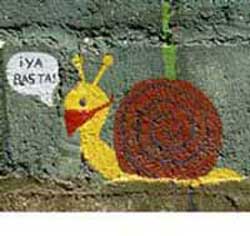 El Subcomandante Insurgente Marcos dijo una vez que “decían que con el caracol se llamaba al colectivo para que la palabra fuera de uno a otro y naciera el acuerdo. Que el caracol era ayuda para que el oído escuchara incluso la palabra más lejana.”
 Sin embargo, los pueblos zapatistas no sólo contienen la violencia con que se les quiere acabar sino continúan con su cotidiana lucha por la construcción de un modo autónomo y digno para vivir. Por ello para honrar un año más de autonomía, recuperar la esperenza recuperando la historia, recordamos:
